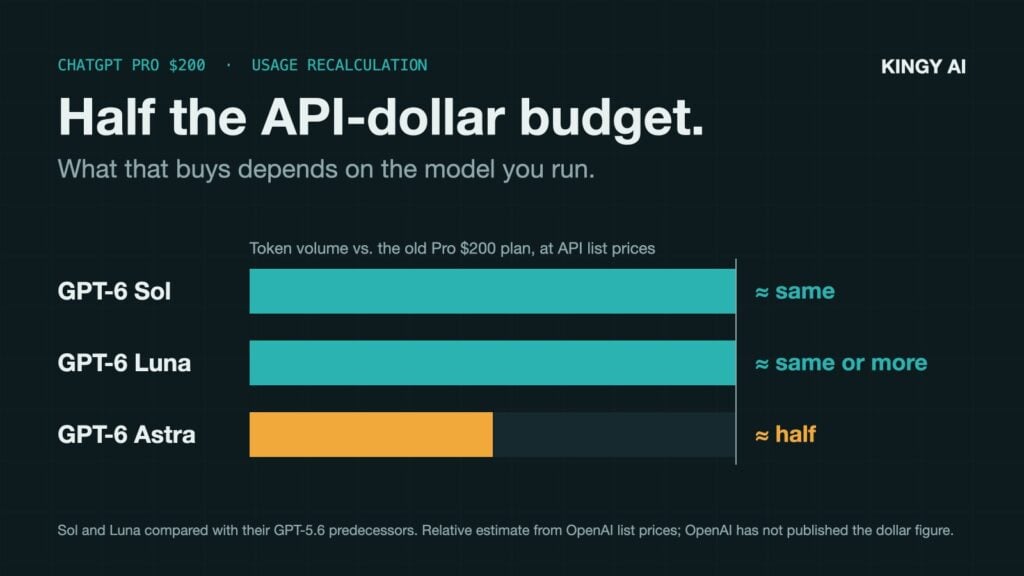
Our take: OpenAI is reopening its $200 ChatGPT Pro plan to new subscribers today, and it is cutting what the plan buys by half when measured in API dollars. If your work runs on GPT-6 Sol or GPT-6 Luna, last week’s API price cuts roughly cancel out the reduction. If it runs on GPT-6 Astra, whose price did not fall, plan on about half the Astra work you got before. The bigger story is structural: OpenAI now describes its top subscription as a discounted API budget, not a flat-rate pass.
Checked Tuesday, September 29, 2026, early morning Pacific, before OpenAI’s DevDay keynote. OpenAI had not yet updated its Help Center or said whether existing subscribers are affected.
What OpenAI announced
At 11:41 p.m. Pacific on Monday, about ten hours before the DevDay keynote at Fort Mason in San Francisco, Thibault Sottiaux posted the change on X. He posts as “Tibo” and leads Codex and ChatGPT Work at OpenAI. He called the post an attempt to be transparent before “all the big announcements tomorrow.” The post drew roughly 2.3 million views within its first couple of hours.
There are three parts. First, the Pro $200 plan, which OpenAI also labels Pro 20x, reopens to new subscribers today. Sign-ups and upgrades have been paused since September 10. Second, OpenAI is changing how it calculates usage for the plan. In Sottiaux’s words, it will net out at “half the dollar in API spend compared to the old Pro $200 plan.” Third, OpenAI is offering subscribers four things in return:
- No five-hour cap. OpenAI commits not to bring back the rolling five-hour limit, so you can use your weekly allowance whenever you want.
- Price cuts pass through. Sottiaux says subscribers will get more work per dollar over time because future API price cuts will carry into the subscription.
- No inflated list prices. OpenAI says it won’t raise API list prices just to make the subscription look like a better deal.
- Unmetered extras. OpenAI will add unnamed features to the subscription that “won’t draw on the usage,” to be announced at DevDay.
He also claims Pro subscribers will get more work done than they did on the same plan a month ago. The numbers below show that this depends almost entirely on which model you use.
The math: who breaks even and who takes the cut
Sottiaux’s framing means the allowance is now, in practice, a budget valued at API list prices. OpenAI has not published the dollar value of either the old or the new plan. So the comparison below is relative, and it assumes usage is charged in proportion to list price, as the post implies.
| What you run | API price a month ago (in / out per 1M tokens) | API price today | Token volume vs. the old plan |
|---|---|---|---|
| GPT-5.6 Sol → GPT-6 Sol | $4 / $20 | $2 / $10 | About the same |
| GPT-5.6 Luna → GPT-6 Luna | $0.20 / $1.20 | $0.10 / $0.50 | Same on input, about 20% more on output |
| GPT-6 Astra (standard) | $10 / $50 | $10 / $50 | About half |
| Staying on GPT-5.6 Sol | $4 / $20 | $4 / $20 | About half |
Prices from OpenAI’s GPT-6 Sol and Luna announcement and reporting on Astra’s API pricing. Astra’s Fast mode lists at $20 / $100.
The Sol row is the case Sottiaux is making. GPT-6 Sol’s API price is exactly half that of GPT-5.6 Sol, and OpenAI told VentureBeat the new rates are permanent. So half the budget buys about the same number of Sol tokens. If GPT-6 Sol also does more per token, his claim that subscribers will get more done than a month ago holds up.
The Astra row is the one most heavy users care about. Astra still lists at $10 per million input tokens and $50 per million output tokens, five times GPT-6 Sol’s price. Nothing was cut, so half the budget buys half the Astra. Plenty of Pro subscribers say Astra is the main reason they pay $200. For them this is a 50% cut.
There is also a labeling problem. As of this morning, OpenAI’s Help Center still says Pro $200 gives 20 times the usage of Plus. On August 30, Sottiaux said the 20x figure does “exactly what it says on the tin.” If the Plus allowance stays the same, halving the $200 budget makes it closer to 10x Plus in API dollars. OpenAI has not said whether Plus or the $100 Pro tier are being recalculated too.
Why now: Astra ate the capacity
The timeline explains the timing:
- August 25: OpenAI brought the five-hour limit back for Plus in Codex and ChatGPT Work. Both Pro tiers stayed exempt “for the upcoming months.”
- September 3: GPT-6 Astra launched. It shares the Work and Codex allowance rather than having a cap of its own. OpenAI handed out banked resets while access rolled out.
- September 9–10: Sottiaux warned that “demand for Astra is really unprecedented.” The next day OpenAI paused new $200 sign-ups, calling it the smallest step that kept access broad. TechCrunch reported that $200 accounts put the most strain on OpenAI’s systems.
- September 22: GPT-6 Sol and Luna launched at half the price of the 5.6 versions. OpenAI credited improvements to inference and caching.
- September 25: Codex went down. The same day, a long-time Pro 20x subscriber posted on OpenAI’s community forum about hitting a “Limit reached” wall with no explanation of which limit.
Our read: the $200 accounts running Astra were the capacity problem. Reopening sign-ups on the old terms would have brought that load straight back. The recalculation lets OpenAI sell the plan again while cutting each subscriber’s Astra consumption roughly in half, and pointing everyone else to the cheaper models it just released.
The real change: a subscription priced like an API
Point (c) in Sottiaux’s post, the one about list prices, is the one to remember. OpenAI says it expects API prices to fall far enough that most people will buy usage as they need it, with little gap between what a dollar buys on a subscription and on the API. In plain terms, OpenAI expects the subscription discount on frontier compute to shrink toward zero.
That cuts both ways. Tying the allowance to list prices means every future API price cut automatically makes the subscription bigger. That is a firmer promise than a “20x” label nobody can audit. But OpenAI sets the list prices and chooses which models get cut. Last week’s cuts covered Sol and Luna, not Astra, the model many heavy subscribers say they rely on most.
It also makes the plan checkable, which is good for buyers. If the subscription is an API-dollar budget, subscribers can price their own usage against the API. OpenAI should publish that number. Until it does, “half” means half of a figure nobody outside the company knows.
OpenAI is not alone. In July, Anthropic set Claude Max so subscribers can use up to half their weekly limits on its Fable models. Claude Pro users now pay for Fable with usage credits billed at API rates. The mechanics differ, but the direction is the same: the most expensive models on consumer plans are increasingly metered like the API.
How subscribers reacted
The replies came fast and were mostly hostile. The most common objection was the Astra math: cheaper Sol and Luna don’t help people whose work runs on Astra. One heavily liked reply summed it up as “We can do the math.” Several people asked whether existing subscribers keep their current allowance. As of our check, Sottiaux had not answered that in the thread. Several said they would move to Claude Opus 5.5, which Anthropic released on September 22 at lower prices than the Opus it replaced. Sottiaux replied “Agreed” to one user who said OpenAI should simply beat Opus 5.5 on value per dollar instead of writing long justifications.
What we still don’t know
- Existing subscribers. Does the new calculation apply when current $200 subscriptions renew, and from what date?
- The dollar figure. What is the plan’s weekly or monthly allowance in API dollars?
- Other tiers. Are Plus and Pro $100 unchanged, and does “20x” still describe anything?
- Astra pricing. Will DevDay bring an Astra price cut? Under the new model, that would automatically enlarge every subscription.
- Scope. Does the change cover GPT-6 Pro messages in Chat, or only the shared Work and Codex allowance?
- The extras. What will OpenAI add that doesn’t count against usage, and is any of it compute-heavy?
What to do if you pay $200
- Don’t cancel before the details land. If existing subscribers keep the old calculation, cancelling gives that up for good.
- Check your model mix. The Codex usage dashboard and
/statusin the CLI show where your week goes. If most of it is Astra, plan for about half. - Use each model for what it’s good at. Send routine edits, search and boilerplate to GPT-6 Sol or Luna. Save Astra for work where it clearly does better.
- Compare against the API. If OpenAI is moving subscriptions toward API value, pay-as-you-go or a split plan may win. Our ChatGPT Pro vs Claude Max guide and Astra vs Opus 5.5 comparison cover the options.
Bottom line: For Sol users, OpenAI is mostly relabeling the plan. For Astra users, it is a 50% cut. The only protection is that the subscription is now tied to API prices OpenAI has promised to keep lowering. DevDay will show whether that promise covers Astra.
Sources
- Thibault Sottiaux on X, September 28, 2026 (the announcement and replies)
- Thibault Sottiaux on X, August 30, 2026 (“20X” clarification)
- OpenAI Help Center: About ChatGPT Pro tiers
- OpenAI Help Center: Managing usage with GPT-6 Astra in Work and Codex
- OpenAI: Introducing GPT-6 Sol and Luna
- VentureBeat: GPT-6 Sol and Luna pricing
- TechCrunch: OpenAI puts Pro subscriptions on hold due to Astra demand
- 9to5Mac: OpenAI restores 5-hour limits for Plus
- OpenAI Developer Community: Pro 20x hard usage limits thread
- Claude Help Center: Claude Fable models on your plan
- The Decoder: Anthropic changes Fable 5 limits in Max and Team Premium
- TechCrunch: Anthropic releases Opus 5.5
- OpenAI DevDay 2026
The Kingy Brief
Get the next Kingy Brief.
Source-checked AI changes, original tests and one practical thing to try.
Free · Choose your subjects · Double opt-in · Unsubscribe anytime