A big contract for an even bigger plan
AI may arrive on your screen as a neat answer to a question. Behind that answer sits a much less tidy collection of equipment: processors, cables, power systems and cooling machinery. Lots of cooling machinery.
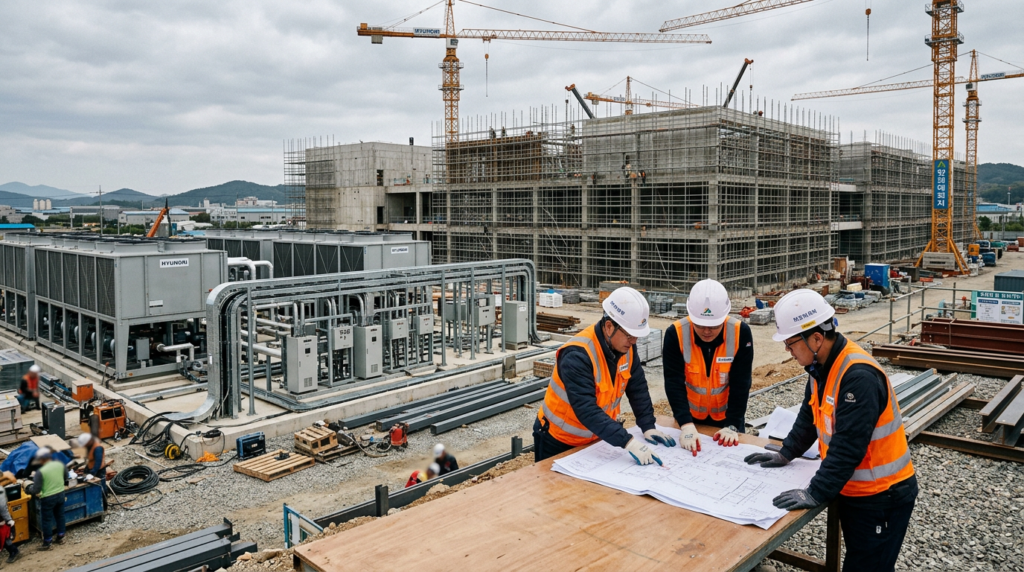
On September 28, Hyundai Engineering announced that it had won a contract worth approximately ₩870 billion to build the first phase of an AI data center in Gunsan, South Korea. The initial facility is planned for 60 megawatts. It forms part of SGC Group’s longer-term proposal for a 300-megawatt data center cluster.
Hyundai expects construction to begin in October. Another project participant, KT Cloud, has described a start later this year. Either way, this is a construction plan, not an operating AI campus. The first phase is targeted to begin service in the first quarter of 2028.
The contract gives Hyundai Engineering a substantial role in a fast-growing category of construction. It also puts a spotlight on the physical challenge behind AI expansion: someone has to build a place where powerful computers can run reliably, day after day.
First, find a place for the machines
The planned facility will occupy a 115,702-square-meter site in Bieungdo-dong, an industrial area of Gunsan in Jeonbuk State. That is the project site, not the floor area of a completed data center.
SGC Group is developing the larger cluster. Its first planned phase accounts for 60 megawatts, with another 240 megawatts envisioned in later stages. Hyundai Engineering’s newly announced order concerns the initial phase. The remaining capacity is a plan that would require further work and agreements.
Gunsan was already in the picture before this week’s contract news. In August, SGC AI Infrastructure, an SGC Energy subsidiary, signed an investment agreement with local authorities for the project. That agreement set out the broad development plan. Hyundai’s September announcement identifies the company taking on a major construction role.
That sequence matters. The September news does not mean a fully built center suddenly appeared, or that all 300 megawatts received a single construction order. It means the first phase has gained a contractor and moved further along its planned path.
There is plenty to build before a single AI server takes its place.
Who does what in Gunsan?
A project of this size needs more than one specialist. Hyundai Engineering will handle work that includes the buildings, civil engineering, equipment installation, landscaping and telecommunications. It will also take responsibility for specified cooling and power distribution equipment, including cooling towers, chillers and switchgear.
KT Cloud has a separate role. Reporting on the project says it will handle uninterruptible power supplies, batteries and automated controls. KT Cloud has described its broader participation as spanning design, construction-related work, checks before service and eventual operation.
That division helps explain why a data center cannot be reduced to rows of computer racks. The racks need a building that supports them, an electrical system that feeds them and cooling that carries heat away. Operators also need backup arrangements and controls that let them see what is happening across the facility.
SGC Group is the developer behind the larger plan. Hyundai is a major construction contractor. KT Cloud brings data center expertise. Their jobs connect, but they are not interchangeable.
The practical test will come when those separate systems have to operate together as one dependable facility.
Why 60 megawatts matters
A megawatt measures power. Sixty megawatts is the capacity figure attached to the first planned phase in Gunsan. It signals the scale of infrastructure the project aims to support, but it does not tell us how much electricity the site will consume every hour once operational.
That distinction is useful. Project capacity is a design and development measure. Actual electricity use will depend on the equipment installed, how heavily customers use it and how the finished site operates.
Modern AI equipment makes power planning especially demanding. Processors working through large model tasks use electricity and release heat. Pack more equipment into a rack, and both demands rise. The building must supply power safely while removing heat consistently.
Hyundai’s order is therefore about much more than constructing walls. Its assigned work reaches into the systems that will determine whether the future facility can accommodate dense AI hardware.
The wider 300-megawatt figure is larger still, but it belongs to the proposed cluster’s eventual scale. Only the 60-megawatt opening phase is the subject of this Hyundai construction win. The other phases should be treated as future possibilities until their arrangements are settled.
AI needs a cooling plan
If you have ever heard a laptop fan accelerate during a demanding task, you already know the basic problem. Computers produce heat when they work. AI data centers face that issue at a scale no laptop owner would wish to manage.
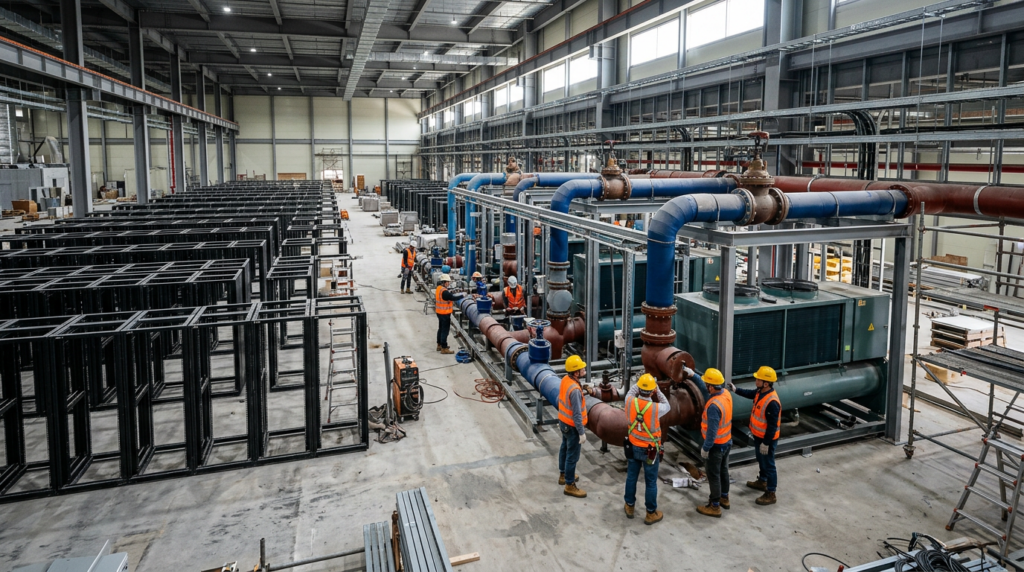
The Gunsan project is being designed with high-density AI systems in mind. Hyundai Engineering says it will install cooling infrastructure as part of its work. Project reporting also describes the use of liquid cooling and prefabricated power and cooling equipment supplied by Vertiv.
Cooling is not a decorative feature to add near the end of construction. It shapes the layout, equipment choices and operating plans from the beginning. If a facility cannot move heat away reliably, expensive processors cannot simply run at their intended load.
KT Cloud says the first phase is being planned with liquid-cooling capability on every floor. Hyundai and KT Cloud have described the site as intended to support Nvidia’s next-generation Vera Rubin AI equipment. That describes a design target; it does not mean such chips are already installed or operating in Gunsan.
The machines may get the headlines. The cooling system earns its place by letting them keep working.
Building in modules
The partners also plan to use modular and skid-mounted equipment. In this context, that means assembling certain power and cooling components in a factory before bringing them to the site for installation.
Think of it as preparing complex pieces of the puzzle before arriving at the puzzle table. Factory assembly may help teams repeat a design, check components and reduce some work at the construction site. Hyundai and industry reporting say the approach is intended to support quality and shorten the schedule.
That is the goal, not a guaranteed time saving. A project still needs permits, site work, connections, testing and coordination among contractors. Prefabricated equipment does not remove those jobs.
It does, however, fit the challenge facing builders of AI facilities. The equipment inside these centers keeps evolving. Construction teams want methods that let them deliver large, carefully controlled systems without treating every component as a one-off experiment.
Gunsan will offer a practical test of that approach. The important measure will be whether the finished power and cooling systems perform reliably, not merely whether their components arrived in tidy modules.
SGC’s larger ambition
SGC Group sees Gunsan as more than a single 60-megawatt building. Its stated plan calls for a cluster that could eventually reach 300 megawatts, developed in stages according to demand and future arrangements.
The site’s location is part of its pitch. Earlier reporting on the August investment agreement described the developer’s interest in its access to power infrastructure and potential cooling options near the coast. Those are proposed advantages for the development, rather than proof of how the finished center will operate.
Hyundai Engineering says the first-phase order could position it for priority negotiations on the remaining 240 megawatts. Priority negotiations are not an award for the later work. Costs, schedules and the extent of those phases would still need to be decided.
That difference is easy to lose when every data center announcement arrives wrapped in enormous numbers. The confirmed Hyundai news is a roughly ₩870 billion contract tied to the opening phase. The 300-megawatt figure describes the developer’s broader ambition.
The size of that ambition makes the first phase more consequential. It is the part that must turn drawings and partnerships into a working facility.
Why Hyundai Engineering wants this work
Hyundai Engineering formed a dedicated organization for high-tech industrial construction earlier in 2026. The Gunsan order is its first major data center win since that move, according to the company and Korean business reporting.
The contractor already has experience building complex industrial facilities. It points to work involving factories and other projects where heavy equipment, power distribution and precise environmental control matter. An AI data center presents a different mix of requirements, but some of those construction skills carry over.
Hyundai also says it has been selected as a preferred bidder for separate data center projects in Incheon and Gumi. Those are not completed contracts. If it secures them during the year, the company expects its data center orders to reach about ₩1.9 trillion.
For now, Gunsan is the firm contract at the center of this story. It gives Hyundai a chance to show that its industrial construction experience can meet the demands of AI infrastructure.
The company’s interest extends beyond building, too. It has discussed future roles in operations, maintenance and investment. Those are plans for its business, separate from the work confirmed in Gunsan.
A date on the calendar, with room to move
Hyundai Engineering says it expects to break ground within October 2026. Earlier reporting on SGC’s investment agreement also pointed to October. KT Cloud’s September 28 description says the first phase is due to begin construction by the end of the year.
The accounts differ in precision, so the safest reading is straightforward: the partners intend to start construction soon, but the exact start should be confirmed when it happens.
Their target for full-scale operation of the first phase is the first quarter of 2028. A data center has a long journey between groundbreaking and opening. Workers must prepare the site, construct the buildings, install electrical and cooling equipment, connect systems and test them.
Those tests matter. Power equipment has to support the installed load. Backup systems must respond when needed. Cooling and controls must operate together. A facility designed for AI workloads needs to prove it can sustain them before customers rely on it.
The dates provide a roadmap for following the project. They are targets, not evidence that construction or operations have already reached those milestones.
What this means for the AI market
An AI model can improve through software, research and better chips. Using that model at scale also requires places to run it. Gunsan is a reminder that the AI business depends on both.
For South Korea, the project adds to plans for domestic AI computing infrastructure. For SGC, it is an opportunity to develop a substantial new facility. For Hyundai Engineering, it is a major construction order in a field the company wants to grow. KT Cloud, meanwhile, has a role in the infrastructure and operation of the planned center.
Those are different business interests meeting at the same site. None guarantees that every phase of the cluster will be built, or that customers will fill it. Demand, financing, construction and operating performance will shape what follows.
Still, the announced contract is concrete progress for the first phase. It names a builder, sets out major responsibilities and gives the development a near-term construction target.
AI often feels weightless from a user’s point of view. Projects like Gunsan show just how much steel, electricity and engineering sit beneath that experience.
The milestone worth watching
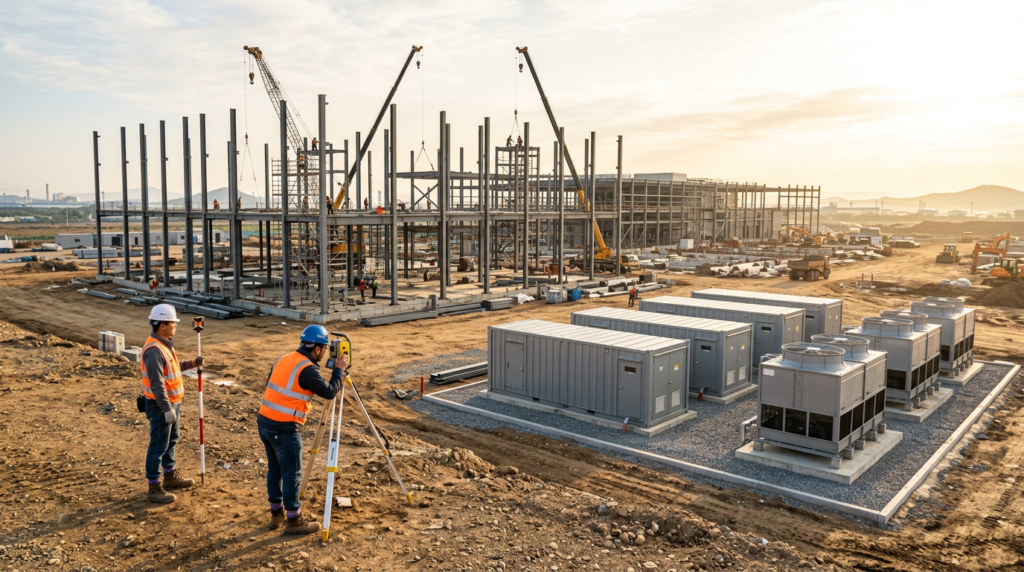
The ₩870 billion award is the headline today. The next milestones will be easier to see on the ground: the start of construction, installation of power and cooling systems, and eventually the first phase’s opening.
Watch the 60-megawatt facility first. That is the confirmed construction scope. The proposed expansion to 300 megawatts will be a separate story if later phases advance.
There is a simple reason to follow the less glamorous details. An AI data center succeeds when its systems work together reliably. The building must support the equipment. Electricity must reach it. Cooling must remove its heat. Operators must be able to keep the whole arrangement running.
Hyundai Engineering now has a substantial contract to help make that happen in Gunsan. SGC and KT Cloud have their own parts to deliver. If the partners meet their targets, the first phase could begin operating in early 2028.
For the moment, this is a promising AI infrastructure project entering its construction chapter. The servers can wait for their turn. First, someone has to build the room.
Sources
- Hyundai Engineering’s announcement via Hyundai Motor Group (현대자동차그룹)
- Seoul Economic Daily’s report on the Hyundai contract (Seoul Economic Daily)
- Data Center Intelligence’s project report (datacenter-intelligence.com)
- The Asia Business Daily’s report on KT Cloud’s role and timeline (The Asia Business Daily)
- Yonhap’s report on the earlier SGC investment agreement (연합뉴스)
The Kingy Brief
Get the next Kingy Brief.
Source-checked AI changes, original tests and one practical thing to try.
Free · Choose your subjects · Double opt-in · Unsubscribe anytime