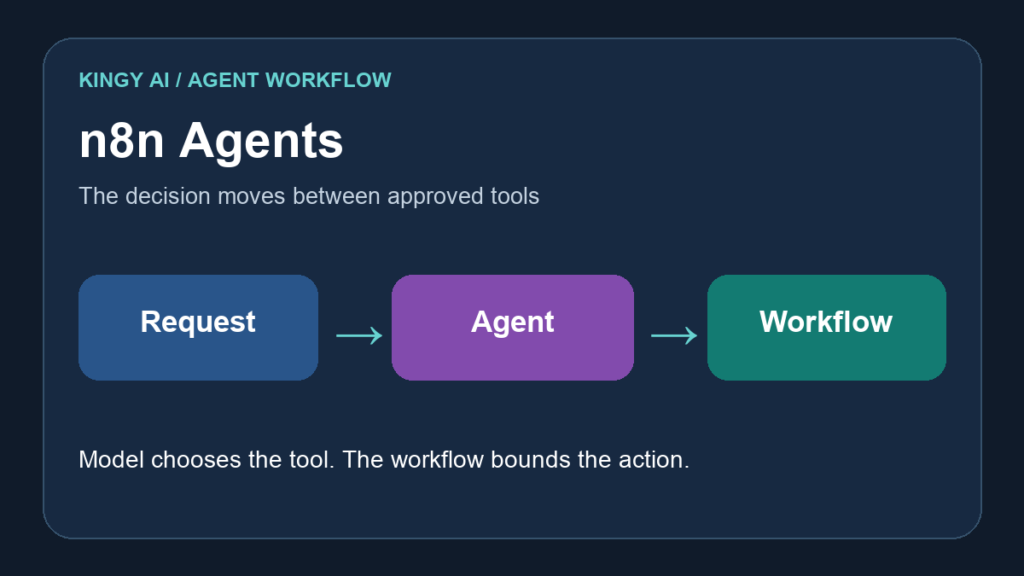
n8n has added a dedicated Agents builder alongside its existing workflows. An agent can receive a request through chat or a connected channel, choose tools, call an existing workflow, remember the conversation, and run on a schedule. The release matters because people who already automate tasks in n8n can now give a model discretion over which approved process to use without rebuilding every process as a giant branching workflow. It is also a preview feature, so an agent that writes to a customer record or sends a message still needs a controlled pilot. n8n announcement · n8n documentation
This is a reading of n8n’s release and documentation, checked September 27, 2026. Kingy did not test an n8n account or measure reliability.
What actually launched
The new Agents tab creates an agent as its own project object. You choose a model, write instructions, attach tools and skills, and connect it to channels such as Slack, Telegram, or Linear. Agents can run from a schedule or be called by the new Message an Agent workflow node. The same published agent can serve several entry points, while its draft remains available for edits and preview. n8n stores sessions and exposes the steps and tool calls for review. Announcement · Build and manage agents
This does not replace the older AI Agent node. n8n says existing AI Agent node workflows keep working. The distinction is where the model sits. In a conventional workflow, the builder defines the route and may use an AI node for a bounded step. In the new Agents product, the model receives an open-ended request and chooses among tools, workflows, and follow-up questions. A workflow can also call a published agent when one step needs that judgment. n8n announcement
| Your job | Better starting point | Why |
|---|---|---|
| A known sequence: validate a form, enrich a record, send it to a queue | Fixed workflow | The path is explicit, repeatable, and easy to audit. |
| A single judgment inside a known process | Workflow with an AI Agent node or Message an Agent | The process keeps control of when the model runs and what happens next. |
| A request whose next step depends on the answer: investigate an account, ask a clarifying question, use one of several approved tools | New n8n Agent | The agent can choose its next action while the attached tools limit its reach. |
These are editorial starting points, not a product benchmark. The best choice depends on your own failure tolerance and how much discretion the task really needs.
The useful design choice: workflows as tools
n8n’s strongest example is not “give the agent the whole CRM.” It gives an agent narrow workflows, such as fetching account context or adding a note. The model chooses when to call a workflow; the workflow defines how the write happens. A note-writing workflow can accept only an account ID and a note, while its credential remains attached to that tool. n8n also offers per-tool credentials and approval gates for sensitive actions. n8n announcement
That separation is useful, but only if the underlying workflow really has narrow inputs and permissions. A broad “execute arbitrary request” tool would undo it. Start with read-only lookup and a test channel. Add a single write action after you can inspect the agent’s sessions, confirm the correct account was selected, and undo a bad update. Kingy’s agent security guide explains the wider permissions and logging checks.
Availability and the cost you should count
n8n says Agents are available on n8n Cloud for everyone on the latest stable version. Self-hosted installations can enable them with extra setup from version 2.32.3. The company says self-hosted Enterprise support is still coming. Agents remain in Preview, including a warning that behavior can change. Knowledge bases are available on Cloud; the self-hosted version is also in preview and needs additional setup. Check your own instance and plan before designing a production process around a specific capability. n8n documentation · n8n announcement
n8n counts one agent turn as one execution. Calls to attached workflows or sub-agents do not count as separate n8n executions, and agents share the existing workflow execution quota. That is only one part of cost. Building an agent with n8n Assistant consumes AI credits, according to n8n; model-provider usage or Gateway credits also matter. An agent that loops through several turns can therefore change both execution use and model spend. The source pages do not give a universal dollar price for a real task, so estimate from a representative run and inspect the actual bill. n8n announcement · n8n documentation
A first pilot that can tell you something
Pick one task where users currently describe a problem and an operator chooses a known workflow. A support-queue triage assistant is a candidate: read a ticket, fetch customer context, ask for missing information, and recommend a route. Give the agent a read-only account lookup, a limited ticket classifier, and a draft-only reply action. Keep the existing workflow that actually sends the reply. Give the agent a test queue and review its session trace after each attempt.
Use a small set of real-looking, non-sensitive fixtures: ordinary requests, missing account IDs, conflicting records, and a malicious instruction inside a ticket. Score the final ticket state, tool calls, unwanted writes, and time spent reviewing. If the agent only summarizes when it should ask a question, improve the instructions or the tool contracts. If it selects the wrong customer, stop before adding send or write privileges. This is a proposed evaluation method, not a test Kingy has run on n8n.
Once the read-only path works, publish a versioned agent and add one narrow write workflow with an approval gate. n8n’s draft/published split lets you test a change without silently changing the running version. Confirm the schedule and channels point to the version you intended. A fixed workflow should still own any step whose order, validation, or output must be exact. n8n documentation
The release gives n8n builders a cleaner place for open-ended work. Whether it improves your operation depends on the tool boundaries, the trace you review, and the amount of correction the agent creates. Those are measurable in a pilot; a polished demo cannot answer them.
The Kingy Brief
Get the next Kingy Brief.
Source-checked AI changes, original tests and one practical thing to try.
Free · Choose your subjects · Double opt-in · Unsubscribe anytime