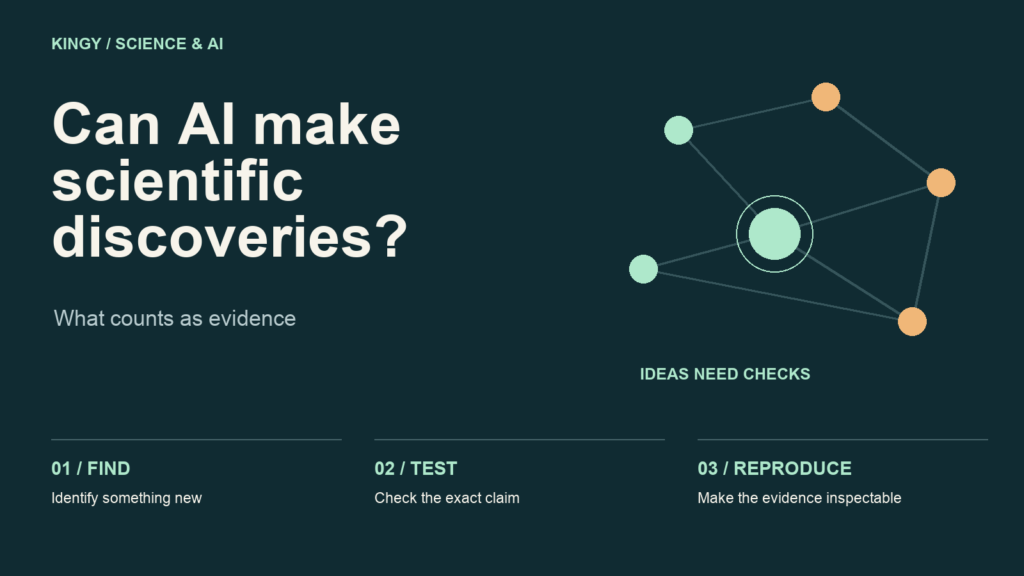
Yes. AI systems can contribute new, testable knowledge by finding patterns in data, proposing candidates, and searching for solutions that people have not previously identified. Whether a particular result deserves the word “discovery” depends on what was new and how it was checked.
A protein structure prediction, a promising molecule, and an experimentally characterized biological mechanism are different kinds of results. Reading them as interchangeable achievements makes it hard to understand either the progress or the remaining work.
Anthropic’s September 2026 enzyme announcement is a useful case. The company reports that Claude identified the defining features of an uncharacterized system called array-associated reverse transcriptases, or ART. The underlying reverse transcriptase had appeared in earlier research; the newly recognized system includes associated repeats and a partner protein. Its biological function remains unresolved. Read Anthropic’s announcement.
That is a substantial research lead with a specific evidential boundary. This guide explains how to recognize that boundary, compare AI discoveries across fields, and evaluate the next claim you encounter.
Evidence checked September 23, 2026. The ART findings are reported in an Anthropic preprint. The evaluation framework below is Kingy’s editorial framework, not a formal scientific grading standard.
What counts as an AI scientific discovery?
A useful working definition is a new finding about a scientific or mathematical question, produced with a meaningful contribution from an AI system and supported by an appropriate check.
Each part matters. “New” means more than unfamiliar to the person asking the question. “Meaningful contribution” identifies what the system did. “Appropriate check” changes with the claim: a mathematical construction may be checked computationally, while a proposed biological mechanism usually needs experimental evidence.
Consider five distinct outputs:
| Output | What it establishes | What it still leaves open |
|---|---|---|
| Literature synthesis | A useful account of existing work, if sources support it | Whether any finding is new |
| Candidate or anomaly | A pattern or object worth investigating | Whether it is real, novel, and consequential |
| Prediction | An expected structure, property, or outcome | Whether reality agrees under the relevant conditions |
| Validated finding | A claim that survives the stated test | Its generality, mechanism, and independent reproducibility |
| Useful application | Performance in a defined practical setting | Reliability beyond that setting and readiness for wider use |
These are different claims, not compulsory stages in one universal pipeline. A new mathematical result does not need a clinical trial. A molecule that works in one laboratory assay has not thereby become a medicine.
The most useful reading habit is to replace “AI discovered X” with a more exact sentence: “This system did Y, and researchers checked Z.”
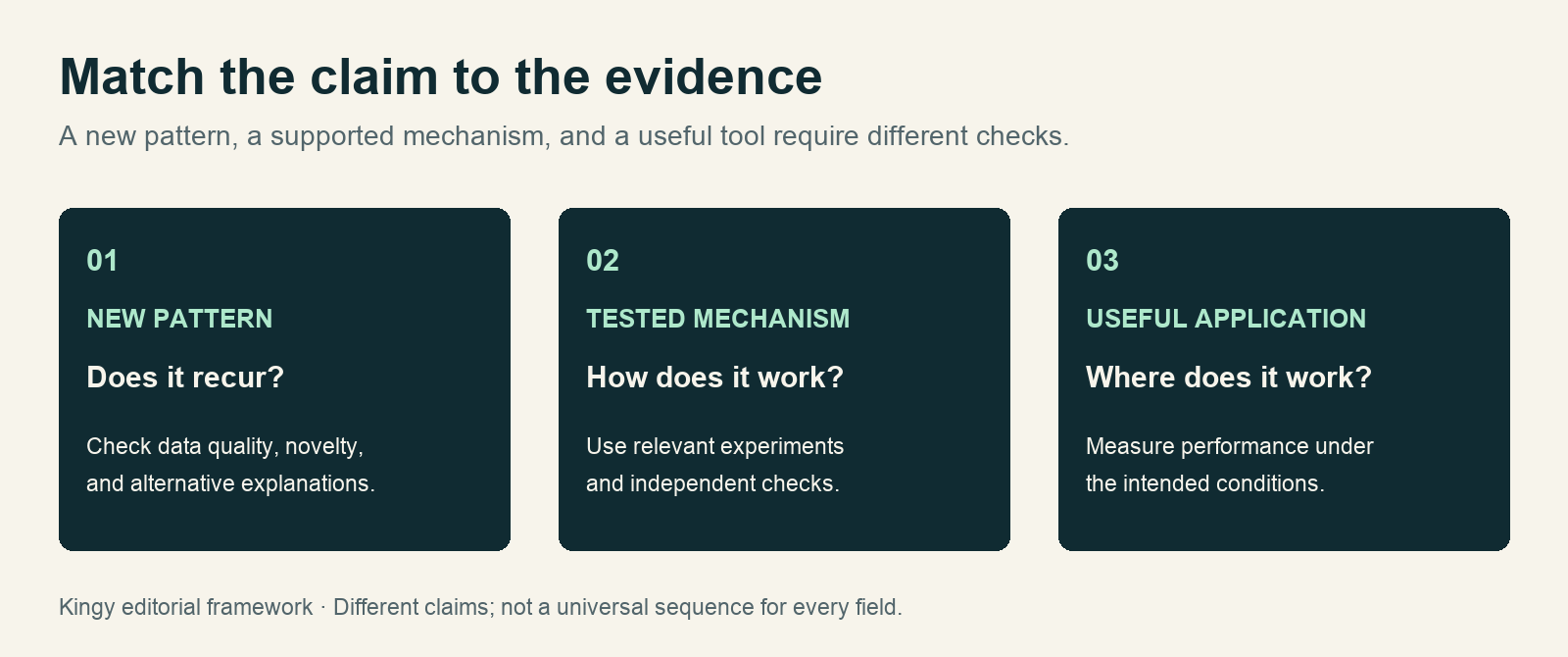
Different claims require different evidence. This is an editorial framework, not a mandatory sequence for every field.
What Claude’s ART discovery actually showed
ART is associated with bacteriophages, viruses that infect bacteria. Its arrangement includes a reverse transcriptase, a neighboring partner gene, and a repeat array. Early experiments found that the array produces distinct short RNAs. Anthropic draws a comparison with CRISPR because of the repeated architecture; that comparison does not establish a gene-editing capability. Announcement and early experimental findings.
The technical report, Autonomous AI agents discover reverse transcriptases with tandem repeat arrays, gives the campaign’s exact scale: 949 agent sessions, 119 tasks, 215.6 million tokens, and 21.5 hours of elapsed time. The campaign used Claude Mythos 5 in a system that coordinated workers, reviewers, and shared records. Those figures describe the computational campaign, not the duration of the entire scientific project.
The report also states a decisive limitation: the authors had not shown that the reverse transcriptase was active or that the array’s RNAs were its substrates. Whether the enzyme and partner interact, and what the system does for the phage, remained unknown.
There is another revealing detail. Fourteen of 17 candidate partner families were rejected or set aside. A productive search included substantial elimination, not just the successful lead. Technical report, Results and Discussion.
For a reader, the distinction is practical. The evidence supports identifying an unusual system and motivating further study. Claims about programmable editing, therapeutic value, or replacing CRISPR require additional evidence with different tests.
Four examples of AI in scientific discovery
The cases below involve different systems and different standards of validation. Comparing them makes those differences visible.
| Example | AI contribution | How the result was checked | Limit of the cited evidence |
|---|---|---|---|
| Claude and ART | Identification and analysis of an unusual biological system | Sequence analysis and initial laboratory observations | Its function and engineering utility remain unresolved |
| AlphaFold 2 | Protein structure prediction | Blind comparison against experimentally determined structures | A structure prediction alone does not establish biological function |
| Halicin research | Prioritization of a compound for antibacterial activity | Laboratory experiments and mouse models | Preclinical findings do not establish clinical safety or efficacy |
| FunSearch | Generation of programs producing mathematical constructions and algorithms | A task-specific computational evaluator | Success is bounded by the problem and evaluator |
AlphaFold: predictions tested against withheld structures
The 2021 AlphaFold paper reported strong protein structure prediction performance in CASP14, a blind assessment using structures that had not yet been publicly disclosed. That matters because comparison with an already-known answer can give a misleading impression of predictive ability. Jumper and colleagues, Nature.
A predicted structure can help a scientist formulate an experiment or interpret other evidence. It does not automatically explain every interaction, establish a drug’s effect, or capture every state a protein can occupy.
The lesson is to identify the prediction target precisely. Accuracy on the shape of a protein is evidence about structure prediction. A broader biological claim needs its own support.
Halicin: a computational lead followed by experiments
In their 2020 study, Jonathan Stokes and colleagues used deep learning to identify antibacterial candidates. They investigated a compound they named halicin and reported antibacterial effects in experimental work, including mouse models. The molecule already existed; the research identified an antibacterial use worth investigating. Stokes and colleagues, Cell, full paper.
This is a useful example of discovery through prioritization. A model can create value by directing scarce experimental attention toward an overlooked candidate. It does not have to invent a molecule from scratch to contribute something scientifically important.
The cited paper’s preclinical results should be described at that level. Establishing a treatment for people requires evidence that those experiments do not supply.
FunSearch: generated ideas with a computable check
FunSearch combined a language model that proposed programs with an evaluator that scored their outputs. Its paper reported new results for the cap-set problem and improvements in online bin-packing heuristics. The search retained useful programs and built on them. Romera-Paredes and colleagues, Nature.
Here, the evaluator is central. The system could explore many proposals because there was a concrete way to assess candidates. A fluent explanation was not the acceptance criterion.
This illustrates why progress can differ sharply between fields. Some tasks permit cheap, exact checks. Others require expensive experiments, uncertain measurements, or years of follow-up. A system’s ability to generate ideas is only one part of its usefulness.
How AI agents move from a question to a research lead
An AI research agent combines a model with tools and a record of its work. In a well-designed workflow, the model can inspect data, write analysis code, use search tools, interpret outputs, and decide which question to investigate next. The quality of the surrounding process matters alongside the model’s capabilities.
For evaluating such a process, look for five explicit decisions.
The question. Someone must define what is being searched for. “Find interesting science” gives no reliable way to assess completeness. A defined population, dataset, outcome, and novelty criterion make the work inspectable.
The reference point. A candidate can appear unusual because the comparison set is incomplete. Established examples, known failure cases, and a clear account of prior work provide a baseline.
The evidence trail. A useful report connects a claim to an input, method, result, and source. Saving the final prose alone loses the transformations that may explain a surprising answer.
The rejection rule. A search needs reasons to discard candidates: a duplicate result, an annotation error, a weak association, or a failed experiment. Otherwise, the process accumulates stories faster than it accumulates knowledge.
The next test. A candidate should lead to a question that another method or measurement can resolve. “Investigate further” is less useful than identifying the observation that would strengthen or weaken the proposed explanation.
These are design recommendations. Their purpose is to make an AI-assisted project easier to challenge and reproduce, regardless of the particular software involved.
A practical checklist for evaluating an AI breakthrough
You do not need to reproduce a laboratory study to ask better questions about its claims. Start with the paper or technical report, then work through the following checks.
1. State the new result in one sentence
Distinguish discovering an object, recognizing a property, proposing a mechanism, and building an application. If the headline claims all four but the paper supports one, narrow the conclusion to the supported result.
2. Identify what the AI actually did
Look for the supplied prompt, data access, tools, human interventions, and selection process. “Autonomous” is incomplete without a boundary. Autonomy during a computational search does not imply autonomy in choosing the research agenda or carrying out laboratory work.
3. Ask how novelty was assessed
A finding can be new to the model, new to a research team, or new to the field. Those are different claims. Useful evidence includes comparisons with prior literature, previously described systems, and established methods.
4. Match the test to the claim
A simulation checks behavior under a model’s assumptions. A laboratory assay checks a defined experimental setting. Independent replication adds evidence beyond the original team. None should silently stand in for another.
5. Check whether information leaked into the evaluation
An impressive result can weaken if the test data influenced model development or analysis choices. Sayash Kapoor and Arvind Narayanan’s study documented leakage problems across 294 papers in 17 fields. Their work provides a taxonomy of failure modes rather than a license to dismiss all machine-learning research. Kapoor and Narayanan, Patterns.
For a specific study, ask what was held out, who could inspect it, and when. In grouped data, separating rows may still leave information from the same patient, site, or experimental batch on both sides of a split.
6. Look for the denominator
One successful candidate means something different after ten attempts than after a million. Ask how many proposals were generated, how many were tested, why they were selected, and how many failed. A success story without its selection process cannot establish a general success rate.
7. Separate exploration from confirmation
Exploratory analysis is valuable because it can reveal unexpected patterns. Confirmation requires a design that does not quietly reuse those discoveries as if they had been specified in advance. Preregistration can make planned analyses and later changes visible; it does not guarantee that the plan is sound. Center for Open Science’s guidance.
8. Read the limitations before forecasting the application
The strongest limitation is often a missing measurement. A result may be promising precisely because it opens an unanswered question. List that question explicitly before predicting a product, treatment, or industry impact.
What does it cost to produce a useful discovery?
A reported runtime is not a full research budget. A practical estimate needs model usage, compute, data preparation, expert review, experiments, and the work spent on unsuccessful candidates.
Even token counts do not determine an exact invoice. Input and output rates can differ; caching, billing arrangements, and infrastructure also matter. Without that information, converting a campaign’s total tokens into a confident dollar figure creates false precision.
For a research team, a more useful operational measure is cost per candidate that passes a defined validation test. Track the total campaign cost, the number evaluated, the number retained, and the criteria used. Record scientific value separately: a low-cost candidate is not necessarily an important one.
Speed claims need the same care. An agent’s elapsed search time, summed agent-hours, a human team’s analysis time, and the time to complete experiments describe different quantities. A fair comparison names the task and holds the acceptance standard reasonably consistent.
Frequently asked questions
Can AI discover something outside its training data?
It can contribute to new findings through search, computation, and interaction with new data. The relevant test is the novelty and validity of the output. Establishing that a result was absent from all training data can be difficult when the training corpus is not fully disclosed.
Did Claude discover a new CRISPR gene editor?
The reported ART result does not establish that claim. Researchers identified a system with a repeat architecture that invites comparison with CRISPR. Its biological role and potential use as an engineering tool remained open questions at the evidence cutoff.
Is an AI-generated hypothesis a discovery?
A hypothesis is a proposed explanation. It becomes part of a supported scientific finding when appropriate evidence survives scrutiny. A valuable hypothesis can deserve attention long before that point, provided its status stays clear.
Does a second AI agreeing make a result reliable?
Agreement can help identify questions for review, but two systems can share assumptions, sources, or errors. Stronger checks involve inspecting the underlying source, rerunning the calculation, using a different method, or collecting relevant new evidence.
Will AI replace scientists?
These examples establish useful contributions to particular research tasks. They do not measure the replaceability of an entire profession. The practical question for a lab is which tasks improve with AI assistance and which decisions still need accountable scientific judgment.
Before accepting the next discovery headline, write down three things: the exact new finding, the test that supports it, and the most consequential unresolved question. Those three sentences will usually tell you more than the adjective attached to “breakthrough.”
Method: This article compares primary research and official documentation. Kingy has not independently reproduced the cited biological experiments. For our approach to sourcing and corrections, see Kingy’s editorial standards.