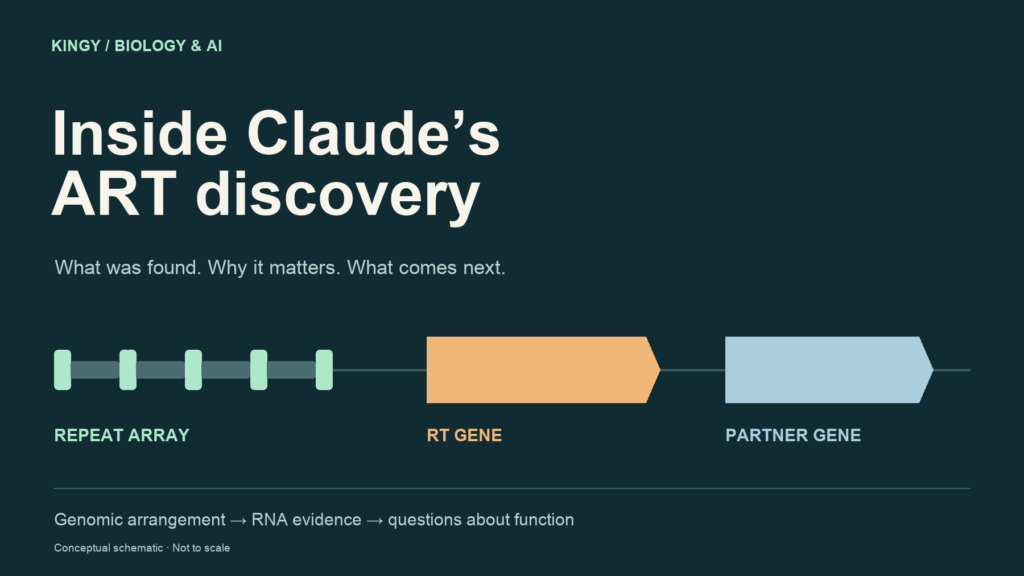
Claude helped identify a previously unrecognized biological system in phage genomes: array-associated reverse transcriptases, or ART. The interesting object is an arrangement of repeated DNA, an enzyme gene and a neighboring protein gene. Anthropic’s researchers then investigated it computationally and in the laboratory. Their September 23, 2026 announcement presents an AI-assisted discovery whose biological purpose remains unresolved.
Understanding that arrangement is more useful than deciding whether to call it a breakthrough. It explains why researchers care, why comparisons with CRISPR attract attention, and why a possible biotechnology application still requires several distinct discoveries.
This article examines the molecular evidence and the questions it opens. The central research source is Anthropic’s technical preprint, Autonomous AI agents discover reverse transcriptases with tandem repeat arrays. The wider context comes from the original phage, CRISPR, retron and prime-editing studies linked below. Future applications discussed here are conditional analysis, not reported ART capabilities.
What exactly did Claude discover?
The novelty is easiest to understand as a question about organization: why do these particular biological components keep appearing together?
A protein sequence can already be present in a database while its role in a larger system remains unknown. Discovering that larger system changes the questions scientists can ask. Instead of studying one isolated protein, they can investigate a recurring relationship among DNA, RNA and proteins.
Here is the compact technical inventory from the ART report:
| Feature | Reported finding |
|---|---|
| Organization | Upstream repeat array, reverse-transcriptase gene, downstream partner gene |
| Family survey | 95 RT clusters; 28 detectable upstream arrays |
| Array size | 0.3–4.1 kilobases; 3–21 repeat copies |
| Repeated sequence | 15–49 nucleotides, including a roughly 15-nucleotide palindromic core |
| Intervening sequences | Variable spacers of 120–220 nucleotides |
| Protein architecture | Unusually long RT N-terminal extension, about 180 amino acids |
| Associated proteins | Three unrelated partner families |
| Infection data | Array RNA reached up to 8% of phage RNA at 15 minutes |
Source: ART technical report, Results and Figures 2–3. A kilobase is 1,000 DNA bases; an amino acid is a protein building block. “Cluster” here is a sequence-grouping unit, so the family count should not be read as a count of experimentally characterized enzymes.
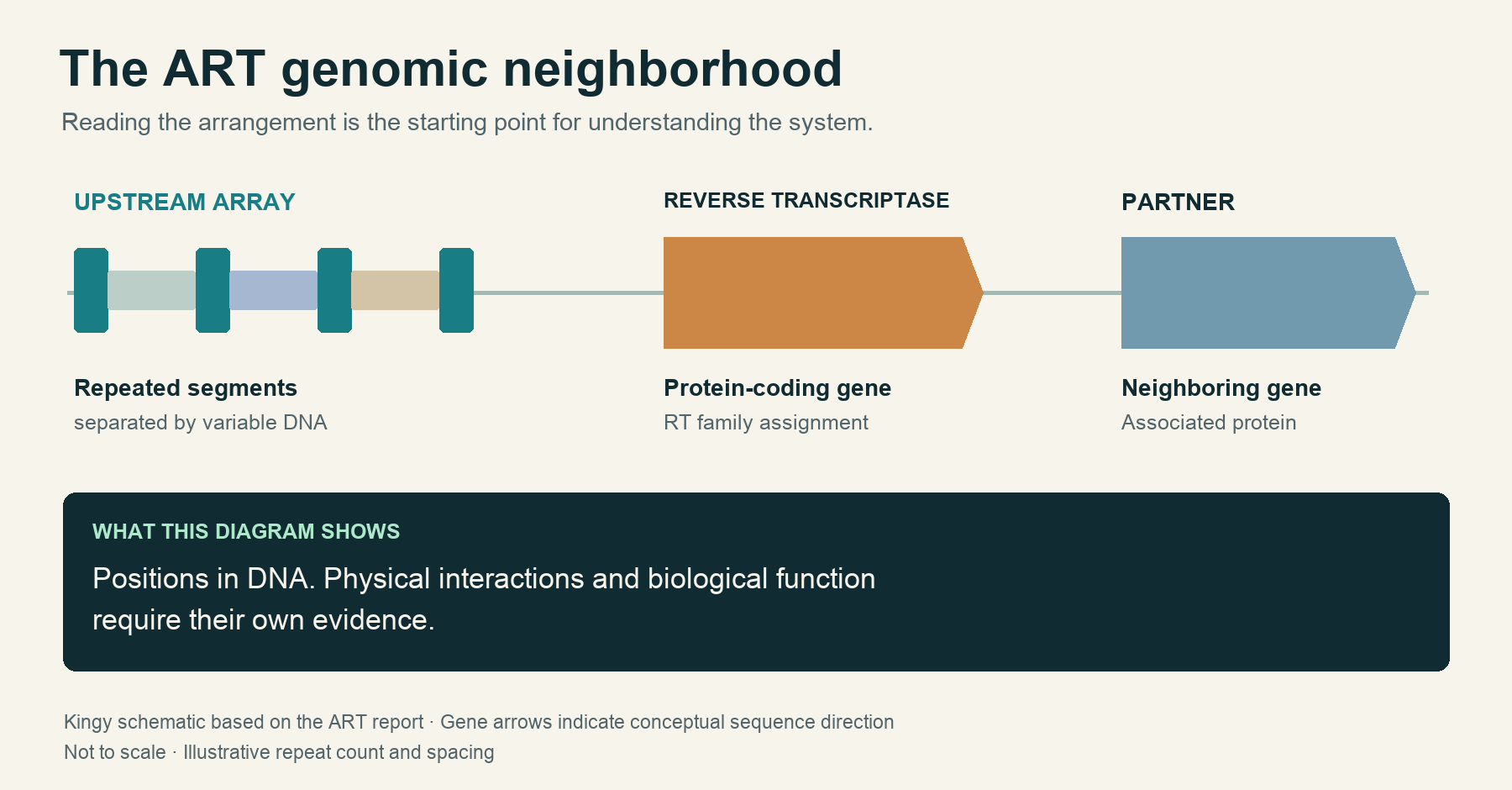
Original Kingy schematic based on the reported genomic organization. Not to scale; gene positions do not demonstrate physical binding between the resulting molecules.
Three distinctions make those observations easier to interpret.
First, a recurring genomic neighborhood is a clue to a shared biological job. It gives researchers a reason to study components together. It cannot, by itself, reveal which molecule touches which other molecule, or which chemical reaction occurs.
Second, an array is an organized series of sequence units. Repetition offers a possible way to produce related molecular parts from one region of a genome. The variable portions raise a further question: could the units share a common structural role while doing something different from one another?
Third, detectable is a measurement qualifier. A computational survey reports what its methods identify in the available sequences. A count of detected arrays cannot establish how common the system is across all phages, including those scientists have never sampled.
The palindromic sequence and the protein extension point toward different questions about shape. Complementary sections of an RNA can pair with one another, allowing a strand to fold back on itself. A repeated sequence could therefore help different RNA units form a shared structural feature. An extra region of a protein could create a surface for an interaction. Both are reasons to investigate molecular structure; neither establishes a specific interaction merely from its presence. RNA’s ability to adopt functional structures is part of the biology described in NHGRI’s RNA fact sheet.
The point of the inventory is therefore not that a larger number automatically means a stronger discovery. Its value is that it turns an intriguing observation into specific, checkable claims about organization, dimensions and molecular output.
The biology primer: DNA, RNA and reverse transcriptase
DNA stores sequence information. Transcription produces RNA from a DNA template. Some RNA carries instructions for making proteins; other RNA acts as a structural, regulatory or catalytic molecule. “Non-coding” means that a sequence does not encode a protein. It does not tell us whether the sequence is useful, dispensable or still unexplained. The National Human Genome Research Institute’s explanations of RNA and non-coding DNA make this distinction explicit.
Reverse transcriptase, usually shortened to RT, performs RNA-templated DNA synthesis. The name describes the direction of information transfer: RNA is used to make DNA. It does not mean that the enzyme automatically rewrites a genome. NHGRI’s description of complementary DNA explains this copying step.
That last distinction matters. Making a DNA molecule, recognizing a particular genomic address and changing the DNA at that address are different capabilities. A useful editing system has to bring the required capabilities together.
Enzymes are catalysts: they accelerate particular chemical reactions. Many work as parts of larger molecular assemblies. Learning that a protein resembles a known enzyme family therefore helps narrow the investigation, but it leaves the identity of its natural substrate, its interacting partners and its biological effect to be established. See NHGRI’s enzyme definition.
A helpful way to read an unfamiliar molecular system is to ask four questions: what information is stored, what molecules are produced, what reaction takes place, and what difference that reaction makes to the organism. Those questions are related, but evidence for one cannot silently substitute for evidence for another.
What was already known before Anthropic’s work?
The earlier research deserves attention because it changes the discovery story.
In 2021, Abby Korn and colleagues described the jumbo bacteriophages MarsHill, Madawaska and Machias. Their comparative-genomics paper identified a retron-like reverse transcriptase. These phages had genomes averaging approximately 269,000 base pairs and many predicted genes. Phages are viruses that infect bacteria; “jumbo” refers to their unusually large genomes.
That history separates discovering a sequence from discovering what its surroundings might mean. The new interpretation depends on earlier researchers having isolated organisms, produced sequence data and made those results accessible. An AI system can contribute an important insight without having originated every observation on which it rests.
There is a second layer of prior work. Bingyan Zhang and colleagues published a 2022 transcriptomic study of phage SA1 and its bacterial host. They examined RNA expression during infection, including how the phage’s activity changed over time. Such an experiment records many molecular signals at once, potentially supporting questions beyond those emphasized in the original publication.
For scientific discovery, this is an unusually productive combination: a sequence suggests where to look, and an independently collected dataset offers a different kind of measurement. A pattern becomes more interesting when another experimental method supplies information about it.
The broader lesson is about the value of research archives. A dataset can become more useful as the questions asked of it improve. That is a reason to invest in accurate metadata, accessible repositories and durable links to original experiments. More analysis is only helpful when future researchers can understand what the earlier measurements actually represent.
What did the RNA experiments establish?
The ART authors report that small-RNA sequencing after expressing the SA1 system in E. coli detected discrete array-derived RNAs. Reverse-transcriptase activity, use of those RNAs as substrates, and the system’s biological function remain unestablished. ART technical report.
To understand the importance of that result, consider what RNA sequencing measures. RNA-seq determines which RNA sequences occur in a sample and provides information about their abundance. It can help connect a region of a genome to molecules that cells actually produce. It does not directly measure every reaction involving those molecules. NHGRI’s RNA-seq explanation describes both the measurement and the use of a laboratory RT to prepare sequenceable material.
That creates an easily missed distinction: the reverse transcriptase used as a laboratory reagent in an RNA-sequencing workflow is not evidence that the biological RT being investigated performed the same reaction inside the cell.
Likewise, finding RNA products answers an existence question before it answers a mechanism question. To assign a mechanism, researchers need evidence connecting a particular component to a particular effect. The important comparison is between plausible explanations of the same observation.
For example, distinct RNA molecules could potentially serve as templates, binding partners, regulators or products of processing. Those are general molecular possibilities, not findings about ART. Selecting among them requires observations that would differ depending on which explanation is correct.
The abundance measurement also needs its denominator. A percentage of phage RNA describes a share within that measured category. It cannot be converted into the same percentage of all RNA in an infected cell. Nor does high abundance alone reveal whether a molecule is essential. It makes the molecule worth explaining.
For readers following the story, the most useful next question is therefore precise: what evidence would connect the observed RNA to a defined biochemical activity?
Why “CRISPR-like” needs a careful explanation
CRISPR is a natural point of comparison because its name refers to a distinctive arrangement of repeated and intervening sequences. But CRISPR’s value as an engineering platform comes from a demonstrated mechanism.
In their 2012 Cas9 paper, Martin Jinek and colleagues showed that an RNA complex directs Cas9 to cut target DNA. They also engineered a combined guide RNA that supported sequence-specific cleavage. That work linked an address encoded in RNA to an experimentally observable action at a matching DNA sequence.
This is a useful standard for the word programmable. Researchers must be able to specify an input and obtain the predicted change in behavior. For sequence targeting, a particularly clear test is whether changing the guide changes the target in the expected way.
A visual resemblance between two genomic arrangements cannot establish that capability. Repeated elements may organize molecules without encoding target addresses. Variable segments may matter for structure, recognition or regulation without behaving like CRISPR guides.
The practical comparison should therefore ask what each system can be shown to do:
| Question | Evidence an engineering claim would require |
|---|---|
| Does it recognize a chosen target? | A predictable relationship between the specified input and recognized target |
| Does it act on that target? | A measurable molecular outcome linked to recognition |
| Can the target be changed? | Successful redirection across more than one example |
| Does it behave selectively? | Measurement of intended and unintended activity |
| Can it work outside its original context? | Performance in the environment where researchers want to use it |
This table is an editorial framework for evaluating future results, not an ART experimental report. It shows why “could become programmable” is a research question with several parts.
Retrons provide a more specific mechanistic comparison
Retrons connect a reverse transcriptase with non-coding RNA and additional molecular machinery. In their 2020 Cell study, Adi Millman and colleagues established anti-phage defense functions for bacterial retrons. Their work linked a previously puzzling class of genetic elements to a biological consequence for the cell and invading phage.
The distinction between bacterial defense and phage biology matters here. A function demonstrated in a bacterium cannot simply be assigned to a system because its components look related, especially when the system occurs in a different biological setting.
The ART researchers propose a retron-like mechanism involving a bank of distinct RNAs and an RT–partner pair. This remains a hypothesis. ART technical report.
As a hypothesis, it raises an interesting design question: can one set of protein machinery support multiple molecular states through different associated RNAs? If that principle were demonstrated, researchers could ask which features are shared across the states and which features determine their differences.
There are several possible outcomes. Different RNAs might change recognition. They might change when an activity is triggered. They might instead be required for assembly or stability, with little scope for redirection. Each outcome would teach something different about the relationship between sequence and function.
An attractive hypothesis is valuable when it exposes those alternatives. Its explanatory appeal is not itself a measurement. The aim of follow-up research should be to distinguish possibilities, including the possibility that the preferred analogy turns out to be incomplete.
Why reverse transcriptases interest biotechnology researchers
There is a concrete precedent for using an RT in a useful editing system: prime editing.
In the 2019 prime-editing study, Andrew Anzalone and colleagues combined an engineered Cas9 nickase with a reverse transcriptase and a specialized guide RNA carrying editing information. They demonstrated targeted DNA changes in cells. The contribution of the RT was part of a larger engineered arrangement that supplied targeting and coordinated the molecular steps.
That precedent supports interest in unfamiliar RT systems. It also clarifies the distance between finding a promising molecular component and establishing an application.
A newly characterized enzyme might eventually offer a useful property: compatibility with a different substrate, a different operating environment, a convenient size or a useful interaction with RNA. None of those advantages should be assumed before comparison with existing tools. A component only improves a technology if the advantage survives incorporation into the complete system.
Researchers also have to ask what the application actually needs. A research assay may tolerate conditions that a living cell cannot. A cell-culture tool can be valuable without being suitable for use in a person. An enzyme that works well in one context may require extensive development in another.
For ART, the sensible commercial question is which measurable property would justify further development. “Another route to genome editing” is too broad to answer until the underlying activity is characterized.
What Claude contributed, and where humans remained essential
Anthropic describes a campaign involving roughly 950 agent sessions, about 21 hours of elapsed search time and approximately 210 million tokens. Scientists supplied the research direction and infrastructure, then carried out laboratory work and further analysis. These figures describe a substantial organized search, not a single chat response or the full time needed for experimental validation. Anthropic’s announcement.
The useful question is how work was divided. A research agent can select analyses, write code, inspect outputs and pursue a candidate. Human researchers still have to establish what the outputs mean and connect them to reliable measurements of the physical world.
This matters when interpreting the word “autonomous.” Autonomy can describe a phase of a project or a set of decisions within a defined environment. It should be attached to the actual work performed. Otherwise, a reader may wrongly infer that the same system selected the entire research agenda, supplied its own infrastructure and completed every experiment.
Nor does computational scale, by itself, establish efficiency. Assessing efficiency would require a denominator such as useful validated findings per unit of total cost, researcher attention or laboratory capacity. A token count alone cannot provide that answer.
For a broader examination of discovery claims across fields, see Kingy’s guide to whether AI can make scientific discoveries.
There is also relevant work beyond this Claude campaign. The Minerva preprint from the Hie lab and collaborators describes a genome-language-model approach to identifying molecular relationships directly from sequence. In a different RT group, UG27, the authors report arrays of non-coding RNAs that template complementary-DNA hairpin products. That is a separate finding, not experimental confirmation of ART.
The comparison is useful because it connects the future of AI biology to concrete scientific questions. Different computational approaches may identify different families, and those families may offer contrasting examples of what an RNA–protein arrangement can do. A general-purpose research agent and a specialized genome model could eventually contribute at different stages of the same investigation. Their value should be judged by the evidence and useful questions they produce.
The ten repeat searches are crucial to the AI story
In ten repeat campaigns using the same harness and brief, none rediscovered the ART array; none inspected the upstream DNA. ART technical report.
That result separates two meanings of reproducibility. One concerns whether other investigators can check the biological evidence. The other concerns how reliably a search process reaches the finding in the first place.
A discovery can be worth investigating even if the search that produced it is unreliable. Conversely, a process that consistently generates the same suggestion may still generate a bad suggestion. Finding reliability and finding validity need separate evaluation.
The practical implication for AI research tools is that making data available is insufficient. A workflow also needs to bring relevant evidence into the agent’s actual investigation. That suggests design questions about inspection coverage, preserved intermediate results and whether a search repeatedly neglects the same categories of information.
It would be a mistake to convert ten unsuccessful repeats into a universal discovery probability for Claude. The trials concern one task, one setup and one target finding. They are still useful evidence against assuming that the successful run represents routine performance.
For future claims, a stronger evaluation would report the range of outcomes across searches, the criteria used to promote candidates and what happened to candidates that did not survive review. Readers could then judge both the interesting success and the reliability of the process that produced it.
What would count as the next major advance?
The most consequential follow-up results would connect the pieces into a causal account. The questions below are an editorial assessment of what would change the interpretation, rather than a laboratory protocol or an announced research schedule.
A defined biochemical activity. What reaction does the system perform, and what are its products? This would replace a family-level expectation with a measured activity.
A demonstrated role for the RNA. Does the RNA supply information, support assembly, regulate activity or perform another job? This would explain why the array belongs in the same investigation as the proteins.
A demonstrated relationship among the components. Which parts interact, and which are necessary for the effect under study? This would help distinguish a functional system from a collection of nearby features.
A biological consequence. What changes for the phage or its host when the system functions? This would connect molecular behavior to the setting in which evolution maintained it.
A controllable property. Can researchers reliably alter an input to produce a desired change? This would make a proposed application more concrete.
Independent confirmation. Can another group reproduce the relevant observation and its interpretation? Independent work would broaden confidence beyond the original investigators and their analysis choices.
These questions need not be answered in a rigid order. A biological effect could guide the biochemical investigation, or a biochemical result could reveal where to look for the biological effect. The important point is that each answer reduces a different kind of uncertainty.
What ART could mean for the future
The nearest opportunity is a focused program of basic biology. A well-defined candidate system gives researchers something specific to characterize and compare. Even an outcome with no immediate commercial use can improve knowledge of how RNA and proteins work together.
A second opportunity concerns how existing data is explored. If research agents become better at following relationships across sequences, expression datasets and published experiments, they could help surface questions that deserve human attention. The value would come from better candidates and better evidence packages, especially where a laboratory has limited capacity to test them.
A third, more conditional opportunity is molecular engineering. A useful activity, an understandable mechanism and reliable control would give engineers a basis for adaptation. A future application could emerge from one component rather than from transplanting an entire natural system. It is too early to choose which component or application would be most promising.
The biomedical horizon is more distant still. Any proposed human use would require evidence suited to the intended context, including delivery, performance and unwanted effects. A promising genomic pattern cannot answer those application-specific questions.
The most revealing development to watch will be a result that turns a proposed relationship into a measured mechanism. That would deepen the biological discovery and make its technological possibilities easier to assess. For AI-assisted science, the parallel milestone is a search process that can produce similarly valuable candidates with a reliability researchers can measure and plan around.
Research note: This analysis reflects sources available on September 23, 2026. The ART findings are reported in an Anthropic-authored technical preprint; this article does not represent independent experimental replication. Diagrams are original explanatory schematics, not molecular structures or experimental data.