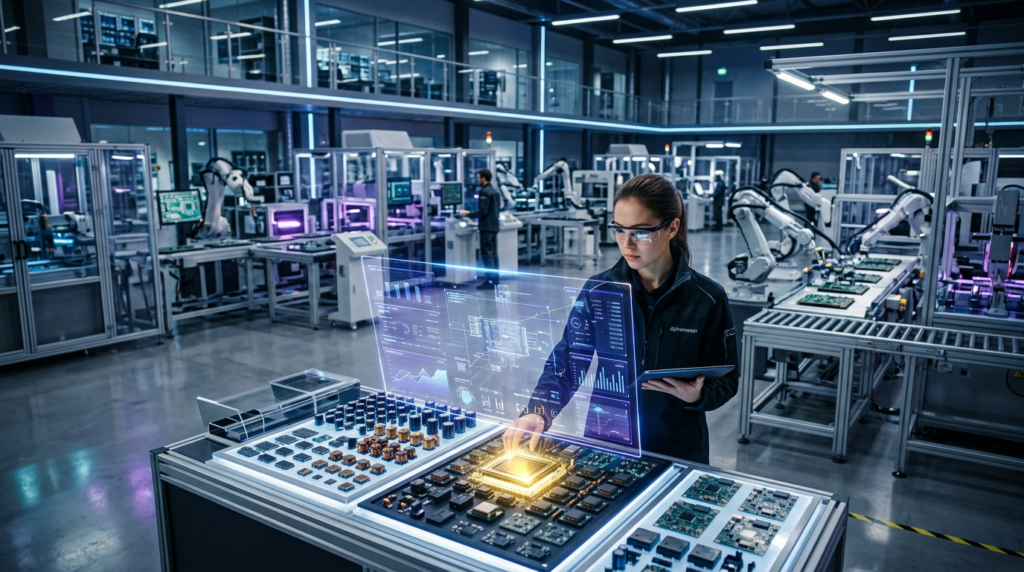
Finding the correct electronic component among two million possibilities sounds less like shopping and more like searching for one specific grain of sand on a particularly unfriendly beach.
LG Innotek believes artificial intelligence can make that search far easier.
The South Korean electronics manufacturer has deployed an AI-powered component-recommendation system across all its business divisions. The platform searches a database covering approximately two million components, identifies parts that match a product’s technical requirements and helps employees calculate expected costs.
The result is a dramatic improvement in speed. LG Innotek says the system has reduced the time required to prepare new-product quotations by more than 70%.
It can also narrow the list of suitable components within two hours. Employees can then concentrate on validating the recommendations, checking supplier quotations and refining the proposal for the customer.
This is not the splashiest use of AI. It does not write poetry, produce cinematic videos or impersonate your favorite celebrity. It tackles something more practical: a slow, complicated business process that affects product development, purchasing and customer response times.
And that may be precisely why it matters.
Two Million Parts, One Difficult Search
LG Innotek manufactures sophisticated components used in cameras, semiconductor packaging, communications equipment and vehicles.
Building those products requires an enormous variety of smaller parts. The company reportedly manages information covering approximately two million component types, including capacitors and inductors.
Each component may come with different dimensions, electrical characteristics, operating temperatures, tolerances, prices and availability conditions. Manufacturers may also describe similar parts using different names, units or specification formats.
Before the new system arrived, employees often had to search across information stored in separate business divisions and internal platforms. They also needed to investigate parts available through external suppliers.
The work became particularly demanding when LG Innotek developed a new product. Employees had to translate the customer’s requirements into component specifications, locate compatible products, compare prices and contact potential suppliers.
A person might know exactly what the finished product needs while still spending hours hunting for the right underlying parts.
LG Innotek’s AI system attempts to compress that maze into a much shorter journey.
Two Years of Development
LG Innotek spent about two years developing its AI component-recommendation platform, according to The Elec.
The long development period reflects the less glamorous side of enterprise AI: preparing the data.
The company collected internal and external information about its enormous component inventory. Engineers then had to standardize product names, specifications and measurement units that differed among manufacturers.
That preparation is essential. An AI model cannot reliably compare components if one supplier records capacitance in one format, another uses a different naming convention and a third leaves important fields scattered across technical documents.
Once the information is organized, the system can compare parts on a common foundation.
Employees enter the specifications required for a new product. The AI then searches the database and recommends components with matching or similar characteristics.
The system searches beyond parts that LG Innotek previously purchased. It can also consider products currently available on the external market, widening the pool of potential choices.
In short, the AI does not merely remember the company’s shopping history. It helps discover new shelves.
The Two-Hour Component Shortlist
LG Innotek says its AI can narrow the pool of component candidates within two hours.
That does not necessarily mean a final purchasing decision arrives two hours after someone presses a button. Employees still need to verify technical compatibility, communicate with suppliers and review actual commercial quotations.
The system accelerates the early stages.
Instead of manually examining a vast catalog, purchasing and engineering teams receive a manageable shortlist. They can then focus their attention on suppliers and parts that appear most likely to satisfy the project.
That change matters because product quotations often sit at the intersection of several departments. Engineers understand the technical design. Purchasing teams track suppliers and pricing. Sales employees must answer customers. Finance teams care about margins.
If the component-selection stage moves slowly, the delay travels through the entire chain.
According to the Seoul Economic Daily, the platform helps identify components for core LG Innotek products, including camera modules and semiconductor substrates.
Those are complex products with little room for “close enough.” Faster must still mean accurate.
Quotation Time Falls by More Than 70%
The headline improvement is a reduction of more than 70% in quotation-preparation time.
This refers to the work required to select components and calculate costs for a proposed new product. It does not mean every supplier responds 70% faster or that complete product development suddenly takes less than one-third of its previous duration.
Still, quotation speed can influence whether a manufacturer wins an order.
Customers evaluating a new device or component may approach several suppliers. A company that responds quickly with a credible proposal gains more time to answer questions, adjust specifications and demonstrate that it understands the project.
The saved hours can also improve quality. Employees who spend less time searching through databases can spend more time reviewing customer requirements and checking whether the proposed solution makes sense.
That is the more interesting productivity story.
AI does not simply perform the old process faster. It shifts human effort away from repetitive searching and toward judgment, verification and customer communication.
LG Innotek expects the system to strengthen its competitiveness when pursuing new business. In an industry where customers care about speed, cost and technical precision simultaneously, a 70% improvement is difficult to ignore.
AI Creates a Reference Price
Finding a compatible component is only part of the problem. LG Innotek must also estimate what that component should cost.
Prices can move as demand, production capacity, material expenses and supply conditions change. A quotation based on outdated pricing may erase a project’s expected profit or make the proposal unnecessarily expensive.
LG Innotek’s system therefore provides a reference price for individual components.
The AI analyzes information such as previous purchases and price movements to estimate the current market level. The company says the feature delivers reliability exceeding 96%.
The system can also estimate prices for new components that have no internal purchasing history. Presumably, it does this by examining comparable parts and relevant market information, although LG Innotek has not publicly disclosed the complete model architecture.
A reference price is not the same as a guaranteed supplier offer. Negotiations, quantities, delivery terms and market conditions can still affect the final amount.
It does give employees a data-supported starting point. That helps them identify unusual quotations and prepare more realistic product-cost estimates.
It is less dramatic than asking an AI to predict civilization’s future—but considerably more useful before a purchasing meeting.
A Safety Net for Supply Disruptions
Component shortages can derail even a well-designed product.
A small capacitor may cost very little compared with the finished device. Yet if that capacitor becomes unavailable, production can stop. The missing part does not care that everything else is ready.
LG Innotek’s system can search for alternative components when a supplier discontinues a product or a shortage interrupts availability.
This capability could shorten the time required to respond to supply-chain problems. Instead of beginning a replacement search from scratch, employees can ask the AI to identify parts with comparable specifications.
Engineers must still confirm that a substitute works safely and reliably. In regulated or safety-critical products, changing a component may also require additional testing and customer approval.
The AI provides candidates, not permission to skip validation.
Even with that limitation, faster substitute identification offers practical value. Supply disruptions often reward companies that react first. Firms that quickly secure acceptable alternatives can maintain production while slower competitors remain stuck in spreadsheets and supplier emails.
The system therefore functions as more than a quotation tool. It can also support supply-chain resilience.
The Data Standardization Victory
The 70% figure will attract attention, but the system’s quieter achievement may be data standardization.
LG Innotek had component information scattered across internal divisions and external sources. Manufacturers described similar items using inconsistent names, measurements and units.
AI alone cannot magically repair disorder at that scale.
The company first had to create common definitions and structures. It needed to determine which fields mattered, how specifications should be compared and how products from different suppliers related to one another.
That work creates value beyond the recommendation model.
Standardized data can help engineers compare designs, purchasing teams analyze spending and managers understand where the company relies heavily on particular suppliers. It may also make future automation projects easier because the information already follows consistent rules.
Many corporate AI initiatives struggle because companies rush toward models before organizing the underlying data. LG Innotek appears to have taken the opposite approach: spend roughly two years building the information foundation, then deploy the intelligent system across the business.
The AI receives the applause. The database probably deserves a quiet standing ovation.
Humans Remain in the Decision Loop
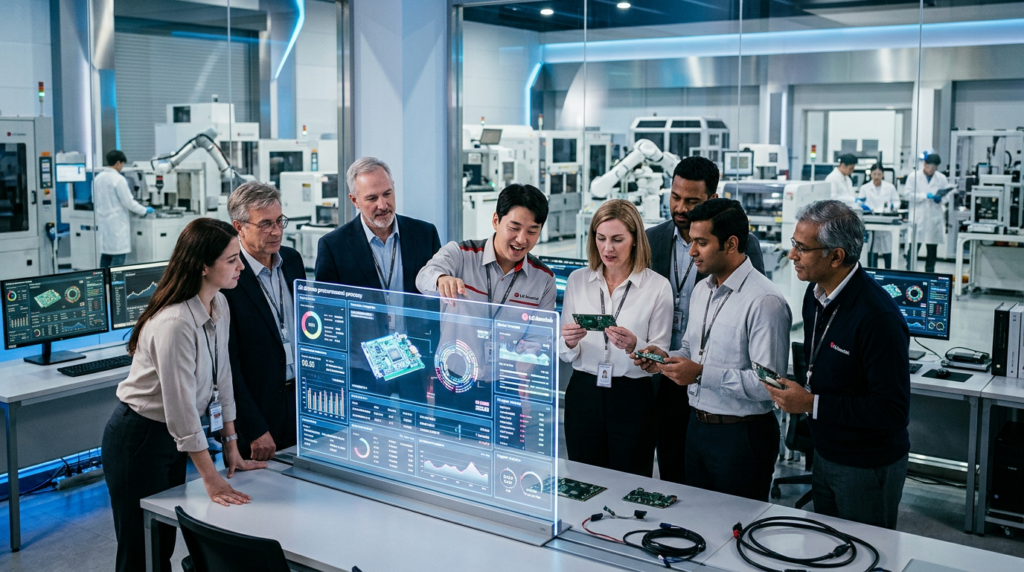
LG Innotek’s platform recommends components and estimates reference prices, but people still make the consequential decisions.
Employees review the shortlist. Engineers confirm technical suitability. Purchasing specialists obtain actual quotations from selected suppliers. Teams then decide whether the proposed components satisfy the customer’s requirements and the company’s commercial goals.
This division of labor makes sense.
An algorithm can compare more records than a human can reasonably examine. It can find patterns across prices and specifications without becoming tired or developing a personal vendetta against spreadsheets.
Humans contribute context.
An experienced buyer may know that a supplier has delivery problems despite offering an attractive price. An engineer may recognize that a theoretically compatible component behaves differently under real manufacturing conditions. A sales employee may know that a customer strongly prefers a particular supplier.
The best enterprise AI systems combine computational reach with professional judgment. They reduce the amount of information employees must manually process without pretending that every purchasing decision can be automated safely.
LG Innotek’s current system appears designed around that balance.
Camera Modules Provide a Demanding Test
LG Innotek is widely associated with advanced camera modules used in mobile devices and other electronics.
A modern camera module combines lenses, image sensors, actuators and stabilization hardware inside an extremely small space. The components must meet tight standards for precision, power consumption, durability and size.
Choosing an unsuitable part could affect image quality or make the final module too large, expensive or unreliable.
The company also develops semiconductor substrates, which provide critical electrical connections between chips and larger systems. These products demand similar attention to materials, geometry and manufacturing quality.
An AI recommendation system working in these areas must therefore do more than locate approximate matches. It needs structured, detailed information capable of supporting precise comparisons.
That helps explain why the development took two years and why employees still validate the results.
The potential benefit is substantial. As consumer-electronics designs change rapidly, manufacturers must evaluate new components without slowing customer projects. A system that shortens that evaluation can help LG Innotek respond more quickly while preserving time for engineering review.
Agentic AI Is the Next Upgrade
LG Innotek plans to enhance the platform with agentic AI.
The proposed upgrade would independently search for the latest component information, analyze what it finds and incorporate relevant updates into the system.
At present, a large industrial database requires continuous maintenance. Suppliers launch products, revise specifications and discontinue older components. Prices change. Availability tightens and loosens. A recommendation engine becomes less useful if its information quietly grows stale.
An AI agent could automate part of that maintenance.
It might monitor supplier catalogs, identify updated technical documents and flag changes for review. It could also discover new components that match categories already stored in the system.
The word “independently” needs sensible boundaries. Automatically collected information should still undergo validation, especially when engineering and purchasing decisions depend on it. A supplier changing a web page should not instantly rewrite an important internal record without checks.
Nevertheless, agentic AI could make the system more current and scalable. The original platform helps employees search an organized library. The planned upgrade could help keep that library stocked.
Part of a Larger AI Transformation
The component-recommendation system is not LG Innotek’s first industrial AI project.
The company has introduced an AI system for inspecting incoming raw materials. According to The Elec, that tool reduced the time needed to investigate the causes of material defects by as much as 90%.
LG Innotek also uses AI vision systems to inspect finished products. Computer-vision models can examine surfaces and identify defects that might be difficult to detect consistently through manual inspection alone.
Another system, called AI Process Recipe, reportedly reduced the time needed to identify optimal camera-module production conditions from 72 hours to under six hours.
These examples reveal a broader strategy.
LG Innotek is applying AI at several stages of its operations: incoming materials, manufacturing settings, product inspection, component selection and quotation preparation.
Its Gumi “Dream Factory” also integrates AI and robotics throughout production. The company is collaborating across the wider LG Group, including work involving LG AI Research’s industry-oriented EXAONE technology.
This is AI transformation at factory speed—less chatbot, more torque wrench.
Why Enterprise AI Often Looks Boring
Consumer AI attracts attention because people can see it immediately. A model writes a paragraph, creates an image or speaks with a remarkably natural voice.
Industrial AI often operates behind the scenes.
It recommends a capacitor. It detects a scratch. It adjusts a process setting. It predicts whether a supplier’s price looks reasonable.
None of those tasks will dominate social media for long. Together, however, they can determine whether a factory operates efficiently.
LG Innotek’s system demonstrates why narrow AI applications remain valuable. The platform addresses a defined problem, uses company-specific information and measures success through a concrete operational result.
The 70% reduction gives executives something more useful than an impressive demonstration. It gives them a performance metric.
That approach may become increasingly common as companies move beyond experimental AI projects. Businesses will ask whether a system saves time, reduces defects, improves customer service or protects revenue.
“Because AI is trendy” is not a business case. “Because quotations now take 70% less time” certainly is.
Employees Gain Time for Higher-Value Work
Automation regularly raises concerns about what happens to employees whose repetitive work disappears.
LG Innotek presents the system as a tool that redirects workers toward more valuable tasks.
Employees no longer need to spend as much time gathering scattered specifications and manually comparing long lists of components. They can devote more attention to customer requirements, proposal quality and technical verification.
That shift may improve job quality as well as productivity. Few professionals dream of spending their careers reconciling inconsistent part numbers across several databases.
However, companies only receive this benefit if they redesign work thoughtfully. Saving time does not automatically create better results. Managers must decide where employees should redirect their attention and ensure that people understand how to challenge the system’s recommendations.
Training also matters. Users need to know what the reference price represents, where the AI may be uncertain and when an unusual recommendation deserves deeper investigation.
Used well, the system acts like a very fast research assistant. Used carelessly, it could become an authoritative-looking shortcut.
The 96% Reliability Figure Needs Context
LG Innotek says the reference-price function achieves reliability above 96%.
That sounds impressive, but the number should be interpreted carefully.
Public reports do not provide a full technical explanation of the measurement. They do not specify the testing dataset, error tolerance or whether performance varies significantly among component categories.
A 96% reliability rate also does not mean every predicted price will land within a tiny distance of the final supplier quotation. Commercial prices can change based on purchasing volume, delivery schedules, contracts and market disruptions.
The figure still indicates that LG Innotek has evaluated the system rather than releasing it solely on intuition.
Real-world performance will become clearer as employees use the platform across business units and encounter unusual parts, new suppliers and rapidly changing markets.
The company can then compare predicted reference prices with completed transactions, retrain its models and improve weak areas.
Enterprise AI should not be treated as a finished statue. It behaves more like production equipment: monitor it, maintain it and fix it when something starts making an alarming noise.
Recognition From the LG Awards
LG Innotek’s component-recommendation system received a Customer Satisfaction Award at the 2026 LG Awards in April.
The recognition arrived before the company’s broader public announcement, suggesting that the project had already demonstrated value internally.
An award does not independently prove every performance claim. It does indicate that the wider LG organization viewed the system as more than a small experimental prototype.
Deploying it across all LG Innotek business divisions provides a stronger signal.
Many corporate AI projects remain trapped in pilot programs. They perform well in a demonstration but struggle when introduced to different departments, datasets and user groups.
A company-wide rollout requires integration with existing systems and cooperation among engineering, purchasing and business teams. It also requires employees to trust the results enough to use them in real workflows.
LG Innotek has crossed that organizational threshold. The next test is whether the measured benefits remain consistent as adoption expands and component markets change.
A Practical Blueprint for Manufacturing AI
LG Innotek’s project offers a useful model for other manufacturers.
Start with a costly bottleneck. Gather the relevant data. Standardize it. Build an AI system around a specific workflow. Keep professionals involved in decisions. Then measure whether the result actually improves performance.
The formula sounds simple. Executing it across two million components is not.
Other manufacturers face similar problems with parts catalogs, supplier records, technical specifications and price histories. A system capable of organizing that information could improve procurement, product design and supply-chain planning.
The technology could prove especially useful when companies need to replace discontinued components or respond to sudden shortages.
Still, organizations cannot copy the result by purchasing a generic chatbot. LG Innotek spent roughly two years integrating its data and adapting the platform to its own products and processes.
The lesson is not that every company needs exactly the same system. It is that enterprise AI becomes most valuable when it understands the company’s real operational world.
A Small-Sounding Change With Large Consequences

Cutting quotation-preparation time may not sound revolutionary. In manufacturing, small improvements can travel surprisingly far.
Faster component selection can accelerate customer proposals. Better reference prices can protect margins. Quicker identification of substitute parts can reduce disruption. More organized data can support future automation.
LG Innotek’s system connects all these advantages through one practical AI platform.
The company still needs to maintain data quality, monitor prediction reliability and ensure that employees continue to validate important recommendations. Its planned use of agentic AI will introduce additional opportunities—and additional governance requirements.
But the underlying result is already meaningful.
LG Innotek has taken a process involving two million component choices, scattered information and extensive manual research, then reduced quotation time by more than 70%.
That is what successful enterprise AI often looks like. It does not arrive with dramatic music. It simply removes a mountain of tedious work and quietly hands employees their afternoon back.
Sources
- The Elec — LG Innotek Uses AI for Component Selection, Cuts Quotation Time by 70%
- Seoul Economic Daily — LG Innotek Adopts AI to Find Optimal Parts, Cutting Quote Time 70%
- ChosunBiz — LG Innotek Deploys AI to Speed Part Selection and Cost Estimates
- Korea Bizwire — LG Innotek Has Two Million Parts to Choose From
- LG Innotek — Official Company Website
- LG AI Research — EXAONE
The Kingy Brief
Get the next Kingy Brief.
Source-checked AI changes, original tests and one practical thing to try.
Free · Choose your subjects · Double opt-in · Unsubscribe anytime