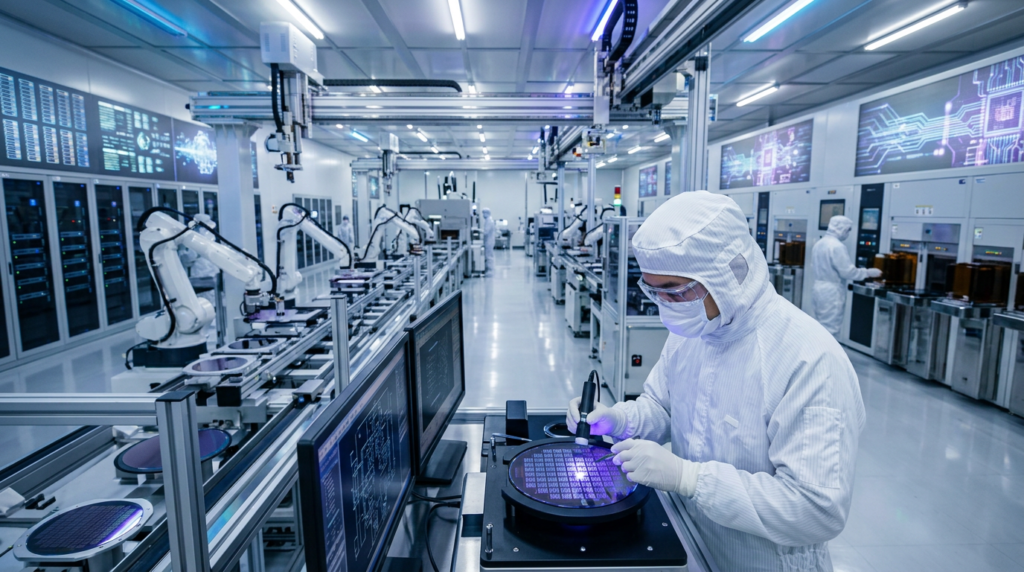
The global memory-chip race just gained another serious competitor.
ChangXin Memory Technologies, better known as CXMT, has reportedly begun mass-producing chips based on its fifth-generation memory platform. The milestone could strengthen China’s domestic semiconductor supply chain while giving device manufacturers another potential source of advanced dynamic random-access memory, or DRAM.
That matters because modern artificial intelligence systems devour memory almost as enthusiastically as they consume computing power. AI servers need enormous amounts of fast memory. AI-enabled computers and smartphones also require larger capacities as more processing moves directly onto personal devices.
For CXMT, reaching mass production represents far more than producing a few successful samples. It suggests that the company has moved its latest manufacturing platform beyond laboratory development and into sustained commercial output.
Important technical details—including exact production volume, customer commitments and manufacturing yields—have not been comprehensively disclosed. The development nevertheless signals that CXMT intends to compete more aggressively in a market dominated by Samsung Electronics, SK Hynix and Micron.
Memory chips may lack the glamour of a shiny new AI model. Without them, however, that model is basically a very expensive thinker with nowhere to put its thoughts.
From Development to the Factory Floor
Semiconductor companies often announce new technologies long before they can manufacture them economically.
A laboratory may produce a working chip. Engineers may demonstrate promising performance. The company might even distribute samples to customers. None of those steps automatically equals mass production.
Mass production requires stable manufacturing processes, acceptable yields and enough working chips per wafer to make the product commercially viable. Production lines must operate repeatedly rather than delivering a handful of carefully selected examples.
That distinction makes CXMT’s reported milestone significant.
Its fifth-generation platform has apparently progressed from development and qualification into volume manufacturing. This does not reveal how many wafers CXMT is processing or how its yields compare with those of established competitors. It does show that the company believes the platform is mature enough for commercial deployment.
Successful mass production could eventually support computers, servers, mobile devices and other electronics. The precise markets will depend on the individual memory products CXMT manufactures on the platform and whether major customers approve them.
For now, the factory transition is the news. Everything else begins there.
What the “Fifth Generation” Actually Means
The term “fifth-generation memory platform” requires some unpacking.
It should not automatically be interpreted as DDR5. DDR5 is an industry-standard generation of synchronous DRAM defined through standards developed by JEDEC, the organization responsible for many semiconductor specifications.
A manufacturer’s fifth-generation platform can instead refer to its internal progression of DRAM fabrication processes. Each generation may include changes to transistor structures, memory-cell design, materials, manufacturing techniques and production efficiency.
That means CXMT’s platform generation and the DDR generation of a finished product describe different things. One concerns how the company manufactures memory. The other concerns how a memory product communicates with the system around it.
The distinction is not thrilling dinner conversation, admittedly. It is still crucial.
Without complete technical documentation, it would be premature to attach an exact process dimension, speed or power-efficiency figure to CXMT’s new platform. What can safely be said is that advancing to a newer manufacturing generation normally aims to improve density, performance, power consumption, production economics—or some combination of all four.
Why DRAM Matters to Artificial Intelligence

AI discussions often revolve around processors. Nvidia’s accelerators, custom cloud chips and powerful neural-processing units receive most of the attention.
But processors cannot work efficiently without memory.
During AI training, memory stores model parameters, intermediate calculations and the enormous datasets moving through the system. During inference—the stage when a trained model answers questions or generates content—memory holds the information that the processor needs immediately.
If the memory system cannot supply data quickly enough, even an exceptionally powerful processor can sit idle. Engineers call this the memory bottleneck.
Conventional DRAM remains essential across servers, workstations, laptops and smartphones. High-bandwidth memory, or HBM, serves an even more specialized role by feeding large quantities of data to advanced accelerators at very high speeds.
CXMT’s fifth-generation manufacturing platform should not be automatically described as an HBM platform unless the company confirms that connection. However, stronger underlying DRAM capabilities can provide experience relevant to more advanced memory development.
In AI infrastructure, faster processors make headlines. Memory determines how much of that speed systems can actually use.
CXMT’s Place in the Memory Industry
CXMT emerged as one of China’s most important domestic memory manufacturers after its establishment in Hefei in 2016.
The company concentrates on DRAM, a type of memory used throughout the electronics industry. DRAM provides temporary working space for processors, allowing applications and operating systems to access information more quickly than they could from long-term storage.
This market remains highly concentrated.
Samsung Electronics, SK Hynix and Micron collectively control the overwhelming majority of global DRAM production. Their enormous research budgets, manufacturing experience and patent portfolios make the industry difficult for new competitors to enter.
Memory manufacturing also demands relentless investment. Producers must build costly fabrication facilities, improve process technology and expand capacity while managing a notoriously cyclical market. Prices can rise sharply when supply tightens and collapse when manufacturers produce too much.
CXMT has gradually narrowed part of the technological gap. Its latest mass-production milestone suggests that the company wants to move beyond serving as a small domestic alternative and become a more consequential supplier.
That journey remains long. But it is no longer theoretical.
A Boost for China’s Semiconductor Ambitions
China consumes enormous quantities of semiconductors, yet many of its manufacturers rely on foreign companies for advanced chips and production equipment.
That dependence has turned memory into a strategic priority.
Domestic DRAM production could help Chinese computer, smartphone and server manufacturers reduce their exposure to overseas supply disruptions. It may also support the country’s broader effort to build locally controlled technology stacks for cloud computing and artificial intelligence.
CXMT’s progress therefore carries both commercial and strategic weight.
Mass production on a newer platform could enable the company to supply more competitive memory products to Chinese electronics businesses. Those customers may value reliable domestic availability even if CXMT does not immediately match every specification offered by industry leaders.
However, self-sufficiency is not achieved through a single production announcement. Semiconductor manufacturing depends on equipment, materials, intellectual property, engineering software and specialized expertise from interconnected global suppliers.
CXMT has reached an important checkpoint. It has not magically removed every constraint facing China’s chip industry. Silicon, sadly, does not respond to patriotic speeches.
The AI PC Opportunity
One promising market for additional DRAM capacity is the emerging category of AI personal computers.
AI PCs use processors containing dedicated neural-processing hardware. These chips can run tasks such as image enhancement, translation, transcription and assistant features locally instead of sending every request to a cloud data center.
Local AI can improve responsiveness and privacy. It also increases memory requirements.
A conventional productivity laptop might operate comfortably with a moderate amount of RAM. A computer running generative models in the background may need substantially more memory to hold the operating system, applications and AI workloads simultaneously.
This trend could encourage manufacturers to install higher memory capacities as standard. The result would benefit DRAM suppliers across the industry.
If CXMT can produce reliable, competitively priced memory using its new platform, Chinese PC brands may have another option when designing AI-ready computers.
The opportunity extends beyond premium machines. More efficient production could eventually help bring larger memory configurations into midrange devices, where high component prices matter greatly.
AI PCs will not transform the DRAM market overnight. They could still create a durable new layer of demand.
Smartphones Are Becoming Memory-Hungry Too
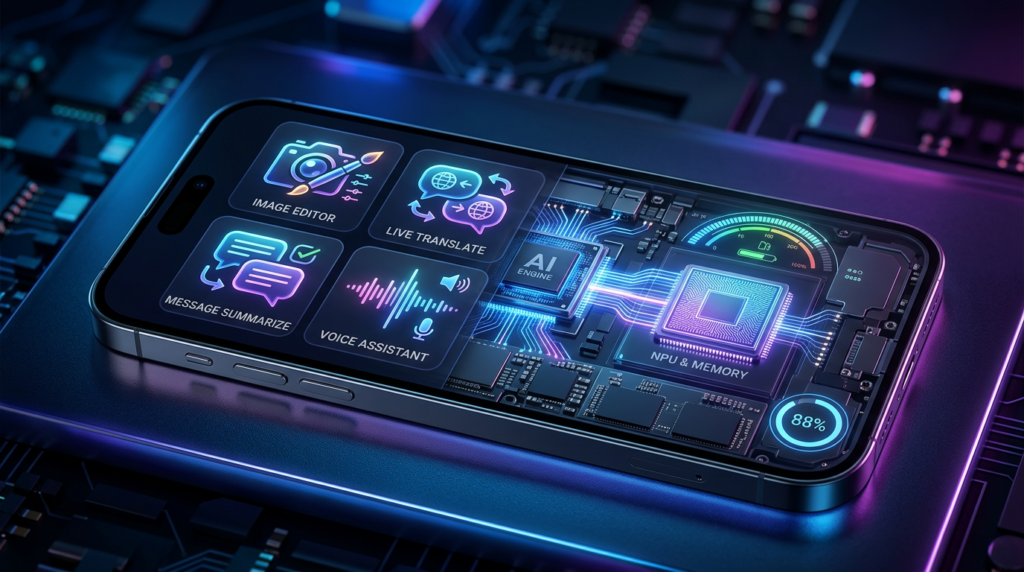
AI is also changing what smartphones need from their memory systems.
Manufacturers increasingly want phones to summarize messages, edit photographs, translate conversations and generate text directly on the device. Running those features locally can reduce cloud costs and make them available when internet connections are unreliable.
Once again, memory becomes the quiet enabler.
A phone must hold AI models while preserving enough capacity for the operating system and other applications. Larger models create pressure for greater memory density, higher bandwidth and better energy efficiency.
Power consumption matters especially in mobile devices. Faster memory offers little benefit if it empties the battery before lunch.
A more advanced CXMT platform could help the company pursue memory products suited to increasingly demanding consumer devices. Yet product-level results will matter more than the platform announcement itself. Smartphone makers test components for reliability, temperature behavior, power use and long-term consistency before adopting them.
Mass production gives CXMT an entry ticket. Winning major designs requires passing a much tougher audition.
The Server Market Presents a Bigger Test
Servers offer potentially valuable opportunities, but they also impose demanding requirements.
Data-center operators expect memory to run continuously while maintaining extremely low failure rates. A faulty module can interrupt services, damage customer trust and create expensive maintenance problems.
AI servers raise the pressure further. They combine large memory capacities with power-hungry processors and accelerators. Every component must operate predictably under heavy workloads.
CXMT will therefore need more than manufacturing volume if it wants to expand into demanding server applications. It must demonstrate reliability, compatibility and consistent performance across large deployments.
Customers may also require extensive validation before placing substantial orders. That process can take time, particularly for suppliers without decades of experience in enterprise systems.
Even so, the fifth-generation platform may strengthen CXMT’s ability to address portions of the server market. Domestic cloud providers and technology companies could become important early customers if the products meet their requirements.
The opportunity is considerable. So is the technical homework.
This Is Not Yet an HBM Victory
The AI boom has made high-bandwidth memory one of the semiconductor industry’s most valuable products.
HBM stacks multiple memory dies vertically and places them close to an AI accelerator. This design allows enormous amounts of data to move between memory and processor more efficiently than through conventional memory modules.
SK Hynix, Samsung and Micron are investing heavily in HBM production. Demand has surged as companies build clusters containing thousands of AI accelerators.
CXMT has also been associated with Chinese efforts to develop domestic HBM. Reuters previously reported that the company was making progress related to HBM development.
However, the mass production of a fifth-generation DRAM platform does not, by itself, prove that CXMT has achieved high-volume HBM manufacturing. HBM requires advanced packaging, die stacking, thermal management and extremely demanding quality control.
The new platform may strengthen CXMT’s technological foundation. Calling it a completed HBM breakthrough would sprint several laps ahead of the evidence.
More Competition Could Help Device Makers
A stronger CXMT could eventually create another source of supply for electronics manufacturers.
Memory buyers dislike shortages. They also dislike depending on a tiny group of suppliers whose production decisions influence global prices.
Additional capacity can improve supply resilience and give manufacturers more negotiating power. Chinese device makers may particularly welcome a local supplier capable of delivering competitive products in meaningful quantities.
Consumers could benefit if stronger competition helps lower component costs. Cheaper memory may encourage manufacturers to provide more RAM without sharply raising device prices.
There is a catch.
Memory markets regularly swing between undersupply and oversupply. New capacity can pressure prices, but severe price declines can also discourage investment and weaken producers. The industry must continuously balance affordability against the need to fund future factories.
CXMT’s production expansion will not instantly rewrite global pricing. Its impact will depend on capacity, yields, product quality and customer adoption.
Still, another credible supplier changes the conversation—even before it changes the market share table.
Samsung, SK Hynix and Micron Still Lead

CXMT’s achievement should not be mistaken for immediate technological leadership.
Samsung, SK Hynix and Micron possess mature manufacturing networks, extensive customer relationships and generations of intellectual property. They also continue to improve their own DRAM and HBM technologies rather than waiting politely for challengers to catch up.
SK Hynix has built a particularly strong position in AI-oriented HBM. Samsung operates across memory, logic chips, consumer electronics and foundry manufacturing. Micron supplies customers throughout computing, mobile and data-center markets.
These companies produce at enormous scale. They also benefit from experience solving the tiny manufacturing defects that can destroy yields and profits.
CXMT does not need to overtake all three companies for its fifth-generation platform to matter. It could gain influence by serving domestic customers, competing in selected product categories and steadily increasing its production quality.
Semiconductor competition rarely resembles a single dramatic race. It looks more like an endless staircase. CXMT has climbed another step. The leaders are climbing too.
Export Controls Complicate the Road Ahead
CXMT’s progress comes amid tightening international restrictions on China’s access to advanced semiconductor technology.
Modern chip factories rely on specialized equipment for lithography, deposition, etching, measurement and inspection. Many of those systems originate from companies in the United States, Europe and Japan.
Restrictions can affect how quickly Chinese manufacturers obtain or upgrade crucial tools. They can also complicate maintenance and long-term production planning.
CXMT may respond by adapting available equipment, working with domestic suppliers and redesigning manufacturing processes. Such efforts can build local expertise, but they may also increase development costs or delay production improvements.
The fifth-generation platform indicates that the company has continued advancing despite this difficult environment. It does not reveal how easily CXMT can expand the platform or transition to the generation that follows.
The next challenge will be sustaining progress. One successful platform proves capability at a particular moment. Long-term competitiveness requires repeating that accomplishment again and again.
In the chip business, the finish line has a nasty habit of moving.
Production Yield Will Decide the Economics
One of the most important unanswered questions is yield.
A semiconductor wafer contains many individual chips. Some work correctly. Others contain defects and must be discarded. Yield describes the percentage that meet the required standard.
A company can possess an advanced process but still struggle commercially if too few usable chips emerge from each wafer. Improving yield lowers the cost of every successful chip and increases the factory’s effective output.
That is why mass production announcements require careful interpretation.
CXMT may have achieved the internal yield threshold needed to begin volume manufacturing. Public information does not necessarily show whether those yields match the economics achieved by established DRAM producers.
Customers will also evaluate consistency. A supplier must deliver components with predictable characteristics across large batches and extended periods.
If CXMT can raise yields while expanding output, the fifth-generation platform could become commercially significant. If yields remain challenging, the company may need more time and investment before it can compete aggressively on price.
The factory may be running. Now it must run efficiently.
What the Milestone Means for AI
CXMT’s advance will not immediately solve the AI industry’s memory shortages. Nor does it place the company beside the leading HBM suppliers overnight.
Its importance lies in the direction of travel.
Artificial intelligence is increasing demand across several layers of the memory market. Cloud systems need high-capacity server DRAM and HBM. AI PCs require more working memory. Smartphones running local models need dense, energy-efficient components.
A manufacturer capable of producing newer DRAM technology at scale can participate in more of that growth.
CXMT could initially make its greatest impact inside China, where domestic technology companies have strong incentives to diversify their suppliers. Over time, successful products could place competitive pressure on the broader market.
Much depends on factors the headline cannot answer: volume, yield, performance, cost, reliability and customer qualification.
The fifth-generation platform gives CXMT a stronger foundation. It does not guarantee the skyscraper.
A Quiet Milestone With Global Consequences
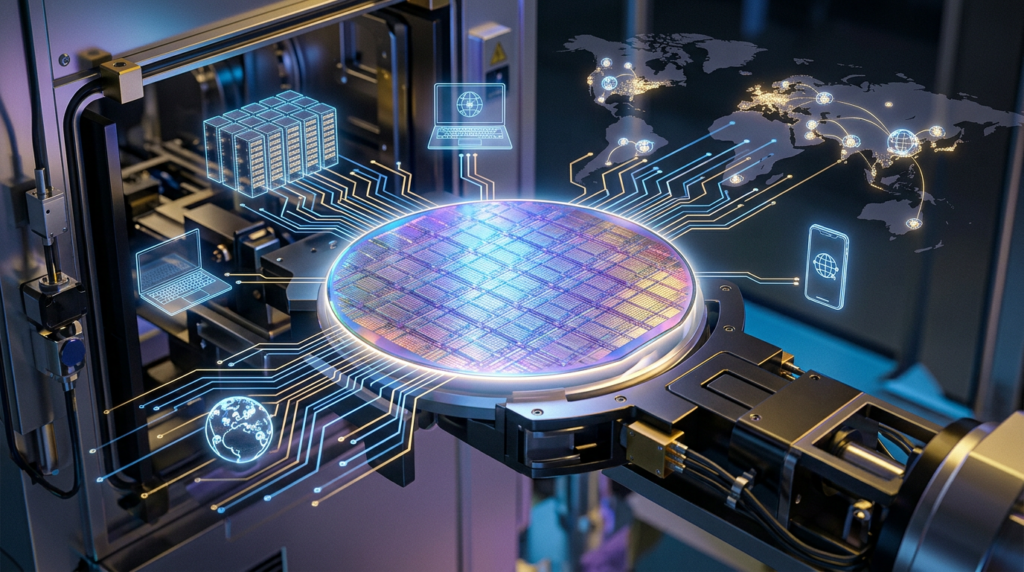
Memory manufacturing rarely produces a dramatic product launch. There are no celebrity demonstrations. Nobody queues overnight outside a factory to buy a DRAM wafer.
Yet advances in memory shape nearly every part of modern computing.
CXMT’s move into mass production suggests that China’s leading domestic DRAM producer continues to improve its manufacturing capabilities. It could support local electronics companies, expand memory supply and intensify competition in a highly concentrated industry.
The development also arrives at an ideal moment. AI is pushing manufacturers to place more memory in data centers, computers and mobile devices. Demand is spreading beyond specialist hardware and into products used every day.
CXMT still faces formidable rivals, technical barriers and geopolitical restrictions. Important details about its fifth-generation platform also remain undisclosed. Those uncertainties should prevent anyone from declaring the global memory race settled.
But mass production is tangible progress. It converts a technology platform from an engineering project into something that can reach actual devices.
And in the semiconductor world, that is when an experiment starts becoming an industry force.
Sources
- CXMT — Official company website
- CXMT — Products and memory technologies
- Reuters — CXMT and China’s development of high-bandwidth memory
- JEDEC — Memory technology standards
- Samsung Semiconductor — DRAM products and technology
- SK Hynix — DRAM product information
- Micron — DRAM components
The Kingy Brief
Get the next Kingy Brief.
Source-checked AI changes, original tests and one practical thing to try.
Free · Choose your subjects · Double opt-in · Unsubscribe anytime