Samsung Is Building More Than Another Factory
Artificial intelligence may live in the cloud, but the machinery underneath it gets extremely hot.
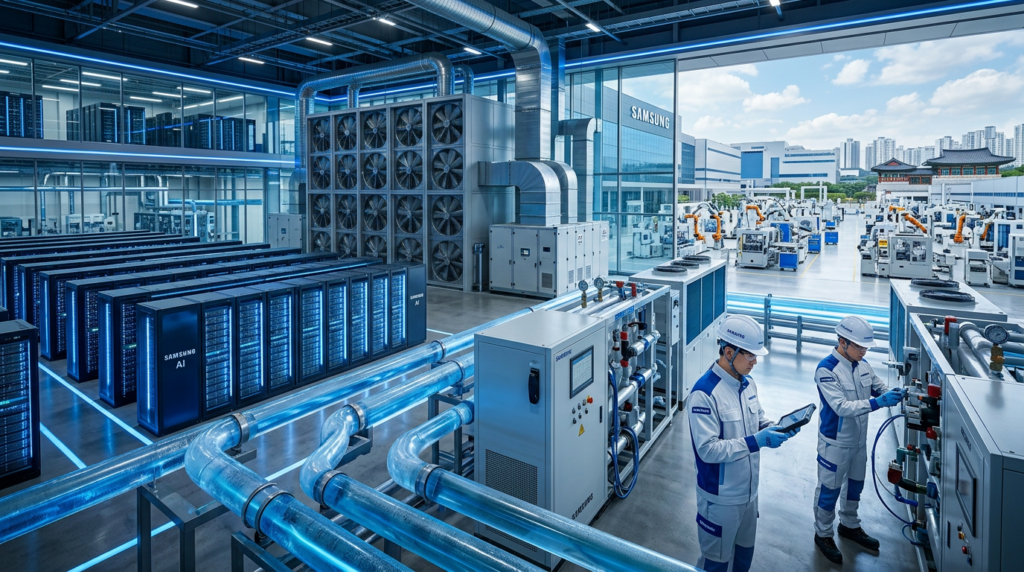
Samsung Electronics has broken ground on a new production line in Gwangju, South Korea, dedicated to cooling systems for AI data centers and advanced manufacturing facilities. According to EDAILY’s September 21 report, the company plans to invest ₩240 billion in the project.
The new line will occupy approximately 21,800 square metres, or about 6,600 pyeong, at the third campus of Samsung’s Gwangju complex. Once completed, it will manufacture equipment designed to control the enormous quantities of heat produced by modern servers, processors, and densely packed AI computing racks.
Samsung expects full-scale operations to begin in early 2028.
At first glance, cooling equipment may sound less exciting than a new AI model or a record-breaking GPU. It is not. Without reliable thermal management, even the world’s most advanced processors become extraordinarily expensive room heaters.
That makes Samsung’s latest investment strategically important. The company is not merely betting on the chips powering the AI boom. It wants to sell some of the essential machinery that keeps those chips alive.
In other words, Samsung is moving closer to becoming a supplier for the entire AI factory—not just the silicon inside it.
Welcome to FläktGroup’s Fifteenth Production Hub
The forthcoming Gwangju line will become the 15th global production hub operated by FläktGroup, the German heating, ventilation, and air-conditioning specialist owned by Samsung.
FläktGroup already operates across Europe, Asia, and the United States. It supplies air-management and cooling technologies for data centers, factories, hospitals, commercial buildings, and other complex facilities. Its product portfolio includes air-handling equipment, fans, controls, heat-recovery systems, and specialized data-center cooling solutions.
Samsung agreed to acquire FläktGroup for €1.5 billion, approximately $1.68 billion at the time, in 2025. Reuters described the transaction as Samsung’s largest acquisition in eight years.
The logic behind that purchase is becoming clearer.
Samsung already produces semiconductors, memory, consumer electronics, displays, appliances, and network equipment. FläktGroup gives it a stronger position in the physical infrastructure surrounding computing systems.
The new Gwangju line connects those worlds. It combines Samsung’s manufacturing scale with FläktGroup’s cooling expertise, creating a production base closer to customers in South Korea and East Asia.
The factory therefore represents more than additional capacity. It is a visible step in Samsung’s attempt to transform cooling and HVAC technology into a major growth business.
Why AI Has a Serious Heat Problem
AI systems demand huge amounts of computation. That computation consumes electricity, and much of that electrical energy eventually becomes heat.
Traditional data centers often spread workloads across machines that could be cooled primarily with fans and chilled air. Modern AI facilities face a tougher assignment. They pack large numbers of high-performance accelerators into tightly integrated racks so the chips can exchange data quickly.
That density improves computing performance. It also concentrates heat in a much smaller space.
The more power a rack consumes, the harder it becomes to remove that heat using air alone. Operators must move toward systems that transfer heat more directly and efficiently. This is why liquid cooling has shifted from a specialist technology into one of the AI infrastructure industry’s biggest opportunities.
The wider market is already reacting. In March 2026, Ecolab agreed to acquire liquid-cooling company CoolIT Systems for roughly $4.75 billion, specifically targeting demand from AI data centers. Reuters reported that the sector is moving toward liquid-based systems as processors become denser and more power-hungry.
Samsung has spotted the same opening. Powerful AI chips may command the headlines, but every one of them needs electricity, networking, storage—and a reliable way to avoid cooking itself.
What the Gwangju Factory Will Produce
Samsung’s new production line will manufacture several different categories of cooling and air-management equipment.
One of the most important is the chilled water distribution unit, commonly called a CDU. This system receives chilled water from a data center’s central cooling infrastructure and circulates it toward cooling plates positioned near heat-generating components.
The cooling liquid absorbs heat from the servers. It then returns through the system so that the heat can be removed and the process repeated.
The factory will also produce fan wall units, or FWUs. These use arrays of fans to move large volumes of air efficiently through server rooms. Because the workload can be distributed across several fans, operators gain more control over airflow and redundancy.
Additional products will include computer-room air-handling units, known as CRAHs, and larger air-handling units for buildings and industrial facilities.
This matters because data-center cooling rarely depends on one magic box. It works as a coordinated system involving liquid circulation, airflow, temperature regulation, humidity control, filtration, sensors, and building-level heat rejection.
Samsung wants the new site to support that complete thermal chain. It plans to connect product development, manufacturing, installation, and maintenance rather than simply shipping individual pieces of equipment and waving goodbye.
From Refrigerators to AI Factories
Samsung’s move into AI cooling is less unusual than it initially appears.
The company has decades of experience building refrigerators, air conditioners, heat pumps, compressors, and commercial climate-control systems. Those products operate on different scales, but they revolve around the same basic challenge: transferring heat safely and efficiently.
AI data centers give that familiar problem a much larger price tag.
Samsung can bring manufacturing expertise, electronics, sensors, controls, and supply-chain management to the sector. FläktGroup contributes specialized knowledge of large buildings, mission-critical facilities, industrial airflow, and data-center design.
That combination allows Samsung to approach the market from both sides. It understands the computing equipment producing the heat and the mechanical systems needed to remove it.
Samsung has also been expanding its wider AI infrastructure position. It manufactures memory and storage products, operates semiconductor foundries, and has been deepening its relationship with OpenAI. Reuters reported in September that the companies were collaborating on next-generation chips and enterprise AI services.
Cooling adds another piece to that puzzle. Samsung increasingly wants to supply the building blocks around AI—not merely the gadgets people use to access it.
A Strategic Response to Samsung’s AI Challenges
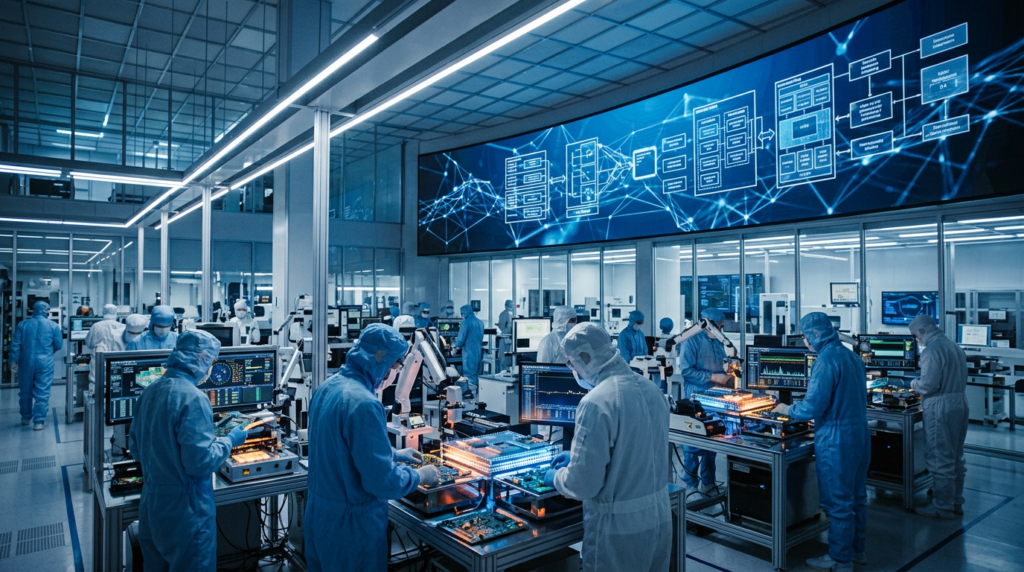
Samsung remains one of the world’s largest technology companies, but scale has not guaranteed an easy ride through the AI boom.
The company has faced intense competition in high-bandwidth memory, or HBM, from SK Hynix and Micron. HBM has become critically important because AI accelerators need enormous quantities of data delivered at extremely high speeds.
Samsung has responded with additional investments, new partnerships, manufacturing plans, and a renewed acquisition strategy. Cooling offers a route into the AI infrastructure market that does not depend entirely on winning every semiconductor contest.
That distinction matters.
The demand for AI facilities creates opportunities across power systems, networking, storage, construction, cooling, and maintenance. A company does not need to produce the fastest accelerator to benefit from the expansion. It can provide the equipment that allows those accelerators to operate.
Samsung’s FläktGroup acquisition initially received a restrained response from some analysts. Reuters noted that investors hoping for a dramatic semiconductor purchase could view an HVAC deal as overly cautious.
The Gwangju project strengthens Samsung’s answer to that criticism. The acquisition now has a clear industrial expansion attached to it. Samsung is turning the deal into production capacity, regional reach, and a potentially important AI infrastructure business.
Why Local Production Matters
Location is a major part of the strategy.
The new Gwangju facility will primarily address demand in South Korea and East Asia. This brings manufacturing closer to a region filled with semiconductor factories, cloud providers, electronics companies, and rapidly expanding digital infrastructure.
Large cooling systems are not as simple to distribute as software. Customers need equipment, engineering, installation, testing, replacement components, and ongoing technical support. Shorter supply chains can reduce delivery times and help manufacturers respond more quickly when a facility requires a customized design.
Samsung says the production line will support an integrated operating model stretching from development through installation and maintenance. That could give the company a stronger relationship with data-center operators over the full life of a project.
Local production also gives Samsung more control over manufacturing schedules and product adaptation. A cooling configuration designed for one server architecture may not suit another. Power density, climate, building design, available water, energy costs, and local regulations all influence the final system.
The Gwangju facility should help Samsung and FläktGroup respond to those variables without relying entirely on equipment shipped from distant plants.
In infrastructure, proximity is not glamorous. It is simply profitable when customers need something fixed before thousands of expensive processors overheat.
More Than Liquid Cooling
Liquid cooling will attract most of the attention, but Samsung is not abandoning air.
That would be a mistake because real data centers often use multiple cooling technologies simultaneously. Liquid may carry heat away from processors and memory modules, while air-handling systems manage the wider room, power equipment, networking hardware, and other components.
Older data centers may also continue operating air-cooled servers for years. Not every company will replace its entire computing fleet whenever a more powerful chip appears.
Samsung’s planned product mix reflects this hybrid reality. CDUs will support liquid-cooled systems, while fan walls and computer-room air handlers will maintain airflow throughout the facility.
This broader portfolio could prove useful as customers upgrade gradually. A company might introduce liquid cooling for its densest AI racks while continuing to run conventional servers elsewhere in the building.
The design challenge becomes one of balance. Operators must remove heat efficiently without wasting excessive electricity or water. They also need redundancy because a cooling failure can interrupt services or damage costly equipment.
That is where engineering experience becomes a competitive advantage. Data-center operators are not purchasing an oversized household air conditioner. They are commissioning a mission-critical thermal system expected to run continuously while the computing hardware beneath it changes rapidly.
Cooling Is Becoming a Technology Battleground
Samsung is entering a crowded field.
Specialists such as Vertiv, Schneider Electric, CoolIT, Eaton, Johnson Controls, and Stulz are all pursuing opportunities created by high-density computing. Server manufacturers and chip companies are also working with cooling partners to develop reference designs for new hardware.
The competition will involve more than price.
Customers will examine energy efficiency, water consumption, reliability, maintenance requirements, compatibility with different processors, and the ability to deploy equipment across multiple countries. They will also want suppliers capable of supporting enormous projects without turning installation into a multi-year scavenger hunt for components.
Samsung can compete through scale, manufacturing discipline, electronics expertise, and its global brand. FläktGroup gives it the specialized portfolio and project experience that Samsung could not instantly manufacture from scratch.
Still, the company must prove that combining the two organizations produces better products and smoother delivery. Acquisitions look tidy in presentation slides. Integrating engineering teams, sales operations, factories, and service networks is where the real work begins.
The Gwangju line will become an early test. If Samsung can turn the facility into a dependable production and service hub, it could establish itself as a serious rival in one of AI infrastructure’s fastest-growing categories.
The Energy Question Cannot Be Ignored
More efficient cooling can reduce wasted energy, but it does not erase AI’s environmental footprint.
Data centers require electricity for computation and additional power for cooling, networking, backup systems, and other supporting equipment. As AI deployments grow, governments and communities are asking harder questions about grid capacity, water use, emissions, and the effect on local electricity prices.
The International Energy Agency has warned that electricity consumption from AI-focused data centers could rise sharply by 2030. That makes thermal efficiency a practical necessity rather than a decorative sustainability feature.
Better cooling can help operators extract more computing output from available power. However, the environmental result depends on the full design. A liquid-cooled installation may save energy while increasing water requirements. An air-based system may conserve water but consume more electricity.
There is no universal answer.
Samsung will therefore need to compete on measurable efficiency, not simply the ability to keep equipment cold. Customers will want to know how much energy a system uses, how much water it consumes, how it performs in different climates, and whether waste heat can be recovered.
The companies that solve those trade-offs will shape how sustainably the AI boom expands.
Gwangju Gains a New Industrial Role
Samsung says the project will create opportunities for local recruitment, employee development, and cooperation with partner companies.
Those commitments will matter to Gwangju. The facility could help the city build expertise in advanced HVAC manufacturing while connecting local suppliers to the international data-center market.
Samsung intends to develop the complex into a manufacturing hub for both AI-enabled appliances and next-generation climate systems. That gives the plant a role spanning consumer technology and massive industrial infrastructure.
The skills required will extend beyond traditional factory work. Advanced cooling products involve mechanical engineering, electronics, software controls, fluid management, testing, safety systems, and precision manufacturing.
Samsung has also promised stronger safety management throughout construction, completion, and the stabilization of mass production. That last phase deserves attention. New factories rarely achieve maximum capacity the moment someone cuts a ribbon. Equipment must be calibrated, supply chains synchronized, workers trained, and quality problems identified.
The early-2028 operational target gives Samsung time to prepare, but the AI infrastructure market will not stand still while it builds.
By then, computing racks may generate even more heat than today’s systems. The factory must therefore produce equipment for the demands customers will face several years from now—not merely the specifications currently sitting on an engineer’s desk.
Samsung Is Selling the Picks and Shovels
The AI industry often celebrates whoever builds the smartest model or fastest processor. Yet technological revolutions also reward the companies selling the less glamorous tools required to keep everything working.
Cooling equipment fits that description perfectly.
It does not write poetry, generate videos, or answer questions about the meaning of life. It circulates water, moves air, controls humidity, and prevents immensely expensive computers from shutting down.
That job becomes more valuable every time AI companies add another row of power-hungry servers.
Samsung’s ₩240 billion commitment shows that it views thermal management as a durable business rather than a temporary side effect of the current AI rush. The company is building manufacturing capacity, integrating an acquired specialist, and positioning itself near major Asian customers.
There are risks. AI infrastructure spending could slow. Competing cooling technologies could evolve. Customers may demand systems that use less water or support hardware architectures that have not yet reached the market.
Still, the underlying physical problem will remain. More computation creates more heat, and that heat must go somewhere.
Samsung’s bet is refreshingly tangible. It is concrete, piping, machinery, engineering, and chilled water—the physical reality underneath an industry that sometimes sounds as though it runs entirely on algorithms and enthusiasm.
The Bigger Picture
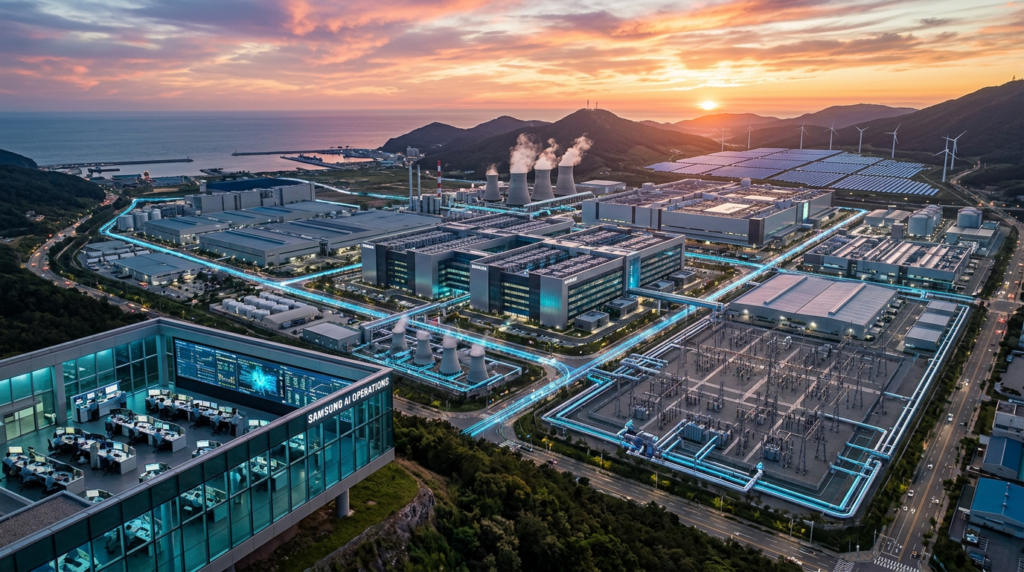
Samsung’s Gwangju investment reveals how the AI economy is spreading far beyond model developers and chip designers.
The next phase of competition will involve complete systems: processors, memory, networking, power delivery, cooling, construction, software, and long-term maintenance. Companies capable of combining several of those layers may capture more value than businesses selling a single component.
Samsung already participates in many of them. Its challenge is making those pieces operate as a coherent strategy.
The new cooling line offers a practical step in that direction. It links Samsung’s manufacturing base with FläktGroup’s thermal expertise. It places production closer to Asian customers. And it gives the company another way to benefit from AI infrastructure growth, even when the spotlight falls on someone else’s processors.
When operations begin in 2028, the factory will enter a market that could look very different from today’s. AI systems will likely be larger, denser, and more demanding. Cooling may become just as important to data-center design as the chips being cooled.
Samsung appears determined to arrive early.
The company is not merely asking who will build the brains of the AI era. It is preparing to answer a more immediate question:
Who will stop those brains from overheating?
Sources
- EDAILY — Samsung Electronics to Begin Domestic Production of AI Data Center Cooling Equipment
- Reuters — Samsung to Buy FläktGroup for €1.5 Billion
- Reuters — Ecolab to Acquire CoolIT Systems for $4.75 Billion
- Reuters — OpenAI Deepens Next-Generation Chip Cooperation With Samsung
- FläktGroup — Air-Handling and Cooling Product Portfolio
- The Guardian — IEA Forecast for AI Data-Center Electricity Demand
The Kingy Brief
Get the next Kingy Brief.
Source-checked AI changes, original tests and one practical thing to try.
Free · Choose your subjects · Double opt-in · Unsubscribe anytime