
Healthcare has no shortage of information.
There are lab results, screening schedules, insurance benefits, fitness data, sleep statistics, medical recommendations and enough forms to make even the healthiest person suddenly feel tired.
The harder problem is turning all that information into action.
On September 17, 2026, Vitality and Google announced the U.S. expansion of Vitality AI, a personalized health platform built on Google Cloud and powered partly by Gemini Enterprise and Google’s Gemini models. The system is designed for employers and health plans, using AI to recommend personalized actions, provide coaching and pair recommendations with incentives intended to encourage healthier behavior. (Google Cloud Press Corner)
This isn’t an AI doctor replacing your physician.
The concept is considerably more practical.
Vitality AI analyzes available health, behavioral and lifestyle information and attempts to answer a deceptively simple question:
What is the most useful thing this person could realistically do next?
Maybe that’s completing a cancer screening.
Maybe it’s increasing daily activity.
Maybe it’s taking a health assessment.
The technology then personalizes how and when that recommendation is delivered.
It’s AI being applied not merely to understanding health—but to encouraging people to actually do something about it.
And Google and Vitality think that could make a measurable difference.
Gemini Meets 2,800 Dimensions of Health Data
The engine behind Vitality AI combines Google’s technology with something Vitality has accumulated over years: behavioral health data.
The platform uses more than 2,800 health and behavioral dimensions, according to the companies. Those can help the system understand an individual’s health profile, lifestyle and risk factors before generating a personalized recommendation. (Google Cloud Press Corner)
Google provides the AI and cloud layer.
That includes Google Cloud, Gemini Enterprise and Gemini models.
Vitality provides the health, actuarial and behavioral framework.
Together, they’re attempting to build something more sophisticated than a generic wellness notification.
Consider two people who both need to become more physically active.
One might respond well to a step target.
Another might need a much smaller initial goal.
Someone else could be more motivated by an incentive.
The ideal recommendation can therefore depend on far more than the medical objective itself.
Timing matters.
Motivation matters.
Personal circumstances matter.
Even the way a message is framed can matter.
Vitality says its system adjusts recommendations around these factors to identify what it calls a personalized “next best action.” (HLTH)
That phrase captures the entire strategy.
Don’t overwhelm people with 25 things they could improve.
Find the next achievable one.
The AI Isn’t Supposed to Replace Your Doctor
Whenever “AI” and “healthcare” appear in the same sentence, one question arrives almost immediately:
Is the AI making medical decisions?
That’s not how Vitality is positioning this platform.
The system focuses on personalized health recommendations, engagement, coaching and incentives rather than replacing physicians or independently diagnosing disease.
That’s an important distinction.
Imagine someone is eligible for a recommended screening but hasn’t completed it.
The AI’s job isn’t to perform the screening.
It might identify the screening as an appropriate next action, personalize the recommendation and potentially connect that recommendation with an incentive.
The actual medical care remains medical care.
Vitality says physician reviews of platform-generated reports produced a 99.2% accuracy rate. But that figure requires context: the company says 686 physicians reviewed reports tested on a cohort of more than 1,300 Discovery employees. It’s a company-reported evaluation, not a universal measure of diagnostic accuracy or proof that the platform is correct 99.2% of the time in every healthcare setting. (Google Cloud Press Corner)
That distinction matters.
The interesting part of Vitality AI isn’t that Gemini suddenly became your family doctor.
It’s that AI might help close the gap between receiving good health advice and actually following it.
The Early Engagement Numbers Are Interesting
Vitality already has some U.S. experience behind the expansion.
According to the company, more than 210,000 people in the United States have received an AI-driven personalized health action since June 2025.
Vitality says 54% completed at least one AI-recommended health action. (Google Cloud Press Corner)
The company has also published results from its broader international operations.
Members receiving personalized AI recommendations were reportedly 3.3 times more likely to complete a mental-wellbeing assessment and 2.7 times more likely to complete an online health review. Vitality also reports a 1.4-times increase in colorectal-cancer screening completion. (Google Cloud Press Corner)
Those numbers sound impressive.
But they need the proper label.
They come from Vitality’s own data rather than a new independent clinical trial accompanying the U.S. announcement.
Still, they address an important problem.
Healthcare systems often know what preventive measures people should take.
The challenge is getting people to take them.
A reminder everyone ignores isn’t particularly useful.
If personalization makes people meaningfully more likely to complete beneficial actions, that could be where AI produces practical value without needing to reinvent medicine itself.
Sometimes the breakthrough isn’t discovering a new treatment.
It’s getting someone to schedule the screening they’ve postponed three times.
Vitality Is Combining AI With Behavioral Science
This is where the platform becomes more interesting than a health chatbot.
Vitality isn’t relying exclusively on Gemini to produce clever recommendations.
The company’s core business has long revolved around behavioral change and incentives.
Vitality AI combines that experience with machine learning to determine not only what action to recommend but potentially how to encourage someone to complete it.
Maia Surmova, CEO of Vitality U.S., told MobiHealthNews that the platform adjusts the context, framing and timing of communications based on people’s motivations and barriers. (MobiHealthNews)
Then incentives can enter the picture.
Vitality reports that relatively modest rewards have produced measurable changes in some preventive-care behaviors. Its data suggests a $31 incentive increased the likelihood of cholesterol testing by 52% compared with no reward, while rewards between $19 and $45 were associated with increased completion of other screenings. (Google Cloud Press Corner)
Again, those are Vitality’s findings and shouldn’t automatically be generalized to every population.
But the principle is fascinating.
The AI isn’t merely saying:
“Get a cholesterol test.”
It’s trying to determine which recommendation, communication and incentive combination might actually motivate that individual.
Artificial intelligence meets behavioral economics.
Your smartwatch has officially discovered psychology.
Personalized Activity Goals Could Be More Realistic
Fitness recommendations provide another example.
“Walk 10,000 steps.”
Great.
Unless you’re currently walking 2,000.
Then 10,000 can feel less like encouragement and more like your phone personally insulting you.
Vitality’s personalized steps program takes a more adaptive approach.
The company says participants receive starting targets based on their existing activity levels. The algorithm then progressively increases those targets at a pace intended to make the behavior sustainable. (Google Cloud Press Corner)
Among roughly 1,500 members who completed at least five weeks of the program, Vitality says average daily activity increased from approximately 4,900 steps before enrollment to 6,900 after completing the program.
That’s around a 40% improvement.
The company separately reports that high-BMI participants experienced increases of more than 200% in physical activity after enrolling in Vitality AI. (Google Cloud Press Corner)
Those figures come from different analyses and shouldn’t be treated as one combined study.
But both illustrate the personalization philosophy.
Instead of giving everyone identical targets, AI can potentially adapt goals to someone’s starting point.
That’s a broader lesson for consumer health technology.
The theoretically perfect recommendation isn’t always the most useful recommendation.
Sometimes the best target is simply the one someone can realistically achieve—and then build upon.
Sleep Is Becoming Part of the Equation Too

Exercise gets most of the attention in wellness apps.
Sleep is increasingly joining the party.
Vitality says members who improved their sleep habits through its rewards program gained an average of about 19.8 minutes of sleep per night.
That works out to roughly two hours and 20 minutes of additional sleep each week. (Google Cloud Press Corner)
The company also reports an association between maintaining good sleep habits and lower in-hospital claims.
Important word: association.
That doesn’t establish that additional sleep directly caused lower healthcare costs.
Still, incorporating sleep into personalized recommendations demonstrates how broad these AI-driven health platforms are becoming.
Health isn’t one variable.
Physical activity affects wellbeing.
Sleep affects energy.
Stress affects behavior.
Preventive screenings affect early detection.
Personal circumstances affect whether recommendations are practical.
The attraction of AI is its ability to analyze large numbers of interacting variables simultaneously and tailor recommendations accordingly.
That’s where those 2,800 health and behavioral dimensions become relevant.
No human wants to manually compare thousands of variables every morning before deciding whether you should walk another 1,500 steps.
Computers, fortunately, don’t complain.
Preventive Care Could Be the Bigger Prize
Some of Vitality’s most striking figures involve preventive care.
The company estimates that personalized recommendations and incentives resulted in 23,302 additional cancer screenings during 2025, representing a 5.5% increase over historical trends in its analyzed population. (Google Cloud Press Corner)
Vitality further estimates those additional screenings produced 219 additional early detections and potentially prevented six deaths.
Those are modeled estimates based on Vitality and Discovery data, not results from a randomized U.S. population study, so they deserve cautious interpretation.
But they point toward an important use case.
AI’s role in healthcare doesn’t have to begin with discovering miracle drugs or autonomously diagnosing rare diseases.
It can help improve participation in interventions we already know matter.
Screenings are a perfect example.
The medical technology already exists.
The guidelines already exist.
The healthcare providers already exist.
The missing piece is often participation.
If personalized AI can identify who might benefit from a preventive action, explain why it matters at an appropriate moment and provide a meaningful incentive, the technology could improve outcomes through better engagement rather than new medicine.
That’s less science-fiction.
It might also be easier to deploy at scale.
Employers and Health Plans Are a Huge Part of the Strategy
Vitality isn’t primarily pitching its U.S. expansion as another consumer fitness app.
The target includes employers, insurers and health plans.
That makes financial outcomes important alongside health outcomes.
Vitality says engaged clients have experienced an average 4% reduction in healthcare claims costs, producing a reported 180% return on investment. The company says the claims-cost and ROI analysis was independently reviewed by Arbital Health. (Google Cloud Press Corner)
Vitality also reports that members reaching higher levels in its reward system showed 15% lower risk-adjusted claims costs.
Meanwhile, the company estimates its platform can recover an average 4.4 productive days per employee annually, representing approximately $1,047 in annual productivity value per worker. (Google Cloud Press Corner)
These are significant claims.
They’re also precisely the kind of claims U.S. employers will scrutinize.
A wellness platform might sound wonderful.
A wellness platform that can demonstrate measurable engagement, reduced claims and improved productivity becomes much easier to justify financially.
That’s one reason AI-powered health platforms may increasingly become an enterprise technology story.
The buyer isn’t always the patient.
Sometimes it’s the company paying the healthcare bill.
America Is a Particularly Interesting Test
The United States provides an enormous opportunity—and an enormous challenge.
Healthcare is fragmented.
Insurance can be complicated.
Benefits are often difficult to navigate.
And preventive care sometimes gets postponed because people don’t know where to start, what is covered or how much something will cost.
An August 2026 survey conducted by Opinium for Vitality found that 41% of 2,000 surveyed U.S. workers said they struggled to navigate health benefits and digital health tools. Another 49% reported difficulty navigating healthcare and insurance, while 53% said they had delayed or avoided preventive care because of cost. (Google Cloud Press Corner)
Those figures come from Vitality-commissioned polling, so the source matters.
Still, the underlying navigation problem is well recognized across American healthcare.
Vitality sees personalization as part of the answer.
Instead of expecting someone to understand an entire healthcare system, the platform attempts to surface the most relevant next step.
That’s a much more manageable interface.
You don’t need to understand everything.
You need to understand what matters now.
If AI can reliably simplify that decision without overstepping into inappropriate medical guidance, it could become a useful navigation layer between consumers and an extraordinarily complicated healthcare system.
That’s a big “if.”
But it’s also a big opportunity.
Google Gets Another Major Enterprise Gemini Use Case
For Google, this expansion is another example of Gemini moving beyond a chatbot.
Google increasingly wants Gemini to function as an intelligence layer inside businesses, software platforms and specialized workflows.
Healthcare is an especially valuable proving ground.
Vitality AI combines Gemini models, Gemini Enterprise, Google Cloud infrastructure, data analytics and an industry-specific dataset rather than asking a general-purpose model to do everything itself. (Google Cloud Press Corner)
That’s likely to be a recurring pattern across enterprise AI.
The foundation model provides broad reasoning capabilities.
Companies provide specialized data.
Existing software provides workflows.
Domain experts provide rules and oversight.
Cloud infrastructure ties everything together.
The result becomes less like “ChatGPT, but for healthcare” and more like an AI-powered layer embedded inside an existing health platform.
That distinction matters commercially.
Businesses don’t necessarily want another chatbot.
They want technology that improves the systems they already operate.
For Google Cloud, every successful deployment of Gemini inside a specialized enterprise workflow provides another argument that generative AI can deliver practical business value beyond content generation.
Health happens to be a particularly high-profile place to prove it.
Privacy and Trust Will Matter as Much as Intelligence
Personalization requires information.
Health personalization requires particularly sensitive information.
That makes privacy, security and governance unavoidable parts of the story.
Vitality says members retain control over their data and that the platform applies security, governance and compliance standards intended to promote fairness, transparency and user choice. (HLTH)
Those commitments will matter enormously as the platform expands.
An AI system might become more useful when it understands activity levels, risk factors, health history and behavioral patterns.
But people need confidence that such information is handled appropriately.
There’s another challenge: personalization can feel helpful until it becomes creepy.
“Here’s a screening you may want to consider” feels useful.
“We’ve analyzed everything about your life and noticed something” can feel considerably different.
The line between those experiences will depend on transparency, permissions and product design.
Healthcare also carries higher stakes than ordinary consumer AI.
A strange restaurant recommendation is annoying.
A misleading health recommendation can matter considerably more.
That means platforms like Vitality AI will need to demonstrate not merely impressive models, but responsible deployment, strong safeguards and reliable human healthcare pathways.
In this category, trust isn’t a nice bonus.
It’s infrastructure.
The Real Opportunity Is Turning Advice Into Action
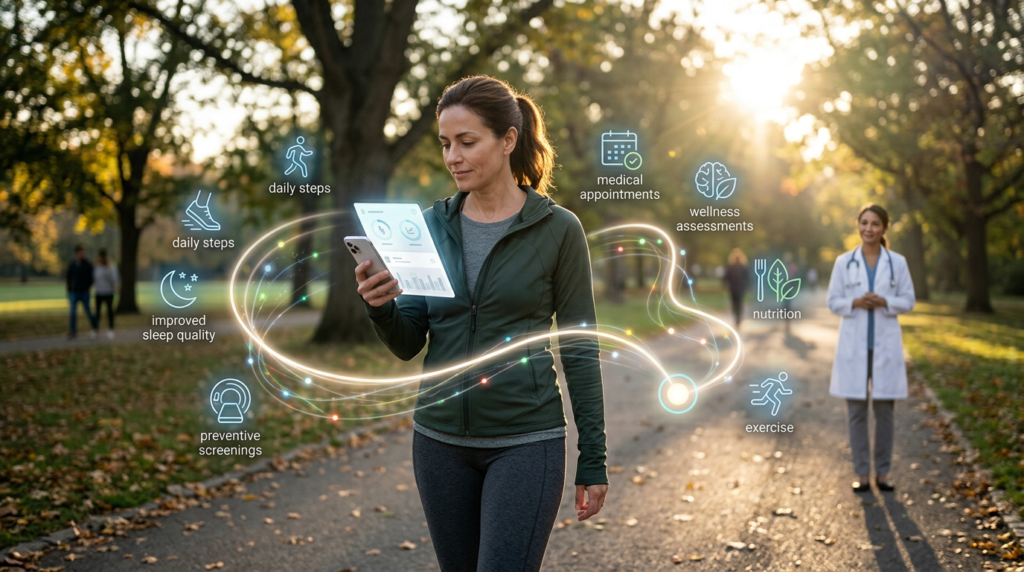
We’ve spent much of the generative-AI boom marveling at what machines can produce.
Text.
Images.
Video.
Software.
Research.
But healthcare presents a different challenge.
Sometimes we already know the answer.
Exercise more.
Sleep enough.
Complete recommended screenings.
Attend health assessments.
Manage known risk factors.
The difficult part is translating general advice into something personally relevant—and then motivating someone to follow through.
That’s where Google and Vitality are placing their bet.
Vitality AI uses Google’s Gemini technology alongside thousands of health and behavioral dimensions to determine a personalized next action. It can adjust the message, timing and incentive around the individual. (Google Cloud Press Corner)
Early results reported by Vitality suggest that personalization can improve engagement, although many of the figures still come from company analyses and specific populations rather than independent, broadly representative clinical trials.
The U.S. expansion should therefore provide an important test.
Can personalized AI meaningfully improve health behavior at scale?
Can it help people navigate complicated benefits?
Can it encourage preventive care without overwhelming users?
And can it do all of that while earning enough trust to handle deeply personal information?
If the answers increasingly become yes, AI’s healthcare impact may look less dramatic than science fiction imagined.
No robot doctor.
No holographic hospital.
Just an intelligent system quietly nudging millions of people toward one healthier decision at a time.
Sometimes the future arrives wearing a lab coat.
This one might arrive carrying a step counter and reminding you that you’ve been ignoring that screening for six months.
Sources
- Google Cloud — Vitality and Google Expand Technology Partnership
- Vitality — Vitality and Google Expand AI-Driven Health Platform to the U.S.
- MobiHealthNews — Vitality and Google Bring AI Health Platform to U.S. Market
- HLTH — Vitality and Google Expand AI-Powered Health Platform Into U.S. Market
The Kingy Brief
Get the next Kingy Brief.
Source-checked AI changes, original tests and one practical thing to try.
Free · Choose your subjects · Double opt-in · Unsubscribe anytime