
Quantum computing has spent years living in an awkward neighborhood between extraordinary scientific promise and brutally difficult engineering.
Researchers know what powerful quantum computers could eventually do. They could help scientists model molecules, develop new materials, tackle complex optimization problems and potentially transform areas such as drug discovery and finance. The problem is getting quantum machines reliable enough to actually do those things at useful scale.
Now NVIDIA wants to make that journey considerably faster.
On September 14, NVIDIA announced CUDA-Q Logical, a new open-source orchestration layer for its CUDA-Q quantum computing platform. The technology is designed to help researchers develop and evaluate applications for fault-tolerant quantum computers—machines capable of dealing with the errors that plague today’s quantum hardware. (NVIDIA Newsroom)
And NVIDIA already has a pretty spectacular number to put behind the announcement.
Fermilab says work that would normally take roughly five months was completed in three weeks using CUDA-Q Logical.
That’s around a 7x acceleration.
For NVIDIA, however, this isn’t simply about making quantum researchers work faster. It’s another piece of a much bigger strategy: putting GPUs and NVIDIA’s software ecosystem at the center of computing’s next major era.
NVIDIA Is Going Deeper Into Quantum Computing
NVIDIA doesn’t manufacture quantum processing units in the same way companies such as IonQ and other quantum-hardware developers do.
Instead, NVIDIA is building something potentially just as important: the infrastructure connecting quantum processors with classical accelerated computing.
CUDA-Q already serves as NVIDIA’s open-source platform for building hybrid quantum-classical applications. CUDA-Q Logical expands that stack into the especially difficult world of fault-tolerant computing.
The new layer lets researchers work with algorithms, quantum error-correction techniques, logical architectures and physical hardware configurations while comparing how different choices affect the resources required to perform a computation. (NVIDIA GitHub)
That matters because quantum computers aren’t simply very fast conventional computers.
They operate according to fundamentally different rules.
And their basic computational units—qubits—are notoriously fragile.
Environmental interference, imperfect gates and other sources of noise can introduce errors into calculations. Those errors become an enormous obstacle as researchers try to build larger quantum systems capable of performing long and complicated calculations.
CUDA-Q Logical is NVIDIA’s attempt to give researchers a common environment for tackling that problem.
Think less “NVIDIA built a quantum computer.”
Think more “NVIDIA wants to build the workshop where tomorrow’s quantum computers are designed.”
That’s potentially a very powerful position.
The Big Problem: Quantum Computers Make Mistakes
Here’s where things get tricky.
A classical computer can reliably store information as bits representing zeros and ones. Quantum computers use qubits, which exploit quantum phenomena such as superposition and entanglement.
That gives quantum computing its extraordinary potential.
It also creates headaches.
Lots of them.
Qubits are sensitive to noise, meaning errors can creep into calculations. One approach to overcoming this problem is quantum error correction, or QEC.
Rather than relying on one physical qubit to represent useful information, researchers can combine multiple physical qubits into a more reliable logical qubit.
The logical qubit is essentially protected through error correction.
The catch?
You may need many physical qubits to produce relatively few reliable logical ones.
That overhead represents one of the largest challenges standing between today’s experimental quantum machines and genuinely useful fault-tolerant quantum computers.
CUDA-Q Logical gives researchers a framework for exploring those trade-offs before massive machines have actually been built.
Researchers can alter error-correction codes, hardware assumptions, architectures and other variables while keeping workloads comparable. NVIDIA’s documentation says the platform can then generate resource estimates and expose the assumptions behind them. (NVIDIA GitHub)
In other words, researchers can experiment with the blueprint before spending years building the house.
Fermilab Turns Five Months Into Three Weeks
This is where NVIDIA’s announcement gets particularly interesting.
Fermi National Accelerator Laboratory—better known as Fermilab—used CUDA-Q Logical while investigating fault-tolerant quantum architectures.
Researchers needed to evaluate different combinations of physical qubits, runtimes, quantum error-correction techniques and hardware architectures.
Normally, creating the specialized infrastructure required for that work could take around five months.
Using CUDA-Q Logical, Fermilab says its researchers explored those combinations in approximately three weeks. (NVIDIA Newsroom)
That’s the 7x improvement NVIDIA is highlighting.
More importantly, Fermilab turned complicated system designs into a workflow that could be repeated and verified.
This is important because quantum computing research often involves interconnected decisions. Change the error-correction strategy and suddenly the hardware requirements might change. Change the hardware and your resource calculations may need another overhaul.
CUDA-Q Logical is designed to connect those moving parts rather than forcing researchers to stitch together a collection of specialized tools manually.
The platform’s compiler architecture also preserves information as programs move through different stages—from logical programs toward physical operations and control plans. That makes it easier to trace where resource requirements came from and compare architectures more systematically. (NVIDIA)
Sevenfold faster development doesn’t mean quantum computers suddenly became seven times faster.
That’s an important distinction.
It means researchers were able to explore and develop the architecture dramatically faster.
And that could shorten the road toward useful machines.
Iceberg Quantum Finds a Way to Slash Qubit Requirements
Fermilab isn’t NVIDIA’s only interesting example.
Iceberg Quantum used CUDA-Q Logical to model its fault-tolerant architecture using qubits from Australian quantum computing company Diraq.
The result was striking.
According to NVIDIA, the modeling indicated that 1,000 logical qubits could potentially be created using approximately 150,000 physical qubits.
NVIDIA says that’s roughly 10 times fewer physical qubits than Diraq’s previous estimates. (Sitelet)
That’s potentially a big deal.
One of the most intimidating problems surrounding fault-tolerant quantum computing is scale. If each useful logical qubit requires an enormous number of physical qubits, then building commercially meaningful quantum computers becomes extraordinarily difficult.
Reduce that overhead, and suddenly the engineering challenge starts looking different.
Again, this doesn’t mean NVIDIA and Iceberg Quantum have already built a 1,000-logical-qubit computer using 150,000 physical qubits.
It’s a modeling result.
But that’s exactly what CUDA-Q Logical is supposed to facilitate: allowing researchers to evaluate possible architectures and determine where hardware requirements might be reduced before committing to physical implementations.
And NVIDIA isn’t working with just one corner of the quantum industry.
The company says CUDA-Q Logical is already being used by organizations including Fermilab, Sandia National Laboratories, Infleqtion, IQM Quantum Computers, QCDesign and Quantum Motion. (Sitelet)
That’s quite a guest list for a technology entering preview.
Infleqtion Is Already Putting the Platform to Work
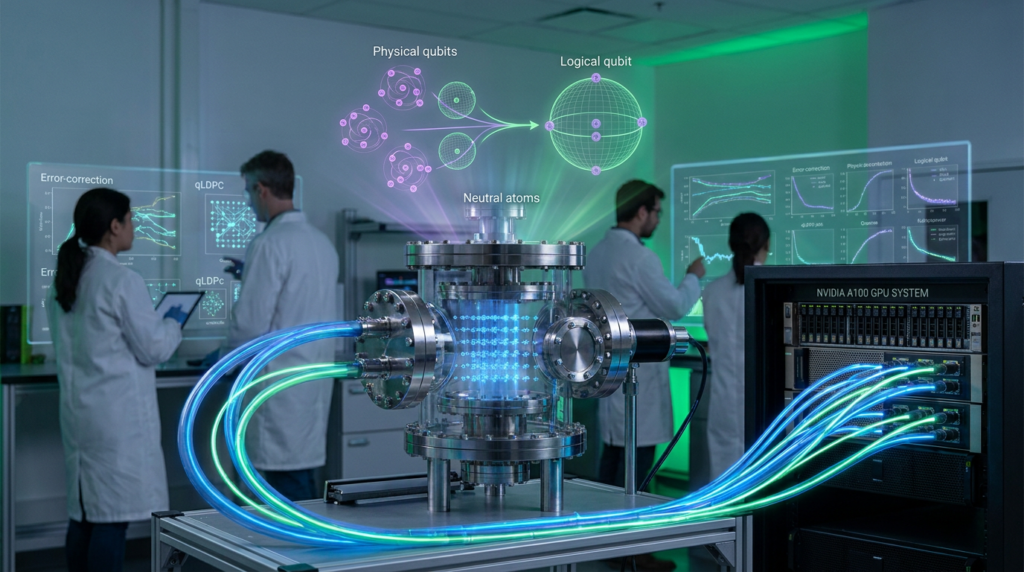
Infleqtion provides another glimpse at how CUDA-Q Logical could be used.
The quantum computing company integrated its open-source qLDPC library with NVIDIA’s new platform to investigate quantum error correction.
Using an early-access version of CUDA-Q Logical, Infleqtion says its researchers constructed and validated a high-rate error-correction code requiring approximately six physical data qubits per logical qubit.
According to the company, that represented roughly a fivefold improvement in code rate compared with the surface-code approach it used for comparison. (Infleqtion)
That doesn’t magically solve quantum error correction.
Far from it.
But reducing physical-qubit overhead is exactly the kind of progress researchers need if fault-tolerant quantum computers are going to become practical.
Infleqtion is now extending the work toward physical execution, including neutral-atom noise modeling, syndrome extraction and decoder benchmarking. (Infleqtion)
There’s also an interesting AI connection hiding inside the announcement.
Infleqtion says portions of its integration work were developed with AI assistance, building on its internal use of AI to improve the efficiency of logical-qubit operations.
So we now have GPUs, AI, classical computing and quantum error correction starting to converge inside the same development ecosystem.
That’s very NVIDIA.
The company spent years convincing developers that GPUs were about much more than graphics.
Now it wants accelerated computing to become part of the infrastructure beneath quantum computing too.
Sandia Adds a Quantum Benchmark to the Mix
Building fault-tolerant machines presents another problem: how do you compare them?
Enter QUOPS.
Sandia National Laboratories developed QUOPS as an independent, cross-platform benchmark for measuring how quantum systems are progressing toward useful fault-tolerant applications.
NVIDIA says QUOPS is now available through CUDA-Q. (NVIDIA Newsroom)
This could become increasingly important as the quantum industry matures.
Quantum computing companies use different hardware technologies. Some rely on superconducting qubits. Others pursue trapped ions, neutral atoms, photonics, silicon-based approaches or other architectures.
Simply comparing raw physical qubit counts doesn’t necessarily tell you which machine will perform useful fault-tolerant calculations most effectively.
The real question is what those systems can accomplish once error correction, runtime, decoding and resource requirements enter the equation.
A hardware-independent benchmark gives researchers another way to evaluate that progress.
And it fits neatly into NVIDIA’s broader approach.
Rather than betting everything on one specific quantum hardware technology, CUDA-Q Logical is designed to work across different error-correction codes and architectures. (NVIDIA)
NVIDIA can therefore position its software and GPU infrastructure as connective tissue between competing quantum technologies.
If multiple quantum architectures survive—and that’s entirely possible—being the company providing tools across those architectures could prove extremely valuable.
CUDA-Q Logical Is About Co-Design, Not Just Compilation
One of the more important ideas behind CUDA-Q Logical is something NVIDIA repeatedly emphasizes: co-design.
Fault-tolerant quantum computing isn’t a problem researchers can solve one layer at a time.
Algorithms affect error correction.
Error correction affects physical-qubit requirements.
Hardware architectures affect execution.
Decoders and classical computing affect how quickly errors can be identified and corrected.
Change one component and the consequences can ripple through the entire system.
CUDA-Q Logical attempts to put those decisions into a unified, programmable framework.
NVIDIA’s research paper describes an extensible compiler infrastructure that progressively translates quantum programs through multiple layers while preserving semantics and provenance along the way. (NVIDIA)
That sounds incredibly technical—and it is.
But the underlying idea is simple.
Researchers shouldn’t have to rebuild their development workflow every time they want to test a different quantum architecture.
They should be able to change components, compare results and understand why resource estimates changed.
CUDA-Q Logical is intended to make that possible.
NVIDIA’s documentation currently labels the technology a preview release, meaning APIs, behavior and documentation may change substantially as development continues. (NVIDIA GitHub)
So this isn’t the finished destination.
It’s infrastructure being built while the quantum industry itself is still figuring out what the destination looks like.
Why NVIDIA Wants Quantum Computers Connected to GPUs
There’s a larger strategy hiding underneath all of this.
NVIDIA doesn’t envision quantum computers completely replacing classical supercomputers.
Instead, the company has consistently pushed a hybrid concept often described as quantum-GPU supercomputing.
Quantum processors would handle calculations particularly suited to quantum mechanics, while CPUs and GPUs continue performing the enormous amount of classical computation surrounding them.
Error correction itself can require substantial classical processing.
That creates an obvious role for GPUs.
And if quantum computers eventually become genuinely useful, they may live inside heterogeneous computing environments where CPUs, GPUs and quantum processors constantly exchange workloads.
CUDA-Q gives NVIDIA a software layer for that future.
CUDA-Q Logical pushes it further toward fault-tolerant systems.
This strategy should sound familiar.
CUDA helped turn NVIDIA GPUs into general-purpose computing platforms long before the current generative-AI explosion.
Once developers built applications around CUDA, NVIDIA’s software ecosystem became one of its greatest competitive advantages.
Quantum computing offers NVIDIA another opportunity to establish infrastructure early.
The quantum processors themselves might come from multiple companies.
But the classical acceleration, development tools and orchestration surrounding them?
NVIDIA clearly wants a seat at that table.
Preferably a very large one.
Quantum Computing Still Has a Long Road Ahead
For all the excitement surrounding this announcement, some perspective is essential.
CUDA-Q Logical does not mean fault-tolerant quantum computing has suddenly arrived.
Today’s quantum systems still face enormous technical challenges.
Researchers need better qubits, lower error rates, scalable control systems, efficient decoders, practical error-correction methods and architectures capable of scaling without becoming impossibly complex.
NVIDIA’s own documentation identifies CUDA-Q Logical as preview software. (NVIDIA GitHub)
Likewise, modeling an architecture requiring fewer physical qubits isn’t the same thing as successfully building and operating that architecture.
But progress doesn’t always arrive as one dramatic breakthrough.
Sometimes it comes from better tools.
If researchers can evaluate designs in weeks instead of months, test more architectures, compare error-correction strategies and identify configurations requiring fewer resources, the entire development cycle can accelerate.
That’s what makes Fermilab’s three-week result interesting.
It’s not proof that fault-tolerant quantum computers are around the corner.
It’s evidence that some of the engineering process required to reach them can potentially become much faster.
And when you’re tackling a problem as difficult as fault-tolerant quantum computing, shaving months off development cycles can matter enormously.
NVIDIA Is Building for a Computing Era That Doesn’t Fully Exist Yet
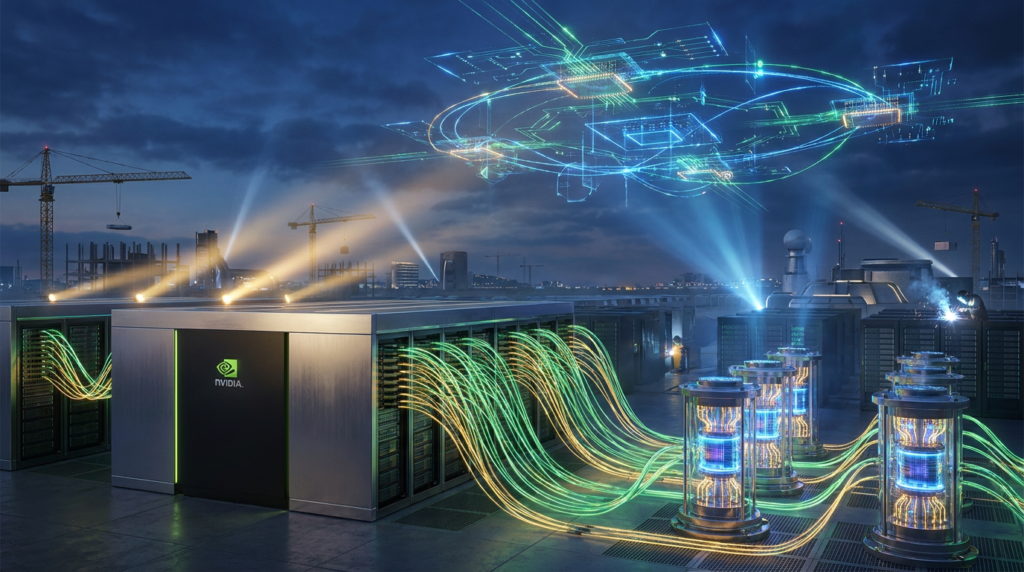
CUDA-Q Logical ultimately tells us as much about NVIDIA as it does about quantum computing.
The company isn’t waiting for fault-tolerant quantum computers to become mainstream before building an ecosystem around them.
It’s moving now.
NVIDIA is providing open-source development tools. Researchers are using those tools to model future machines. Laboratories are testing architectures. Quantum companies are integrating error-correction technologies. Sandia is bringing benchmarking into the ecosystem.
The pieces are beginning to connect.
And that’s perhaps the most interesting part of this announcement.
The quantum industry remains fragmented. Different companies are pursuing radically different qubit technologies, architectures and approaches to error correction.
Nobody knows which combination will ultimately win.
NVIDIA doesn’t necessarily need to know.
If CUDA-Q and CUDA-Q Logical can sit above those competing technologies and connect them to accelerated classical computing, NVIDIA could benefit regardless of which quantum architecture becomes dominant.
It’s essentially a platform strategy for a market that is still being invented.
For researchers, meanwhile, the immediate benefit is much more practical.
A job that once required months might take weeks.
Architectures that looked prohibitively expensive might become more manageable.
And researchers can explore more possibilities before committing precious time and hardware to a particular design.
Quantum computing hasn’t crossed the finish line.
Not even close.
But NVIDIA just handed researchers another tool to help them get there faster.
And considering how difficult the race has been so far, that’s worth paying attention to.
Sources
Sure. Here’s the Sources section reformatted into a clean list:
Sources
- NVIDIA Newsroom — NVIDIA Expands Open-Source CUDA-Q Platform for Fault-Tolerant Quantum Computing
NVIDIA Newsroom - NVIDIA Research — CUDA-Q Logical: Retargetable Compilation for Fault-Tolerant Quantum Computing
NVIDIA Research - NVIDIA CUDA-Q Documentation — CUDA-Q Logical
CUDA-Q Logical Documentation - The Next Web — NVIDIA’s New Quantum Layer Cut Fermilab’s Design Work From Five Months to Three Weeks
The Next Web - SiliconANGLE — NVIDIA Expands CUDA-Q Platform to Support Fault-Tolerant Quantum Processors
SiliconANGLE - The Quantum Insider — NVIDIA Expands Open-Source CUDA-Q Platform
The Quantum Insider - Infleqtion — Infleqtion Advances Fault-Tolerant Quantum Computing Software With NVIDIA CUDA-Q Logical
Infleqtion - The Quantum Insider — Infleqtion Advances Fault-Tolerant Quantum Computing Software With NVIDIA CUDA-Q Logical
The Quantum Insider
The Kingy Brief
Get the next Kingy Brief.
Source-checked AI changes, original tests and one practical thing to try.
Free · Choose your subjects · Double opt-in · Unsubscribe anytime