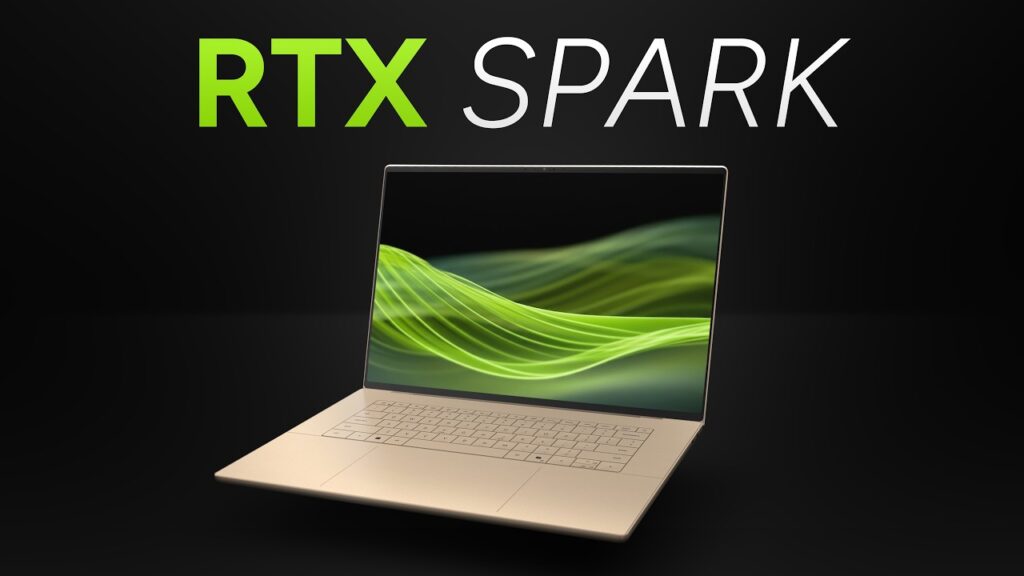
Commercial relationship for this article: None. This is based on Curtis Pyke’s direct confirmation on October 7, 2026.
Evidence summary
- What changed: NVIDIA announced RTX Spark as a Grace Blackwell platform for thin Windows laptops and compact desktops, with first systems named by Microsoft, ASUS, Dell, HP, Lenovo and MSI.
- Current access and cost: NVIDIA now says the first RTX Spark Windows PCs will arrive in October 2026. As of September 3, no reviewed retail unit, final cross-OEM price list or complete regional availability schedule was public.
- Evidence status: Core architecture and announced OEMs are confirmed by NVIDIA and partner materials. Performance, battery, thermals and compatibility remain vendor claims or proxy evidence until shipping hardware is independently tested.
- Kingy-tested: Not tested. Kingy did not receive retail RTX Spark hardware or reproduce NVIDIA’s workload claims.
- Last checked: September 3, 2026.
- Record handoff: No dedicated RTX Spark product or launch record is live yet. Use the NVIDIA company record, AI Hardware Radar and hardware release calendar for current follow-up.
On May 31–June 1, 2026, on a stage in Taipei during NVIDIA’s GTC Taipei keynote at Computex 2026, Jensen Huang did something that would have sounded like science fiction just three years earlier. He stood next to Microsoft’s Satya Nadella and declared that “the PC is being reinvented,” then introduced NVIDIA RTX Spark — a Grace Blackwell “superchip” that drops a data-center-class AI architecture into thin Windows laptops and compact desktops. As one widely shared Medium analysis in the Data Science Collective put it, “your next laptop is a personal supercomputer.”
NVIDIA RTX Spark may be NVIDIA’s most serious attempt yet to reinvent the Windows laptop for the local AI era.
This is not just another GeForce laptop GPU launch. RTX Spark is NVIDIA’s bid to combine a Grace CPU, Blackwell RTX GPU, large unified memory, CUDA, TensorRT, OptiX, DLSS, Reflex, G-SYNC, and Windows-on-Arm into a new class of thin AI laptops and compact desktops.
That is the exciting part.
The caution is just as important: RTX Spark laptops are not fully validated yet. Final prices, retail SKUs, thermals, battery watt-hours, fan layouts, sustained clocks, shipping benchmarks, SSD models, RAM package details, display panel IDs, wireless modules, and regional availability are still missing for most systems.
So this guide is not a review. It is a serious buyer and developer briefing on what is confirmed, what is claimed, what is only proxy evidence, and what still needs independent testing.
TL;DR
- RTX Spark is a Windows-on-Arm laptop and compact desktop platform, not one single laptop.
- It combines NVIDIA Grace CPU cores, a Blackwell RTX GPU, unified memory, CUDA, RTX, DLSS, TensorRT, OptiX, Reflex, and G-SYNC.
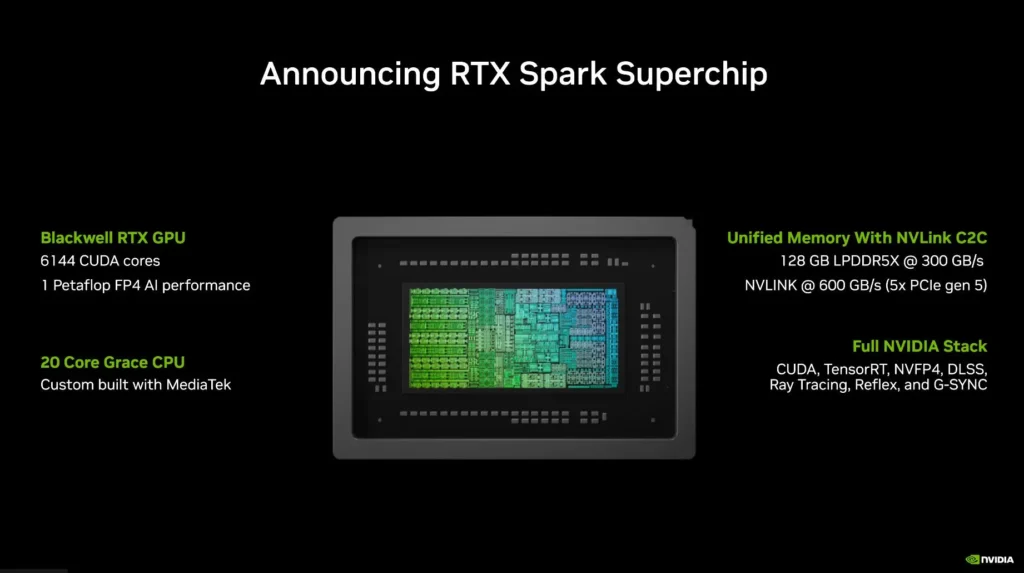
- NVIDIA’s headline claims include up to 20 Arm CPU cores, up to 6,144 CUDA cores, up to 128GB unified memory, and up to 1 petaFLOP of FP4 AI performance.
- First systems are expected from Microsoft Surface, ASUS, Dell, HP, Lenovo, and MSI, with Acer and GIGABYTE later.
- Announced laptops include Surface Laptop Ultra, ASUS ProArt P16 and P14, Dell XPS 16 Creator Edition, HP OmniBook Ultra 16, HP OmniBook X 14, Lenovo Yoga Pro 9n, and MSI Prestige N16 Flip AI+.
- Pricing is not fully known yet.
- Independent shipping-laptop benchmarks are not available yet.
- The strongest use cases are likely local AI, AI agents, CUDA development, creator workflows, large-memory projects, and hybrid creator/gaming use.
- The biggest risks are price, Windows-on-Arm compatibility, thermals, fan noise, and unproven sustained performance.
What Is NVIDIA RTX Spark?
RTX Spark is NVIDIA’s new Windows PC platform for personal AI machines.
The short version: NVIDIA is putting a Grace CPU and Blackwell RTX GPU into one superchip-style platform with unified memory, then pairing it with Windows on Arm and the NVIDIA software stack.
That matters because RTX Spark is not a traditional Intel or AMD Windows laptop with a separate NVIDIA GPU. It is closer to the Apple Silicon idea of a tightly integrated CPU, GPU, and shared memory pool, but with NVIDIA’s CUDA and RTX ecosystem layered on top.
NVIDIA frames RTX Spark as a “personal AI computer” platform for agents, creators, developers, and gamers. Microsoft frames it as a new Windows PC class optimized for local AI workloads, agents, Windows-on-Arm performance, and high-end creator applications.
The strategic story is simple:
Apple proved that large unified memory in a laptop can matter.
NVIDIA is trying to bring that idea to Windows, but with CUDA.
That is the real thesis. RTX Spark is not only about raw GPU wattage. It is about large shared memory, local AI, NVIDIA developer tooling, creator apps, and Windows compatibility in one mobile system.
RTX Spark Specs
Use “up to” carefully here. NVIDIA has announced platform-level capabilities. Individual laptops may ship with lower memory tiers, different cooling systems, different displays, different storage, and different power behavior.
| Spec | What NVIDIA or partners have said | What still needs confirmation |
|---|---|---|
| CPU | Up to 20 Arm CPU cores built on NVIDIA Grace | Exact CPU bins by retail laptop |
| GPU | Blackwell RTX GPU | Laptop-specific clocks and sustained power |
| CUDA cores | Up to 6,144 CUDA cores | Whether every SKU uses full GPU configuration |
| Tensor Cores | 5th-generation Tensor Cores with FP4 support | Laptop-level Tensor performance under sustained load |
| RT Cores | Blackwell-generation RTX graphics with ray tracing | Exact RT-core behavior by SKU |
| AI performance | Up to 1 petaFLOP FP4 AI performance | Real local LLM, ComfyUI, and TensorRT benchmarks |
| Unified memory | Up to 128GB unified memory | Base memory tiers, RAM packages, memory allocation behavior |
| Memory bandwidth | Not clearly published for RTX Spark laptops in the main launch materials | Do not reuse DGX Spark bandwidth as laptop fact |
| NVLink-C2C | CPU/GPU coherent interconnect is part of the platform story | Laptop-specific implementation details |
| Video engines | NVIDIA claims Blackwell media support, including 12K 4:2:2 video workflows and hardware encode/decode capabilities | Real Premiere, DaVinci, and multi-stream tests |
| Operating system | Windows 11 on Arm | App-by-app compatibility |
| CUDA | NVIDIA says CUDA runs natively on RTX Spark | Exact framework readiness at launch |
| TensorRT | Microsoft says Windows ML can leverage TensorRT natively | Real developer setup experience |
| RTX | RTX graphics, ray tracing, RTX Video, NVIDIA Studio workflows | App-level performance |
| DLSS | DLSS support, including new RTX capabilities | Game support and frame-time behavior |
| OptiX | NVIDIA positions OptiX as part of RTX Spark creator workflows | Blender/OTOY rendering benchmarks |
| Reflex | NVIDIA Reflex listed for gaming responsiveness | Game-by-game validation |
| G-SYNC | G-SYNC listed for premium displays | Exact panel support by model |
| Display class | NVIDIA says 14- to 16-inch premium systems; some OEMs cite OLED or mini-LED displays | Panel IDs, calibration results, PWM behavior, brightness tests |
| Size/weight | NVIDIA says designs can be as slim as 14mm and as light as 3 lb | Actual weight/thickness by retail SKU |
| Battery | Vendors claim all-day battery life | Real battery tests under AI, creator, and gaming workloads |
| Ports | Model-specific | Final port maps for most OEM SKUs |
| Availability | Fall 2026 for first-wave OEMs; Acer and GIGABYTE later | Country-by-country dates |
| Pricing | Not finalized publicly for most laptops | Final MSRP, configurations, and regional prices |
The most important table row is pricing. No one should pretend these machines have a known price until OEMs publish retail configurations.
Why RTX Spark Matters
RTX Spark matters because it targets a gap in today’s laptop market.
Traditional RTX laptops are powerful, but many creator-focused models still have limited VRAM. An RTX 5070 laptop configuration with 8GB or 12GB of VRAM can be excellent for many creative and gaming tasks, but it can become awkward for larger local AI models, large scenes, high-resolution generative workflows, or projects that want a much larger working memory pool.
MacBook Pro models solved a different version of this problem with Apple Silicon unified memory. A MacBook Pro with M4 Max can scale to large unified memory configurations, giving creators and developers more room than a conventional laptop GPU with small dedicated VRAM.
RTX Spark tries to combine that large-memory idea with NVIDIA’s strongest advantage: CUDA.
CUDA is still the default acceleration layer for a huge part of the AI world. PyTorch, TensorRT, ComfyUI, many diffusion workflows, inference stacks, developer tools, and experimental AI pipelines often assume NVIDIA hardware first.
That is why RTX Spark is interesting.
The promise is not “this will beat every gaming laptop.” It probably will not.
The promise is this: a Windows laptop with a large unified memory pool, native CUDA, RTX graphics, local AI workflows, and enough portability to carry it like a premium creator notebook.
If NVIDIA and the OEMs execute well, RTX Spark could become a serious category for AI developers, creators, technical founders, and advanced buyers who want local compute without building a desktop workstation.
Every RTX Spark Laptop Announced So Far
| Model | Screen/display | Memory | Battery | Ports | Availability | Price | Confirmed | Missing | Best likely audience |
|---|---|---|---|---|---|---|---|---|---|
| Microsoft Surface Laptop Ultra | 15-inch mini-LED PixelSense Ultra, 3:2, up to 2,000 nits HDR | Up to 128GB unified memory | “All-day” claim, no Wh published | USB-C, USB-A, HDMI, headphone jack, full-size SD | Later 2026 | Unknown | Display, ports, memory ceiling, replaceable SSD, under 18mm, under 4.5 lb | Battery Wh, price, exact SKUs, thermals, clocks | Surface buyers, creators, AI builders |
| ASUS ProArt P16 H7607 | Up to 4K 120Hz VRR ASUS Lumina Pro OLED, G-SYNC | Up to 128GB platform claim | Up to 99.9Wh claim | Not fully published | Fall 2026 select regions | Unknown | P16/P14 models, display class, battery ceiling, ProArt ecosystem | Final SKUs, ports, weight, cooling, storage | Creators, editors, 3D artists |
| ASUS ProArt P14 H7407 | Up to 3K ASUS Lumina Pro OLED | Up to 128GB platform claim | Up to 99.9Wh claim | Not fully published | Fall 2026 select regions | Unknown | 14-inch ProArt RTX Spark model | Final SKUs, ports, cooling, weight, price | Mobile creators, AI developers |
| Dell XPS 16 Creator Edition | Tandem OLED, True Black HDR 600 | Up to 128GB unified memory | Unknown | HDMI and SD card reader confirmed | Not fully specified | Unknown | RTX Spark, XPS 16, OLED, creator ports | Battery, dimensions, cooling, pricing, launch date | XPS creators, video/photo pros |
| HP OmniBook Ultra 16 | Not fully specified | Not fully specified | Unknown | Not fully specified in retrieved official source | Later 2026 | Unknown | RTX Spark model, thinness claim | Display, memory tiers, battery, ports, price | Windows creator/AI buyers |
| HP OmniBook X 14 | Not fully specified | Not fully specified | Unknown | Not fully specified in retrieved official source | Later 2026 | Unknown | RTX Spark model, thinness claim | Display, memory tiers, battery, ports, price | Portable AI laptop buyers |
| Lenovo Yoga Pro 9n | Not fully specified | Not fully specified | Extended unplugged-use claim | Not fully specified | Fall 2026 platform wave | Unknown | Model name and creator positioning | Almost everything else | Lenovo Yoga creator buyers |
| MSI Prestige N16 Flip AI+ | 16-inch UHD+ Tandem OLED, over 1,000 nits peak, 100% DCI-P3, Calman Verified, Delta E <1 | Not fully specified | 99.9Wh | Not fully specified | Not fully specified | Unknown | 2-in-1, display, stylus, battery | Price, ports, weight, cooling, memory tiers | 2-in-1 creators, business pros |
| Acer RTX Spark laptops | No laptop model announced in official sources found | Unknown | Unknown | Unknown | Later, per NVIDIA | Unknown | Acer listed as future partner | Model details | Wait and watch |
| GIGABYTE RTX Spark laptops | No laptop model announced in official sources found | Unknown | Unknown | Unknown | Later, per NVIDIA | Unknown | GIGABYTE listed as future partner | Model details | Wait and watch |
Microsoft Surface Laptop Ultra
Surface Laptop Ultra may become the mainstream flagship for RTX Spark because it is Microsoft’s own hardware, built in direct partnership with NVIDIA, and positioned as the high-end Surface for creators, developers, and AI builders.
Microsoft says Surface Laptop Ultra is its first laptop to combine a Blackwell RTX GPU, up to 128GB unified memory, and full CUDA support. The company also says it can deliver up to 1 petaFLOP of AI compute and run up to 120B-parameter models locally, based on NVIDIA’s FP4 sparsity claim.
The known hardware details are unusually interesting for a Surface:
- 15-inch mini-LED PixelSense Ultra touchscreen
- 3:2 aspect ratio
- 262 pixels per inch
- Up to 2,000 nits peak HDR brightness
- USB-C, USB-A, HDMI, headphone jack, and full-size SD card reader
- Replaceable SSD
- Less than 18mm thick
- Under 4.5 lb
- Platinum and Nightfall finishes
- All-new thermal system with up to 2.5x the thermal capacity of the 15-inch Surface Laptop 7th Edition
That is a serious Surface spec sheet.
But the unknowns matter. Microsoft has not published final pricing, battery watt-hours, exact storage tiers, final retail configurations, sustained clocks, fan noise, exact cooling layout, SSD model, wireless module, or independent performance data.
Who should care? Surface users who wanted a true high-performance creator laptop without the Surface Laptop Studio form factor. AI developers who want a Microsoft-first Windows-on-Arm CUDA machine should watch this one closely.
ASUS ProArt P16 and ProArt P14 RTX Spark
ASUS is bringing RTX Spark into the ProArt line, which makes sense. ProArt buyers are already the kind of people who care about displays, color, AI-assisted creative tools, and enough performance for video, 3D, and production workflows.
The announced models are:
- ASUS ProArt P16 H7607
- ASUS ProArt P14 H7407
ASUS says both are RTX Spark-powered Windows laptops with ASUS Lumina Pro OLED displays. The P16 supports up to 4K 120Hz VRR with G-SYNC, while the P14 supports up to 3K. ASUS also claims Delta E <1 color accuracy, up to 1,600 nits brightness, anti-reflection coating, Nano Black and Neo White finishes, haptic touchpad feedback, and up to a 99.9Wh battery.
This is exactly the kind of hardware RTX Spark should target: high-end creator laptops where unified memory and CUDA could make more practical difference than another small bump in conventional laptop GPU performance.
The missing pieces are still big. ASUS says additional specifications, configurations, and regional availability will be announced later. That means final storage, memory tiers, ports, weight, cooling, pricing, and display panel IDs are not yet locked publicly.
Compared with current ProArt models, the RTX Spark versions appear less about maximum discrete-GPU wattage and more about unified memory, local AI, and platform integration.
Dell XPS 16 Creator Edition RTX Spark
Dell’s XPS 16 Creator Edition is one of the more important RTX Spark systems because XPS has long been a premium Windows alternative to the MacBook Pro.
Dell says the XPS 16 Creator Edition will be powered by NVIDIA RTX Spark with an RTX GPU, ultra-efficient CPU, and up to 128GB unified memory. Dell positions it for smoother 4:2:2 4K timeline playback, faster exports, complex 3D scenes, compositing, multitasking, and AI-assisted creation.
The most useful confirmed creator details:
- Tandem OLED display
- True Black HDR 600
- HDMI
- Built-in SD card reader
- Up to 128GB unified memory
The HDMI and SD card reader matter. Creator laptops become much more practical when they do not require dongles for every camera card or external display.
Still missing: final battery, dimensions, exact cooling design, fan noise, sustained performance, storage options, price, and launch timing.
The likely buyer is a Windows creator who likes XPS design but wants more local AI and GPU memory flexibility than a conventional thin creator laptop can provide.
HP OmniBook Ultra 16 and OmniBook X 14 RTX Spark
HP has announced RTX Spark versions of the OmniBook Ultra 16 and OmniBook X 14.
HP’s main claim is thinness. The company says these will be among the thinnest RTX Spark laptops and gives rear-height figures of 15.73mm for the OmniBook Ultra 16 and 13.53mm for the OmniBook X 14.
That is notable, but it also raises the central RTX Spark question: how much sustained performance can a very thin chassis maintain?
The official HP source confirms the model names, RTX Spark positioning, later-2026 availability, and that additional device details and pricing will come closer to launch.
Do not overstate the rest. In the official HP material available during this research pass, final display specs, memory tiers, ports, cooling systems, battery watt-hours, storage options, and pricing are not yet public.
These laptops are worth watching for buyers who want the thinnest possible local AI Windows machine. But thinness is not the same as sustained performance. Reviews will matter a lot.
Lenovo Yoga Pro 9n RTX Spark
Lenovo’s Yoga Pro 9n is confirmed through Microsoft’s RTX Spark partner list and NVIDIA’s RTX Spark product page, but official model details are sparse.
Microsoft says the Yoga Pro 9n marries Lenovo Yoga’s creator-focused features with NVIDIA’s new chip to deliver a portable, powerful laptop that can last for extended periods away from an outlet.
That is useful positioning, not a spec sheet.
What we know:
- Lenovo Yoga Pro 9n is part of the first RTX Spark wave.
- It is positioned as a creator-focused laptop.
- It is built around NVIDIA RTX Spark.
What we do not know:
- Display type
- Memory configurations
- Storage tiers
- Battery watt-hours
- Ports
- Weight
- Thickness
- Cooling design
- Price
- Regional availability
- Final shipping date
Lenovo’s Yoga Pro line already competes in the premium creator laptop space, so the fit is logical. But until Lenovo publishes a dedicated Yoga Pro 9n spec page, treat this as an announced model with limited details.
MSI Prestige N16 Flip AI+
MSI’s Prestige N16 Flip AI+ is the most distinctive RTX Spark laptop announced so far because it is a 16-inch 2-in-1 convertible.
MSI confirms:
- NVIDIA RTX Spark
- 16-inch UHD+ Tandem OLED display
- Over 1,000 nits peak brightness
- 100% DCI-P3 coverage
- Calman Verification
- Delta E <1 color accuracy
- Variable refresh rate
- Touch and stylus support
- MSI Nano Pen
- MSI Action Touchpad
- Quad speakers
- 99.9Wh battery
- Flip form factor for laptop, tablet, tent, and presentation modes
This could be an interesting machine for creators, business users, and people who want a premium pen-enabled local AI laptop.
The missing facts remain familiar: final price, exact memory tiers, storage options, ports, weight, cooling layout, sustained power behavior, and independent tests.
The 2-in-1 format is appealing, but it also makes thermal design harder. The MSI will need real testing before anyone can know whether it is a creative workstation, a premium AI convertible, or a beautiful machine that throttles under serious loads.
RTX Spark Benchmarks: What We Know So Far
There are no independent shipping-laptop benchmarks yet.
That sentence should be near the top of every serious RTX Spark article.
NVIDIA and its partners have made strong claims. There are also engineering-sample leaks and DGX Spark desktop data. But none of that replaces a real review of a shipping Surface, ASUS, Dell, HP, Lenovo, or MSI RTX Spark laptop.
| Benchmark category | Evidence available | What it means | Confidence |
|---|---|---|---|
| Official AI performance | NVIDIA claims up to 1 petaFLOP FP4 AI performance | Useful headline number, but depends on FP4 and sparsity assumptions | Medium |
| Official creator claims | NVIDIA claims 90GB+ scenes, 12K 4:2:2 editing, 4K AI video generation | Important claims to test in real apps | Medium |
| Official gaming claims | NVIDIA mentions 1440p, 100+ FPS, ray tracing, DLSS, Reflex | Treat as vendor demo territory until frame-time tests arrive | Low to medium |
| N1X Geekbench CPU proxy | Engineering-sample reports around 3,096 single-core and 18,837 multi-core | Directional CPU context only | Low to medium |
| N1X OpenCL proxy | Engineering sample reportedly scored around 46,361 OpenCL | Not representative of final GPU performance | Low |
| DGX Spark GB10 desktop | Official DGX Spark uses related Grace Blackwell desktop hardware | Useful platform lineage, not laptop proof | Medium |
| Shipping laptop 3DMark | Not available yet | Needed for GPU comparison | Unknown |
| Blender/OptiX | Not available yet | Needed for 3D creator workflows | Unknown |
| PugetBench/Premiere | Not available yet | Needed for editor workflows | Unknown |
| DaVinci Resolve | Not available yet | Needed for real video tests | Unknown |
| ComfyUI | Not available yet | Needed for diffusion/image workflows | Unknown |
| LLM inference | Not available yet | Needed for local AI value | Unknown |
| Battery under AI load | Not available yet | Essential for agent workloads | Unknown |
| Fan noise and thermals | Not available yet | Essential for thin laptops | Unknown |
| Plugged vs unplugged | Not available yet | Essential for mobile workstation claims | Unknown |
The benchmark section should stay conservative until reviewers test shipping units.
What matters most is not a single peak number. It is sustained performance over 10, 30, and 60 minutes. Agentic AI and creator workloads are not always short bursts. A laptop that performs well for 90 seconds but falls apart under continuous inference, rendering, or export is not the same product as one that can sustain the work.
RTX Spark for Local AI
This is the strongest reason RTX Spark exists.
Local AI work is increasingly limited by memory, not just raw compute. Running a small model locally is easy. Running larger models, longer contexts, local agents, multimodal workflows, diffusion pipelines, and coding assistants with meaningful headroom is much harder.
RTX Spark’s pitch is that you can run more of that work on your laptop instead of paying for cloud inference every time.
Potential local AI use cases include:
- Local LLM inference
- Private document workflows
- On-device AI agents
- Coding agents
- Claude Code-style development workflows
- Cursor-style coding workflows
- Local retrieval workflows
- PyTorch experimentation
- TensorRT inference
- Hugging Face model workflows
- llama.cpp
- ComfyUI
- Stable Diffusion and image generation
- AI video generation
- LoRA experimentation where memory and framework support allow it
- On-device model evaluation
- Hybrid local/cloud AI development
Microsoft says tools such as GitHub Copilot, Claude Code, ComfyUI, Cursor, and others run across modern PC silicon, and that the NVIDIA/Microsoft partnership plans to bring technologies such as CUDA-accelerated PyTorch, llama.cpp, TensorRT, Hugging Face frameworks, Unsloth, Kohya, and more to the RTX Spark platform.
That is promising. But “planned” and “works beautifully on day one” are not the same thing.
For beginners and non-technical builders trying to understand AI agents, Kingy AI has related guides on AI Agents for Beginners, AI Browser Agents for Beginners, and MCP, AGENTS.md, and Context Engineering for Beginners. For people learning the coding side of this shift, see AI Coding Foundations for Beginners.
What to Test When Reviews Arrive
- Tokens per second across 7B, 13B, 30B, 70B, and larger models
- Maximum practical model size at usable context
- Time to first token
- Prefill speed
- Long-context behavior
- ComfyUI image generation speed
- Flux, SDXL, and video generation workflows
- CUDA PyTorch setup
- TensorRT setup
- Hugging Face compatibility
- llama.cpp performance
- Unsloth fine-tuning behavior
- Kohya LoRA workflow support
- Memory allocation between CPU and GPU
- Thermal throttling during continuous inference
- Battery drain during local AI agents
RTX Spark for Video Creators and 3D Artists
NVIDIA is also aiming RTX Spark directly at creators.
The company claims RTX Spark systems can edit 12K 4:2:2 video using the Blackwell decoder, render ultra-large 90GB+ 3D scenes with OptiX and DLSS, generate 4K AI video, and accelerate creative tools across NVIDIA Studio workflows.
Adobe is central to this story. NVIDIA says Adobe is rearchitecting Premiere and Photoshop for RTX Spark, with up to 2x faster AI, editing, coloring, and effects across creative workflows. NVIDIA also says Premiere will use RTX Spark’s unified memory, Blackwell GPU, and TensorRT, while Substance 3D Painter and Stager will run natively on RTX Spark.
Microsoft adds that creative tools such as Blender, DaVinci Resolve, Maxon Cinema4D, Maxon Redshift, Topaz Photo, CapCut, Cubase, Bitwig Studio, Affinity by Canva, and others run natively on Arm today, while Adobe’s flagship apps are native and being optimized further for RTX Spark.
That is the right software list for this category.
The question is performance.
Large unified memory could matter for:
- High-resolution timelines
- Large 3D scenes
- AI-assisted rotoscoping and masking
- Generative fill and extend workflows
- Multimodal asset generation
- Texture generation
- Simulation previews
- Real-time color work
- Large project multitasking
But creator buyers should wait for PugetBench, DaVinci Resolve tests, Premiere export tests, Blender benchmarks, sustained fan-noise data, and real footage workflows before treating RTX Spark as proven.
For creators exploring AI-assisted production workflows, Kingy AI’s AI Video Production Course for Beginners is a useful companion resource.
RTX Spark for Gaming
RTX Spark is not being marketed only as an AI workstation. NVIDIA also talks about gaming.
The gaming pitch includes:
- 1440p gameplay
- 100+ FPS vendor claims
- Ray tracing
- DLSS
- Reflex
- G-SYNC
- Windows game support
- Anti-cheat compatibility work
The key phrase is “vendor claims.”
Gaming on Windows on Arm has historically been complicated. Emulation, drivers, game launchers, anti-cheat systems, and performance tuning all matter. Microsoft says native anti-cheat solutions from partners like Epic Easy Anti-Cheat and BattlEye are part of the foundation, and Riot’s League of Legends and VALORANT are coming to the platform, along with PUBG: Battlegrounds and other titles.
That is encouraging.
But gamers should care about frame-time stability more than demo FPS. DLSS and frame generation can raise visible frame rates, but they do not automatically prove low latency, clean pacing, broad compatibility, or native performance.
If your main priority is gaming, wait for independent reviews.
If your main priority is local AI and creator work, with gaming as a strong secondary use case, RTX Spark is more interesting.
RTX Spark vs MacBook Pro M4 Max
| Category | RTX Spark laptops | MacBook Pro M4 Max | Practical takeaway |
|---|---|---|---|
| OS | Windows 11 on Arm | macOS | Choose based on workflow and app ecosystem |
| Unified memory | Up to 128GB platform claim | Up to 128GB official Apple config | Both target large-memory mobile workflows |
| CUDA | Yes, NVIDIA says CUDA runs natively | No CUDA | RTX Spark is stronger for CUDA-first AI |
| Local AI tooling | NVIDIA stack, TensorRT, CUDA, Windows ML | MLX, Core ML, llama.cpp, Apple ecosystem | Depends on tooling |
| Creator apps | Adobe, Blender, DaVinci, Cinema4D and more cited by Microsoft | Mature macOS creator ecosystem | Apple is proven; RTX Spark is emerging |
| Battery life | Vendor “all-day” claims | Proven strong battery life in real models | Apple has the trust advantage today |
| Gaming | RTX/DLSS/Reflex/G-SYNC claims, Windows game catalog | Improving but still limited vs Windows | RTX Spark should be more gaming-friendly if compatibility lands |
| Thermals | Unknown in shipping laptops | Well-tested MacBook Pro designs | Apple is safer until RTX reviews arrive |
| Display | Varies by OEM: OLED, mini-LED, G-SYNC | Apple mini-LED Liquid Retina XDR | Both can be excellent |
| Price | Unknown | Known premium pricing | RTX Spark must prove value |
| Maturity | First-generation platform | Mature Apple Silicon generation | MacBook Pro is lower-risk |
| Best buyer | CUDA developers, Windows AI builders, RTX creators | Apple ecosystem creators, battery-first pros | This is workflow-specific, not a universal winner |
Be fair here. RTX Spark is not automatically better than a MacBook Pro.
MacBook Pro is proven. Battery life, thermals, displays, media engines, sleep/wake behavior, and creator workflows have been tested for years.
RTX Spark is more compelling if your work depends on CUDA, Windows, NVIDIA AI tools, RTX rendering, TensorRT, or local AI stacks that favor NVIDIA.
RTX Spark vs AMD Strix Halo / HP ZBook Ultra G1a
AMD Strix Halo is the closest Windows competitor because it also attacks the “large shared memory in a laptop” problem.
The HP ZBook Ultra G1a, for example, can be configured with AMD Ryzen AI Max+ PRO 395 and up to 128GB unified memory.
| Category | RTX Spark | AMD Strix Halo / HP ZBook Ultra G1a | Practical takeaway |
|---|---|---|---|
| CPU | Up to 20 Arm CPU cores | Up to 16 Zen 5 CPU cores on Ryzen AI Max+ 395 | Strix Halo may be stronger or more familiar for CPU-heavy x86 workflows |
| Memory | Up to 128GB unified memory | Up to 128GB unified memory | Both target large-memory buyers |
| GPU | Blackwell RTX GPU | Radeon integrated graphics | RTX Spark has NVIDIA software advantage |
| CUDA | Yes | No | Major RTX Spark advantage |
| AI software | CUDA, TensorRT, NVIDIA ecosystem | ROCm/AMD ecosystem, improving but less dominant | CUDA remains the safer AI bet |
| Windows compatibility | Windows on Arm | Windows x86 | Strix Halo has compatibility advantage |
| Linux | Not confirmed for RTX Spark laptops | Depends on system, generally more conventional x86 path | Linux-first buyers should be cautious with RTX Spark |
| Creator workflows | Adobe/NVIDIA/Microsoft optimization claims | Existing Windows creator workflows | RTX Spark needs proof |
| Buyer recommendation | CUDA/local AI/RTX-first users | x86 compatibility, CPU-heavy, AMD shared-memory users | Pick based on software stack |
The short version: RTX Spark has the stronger CUDA story. Strix Halo has the safer x86 compatibility story.
RTX Spark vs Traditional RTX 5070 Laptops
RTX Spark will be compared to RTX 5070 laptops constantly, but that comparison can mislead buyers.
A traditional RTX laptop has separate system RAM and dedicated VRAM. Depending on the laptop, it may run a discrete GPU at a higher sustained wattage than an RTX Spark system. A thicker gaming laptop may still win in conventional gaming or GPU benchmarks.
RTX Spark’s potential advantage is different:
- Larger shared memory pool
- Tighter CPU/GPU memory model
- CUDA in a unified-memory laptop
- Better local AI model headroom
- Creator workloads that exceed small VRAM limits
- More consistent mobile power behavior if NVIDIA and OEMs deliver
Traditional RTX laptops may still be better for:
- Maximum gaming performance
- Higher sustained GPU wattage
- Established x86 compatibility
- Existing driver maturity
- Lower pricing in some configurations
- Linux workflows, depending on model
RTX Spark is not “RTX 5070 laptop, but better.” It is a different architecture with a different bet.
RTX Spark vs DGX Spark
DGX Spark is useful context, but it is not laptop proof.
DGX Spark is NVIDIA’s compact desktop personal AI system built around GB10 Grace Blackwell hardware. NVIDIA’s DGX Spark product page lists 128GB LPDDR5X coherent unified memory, 273 GB/s memory bandwidth, 4TB NVMe storage, DGX OS, and a 140W GB10 TDP.
That does not mean RTX Spark laptops have the same thermals, power behavior, storage, bandwidth, acoustics, or performance.
Use DGX Spark to understand the lineage. Do not use DGX Spark to claim laptop results.
RTX Spark laptops are mobile Windows-on-Arm systems. DGX Spark is a desktop AI system running NVIDIA DGX OS. Different form factor, different thermals, different buyer, different operating environment.
Price and Release Date
| Company | Model | Release window | Price status | Notes |
|---|---|---|---|---|
| Microsoft | Surface Laptop Ultra | Later 2026 | Unknown | Pre-release product; subject to change |
| ASUS | ProArt P16 H7607 | Fall 2026, select regions | Unknown | More specs later |
| ASUS | ProArt P14 H7407 | Fall 2026, select regions | Unknown | More specs later |
| Dell | XPS 16 Creator Edition | Not fully specified | Unknown | First look published |
| HP | OmniBook Ultra 16 | Later 2026 | Unknown | Details/pricing closer to availability |
| HP | OmniBook X 14 | Later 2026 | Unknown | Details/pricing closer to availability |
| Lenovo | Yoga Pro 9n | First RTX Spark wave | Unknown | Details sparse |
| MSI | Prestige N16 Flip AI+ | Not fully specified | Unknown | Detailed display/battery claims published |
| Acer | Future RTX Spark systems | Later | Unknown | No official laptop details found |
| GIGABYTE | Future RTX Spark systems | Later | Unknown | No official laptop details found |
The price story is simple: mostly unknown.
First-wave RTX Spark laptops are likely to be premium devices because the launch models sit in Surface Ultra, ProArt, XPS, OmniBook, Yoga Pro, and Prestige classes. But “premium” is not a price. Do not invent MSRPs.
Update this section when OEM product pages and preorder listings appear.
Should You Buy an RTX Spark Laptop or Wait?
| Buyer type | Recommendation | Why |
|---|---|---|
| AI developer | Watch closely, wait for reviews unless you need early access | CUDA plus unified memory could be excellent |
| Local LLM builder | Very interested, but wait for tokens/sec tests | Memory is promising, performance unknown |
| AI agent builder | Watch closely | Local agents are a core RTX Spark use case |
| Video creator | Wait for Premiere, DaVinci, and battery tests | Vendor claims need project-level proof |
| 3D artist | Wait for Blender/OptiX benchmarks | Large scenes may benefit, but thermals matter |
| Gamer | Wait | Compatibility and frame-time data matter |
| MacBook Pro user | Do not switch blindly | MacBook Pro is mature and proven |
| Linux-first developer | Wait | Laptop Linux support is not confirmed |
| Budget buyer | Wait or skip first wave | Launch systems will likely be premium |
| AI founder/product marketer | Interesting if demos, local agents, and content workflows matter | Could be a strong portable AI workstation |
| Student | Wait for pricing | Likely too expensive at launch |
What Reviewers Need to Test
When RTX Spark laptops ship, reviewers should test more than one benchmark.
They should test:
- LLM inference tokens/sec
- Model sizes that fit comfortably in memory
- Long-context performance
- ComfyUI generation speed
- Stable Diffusion and Flux workflows
- AI video generation workflows
- Premiere Pro export times
- DaVinci Resolve export times
- 12K playback tests
- Blender render times
- OptiX performance
- 90GB+ scene handling
- 3DMark
- Cyberpunk, Alan Wake, Forza, and other game benchmarks
- Frame-time stability
- DLSS and frame generation behavior
- Battery life under AI workloads
- Battery life under creator workloads
- Battery life under normal web/productivity use
- Fan noise
- Keyboard and bottom-case temperatures
- Plugged vs unplugged performance
- Anti-cheat compatibility
- Windows-on-Arm app compatibility
- Prism emulation performance
- External display behavior
- SSD performance
- Sleep/resume reliability
- Thermal throttling over 30- and 60-minute workloads
That is the review suite this category deserves.
Kingy AI Verdict
RTX Spark is not just another laptop announcement.
It is NVIDIA’s attempt to make the laptop a local AI workstation, agent computer, creator machine, and RTX gaming device in one.
The thesis is strong. Large unified memory matters. CUDA matters. Local AI matters. Creator workflows are becoming more AI-heavy. Windows needs a credible premium answer to Apple Silicon. RTX Spark is one of the first platforms that tries to connect all of those ideas in a single machine.
But the proof is still pending.
No final pricing. No shipping-laptop benchmarks. No teardown-grade thermal data. No fan noise data. No real battery tests under AI workloads. No full retail SKU stack. No clear Linux story for laptops. No country-by-country launch map.
So the right stance is neither hype nor dismissal.
RTX Spark could become one of the most important Windows laptop platforms in years. It could also become a first-generation platform that sounds better on stage than it feels under sustained workloads.
The difference will be proven by shipping laptops, not keynote slides.
FAQ
What is RTX Spark?
RTX Spark is NVIDIA’s Windows PC platform for local AI, creator workflows, and RTX gaming. It combines NVIDIA Grace CPU cores, a Blackwell RTX GPU, unified memory, CUDA, TensorRT, RTX graphics, and Windows-on-Arm platform work.
Is RTX Spark a laptop or a chip?
RTX Spark is best understood as a platform or superchip family used inside laptops and compact desktops. It is not one single laptop model.
What laptops use RTX Spark?
Announced models include Microsoft Surface Laptop Ultra, ASUS ProArt P16 H7607, ASUS ProArt P14 H7407, Dell XPS 16 Creator Edition, HP OmniBook Ultra 16, HP OmniBook X 14, Lenovo Yoga Pro 9n, and MSI Prestige N16 Flip AI+.
When will RTX Spark laptops launch?
NVIDIA says the first RTX Spark Windows PCs from ASUS, Dell, HP, Lenovo, Microsoft Surface, and MSI will ship in October 2026, with other partner models to follow. Individual country dates are still unknown.
How much will RTX Spark laptops cost?
Final pricing is not known yet for most RTX Spark laptops. First-wave systems are likely premium, but exact MSRPs should not be invented before OEMs publish them.
Does RTX Spark run CUDA?
Yes. NVIDIA says CUDA runs natively on RTX Spark.
Can RTX Spark run local LLMs?
NVIDIA and Microsoft position RTX Spark for local LLMs and agents, including up to 120B-parameter model claims. Real model performance still needs independent shipping-laptop testing.
Can RTX Spark run ComfyUI?
NVIDIA and Microsoft mention ComfyUI in the RTX Spark ecosystem. Actual performance in ComfyUI needs independent testing on shipping laptops.
Is RTX Spark good for video editing?
It could be. NVIDIA claims RTX Spark can support demanding video workflows, and Adobe is optimizing Premiere and Photoshop for the platform. But real Premiere, DaVinci, export, playback, and battery tests are still needed.
Is RTX Spark better than MacBook Pro?
Not automatically. RTX Spark may be better for CUDA and NVIDIA AI workflows. MacBook Pro is more proven for battery life, thermals, reliability, and Apple ecosystem creator workflows.
Is RTX Spark better than AMD Strix Halo?
It depends. RTX Spark has the CUDA advantage. AMD Strix Halo has the x86 compatibility advantage and already appears in systems like the HP ZBook Ultra G1a. Wait for real benchmarks.
Is RTX Spark good for gaming?
It may be good for hybrid creator/gaming use, especially with DLSS, Reflex, and RTX features. Pure gamers should wait for independent game compatibility, frame-time, and anti-cheat testing.
Does RTX Spark run Windows on Arm?
Yes. RTX Spark laptops are Windows-on-Arm systems with Microsoft optimization work including Prism emulation and power/thermal scheduling support.
Should I buy RTX Spark or wait?
Most buyers should wait for pricing and independent reviews. AI developers and creators should watch closely. Budget buyers, Linux-first developers, and pure gamers should be cautious.
Are RTX Spark benchmarks available yet?
No independent shipping-laptop benchmarks are available yet. Engineering-sample and DGX Spark desktop data should be treated only as proxy context.
Sources
Official NVIDIA Sources
NVIDIA and Microsoft Reinvent Windows PCs for the Age of Personal AI
NVIDIA RTX Blackwell GPU Architecture PDF
NVIDIA DGX Spark hardware guide
Microsoft Sources
Microsoft Windows RTX Spark announcement
Microsoft Surface Laptop Ultra announcement
Surface Laptop Ultra product page
OEM Sources
ASUS ProArt P16 and P14 RTX Spark announcement
Dell XPS 16 Creator Edition RTX Spark blog
MSI Prestige N16 Flip AI+ RTX Spark announcement
Benchmark and Comparison Context
Apple MacBook Pro technical specifications
AMD Ryzen AI Max+ 395 specifications
HP ZBook Ultra G1a official page
Notebookcheck N1X Geekbench context
Kingy AI Related Reading
AI Browser Agents for Beginners
MCP, AGENTS.md, and Context Engineering for Beginners
AI Coding Foundations for Beginners
AI Video Production Course for Beginners
Creator-distribution fit
Commercial pathway: AI hardware and infrastructure companies can request a creator-distribution fit review for source-backed demos and campaign planning. Paid distribution is evaluated separately from Kingy’s editorial coverage and does not determine inclusion or evidence ratings.
NVIDIA enters the PC processor business
For roughly four decades, the Windows PC has effectively meant “Wintel” — Windows running on x86 chips from Intel and, later, AMD. RTX Spark is NVIDIA’s most serious attempt yet to break that arrangement. As The Register memorably framed it, “Forget Wintel, we’re living in a Winvidia world now.”
According to NVIDIA’s official newsroom release, NVIDIA and Microsoft Reinvent Windows PCs for the Age of Personal AI, RTX Spark “powers the world’s first Windows PCs purpose-built for personal agents,” combining 1 petaflop of AI performance, full-stack NVIDIA AI and graphics technology, and up to 128GB of unified memory. Huang’s framing was deliberately provocative:
“For forty years, you launched apps. Click. Type. With RTX Spark and Microsoft Windows, you ask — and the PC does the work. … This is the new PC. The personal AI computer.”
The market reacted immediately. According to Yahoo Finance, on the news Intel and AMD stock fell roughly 6% and 5% respectively, while NVIDIA rose about 4% and Microsoft climbed 3% — a fairly blunt verdict on who the incumbents fear.
What’s actually inside the RTX Spark Superchip
This is the part NVIDIA has been most specific about. The silicon is the story; the chassis details are still OEM-dependent.
At full strength, the RTX Spark Superchip pairs:
- A 20-core NVIDIA Grace CPU built on the Arm architecture, custom-designed in collaboration with MediaTek, which NVIDIA credits for “best-in-class power efficiency, performance and connectivity.” The Medium write-up reports clocks up to 4.1 GHz, though NVIDIA’s official materials phrase it as “up to” 20 cores.
- A Blackwell RTX GPU with 6,144 CUDA cores and fifth-generation Tensor Cores with FP4 precision, plus fourth-generation RT cores for ray tracing.
- An NVIDIA NVLink-C2C chip-to-chip interconnect linking CPU and GPU. VideoCardz reports 600 GB/s of GPU-to-CPU bandwidth across NVLink-C2C — what NVIDIA compares to roughly 5x PCIe Gen5 bandwidth.
- Up to 128GB of LPDDR5X unified memory, shared between CPU and GPU. Tom’s Hardware lists up to 300 GB/s of memory bandwidth.
- Up to 1 petaFLOP of FP4 AI performance.
Crucially, Engadget confirmed several details that fill in the “up to” gaps. The unified memory scales from 16GB to 128GB, and the chip’s power envelope ranges from single-digit watts up to 80W. NVIDIA also confirmed there are no plans to pair RTX Spark with a discrete GPU — the integrated Blackwell GPU is the whole show. Engadget also notes the chip includes an NPU fast enough to meet Microsoft’s Copilot+ requirement (40 TOPS), though NVIDIA prefers to tout the Blackwell GPU’s Tensor cores for AI work.
It’s worth being explicit about the chip’s lineage. As The Register explains, RTX Spark is built on the N1X processor, which is “essentially the same chip” as the GB10 superchip already shipping inside NVIDIA’s DGX Spark AI workstation (codenamed Project Digits at CES 2025, later a ~$3,999 system). The GB10 packs 20 Arm v9 cores, a 6,144-CUDA-core Blackwell GPU, and 128GB of unified memory — capable of up to 500 teraFLOPS dense FP4, or 1 petaFLOP with sparsity.
The key difference: DGX Spark ships with DGX OS (a customized Ubuntu), whereas RTX Spark ships with Windows 11 on Arm. Per Thurrott and the Medium analysis, the chip is manufactured on TSMC’s 3nm process and reportedly carries around 70 billion transistors.
One practical implication of the “up to” language, flagged by The Register: not every SKU will have all CPU or GPU cores enabled, and lower-memory bins will exist for cheaper notebooks. NVIDIA confirmed to Yahoo Finance that while the first systems target the premium market, it will offer “less powerful versions of the RTX Spark with less memory for use in lower-priced notebooks.”
The pitch: agents, creation, and gaming on one chip
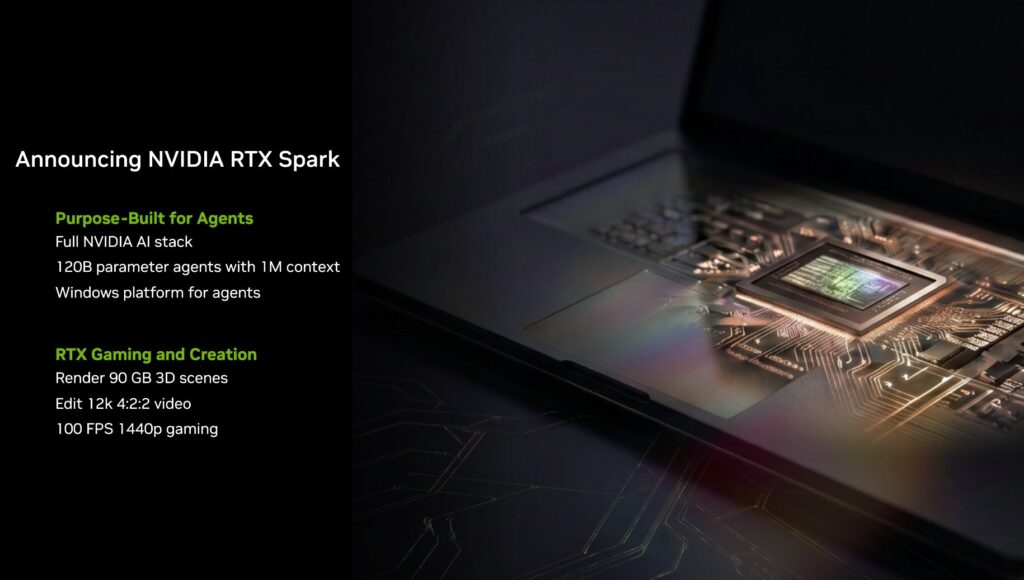
NVIDIA frames RTX Spark around three workloads — AI agents, content creation, and gaming — and the performance claims are aggressive. Per the official release, a top-end RTX Spark system can:
- Render ultralarge 90GB+ 3D scenes with OptiX and DLSS.
- Edit 12K 4:2:2 video using the Blackwell decoder.
- Run 120-billion-parameter LLMs locally with up to 1 million tokens of context.
- Generate 4K AI video.
- Play AAA games at 1440p and over 100 FPS with ray tracing, DLSS, and Reflex.
NVIDIA also previewed new RTX capabilities riding on the platform: DLSS 4.5 Ray Reconstruction featuring a second-generation transformer model (coming to Blender 5.3 and dozens of games), and RTX Video with 4x Frame Generation coming to ComfyUI. According to Tom’s Hardware, the gaming claims may lean on DLSS 4.5 upscaling and Multi Frame Generation, with demos reportedly running Forza Horizon 6 and 007 First Light at 100 FPS at 1440p.
On graphics horsepower, both Engadget and VideoCardz report NVIDIA’s own framing: the Blackwell GPU is “roughly the same class as the RTX 5070 laptop GPU,” but with much lower power draw. That’s a useful expectation-setter — RTX Spark is a midrange-mobile-GPU performance target wrapped in a thin chassis with very large memory, not a desktop-class gaming monster.
The real strategic story: agentic Windows + the CUDA moat
The deepest part of the announcement isn’t the silicon — it’s the software partnership with Microsoft. NVIDIA and Microsoft are co-engineering a Windows platform purpose-built for on-device AI agents.
NVIDIA’s release describes the foundation as “new Windows security primitives and the NVIDIA OpenShell runtime,” delivering identity, containment, and policy controls so agents can run “safely and under full user control.” OpenShell can route queries to local models based on the user’s privacy policies and even disguise personal information in queries sent to cloud models.
This directly addresses the central blocker the company identifies: open-source agent projects like OpenClaw and Hermes Agent have achieved record traction on GitHub and OpenRouter, but adoption has been limited “by the inability to run agents securely and privately on users’ primary PCs.”
Two industry voices anchor the agent story in the official release. Vincent Koc, chief architect at the OpenClaw Foundation, said running OpenShell and Microsoft’s security primitives on RTX Spark “will enable users to leverage a fully integrated stack for private, personal agents running on device.” And Dillon Rolnick, CEO of Nous Research (behind Hermes Agent), said: “You realize you’re buying a full-fledged assistant, not a typical laptop.” Microsoft will expand the collaboration into new RTX Spark agent experiences accessible directly from the Windows taskbar, with more to be revealed at the Microsoft Build keynote running June 2–3.
Why does this matter more than another “AI PC” slogan? Because of CUDA. As the Medium analysis argues bluntly, CUDA is “Nvidia’s real competitive moat.” Virtually every major AI framework — PyTorch, TensorFlow, Hugging Face’s stack, LangChain, llama.cpp — runs optimally on NVIDIA hardware. An RTX Spark laptop runs the same software stack as NVIDIA’s data-center GPUs, something neither Apple Silicon nor Qualcomm can claim today. llama.cpp founder Georgi Gerganov, quoted in the official release, said the platform will “unleash the next wave of personal, private agents,” while ComfyUI’s creator Yannik Marek called it “one of the best-performing laptops to run diffusion models.”
The software readiness problem — and why it’s less scary this time
Windows on Arm has a troubled history. Earlier Arm PC launches stumbled on x86 app compatibility and especially on gaming, where anti-cheat systems blocked popular titles. RTX Spark appears notably more mature.
Microsoft’s Windows blog (Introducing a powerful new chapter for Windows PCs accelerated by NVIDIA RTX Spark) details the tuning: Workload Profile Scheduling, the Microsoft Power and Thermal Framework (MPTF), unified-memory improvements, the Prism x86/x64 emulation layer, and Windows ML access to TensorRT. Windows and devices chief Pavan Davuluri told media the scheduler was tuned so that “whether you’re checking your email or running an agent locally to debug code, the Windows scheduler on RTX Spark will ensure you get the best performance and efficiency.”
On native apps, Microsoft cites Arm-native support for Blender, DaVinci Resolve, Cinema4D, Redshift, Topaz Photo, CapCut, Cubase, Bitwig, Affinity, and MATLAB, with Adobe apps native and receiving further RTX Spark optimizations. On gaming compatibility, Engadget confirms NVIDIA is working with “every” major anti-cheat provider — addressing the exact problem (e.g., Fortnite, Easy Anti-Cheat, BattlEye) that hampered early Snapdragon Copilot+ machines. Riot’s League of Legends and VALORANT, plus PUBG: Battlegrounds, are reportedly coming to the platform, and Xbox, NetEase, Remedy, and KRAFTON are named partners.
Adobe’s commitment is especially notable. CEO Shantanu Narayen confirmed Adobe is rearchitecting Photoshop and Premiere from the ground up for RTX Spark, targeting up to 2x faster AI and graphics performance. Premiere gets a new video pipeline tapping unified memory, the Blackwell GPU, and TensorRT for real-time editing and color; Photoshop gets a GPU-accelerated compositing engine for live filters, HDR, and modern brushing. Substance 3D Painter and Stager will run natively.
The first wave of laptops
NVIDIA expects over 30 laptops and roughly 10 compact desktops at launch, per Tom’s Hardware. The confirmed launch partners are ASUS, Dell, HP, Lenovo, Microsoft Surface, and MSI, with Acer and GIGABYTE to follow. Here’s what each has shown — and, importantly, what’s still missing.
Microsoft Surface Laptop Ultra. Microsoft’s flagship and, per its Surface blog, its most powerful Surface yet. Confirmed: a 15-inch mini-LED PixelSense Ultra touchscreen, 3:2 aspect ratio, 262 ppi, up to 2,000 nits HDR; HDMI, USB-C, USB-A, headphone jack, and a full-size SD card slot; up to 128GB unified memory; a replaceable SSD; less than 18 mm thick; under 4.5 lb; an “all-new thermal system” with up to 2.5x the thermal capacity of the 15-inch Surface Laptop 7th Edition; two finishes; arriving “later this year.” Notably, Microsoft chose mini-LED, not the tandem OLED NVIDIA highlighted at the platform level. Still missing: battery watt-hours, storage tiers, wireless module, panel model, CPU/GPU binning, fan count, and price.
ASUS ProArt P16 (H7607) and P14 (H7407). Per ASUS’s press release, these creator notebooks use ASUS Lumina Pro OLED displays — the P16 up to 4K 120Hz VRR with G-SYNC, the P14 up to 3K — reaching up to 1,600 nits, in CNC-machined ultrathin chassis (Nano Black / Neo White finishes), with up to a 99.9 Wh battery, shipping fall 2026 in select regions. Final storage SKUs, ports, weights, RAM details, and pricing are still TBD.
Dell XPS 16 Creator Edition. Per Dell’s blog, it features a Tandem OLED with True Black HDR 600, HDMI and SD card reader, and up to 128GB unified memory, pitched for smooth 4:2:2 4K playback, faster exports, and AI-assisted creator workflows. Michael Dell framed it as a laptop so “creators shouldn’t have to choose between portability and performance.” Final retail SKU, battery, dimensions, cooling, and price are unpublished.
HP OmniBook Ultra 16 and OmniBook X 14. HP says these will be “among the thinnest RTX Spark laptops,” with a footnote citing rear heights of 15.73 mm (16-inch) and 13.53 mm (14-inch), two Thunderbolt 4 ports, and support for up to four 4K displays. HP says pricing will come closer to launch. Interim CEO Bruce Broussard pitched them as “unprecedented portable power for agentic developers.”
Lenovo Yoga Pro 9n. Per Microsoft’s Windows blog, Lenovo will pair its creator-focused Yoga design with RTX Spark and extended unplugged use. Detailed specs, price, and availability were not yet published in retrieved sources.
MSI Prestige N16 Flip AI+. Unveiled at Computex 2026, this is a 16-inch 2-in-1 flip convertible with a UHD+ Tandem OLED (VRR, 1,000+ nits peak, 100% DCI-P3, Calman Verified, Delta E <1), a 99.9 Wh battery, stylus support, and quad speakers. Exact ports, weight, cooling, and price are not yet public.
Performance: what we know vs. what’s still missing
Here’s the honest part. As of the announcement window, there are no independent, shipping-laptop benchmark reviews of RTX Spark — no 3DMark, no Cyberpunk frame-time logs, no Blender or PugetBench runs, no battery-loop or fan-noise measurements from reputable reviewers. NVIDIA provided no benchmarks or head-to-head comparisons at launch beyond the “RTX 5070-class” framing.
The only meaningful performance proxies available today are:
- A pre-launch Geekbench entry for the NVIDIA N1X engineering sample — a close stand-in for the same Grace/Blackwell notebook class.
- The already-shipping DGX Spark GB10 desktop reference, which shares the design philosophy but runs at a desktop power envelope (and therefore is not a laptop result).
From your research file’s Geekbench compilation, the directional CPU context looks like this (treat as rough, not final): the N1X engineering sample landed around ~3,100 single-core / ~18,500 multi-core, DGX Spark GB10 around ~3,250 / ~19,500, HP’s AMD Strix Halo–based ZBook Ultra G1a around ~3,150 / ~21,000, and the Apple MacBook Pro 16 with M4 Max well ahead at roughly ~3,800 / ~25,000. The takeaway: on raw CPU, the Grace cores look competitive but not class-leading, with Apple’s M4 Max and AMD’s Strix Halo ahead in multi-core. RTX Spark’s differentiator is meant to be the GPU + CUDA + unified-memory combination, not CPU dominance.
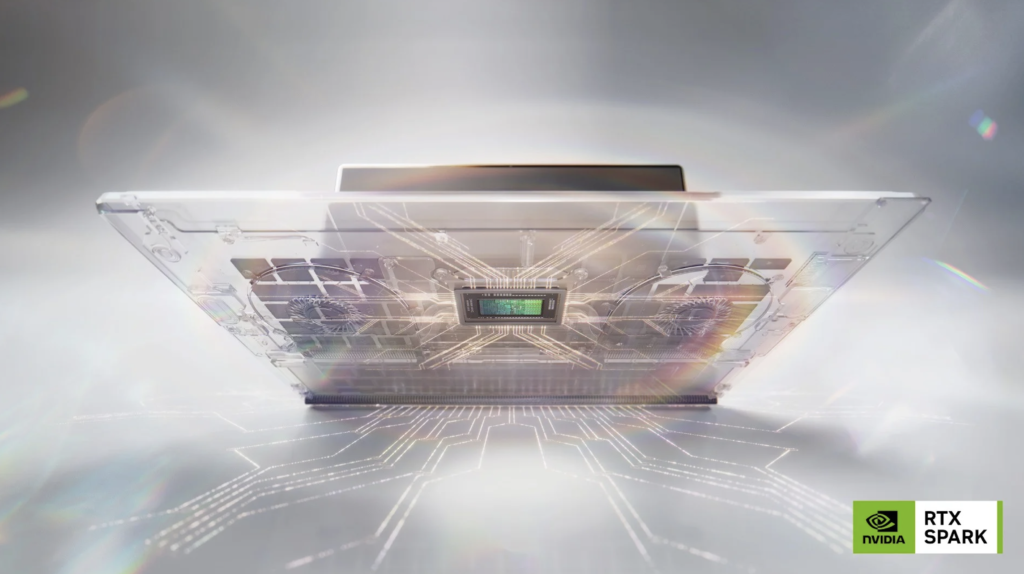
On thermals and acoustics, laptop-level disclosure is thin. NVIDIA says laptops can be as slim as 14 mm and as light as 3 lb; Microsoft cites its 2.5x thermal-capacity figure; ASUS mentions “ultra-thin thermal modules.” But no first-wave spec page published fan counts, heatpipe/vapor-chamber layouts, per-mode power limits, sustained clocks, or throttling thresholds. The only hard thermal/acoustic numbers come from the DGX Spark desktop reference (a 140W GB10 SoC TDP, 240W external PSU, ~29 dB(A) sound pressure under max GPU stress) — useful platform context, but not transferable to Surface, ASUS, Dell, HP, Lenovo, or MSI notebook acoustics.
One encouraging operational claim, echoed by Tom’s Hardware: RTX Spark systems should deliver similar performance plugged in or unplugged, as we’ve come to expect from Apple Silicon and other Windows-on-Arm machines — a meaningful contrast to traditional gaming laptops that throttle hard on battery.
How RTX Spark compares to the competition
RTX Spark’s real competitive set isn’t “all laptops.” It’s the cluster of premium creator / AI-developer / hybrid-gaming notebooks where buyers care about GPU software stack, memory topology, display quality, and mobility simultaneously.
vs. Apple MacBook Pro (M4 Max). This is the toughest comparison and the one RTX Spark is most clearly built to challenge. Apple has spent three years executing the “unified memory + local AI + elite battery life” thesis. The M4 Max offers 36GB standard, configurable to 128GB, with class-leading efficiency. NVIDIA’s edge is raw AI compute (1 petaFLOP FP4 vs. roughly tens of teraFLOPS on M-series) and, decisively, the CUDA ecosystem that Apple simply doesn’t have. Apple’s counter is maturity, efficiency, and a proven macOS experience. As Yahoo Finance notes, getting 128GB on a MacBook Pro today costs around $5,099 — which sets a useful mental anchor for RTX Spark pricing.
vs. AMD Strix Halo (e.g., HP ZBook Ultra G1a). This is the closest Windows alternative if your priority is large unified memory in a compact chassis rather than CUDA specifically. The Ryzen AI Max+ platform already offers a strong integrated GPU and up to 128GB shared memory, and as the Geekbench proxies suggest, it may actually lead RTX Spark in multi-core CPU. The differentiator therefore lands on GPU behavior, developer tooling (CUDA/OptiX/TensorRT), and actual app optimization — not CPU scores.
vs. Qualcomm Snapdragon X2. Qualcomm pioneered the modern Windows-on-Arm push and already ships systems with good battery life. But RTX Spark should significantly outclass it on raw AI compute and, more importantly, on gaming and the CUDA developer story. Qualcomm’s advantage is simply being on shelves now.
vs. current RTX dGPU creator notebooks (ASUS ProArt P16, Dell 16 Premium). Against today’s RTX 5070-class creator laptops, RTX Spark’s promise isn’t “more GPU wattage” — it’s far more addressable shared memory for local models and big creative datasets, plus a tighter CPU/GPU memory path. For certain AI and large-video workflows, that could beat an 8GB-dGPU notebook even if conventional gaming lands closer to midrange mobile RTX parts.
Pricing and availability: the biggest open question
This is the weakest part of the launch picture. No RTX Spark device has a confirmed price. NVIDIA announced the platform and partner roster but published no laptop MSRPs. Microsoft, HP, ASUS, and MSI all deferred pricing to “closer to launch.” NVIDIA now says the first RTX Spark Windows PCs from the six launch partners will ship in October 2026, with other partner models following.
Two practical notes. First, NVIDIA told Yahoo Finance that the first systems target the premium market, with cheaper, lower-memory variants to follow — so expect the launch SKUs to be expensive. Second, despite an ongoing global memory shortage, NVIDIA said it does not expect RTX Spark laptop supply to be constrained at launch. As the Medium analysis cautions, if first-wave devices land above ~$2,500, mass adoption will be slow; the launch prices are the single most important data point still missing.
The roadmap: this is a multi-generation bet
RTX Spark isn’t a one-off. Per Tom’s Hardware’s roadmap coverage and the Medium analysis, NVIDIA outlined three generations:
- Gen 1 — Fall 2026: Blackwell (N1X). LPDDR5X, up to 128GB, ~1 PFLOP FP4, TSMC 3nm. What’s launching now.
- Gen 2 — 2027: Rubin. Moves to LPDDR6 for higher bandwidth, with a next-gen Vera CPU and significant AI gains.
- Gen 3 — 2028+: Rosa, then Feynman. Two further architectures already named, mirroring the near-annual cadence of NVIDIA’s data-center roadmap.
NVIDIA also confirmed at the same event that its Vera data-center CPU is now in full production and previewed a DGX Station for Windows — scaling Blackwell to enterprise developers with a deskside AI supercomputer. The clear message: NVIDIA is treating the PC as a long-term strategic front, not an experiment.
Strengths, weaknesses, and the honest caveats
Based on today’s evidence, the likely strengths are: large unified memory (up to 128GB) plus full CUDA/RTX on a thin, portable Windows machine; a far more mature AI/creator software story than typical first-gen Arm launches; strong creator displays and maker-friendly ports on several designs; consistent plugged/unplugged performance; and a genuinely credible shot at challenging Apple on unified-memory scale while keeping NVIDIA’s tooling.
The likely weaknesses and risks: shipping-laptop thermals, acoustics, and sustained performance are unverified; Windows-on-Arm compatibility, while much improved, remains a variable for niche tooling and custom driver stacks; component-level transparency (SSD models, RAM ICs, panel IDs, wireless chips) is poor for most systems; gaming claims lean heavily on DLSS/MFG marketing language and need frame-time validation; and pricing is a complete unknown. The Medium analysis adds a sharp point: sustained agentic AI workloads (agents running continuously in the background) present a different thermal profile than gaming spikes, so “all-day battery life” claims for AI work specifically need real-world testing.
To be rigorous about the limits of this guide: several figures here — CPU clocks (~4.1 GHz), the ~70-billion-transistor count, specific memory-bandwidth numbers (the 300 GB/s vs. 600 GB/s NVLink figures describe different things — system memory bandwidth vs. CPU-GPU interconnect), and the Geekbench proxy scores — come from press analysis and engineering-sample data, not from final, NVIDIA-certified shipping-laptop spec sheets. Treat them as directional. The hard, officially confirmed facts are the 20-core Grace CPU, the 6,144-CUDA-core Blackwell GPU, up to 128GB unified memory (16GB–128GB range), up to 1 petaFLOP FP4, the 80W power ceiling, NVLink-C2C, Windows 11 on Arm, and the partner/availability roster.
Who should actually care
- AI developers and engineers: the most compelling audience. Running 70–120B-parameter models locally, fine-tuning on-device, and building agents without a cloud bill — all on the same CUDA stack as the data center — is genuinely differentiated. If pricing is reasonable, it’s a near-default choice.
- Content creators and 3D/video professionals: Adobe’s ground-up rebuild of Photoshop and Premiere, native DaVinci Resolve and Blender, 12K 4:2:2 editing, and large unified memory for big assets make this a serious mobile creator platform — especially for those handling sensitive client work they’d rather not push to the cloud.
- Hybrid creator-gamers: one premium machine for work plus RTX 5070-class 1440p gaming with DLSS, in a thin chassis with strong battery. Promising, but wait for game-by-game compatibility confirmations and real frame-time reviews.
- Less ideal, for now: price-sensitive gamers, Linux-first mobile developers (no Linux laptop support was announced — RTX Spark is Windows-only, while DGX Spark uses Ubuntu-based DGX OS), and buyers who refuse launch-risk hardware without teardown-grade transparency.
The bottom line
RTX Spark is one of the most ambitious notebook-platform announcements NVIDIA has ever made because it aims to combine things the mobile market has never fused well in one machine: large unified memory, full CUDA/RTX compatibility, premium creator displays, thin-and-light chassis, and Windows-native local AI agents. Backed by Microsoft, Adobe, and a six-OEM launch roster, plus a three-generation roadmap stretching to Rubin, Rosa, and Feynman, it’s clearly a long-term strategic invasion of Intel and AMD’s home turf — and the stock market’s reaction suggests the incumbents agree.
But as of NVIDIA’s September update, the thesis is strong and the proof is still pending. There’s no full SKU stack, no published prices, no independent benchmarks, and no shipping-laptop thermal/acoustic data. The smart move is to track three things before the October launch: (1) OEM pricing and preorder announcements, (2) the first independent reviews with battery, noise, and frame-time logging, and (3) the Windows-on-Arm game and app compatibility lists.
If the shipping laptops deliver even most of what NVIDIA and its partners promise, RTX Spark could become the first genuinely new notebook class in years. If they don’t, it’ll be remembered as a bold platform thesis that outran its evidence. Right now, it’s high-potential — but not yet fully validated.
The Kingy Brief
Get The Kingy Brief.
AI changes, original tests and one practical thing to try. Fridays at 09:00 Vancouver time.
Free · Double opt-in · Unsubscribe anytime
Sign up for The Kingy Brief on Beehiiv.
Signup help and newsletter schedule
Signup form provided by Beehiiv. After submitting, check your inbox for "Confirm your subscription to The Kingy Brief" and open its confirmation link. Check Spam or Promotions if you cannot find it.
Fridays at 09:00 Vancouver time: source-checked AI changes, original tests and one practical thing to try. We skip a week when there is not enough verified material. Free. Unsubscribe anytime.