
The answer in one sentence: Z.ai’s GLM‑5.3‑Flash launch is credible evidence that a frontier-class open-weight model can be served at production scale on Chinese AI accelerators, but it does not prove that the model was trained without Nvidia, that the domestic stack is cheaper per useful result, or that it matches a named Nvidia system under controlled conditions.
One sentence in Z.ai’s launch announcement deserves more scrutiny than another benchmark table: all traffic for Ox Alpha, the model’s anonymous public preview, was served on Chinese AI chips.
Z.ai says this was not a demonstration cluster handling a few curated prompts. The company describes tens of thousands of domestic accelerators, a custom SGLang inference stack, high-bandwidth interconnect and an Encode–Prefill–Decode architecture. It reports a threefold end-to-end performance improvement over its initial baseline on the same hardware and claims efficiency and per-token cost comparable with mainstream Nvidia GPUs.
That is significant. It is also incomplete.
The official disclosure does not name the accelerator, publish the exact cluster count, show power consumption, define the workload behind “3×,” disclose utilization or identify the Nvidia system used for the cost comparison. There is no independent audit. Most importantly, the claim concerns inference—serving prompts after a model exists—not the compute used to train GLM‑5.3‑Flash.
Kingy evidence position: The Ox Alpha run is a strong systems-engineering signal and a meaningful milestone for non-Nvidia AI deployment. Treat it as proof of operational inference at scale, not proof of end-to-end chip independence or a benchmark victory over Nvidia.
The proof ladder
| Claim | Evidence available | Confidence |
|---|---|---|
| Ox Alpha was GLM‑5.3‑Flash | Z.ai’s first-party launch disclosure and released model | High for identity |
| All preview traffic ran on Chinese AI chips | Z.ai’s explicit first-party statement | Medium-high; not independently audited |
| The deployment used tens of thousands of accelerators | First-party description | Medium; exact count and chip mix undisclosed |
| The optimized stack delivered 3× its initial performance | First-party result on the same hardware | Medium; baseline and workload details incomplete |
| Per-token cost is comparable to mainstream Nvidia GPUs | First-party claim | Low-medium; denominator and cost model undisclosed |
| GLM‑5.3‑Flash was trained on Chinese chips | No supporting primary evidence reviewed | Unsupported |
| Chinese accelerators generally match Nvidia | No controlled cross-hardware benchmark published | Unsupported |
This hierarchy is the heart of the story. A first-party operational claim can be meaningful without being independently verified. What it cannot do is silently expand into claims the source never made.
Inference is not training
Training builds the model. It performs vast forward and backward passes, updates weights and demands high-precision numerical stability plus an efficient distributed-training stack. Inference uses the finished weights to process user prompts and generate output. It has different bottlenecks: model loading, KV-cache capacity, prompt prefill, token-by-token decode, routing, batching and network communication.
Z.ai’s announcement documents the second workload. The company says Ox Alpha traffic was served entirely on Chinese AI chips and describes the inference optimizations that made it possible. It does not disclose the hardware used for the 30-trillion-token multimodal pretraining run.
That distinction does not diminish the deployment. Inference becomes the recurring economic burden once a model is popular. It is where API providers face millions of uneven requests, bursty traffic, long contexts and strict latency targets. A domestic stack capable of handling that load reduces one important dependency even if training remains opaque.
It also explains why the headline should not be “GLM‑5.3‑Flash was built entirely on Chinese chips.” “Served entirely” is supported. “Trained entirely” is not.
Why GLM‑5.3‑Flash is designed for the serving problem
The model and the serving system appear to have been engineered together. GLM‑5.3‑Flash uses a 320B/18B-active mixture-of-experts design with 45 layers. Thirty-four layers use linear attention and 11 use sparse attention; the first three layers are dense. Each token selects eight routed experts from 288, alongside one shared expert.
Z.ai reports that this hybrid architecture reduces attention compute by 3.01× and per-layer KV-cache size by 4.44× compared with GLM‑5.3. These are vendor estimates rather than independent measurements, but they target exactly the constraints that make very long-context inference expensive.
Attention compute
Conventional attention becomes costly as context grows because tokens interact across an expanding sequence. Linear-attention mechanisms trade some of that structure for a more scalable computation. GLM‑5.3‑Flash does not use one mechanism everywhere: it alternates many linear layers with a smaller number of sparse-attention layers, attempting to keep important global reasoning while lowering the recurring cost.
KV cache
Autoregressive inference stores key and value states so every new token does not recompute the entire prefix. At long context and high concurrency, this KV cache becomes a capacity problem in its own right. Reducing it can admit more simultaneous requests or longer prompts on the same cluster.
Z.ai explicitly acknowledges that Flash’s cache remains slightly larger than Kimi K3 and DeepSeek V4 Flash. That is a useful note of restraint. The architecture may be more efficient than GLM‑5.3 without being the minimum-cache design in its class.
Expert routing
A mixture-of-experts model activates a subset of its total weights for each token. That reduces arithmetic relative to a dense 320B model, but it creates a communications problem: the right experts may live on different devices. The cluster must route tokens quickly, balance load and avoid stragglers. This makes high-bandwidth interconnect and scheduling software essential rather than decorative infrastructure.
The serving stack Z.ai says made it work
Z.ai names a set of optimizations in its custom SGLang stack. Each addresses a different bottleneck.
| Component | Role in the system | Why it matters |
|---|---|---|
| Tensor parallelism | Splits model operations across accelerators | Makes very large layers executable but adds communication overhead |
| ReplaySSM | Optimizes state-space/linear-attention execution | Targets efficient replay and state handling in the model’s linear layers |
| W8A8 | Uses 8-bit weights and activations where supported | Reduces memory traffic and compute demand, subject to quality control |
| Mixed INT8/FP8/BF16 cache | Uses different numerical formats for cache elements | Trades precision for capacity and bandwidth in a controlled way |
| Layer Split | Distributes layers or layer work across devices | Helps fit and balance the model on the available accelerator topology |
| Encode–Prefill–Decode disaggregation | Separates three phases onto specialized resource pools | Prevents long prompt ingestion from starving token generation |
| High-bandwidth interconnect | Moves expert and tensor data between devices | Critical for MoE routing and parallel execution at cluster scale |
| Infrastructure agent | GLM-powered tooling assisted engineers | Suggests AI-supported operations; Z.ai does not quantify its contribution |
The software story matters because raw peak FLOPS rarely predicts production model performance. Kernels, compiler maturity, communication collectives, memory layout, quantization, routing and scheduler policy determine how much of a chip’s advertised capability becomes useful tokens.
This is particularly important for domestic accelerators. Nvidia’s advantage is not only silicon; CUDA, libraries, profilers and years of operational knowledge form a mature system. A competing deployment has to close software gaps as well as provide compute.
Encode–Prefill–Decode: the most consequential design choice
Most discussions divide inference into prefill and decode. Z.ai describes three pools: encode, prefill and decode.
- Encode processes multimodal inputs such as images or documents into representations the language model can use.
- Prefill ingests the prompt and constructs the initial state and KV cache. This phase is relatively parallel and compute-intensive.
- Decode generates subsequent tokens one by one. It is latency-sensitive and often limited by memory bandwidth.
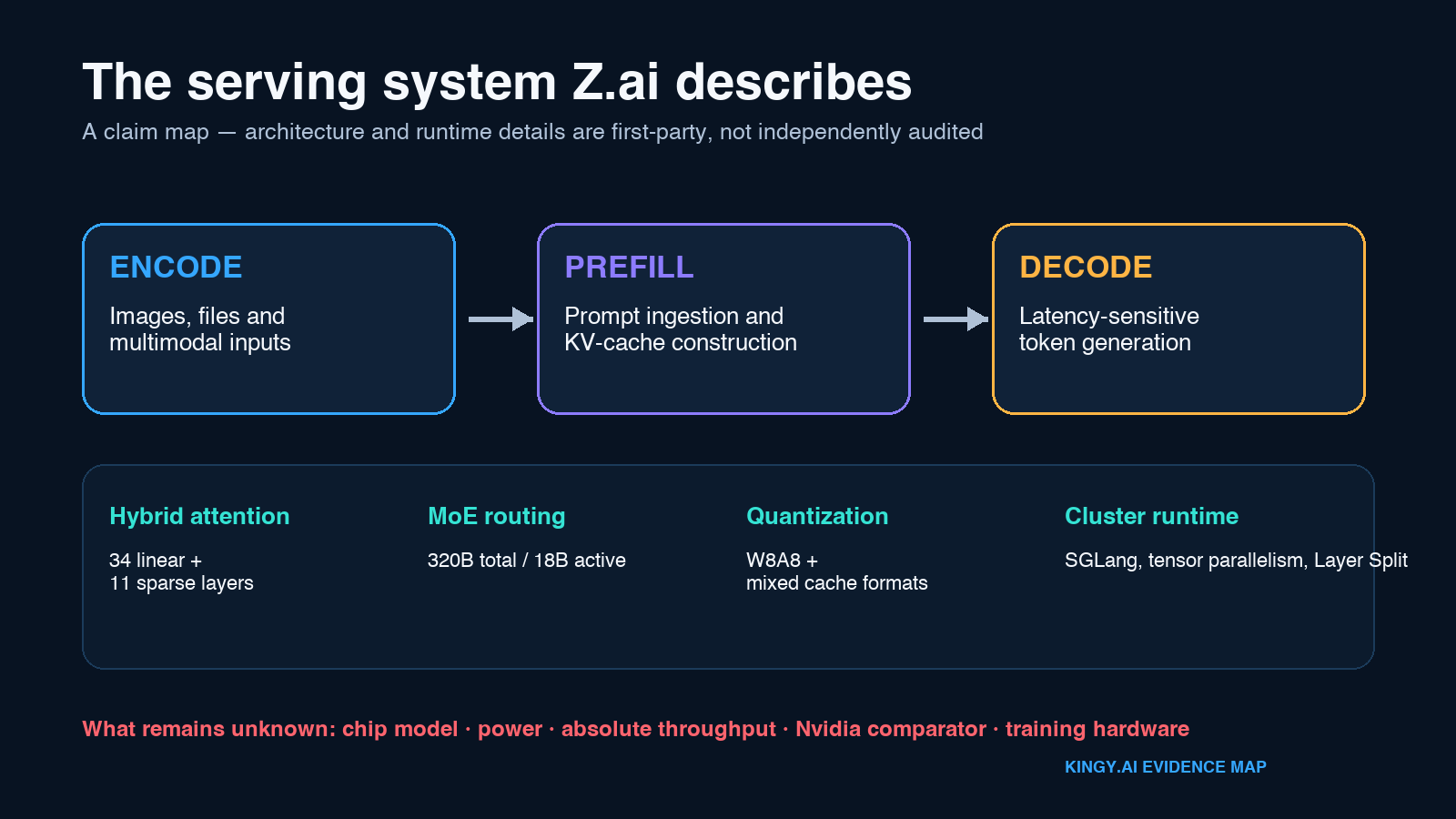
Running these phases on separate resources can raise utilization because they have different computational shapes. A large document upload no longer has to occupy the same serving lane as a short interactive response. Operators can scale the pools independently and route work according to phase.
Disaggregation is not unique to Z.ai, but implementing it across a large domestic-accelerator cluster for a multimodal MoE is a substantial engineering task. It also makes the threefold improvement plausible as a system optimization even if the underlying chips did not change.
The missing measurement is how the gain was distributed. Did it reduce time to first token, increase output tokens per second, raise concurrent capacity or all three? Did quality change under W8A8 and mixed-cache precision? “End-to-end performance” is too broad to answer.
Why Ox Alpha was a meaningful stress test
Ox Alpha appeared anonymously through OpenCode and OpenRouter before Z.ai revealed the model. That setup had two advantages for the launch.
First, users did not know they were testing a Z.ai model, reducing brand-conditioned expectations. Second, the providers exposed the system to real coding and agent traffic rather than a fixed benchmark packet. Kingy’s definitive Ox Alpha identity and GLM‑5.3‑Flash record documents the reveal, availability and pricing context.
Real traffic is valuable because it includes uneven prompt lengths, bursts, retries, tool traces and failure modes that controlled benchmarks can miss. Z.ai says every one of those preview requests ran on the domestic stack.
But production traffic is not automatically a public benchmark. The launch page does not publish the request distribution, success rate, cache-hit rate, service-level target, queue delay or total output. OpenCode and OpenRouter posted very large aggregate token figures during the preview, but the definitions, overlap and accounting boundaries are not sufficiently documented to convert those posts into a clean throughput number here.
The defensible conclusion is operational: the system served a large, uncontrolled public workload. The exact performance envelope remains undisclosed.
What the 3× improvement actually means
Z.ai says its optimized inference stack achieved a threefold end-to-end improvement over the initial baseline on the same hardware.
That wording is important. A same-hardware comparison isolates software, architecture and systems work better than a cross-chip claim would. It suggests the team found substantial gains through quantization, phase disaggregation, parallelism, cache design and kernel work.
It does not tell us the absolute starting point. A system that improved from 10 to 30 tokens per second and one that improved from 100 to 300 both deliver 3×. Nor does the release define whether the measured quantity is throughput, latency, cost capacity or a composite metric.
For buyers, the correct takeaway is that software optimization materially changed the economics of the domestic cluster. The incorrect takeaway is that the chips themselves became three times faster or now outperform an Nvidia cluster.
“Comparable to Nvidia” needs a denominator
Z.ai says the deployment achieved efficiency and per-token costs comparable to mainstream Nvidia GPUs. That could be an important result. It is also the least auditable sentence in the launch.
A useful comparison would disclose:
- The Nvidia accelerator model and precision.
- The domestic accelerator model or mix.
- Servers, interconnect and device count.
- Input/output token mix and context distribution.
- Batch size, concurrency and cache-hit rate.
- Time to first token and output tokens per second.
- Power at the wall, not only board ratings.
- Capital cost, amortization period and utilization.
- Model quality under each quantization configuration.
- The definition of a billable or successful token.
Without those inputs, “mainstream Nvidia GPUs” could refer to several generations with radically different cost and performance. Procurement price in China also differs from global list price, while export controls change availability and replacement cost. A per-token comparison can move depending on whether it includes power, networking, staff, spare capacity and failed requests.
This does not make the claim false. It makes it a hypothesis awaiting a transparent benchmark.
Which Chinese chips were used?
Z.ai does not say.
That absence prevents readers from attributing the result to Huawei Ascend, Moore Threads, Hygon or any other vendor. Secondary reporting has speculated about possible suppliers and a larger chip count, but the company has not confirmed the accelerator identity or whether the fleet is homogeneous.
The difference matters. A deployment across one mature accelerator type is a different engineering achievement from a heterogeneous fleet requiring multiple kernels and schedulers. It also changes how readily another company could reproduce the result.
Until Z.ai publishes the bill of materials, the precise language is Chinese AI accelerators or domestic chips. Naming a vendor as fact would outrun the evidence.
What this changes for the AI market
1. Inference sovereignty is becoming practical
The deployment indicates that Chinese model providers can operate a competitive public model without routing every inference token through Nvidia hardware. That reduces exposure to export controls and supply shocks for the recurring serving workload.
2. Model architecture is adapting to constrained hardware
GLM‑5.3‑Flash is not merely a large model dropped onto alternative chips. Hybrid attention, smaller KV cache, low active parameters and quantization-aware serving all reduce pressure on the hardware. This is co-design: change the model and the runtime together.
3. Software is the strategic layer
The reported 3× improvement on unchanged hardware suggests the largest near-term gains may come from compilers, kernels, routing and scheduling. Domestic silicon does not need to match every Nvidia specification if the complete serving system delivers acceptable cost and latency.
4. Low API pricing is a market signal, not a cost audit
GLM‑5.3‑Flash lists at $0.15 per million input tokens and $0.50 per million output tokens, with a launch promotion at half price. Those rates indicate confidence in serving economics or a willingness to subsidize adoption. They do not reveal Z.ai’s actual margin.
Our independent GLM‑5.3‑Flash review and five-task test examines whether the model quality is sufficient for that price to matter.
5. Nvidia’s moat is pressured, not erased
One production deployment does not dissolve Nvidia’s ecosystem, training leadership or global installed base. It does show that the market can route around part of the dependency when incentives are strong. The strategically important shift is from “Can it run?” to “How efficiently, at what quality, and with which disclosed hardware?”
The questions Z.ai still needs to answer
A rigorous follow-up should ask:
- Which accelerator models and quantities served Ox Alpha?
- Was the cluster homogeneous, and what interconnect topology did it use?
- What exact metric improved 3×, over which workload and time window?
- What were median and p95 time to first token, output speed and queue delay?
- How did W8A8 and mixed cache precision affect benchmark quality?
- What was average accelerator utilization and wall-power draw?
- Which Nvidia GPU, software stack and purchasing assumptions define “comparable” cost?
- Did the cost comparison include networking, staff, redundancy and idle capacity?
- What training hardware was used for GLM‑5.3‑Flash?
- Will Z.ai publish a reproducible inference recipe and performance trace?
These are not gotcha questions. They are the data required to turn an impressive first-party deployment into an industry reference point.
Frequently asked questions
Did GLM‑5.3‑Flash run entirely on Chinese AI chips?
Z.ai says all inference traffic for the Ox Alpha preview ran on Chinese AI accelerators. The statement is first-party and has not been independently audited. It does not establish the hardware used to train the model.
Was GLM‑5.3‑Flash trained without Nvidia GPUs?
There is no supporting primary evidence in the launch materials reviewed here. Z.ai’s detailed domestic-chip claim is about serving and inference, not pretraining.
Which Chinese accelerator powered GLM‑5.3‑Flash?
Z.ai has not named the chip model or supplier. Reports and social posts speculating about Huawei, Moore Threads or Hygon should not be treated as confirmation.
What does Encode–Prefill–Decode disaggregation do?
It separates multimodal encoding, prompt ingestion and token generation into independently scaled resource pools. Because the phases stress hardware differently, separation can improve utilization and prevent long prompts from blocking interactive decoding.
Did Chinese chips beat Nvidia in this launch?
No controlled, named comparison was published. Z.ai says efficiency and per-token cost were comparable with mainstream Nvidia GPUs, but it does not identify the GPU, workload, power, utilization or cost method.
Why does the 3× speedup matter?
It shows that software and model-serving design can unlock much more capacity from the same hardware. It does not mean the chip itself became 3× faster, and the release does not provide enough data to compare absolute performance with another platform.
Final assessment
GLM‑5.3‑Flash’s Chinese-chip deployment matters because it moved beyond a laboratory claim. An anonymous public model handled real agent traffic on a domestic stack, and Z.ai has described a coherent combination of hybrid attention, lower KV-cache demand, expert routing, quantization and phase-disaggregated serving.
The evidence stops at the edge of that achievement. We do not know the chip, the power, the absolute throughput, the utilization or the Nvidia denominator. We do not know the training hardware. No independent party has reproduced the 3× result.
The balanced verdict is therefore strong but bounded: Z.ai has demonstrated a plausible path to large-scale, non-Nvidia inference. It has not yet published the data needed to prove economic or performance parity.
Methodology and primary sources
This analysis separates first-party disclosures, public repository facts and secondary reports. Architecture and performance figures are attributed to Z.ai unless otherwise stated. We did not infer chip vendors from ecosystem partnerships, and we did not treat inference as evidence about training. Z.ai did not provide briefing access or unpublished data for this article.
Primary sources:
- Z.ai: GLM‑5.3‑Flash — Built for Speed
- Official GLM‑5.3‑Flash model repository
- GLM‑5.3‑Flash configuration
- Z.ai API pricing
- SGLang project
The Kingy Brief
Get The Kingy Brief.
AI changes, original tests and one practical thing to try. Fridays at 09:00 Vancouver time.
Free · Double opt-in · Unsubscribe anytime
Signup help and newsletter schedule
Signup form provided by Beehiiv. After submitting, check your inbox for "Confirm your subscription to The Kingy Brief" and open its confirmation link. Check Spam or Promotions if you cannot find it.
Fridays at 09:00 Vancouver time: source-checked AI changes, original tests and one practical thing to try. The weekly restart begins October 9, 2026. We skip a week when there is not enough verified material. Free. Unsubscribe anytime.