
MIT Has Entered Its “Rethink Everything” Era
Artificial intelligence has already wandered into lecture halls, coding assignments, research labs, and late-night study sessions. MIT’s response is not to pretend the door remains closed. It is opening the door, switching on the lights, and asking a much harder question: What should college accomplish when software can produce work that once looked like proof of learning?
That question drives the new report from MIT’s Ad Hoc Committee on AI Use in Teaching, Learning, and Research Training, released publicly on August 25, 2026. MIT formed the committee in January to examine how instructors and students use AI, identify better approaches to teaching and assessment, and propose a policy for AI use.
The resulting message reaches far beyond “Should students use ChatGPT?” MIT sees a structural challenge. Essays, code, summaries, and analyses may still look polished, but the finished product can no longer prove, by itself, what its author understands.
MIT President Sally Kornbluth calls the moment a watershed for MIT and higher education. The institution that helped shape modern computing is effectively saying the syllabus needs more than a software-policy patch.
The Report Moves Beyond the Cheating Panic
The easiest AI conversation in education is also the least useful one: catch the cheaters. MIT’s committee pushes past that framing. Academic integrity matters, but policing output does not solve the deeper problem. If a machine can generate a respectable answer, educators must reconsider what the assignment was supposed to reveal.
The report organizes MIT’s response around three broad priorities. First, the Institute should build “AI-aware” educational processes. That means revisiting what students need to learn, changing assessments, and giving courses clear rules. Second, MIT should protect people, community, and residential education. Third, it should create permanent processes, teams, and tools that allow policy to evolve alongside the technology.
As MIT Admissions’ Chris Peterson observed, the document anchors its response in the Institute’s longstanding purpose: developing human powers of discovery, invention, and problem-solving.
Every Class Needs Rules That Make Sense
MIT does not propose one universal switch labeled “AI: on or off.” It wants every course to explain when students must use AI, may use it, or must leave it alone. That sounds simple. In practice, it forces instructors to identify what each exercise actually teaches.
A writing class might allow AI to critique a finished draft while prohibiting it during the first attempt. A computer science instructor might require students to build foundational algorithms without assistance before introducing coding agents. A laboratory course could permit AI-supported analysis but still require physical experimentation and an in-person defense of the conclusions.
Clear rules also help students. Vague warnings create a campus-wide guessing game in which one professor welcomes AI, another bans it, and a third announces a policy that reads like it was negotiated by twelve lawyers during a thunderstorm. Course-specific guidance tells students what intellectual work remains theirs and why.
Assessment Is Where the Floor Starts Moving
For decades, universities have treated finished work as evidence. Submit the essay. Upload the code. Hand in the problem set. Receive the grade. Generative AI weakens that chain because a strong-looking submission may reveal more about the tool than the student.
As Forbes’ analysis of the MIT report argues, assessment may become the first part of higher education that needs rebuilding. MIT’s recommendations point toward richer proof of learning: hands-on work, conversations, demonstrations, iterative drafts, oral defenses, and direct observation of problem-solving.
The distinction is crucial. Graduates will enter workplaces where AI fluency increasingly matters. A university that bans the technology everywhere prepares students for yesterday. But a university that verifies nothing without AI risks awarding credentials to excellent prompting and borrowed cognition. MIT wants both lanes: unaided competence and responsible tool use.
Hands-On Learning Gets a Surprise Promotion
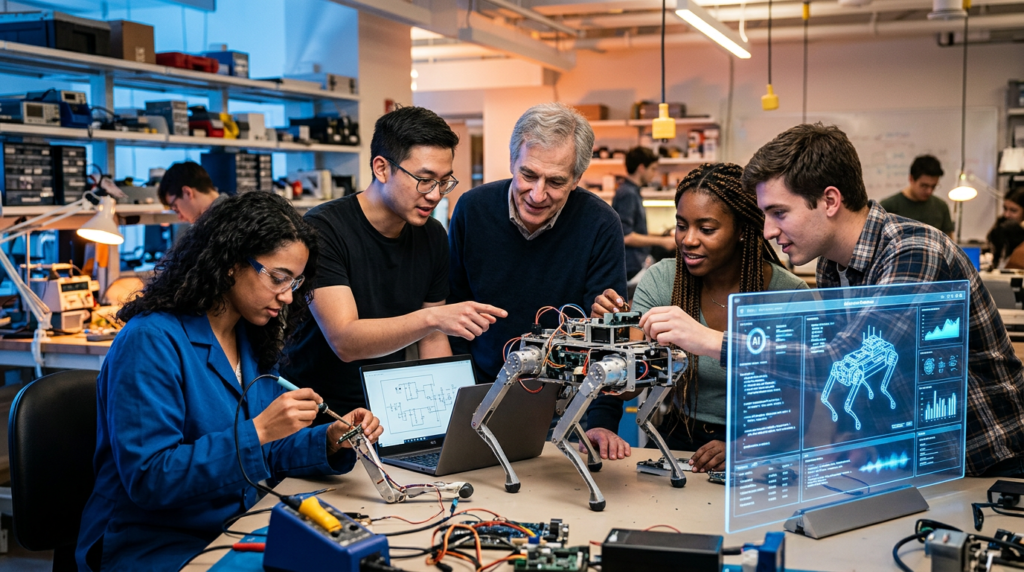
AI makes digital output abundant. It does not make lived experience abundant. That changes the value equation inside a university.
When a chatbot can explain thermodynamics, the laboratory becomes more—not less—important. When a model can draft an argument, a live seminar reveals whether the student can defend it. When an agent can generate code, watching someone diagnose a stubborn failure becomes unusually informative. The messy parts of learning suddenly carry premium status.
MIT therefore calls for renewed attention to hands-on education. That fits the Institute’s culture, but the logic applies widely. Building, testing, presenting, debating, revising, and collaborating reveal how people think when an answer does not arrive in a neat text box.
The shift does not demote knowledge. It changes how schools confirm it. Students still need facts, concepts, and technical foundations. They also need the judgment to connect those foundations to unpredictable reality. AI can accelerate a task. It cannot retroactively supply understanding that a learner never built.
The Residential Campus Becomes More Valuable, Not Less
If tutoring, drafting, and coding assistance become cheap and available everywhere, why live on campus at all? MIT’s answer is striking: because education is not merely information delivery.
The report places people, community, and the residential experience near the center of its strategy. A university gathers students and teachers in laboratories, workshops, studios, dining halls, clubs, and gloriously chaotic team projects. Those settings build relationships and create forms of learning that are difficult to package as an automated service.
A professor can notice hesitation before a student gives a wrong answer. Teammates can challenge one another’s assumptions. A hallway conversation can connect two ideas that never shared a course number. These moments are inefficient in the best possible way.
MIT is not claiming that software cannot support community or tutoring. It is arguing that human interaction becomes scarcer—and therefore more valuable—as machine-generated guidance becomes plentiful. The campus is no longer just where students access expertise. It is where they practice thinking with other humans, accept criticism, negotiate responsibility, and discover that group projects remain undefeated in their ability to reveal character.
MIT’s Disaster AI Shows Why Judgment Matters
The timing offers a useful illustration. One day before MIT released its education story, researchers announced a machine-learning approach that can generate plausible extreme events without needing examples of those extremes in its training data.
The Medium article supplied as a source describes the system as AI that can “imagine” disasters that never happened. The metaphor is catchy, but the technical description is more precise. According to MIT News’ primary account, Extreme Event Aware, or η-learning, combines statistical information about rare outcomes with spatial data to generate plausible maps of unprecedented storms and other hazards.
Researchers trained a demonstration using precipitation data. The method could generate possible locations, coverage areas, and intensities for rare rainfall events, even when the training subset contained few or no comparable extremes. Potential applications include floods, wildfires, robotic navigation, and financial markets.
This research did not come from the education committee, and the two projects should not be conflated. Yet η-learning neatly illustrates MIT’s educational dilemma. A powerful output is only the beginning. Humans still must inspect assumptions, understand probabilities, recognize limitations, and decide whether a simulated catastrophe should influence a seawall, power grid, or public budget.
AI Fluency Cannot Mean Blind Trust
MIT wants students to become capable AI users. That does not mean celebrating every generated answer with the enthusiasm of a golden retriever greeting a tennis ball.
Real fluency includes knowing when to use a tool, how to test its output, and when to reject it. In the disaster-modeling example, a vivid map may feel authoritative. Yet it represents a statistically plausible scenario, not a prophecy. Engineers and planners must understand the data, model design, uncertainty, and real-world constraints before making decisions.
The same principle applies in classrooms. A student who accepts fluent nonsense has not mastered AI. Neither has a student who produces correct work but cannot explain it. Skilled use requires domain knowledge because checking an answer is impossible when the user lacks any basis for recognizing an error.
MIT’s goal is therefore not “AI everywhere.” It is calibrated use. Sometimes the model joins the team. Sometimes it stays on the bench. Wisdom lies in knowing which game is being played.
Teachers Need Support, Time, and Room to Experiment
Course redesign does not happen because administrators publish an inspiring PDF. Faculty need examples, training, technical support, and time. MIT plans to develop guidance, pilot funding, and discipline-specific communities of practice so instructors and researchers can compare methods, document failures, and improve policies.
That collaborative model acknowledges an obvious truth: AI behaves differently across fields. A language teacher, mechanical engineer, historian, and computer scientist do not face identical questions. Useful rules must reflect what counts as evidence, craft, risk, and authorship within each discipline.
Communities of practice can turn isolated trial and error into institutional learning. Professors can share what worked, what collapsed spectacularly, and what needs another semester in the oven. MIT’s third priority—continuous reflection and improvement—gives that work a permanent home.
The Lesson Reaches Beyond Cambridge
MIT’s report targets its own classrooms, but its central problem belongs to colleges and employers everywhere. Businesses also rely on finished output to judge competence. If AI drafts the memo, analyzes the spreadsheet, or writes the code, managers need better ways to understand what employees know and where human review belongs.
Universities face higher stakes because they certify ability. A diploma tells the public that its holder learned something durable. To preserve that meaning, schools must test both independent capability and tool-assisted performance. Employers may eventually do the same through live problem-solving, portfolio discussions, supervised tasks, and clearer disclosure rules.
MIT’s approach avoids two comfortable extremes. It does not promise that AI will effortlessly personalize education and solve every old problem. It also does not imagine that prohibition can restore the pre-chatbot classroom. Instead, it asks institutions to define their purpose, then design AI rules around that purpose.
That order matters. Starting with the tool produces shallow questions: Which model should we buy? Which detector should we install? Starting with the mission produces better ones: What must a graduate understand? What should remain human? What evidence would convince us that learning occurred?
Those questions are harder. Naturally, they are also the ones worth assigning.
College Is Not Dead; Its Alibi Is

AI has exposed a weakness that predates generative models. Higher education sometimes confused producing an artifact with learning the underlying skill. The essay, project, or exam became a convenient proxy. Now that machines can generate many of those artifacts, the proxy looks shakier.
MIT’s report does not announce the death of college. It argues for a more deliberate version of it: clearer goals, explicit AI policies, stronger assessments, more hands-on work, richer human relationships, and systems that keep adapting. The Institute wants students who can harness a technological “superpower” without letting it hollow out their own powers of discovery and judgment.
That balance will not come from a perfect rulebook. It will emerge through practice, disagreement, revision, and evidence. Some assignments should invite AI. Others should protect the productive struggle of working alone. The smartest institutions will explain the difference instead of merely drawing a red line and hoping nobody owns an eraser.
MIT’s extreme-event research provides a fitting final image. AI can help humans model storms that have never appeared in the historical record. Education now faces its own unprecedented scenario. The task is not to predict every gust. It is to build intellectual infrastructure strong enough for whatever arrives—and make sure the humans inside still know how the structure stands.
Sources
- MIT Admissions: “Just Released: Report of MIT’s Ad Hoc Committee on AI Use”
- MIT: Report of the Ad Hoc Committee on AI Use in Teaching, Learning, and Research Training
- Forbes: “MIT Says AI Is Forcing a Rethink of College Itself”
- Ninza on Medium: “MIT Built an AI That Can Imagine Disasters That Have Never Happened”
- MIT News: “Generating Scenarios for Extreme Events, Without Extreme Data”
The Kingy Brief
Get The Kingy Brief.
AI changes, original tests and one practical thing to try. Fridays at 09:00 Vancouver time.
Free · Double opt-in · Unsubscribe anytime
Signup help and newsletter schedule
Signup form provided by Beehiiv. After submitting, check your inbox for "Confirm your subscription to The Kingy Brief" and open its confirmation link. Check Spam or Promotions if you cannot find it.
Fridays at 09:00 Vancouver time: source-checked AI changes, original tests and one practical thing to try. The weekly restart begins October 9, 2026. We skip a week when there is not enough verified material. Free. Unsubscribe anytime.