Moderna and Merck have reported the first positive Phase 3 trial of a personalized mRNA cancer therapy. The result applies to a defined group of melanoma patients; it does not describe a universal vaccine or a cure for cancer.
Evidence status, August 19, 2026: This analysis incorporates the companies’ August 19 Phase 3 announcement, the registered INTerpath-001 trial design, and the peer-reviewed five-year Phase 2b evidence. The complete Phase 3 dataset was not publicly available at publication. Moderna and Merck had not disclosed the Phase 3 hazard ratios, absolute event rates, confidence intervals, survival curves, subgroup analyses, detailed safety results, or mature overall-survival data.
The precise answer
Has Moderna made an mRNA vaccine that helps treat cancer?
Yes, in a scientifically meaningful but tightly bounded sense. Moderna and Merck have developed a made-to-order mRNA treatment called intismeran autogene, previously known as V940 or mRNA-4157. On August 19, 2026, the companies said that adding it to pembrolizumab (Merck’s checkpoint inhibitor Keytruda) significantly delayed recurrence and distant spread in a large Phase 3 trial involving people whose high-risk melanoma had been completely removed by surgery.
The more exact description matters. Intismeran is:
- a therapeutic, not preventive, vaccine;
- personalized from mutations in an individual patient’s tumor;
- intended in this trial to eliminate or control microscopic residual disease after surgery;
- tested as an addition to pembrolizumab, not as a replacement for it;
- supported so far by positive topline Phase 3 results, not a complete published Phase 3 dataset; and
- still investigational rather than an approved treatment.
It is therefore reasonable to call the result a validation of personalized mRNA cancer vaccination in postoperative melanoma. It is not evidence that Moderna has created one vaccine for every cancer, that healthy people can be vaccinated against melanoma, or that the treatment cures patients.
That distinction is not semantic caution. It defines what the experiment actually tested.
A vaccine against a person’s tumor, not against cancer in general
Most familiar vaccines teach the immune system to recognize something shared and predictable: a viral protein, for example. The HPV vaccine prevents infection with viral types responsible for most HPV-related cancers. It can prevent cancer indirectly because it prevents a cause of cancer. Intismeran begins at the other end of the disease process. The patient has already developed melanoma, the primary tumor has been surgically removed, and the treatment is designed around mutations found in that specific tumor.
The National Cancer Institute classifies this broader approach as a cancer treatment vaccine: an immunotherapy intended to strengthen the immune response against an existing cancer. This category is not new. Sipuleucel-T, a personalized cellular treatment for certain prostate cancers, is already approved. What is new here is the combination of individualized tumor sequencing, computational neoantigen selection, an mRNA manufacturing platform and positive randomized evidence at Phase 3 scale.
Cancer cells accumulate DNA mutations. Some produce altered protein fragments called neoantigens that normal cells do not carry. In principle, these are unusually attractive immune targets: they can mark a cell as malignant without directing the same response against healthy tissue. In practice, only some mutations produce peptides that are processed, displayed by the patient’s antigen-presentation machinery and recognized strongly enough by T cells to matter.
Intismeran is an attempt to solve that selection problem patient by patient.
From excised tumor to individualized mRNA
The treatment is not pulled from a freezer containing one standardized melanoma vaccine. A separate product must be designed for every recipient.
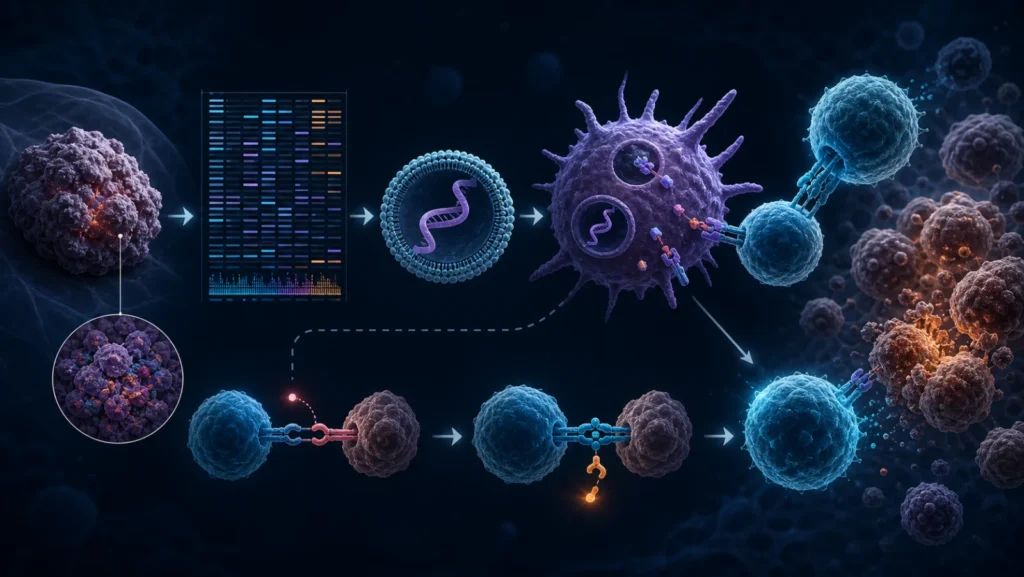
The process begins with tumor tissue and a normal sample. Next-generation sequencing identifies mutations present in the tumor but absent from the patient’s normal genome. A bioinformatics system evaluates candidate neoantigens. Moderna then produces a synthetic mRNA medicine encoding as many as 34 selected neoantigens from that patient’s tumor.
After intramuscular injection, cells take up the mRNA and translate its instructions into neoantigen proteins. Those proteins are processed into fragments and displayed to the immune system. Antigen-presenting cells can then prime or expand CD4 and CD8 T-cell populations capable of recognizing cells carrying those tumor-specific targets.
The mRNA is not an antibody that binds directly to melanoma, and it is not a gene edit. It is a temporary set of biological instructions intended to broaden and focus the patient’s anti-tumor immune response.
This design has two important consequences.
First, the vaccine target is individualized even though the production platform is standardized. Moderna does not need a new factory architecture for every mutation pattern, but it does need a distinct sequence, quality-controlled batch and chain of identity for every patient.
Second, the theoretical specificity of neoantigens does not guarantee clinical efficacy. A predicted neoantigen may not be presented efficiently. A tumor may contain multiple subclones, only some of which carry the target. T cells may fail to reach residual tumor sites. Cancer cells may suppress immune activity or lose antigen-presentation machinery. The value of INTerpath-001 is that it tests the whole system against clinical recurrence, rather than merely showing that vaccination creates an immune signal in a laboratory assay.
Why add Keytruda?
Intismeran and pembrolizumab are meant to solve different parts of the same immune problem.
T cells have regulatory checkpoints that prevent immune responses from running unchecked. One is PD-1. When PD-1 on a T cell is engaged by its ligands, the signal can restrain the cell’s activity. Tumors can exploit this pathway to evade immune attack. Pembrolizumab is an antibody that binds PD-1 and blocks that suppressive interaction.
In compact terms, intismeran is intended to identify and amplify the targets, while pembrolizumab releases an immune brake.
That makes the postoperative, or adjuvant, setting biologically attractive. Surgery removes all detectable disease, but a scan cannot exclude every remaining melanoma cell. If microscopic deposits remain, they contain far fewer cells and potentially less immune-suppressive machinery than a large established tumor. A vaccine-primed T-cell response, supported by checkpoint blockade, may be able to eliminate or contain those deposits before they become a visible recurrence.
But the combination design also sets a limit on interpretation: INTerpath-001 does not establish the efficacy of intismeran alone. Both groups received pembrolizumab. The trial asks whether adding the individualized therapy improves outcomes beyond an active standard treatment.
What INTerpath-001 actually tested
INTerpath-001 is a global, randomized, double-blind, placebo- and active-comparator-controlled Phase 3 trial sponsored by Merck in collaboration with Moderna. The companies’ final enrollment figure is 1,137 adults with completely resected stage IIB, IIC, III or IV cutaneous melanoma who had not received previous systemic therapy.
“Completely resected” is essential. Participants did not enter the trial with a measurable tumor that researchers expected to shrink. They entered after surgery, at substantial risk that melanoma would later return.
| Trial element | Intismeran group | Control group |
|---|---|---|
| Allocation | Two patients for every one control patient | One patient for every two combination patients |
| Personalized injection | Intismeran 1 mg intramuscularly every three weeks, up to nine doses | Dose-matched placebo on the same schedule |
| Active immunotherapy | Pembrolizumab 400 mg intravenously every six weeks, up to nine cycles | Pembrolizumab 400 mg on the same schedule |
| Maximum treatment period | Approximately 56 weeks | Approximately 56 weeks |
| Primary endpoint | Recurrence-free survival | Same comparison |
| Key reported secondary endpoint | Distant metastasis-free survival | Same comparison |
| Continuing endpoint | Overall survival | Same comparison |
Recurrence-free survival, or RFS, measures time until local, regional or distant melanoma recurrence, a new primary melanoma, or death, according to the trial definition. Distant metastasis-free survival, or DMFS, focuses on distant spread or death. Both endpoints matter in adjuvant melanoma: recurrence can require further surgery or systemic treatment, and distant metastatic disease is generally more dangerous and harder to treat.
Overall survival is the clearest endpoint because it asks whether patients live longer, but it often takes much longer to mature. Subsequent therapies can also blur the difference between groups. The trial is continuing to evaluate overall survival and other secondary outcomes.
How to read RFS and DMFS
Neither endpoint is a direct count of patients who are “cancer free forever.” They are time-to-event measures. At any analysis date, some participants have experienced an event, some remain under observation without one, and some have shorter follow-up or are otherwise censored. The survival curve estimates the probability of remaining event-free over time while accounting for those different observation periods.
RFS is also a composite. A local recurrence, a distant metastasis, a new primary melanoma and death all count as events, even though they do not carry the same immediate clinical consequences. The eventual report should therefore show the composition of events rather than only the headline hazard ratio. A treatment that mainly postpones local events would mean something different from one that prevents distant spread.
That is why the positive DMFS result adds weight. Distant metastatic recurrence usually changes prognosis and treatment more substantially than a removable local lesion. Still, DMFS can include death before a recorded distant metastasis, so the endpoint should not be described as a pure metastasis count.
Stage IV in this trial can also be misunderstood. These participants had undergone complete resection and entered without visible disease suitable for measurement. They were at high risk because melanoma had previously reached a distant site, not because the trial was testing whether the vaccine could shrink an existing metastatic tumor. The experiment addresses eradication or control of residual microscopic disease. It does not answer whether intismeran can reverse bulky stage IV melanoma.
What the Phase 3 announcement establishes
In their August 19 announcement, Moderna and Merck reported results from a prespecified interim analysis. They said the combination produced statistically significant and clinically meaningful improvements over pembrolizumab alone in both:
- the primary endpoint, recurrence-free survival; and
- a key secondary endpoint, distant metastasis-free survival.
They also said there were no new safety signals and that the observed safety profiles were consistent with earlier combination studies. The companies plan to present the data at an international medical meeting and engage regulators about filing submissions.
This is a high-value result. A positive Phase 3 trial is not simply “more patients” added to Phase 2. It is a prospectively defined attempt to confirm efficacy in a larger population using randomization, blinding, a placebo injection and an active standard-of-care control. It sharply reduces the chance that the earlier result was a statistical accident, a product of imbalanced groups or an artifact of knowing which treatment was given.
It also matters that both RFS and DMFS succeeded. A reduction in distant spread supports the idea that the recurrence result reflects control of consequential residual disease, not merely a shift toward less important local events.
The announcement supports three increasingly cautious conclusions:
| Evidentiary level | What can be said |
|---|---|
| Established by the topline report | The companies report that adding intismeran to pembrolizumab crossed the prespecified statistical thresholds for RFS and DMFS at an interim Phase 3 analysis. |
| Strongly suggested | Personalized mRNA neoantigen vaccination adds clinically meaningful adjuvant benefit for the studied high-risk melanoma population. |
| Not yet established publicly | The size and durability of the Phase 3 benefit, the absolute number of recurrences prevented, effects in specific subgroups, quality-of-life impact, detailed toxicity and any overall-survival advantage. |
What the announcement does not tell us
The missing numbers are not a footnote. They determine how doctors, patients and regulators will judge the treatment.
As of August 19, the companies had not disclosed:
- how many RFS or DMFS events occurred in either group;
- the Phase 3 hazard ratios or confidence intervals;
- recurrence-free or metastasis-free rates at a fixed time point;
- the absolute difference between treatment groups;
- how many participants were censored in the analysis;
- whether benefit was consistent by disease stage, BRAF status, PD-L1 expression, tumor mutation burden or circulating tumor DNA;
- detailed adverse-event, discontinuation and quality-of-life results;
- the proportion of enrolled patients for whom a vaccine was successfully designed and delivered on schedule; or
- whether any overall-survival trend exists.
“Statistically significant” means the observed difference crossed a prespecified statistical boundary under the trial’s analysis plan. It does not reveal whether the absolute gain was five percentage points or twenty. “Clinically meaningful” is the sponsors’ characterization until the medical community can inspect the effect size, timing, safety burden and patient-level context.
The interim timing also deserves precision. Stopping rules are designed so an early result must meet a more demanding evidence boundary than an ordinary final analysis. Crossing such a boundary can be persuasive. But early success may still produce a less stable estimate of effect than longer follow-up, particularly for overall survival.
The correct response is neither to dismiss the announcement nor to treat it as a peer-reviewed final report. It is strong evidence of success with incomplete public detail.
The five-year Phase 2b study provides the numerical context
Until the Phase 3 numbers are presented, the mature Phase 2b trial, KEYNOTE-942, provides the best quantitative view of the treatment. It should be treated as context, not pasted onto the larger trial.
The peer-reviewed trial enrolled 157 patients with completely resected stage IIIB–IV cutaneous melanoma. It was randomized 2:1 but open-label: 107 patients were assigned to intismeran plus pembrolizumab and 50 to pembrolizumab alone. Intismeran was given at 1 mg every three weeks for nine doses; pembrolizumab was given at 200 mg every three weeks for up to 18 doses.
The five-year follow-up published in the Journal of Clinical Oncology reported:
- RFS hazard ratio: 0.510 (95% confidence interval 0.294–0.887);
- four-year RFS estimate: 72.4% with the combination versus 49.1% with pembrolizumab alone;
- DMFS hazard ratio: 0.411 (95% confidence interval 0.200–0.843); and
- four-year DMFS estimate: 83.9% versus 65.4%.
The first hazard ratio is often summarized as a “49% reduction in the risk of recurrence or death.” More precisely, it estimates a 49% lower instantaneous hazard over the observation period. It does not mean exactly 49% fewer people had a recurrence.
The four-year RFS estimates differ by 23.3 percentage points; the DMFS estimates differ by 18.5 points. Those are clinically substantial separations. They should not, however, be converted casually into a number needed to treat. Kaplan–Meier estimates account for censoring, and a small trial produces wide uncertainty around fixed-time differences.
Overall survival remained unresolved. Seven of 107 patients in the combination group and seven of 50 in the pembrolizumab group had died. The OS hazard ratio was 0.471, but its 95% confidence interval (0.165 to 1.345) was wide and included no difference. The pattern favored the combination; the number of deaths was too small for a reliable conclusion.
The Phase 2 study’s strengths and weaknesses
KEYNOTE-942 was randomized, used an active control and followed patients for a median of 60.3 months. Its RFS and DMFS differences persisted rather than collapsing with time. Translational analyses also found greater expansion of new T-cell clonotypes with the combination, supporting the proposed mechanism.
But it remained a 157-patient, open-label Phase 2b trial with an unusually small 50-patient control arm. Open-label assessment can introduce bias, particularly when investigators participate in recurrence determinations. Subgroup analyses contain few events. Overall-survival evidence is immature. These limitations are why the double-blind 1,137-patient Phase 3 confirmation matters so much.
The mature Phase 2 result makes the positive Phase 3 announcement biologically and statistically coherent. It does not tell us that Phase 3 reproduced a 49% hazard reduction. Only the unreleased Phase 3 dataset can answer that.
Safety: additive burden, but no signal yet of amplified immune toxicity
Pembrolizumab is not a benign control. By releasing immune checkpoints, it can also direct immune activity against normal organs. The National Cancer Institute describes it as a PD-1-blocking immune checkpoint inhibitor, and its label includes potentially serious immune-mediated effects.
In the five-year Phase 2 report, the most common events attributed to intismeran in the combination were fatigue and injection-site pain, each in 59.6% of treated patients, and chills in 51.0%. Most vaccine-attributed events were grade 1 or 2. Fatigue was the most common grade 3 event at 4.8%, and no grade 4 or 5 event was attributed to intismeran. Immune-related adverse events occurred in 45.2% of combination recipients and 44.0% of those receiving pembrolizumab alone.
That pattern suggests the vaccine adds frequent short-term reactogenicity without obviously multiplying checkpoint-related autoimmunity. The Phase 3 announcement says no new signal appeared, but the full tables are needed to assess serious events, treatment discontinuations and how tolerability affected completion of the nine-dose course.
Manufacturing is part of the treatment
For a mass-produced medicine, manufacturing is usually invisible to the clinical hypothesis. For intismeran, it is inseparable from efficacy.
The five-year Phase 2 publication reported that 185 screened patients had tumor tissue assessed. The complete design process, including next-generation sequencing and neoantigen identification, succeeded for 156, or 84.3%. Among combination-arm patients whose designs succeeded, downstream manufacturing succeeded for 104 of 105, more than 99%.
Those numbers expose where the practical bottleneck can sit. Once a viable design exists, production can be highly reliable. Before that point, tissue quantity and preservation, sequencing quality, mutation calling and neoantigen selection can prevent a patient from reaching manufacture.
Investigators previously described a development interval of roughly seven to eight weeks, with pembrolizumab beginning while the individualized product was manufactured. Phase 3 feasibility data will need to show how consistently that process worked across hundreds of patients, countries and treatment sites, as well as whether the biological product worked in those who received it.
Routine adoption would require a durable chain linking surgery, pathology, shipping, paired sequencing, computation, manufacturing, quality release and return delivery. Every batch is both a drug and a patient-specific information product. Regulators must be satisfied not only with the platform but with the repeatability, identity and potency of many unique sequences.
Cost and access remain unknown. A personalized manufacturing process will probably demand more infrastructure than an off-the-shelf vial. Whether it can be reimbursed broadly, delivered outside major cancer centers and scaled across health systems is an economic question the trial cannot answer.
Why the result is historically important
Moderna and Merck describe INTerpath-001 as the first positive Phase 3 readout for both an individualized neoantigen therapy and an mRNA-based cancer therapy. On the public record available August 19, that is a defensible, specifically framed claim.
It is not the first therapeutic cancer vaccine, the first personalized cancer immunotherapy, the first mRNA drug tested in cancer or the first cancer vaccine to reach Phase 3. The historical first is narrower and more consequential: a large randomized late-stage trial has apparently shown that a patient-specific set of tumor mutations can be converted into an mRNA product that improves clinical outcomes beyond checkpoint therapy alone.
That tests several previously fragile assumptions at once:
- Tumor sequencing can identify targets that matter clinically, not just immunologically.
- An algorithm can select enough useful targets across genetically different patients.
- Individualized mRNA products can be manufactured reliably at multinational trial scale.
- Vaccine-induced immunity can add benefit beyond PD-1 blockade.
- The effect can be large enough to detect against an effective active control.
Success would validate a platform logic rather than one fixed antigen. The “payload” can change from patient to patient while the sequencing, selection, mRNA production and clinical delivery system remains broadly reusable.
That does not prove the platform will work in every tumor. Melanoma is unusually immunogenic and often carries many mutations, increasing the supply of possible neoantigens. It is already responsive to checkpoint inhibition. A therapy that succeeds in melanoma may struggle in cancers with fewer mutations, weaker antigen presentation or a more suppressive tumor environment.
The adjuvant setting also matters. Preventing microscopic residual disease is different from reversing bulky metastatic cancer. It is entirely possible for a vaccine to succeed after surgery and fail against large established tumors. That would still be a valuable treatment, but not the universal platform victory implied by the phrase “cancer vaccine.”
What happens next
Intismeran is not currently an approved option that an oncologist can prescribe. Pembrolizumab itself is FDA-approved after complete resection of stage IIB, IIC or III melanoma, as shown in its current prescribing information. Intismeran remains the experimental addition.
The companies say they will present the full Phase 3 data and engage regulators about submissions. A positive trial does not automatically become an approval. Regulators will inspect the magnitude and consistency of benefit, the interim analysis plan, safety, manufacturing controls, product turnaround and the balance of benefit and harm for each disease stage.
If applications are accepted, review must still conclude before marketing authorization. After approval would come coverage decisions, manufacturing expansion, treatment-center preparation and real-world delivery. Trial success, regulatory submission, approval, reimbursement and routine availability are separate milestones.
The larger INTerpath program is testing the same personalized approach in non-small cell lung cancer, bladder cancer, renal cell carcinoma, metastatic melanoma and other settings. Those trials will determine whether the melanoma result is the leading edge of a reusable oncology platform or an especially favorable meeting of one technology with one cancer.
The measured conclusion
The Phase 3 result changes the default scientific question around personalized mRNA cancer vaccines.
Before INTerpath-001, the central question was whether an individualized neoantigen vaccine could produce a sufficiently durable clinical effect to survive a large, controlled late-stage test. According to the topline report, the answer in resected high-risk melanoma is yes.
The next questions are more demanding: How large is the absolute benefit? Does it extend life? Which patients benefit most? Can every eligible patient receive a high-quality product quickly? What toxicity, cost and infrastructure accompany the gain? And will the result generalize beyond melanoma and beyond the minimal-residual-disease setting?
The plain-language claim is correct with boundaries: Moderna and Merck have built a personalized mRNA vaccine that appears to help prevent melanoma from returning or spreading after surgery when added to Keytruda. It is a genuine clinical and technological milestone.
The combination remains investigational, and the complete Phase 3 data are not yet public. The result applies to this postoperative melanoma setting; it does not establish a preventive shot, standalone efficacy, broad benefit across cancers or a cure.
Primary sources
- Moderna and Merck’s August 19, 2026 Phase 3 topline announcement
- INTerpath-001 trial registry: NCT05933577
- Five-year KEYNOTE-942 follow-up, Journal of Clinical Oncology
- Randomized Phase 2b KEYNOTE-942 report, The Lancet via PubMed
- National Cancer Institute: cancer treatment vaccines
- FDA-approved Keytruda prescribing information
This article explains clinical evidence and does not provide individual medical advice.