The Chipmaker Just Put On a Banker’s Suit
Nvidia already sells the engines of the AI boom. Now it wants to help customers finance the whole vehicle and possibly the highway beneath it.
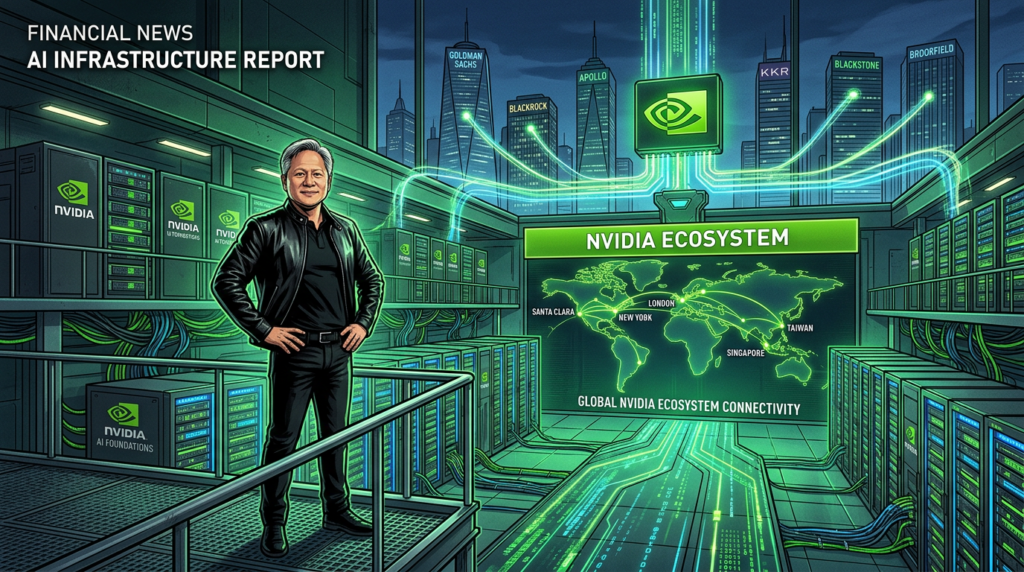
On August 10, the chip giant announced partnerships with Apollo, BlackRock, Blackstone, Brookfield, Goldman Sachs, and KKR. Together, they plan to establish financing platforms capable of mobilizing more than $500 billion in third-party capital for AI infrastructure over time. The money could support GPUs, servers, networking equipment, buildings, and power systems.
The idea, described by Altimeter Capital partner Clark Tang as a “synthetic hyperscaler,” is still a thesis not an official Nvidia label or a completed corporate structure. Yet the pieces fit intriguingly well. Nvidia provides the chips, networking, software, reference systems, technical standards, and now access to enormous pools of capital. Independent cloud operators supply the buildings and run the equipment.
Nvidia gets an ecosystem. Someone else gets the electric bill. Clever.
First, What Exactly Did Nvidia Announce?
The headline number needs a flashing asterisk. Nvidia did not reveal a fully funded $500 billion account, and six Wall Street firms did not wire the company half a trillion dollars before lunch.
According to Nvidia’s announcement, the parties signed memoranda of understanding. They intend to build independent “compute financing platforms” that can mobilize more than $500 billion over time. Nvidia said these platforms would create dedicated pools of capital at attractive rates for its customers.
Reuters reported that Nvidia disclosed neither a deployment timetable nor individual investment commitments. Those omissions matter. The announcement establishes an ambition and a framework, not a finished mountain of cash.
Still, it is no ordinary handshake. These partners manage vast pools of institutional money. They know how to turn expensive physical assets and long-term customer contracts into loans, private-credit investments, and securities. Nvidia brings the technology and customer network. Wall Street brings the plumbing that moves capital.
How the Synthetic Hyperscaler Theory Works
Traditional hyperscalers such as Amazon Web Services, Microsoft Azure, and Google Cloud combine two powerful machines. One is operational. They own or control enormous infrastructure, then use software to divide and sell its capacity. The other is financial. Their size, cash flow, and credit ratings let them buy equipment cheaply and fund expansion at favorable rates.
Nvidia already dominates crucial parts of the operational stack. Its GPUs process AI workloads. Its networking products connect those processors. CUDA anchors developers to its computing platform. Nvidia’s systems and software increasingly shape how operators design and manage AI clusters.
The new partnerships could help reproduce the financial half of the hyperscaler formula across multiple independent operators. Instead of Nvidia constructing every facility, outside investors would finance projects for cloud providers, AI laboratories, enterprises, and governments. Those customers would purchase Nvidia-based systems and repay the financing through leases or usage-linked revenue.
That is why “synthetic hyperscaler” is such a sticky phrase. Nvidia could coordinate the ecosystem without swallowing every asset. It gets reach without buying every acre of land, cooling tower, transformer, and heroic backup generator.
Wall Street Turns GPUs Into Infrastructure
The plan depends on a financial makeover. Historically, lenders viewed chips as equipment that depreciates quickly. A shiny accelerator can lose value when Nvidia launches a faster generation. Toll roads last for decades. GPUs generally do not inspire the same calm, cardigan-wearing confidence.
Jensen Huang wants investors to see the broader system differently. Nvidia argues that AI compute generates revenue, serves many customers, supports multiple workloads, and can move between operators. CUDA updates can also improve performance and extend the practical usefulness of installed hardware.
That pitch transforms compute from a technology purchase into financeable infrastructure. An investment vehicle could raise money to buy Nvidia systems and build a facility. An AI company could then lease the capacity or promise to use it. Those payments would create cash flow, which could support debt.
Axios reports that much of the capital may arrive through GPU securitizations, spreading exposure among insurers, pension systems, sovereign wealth funds, and other investors. Different firms could use credit funds, insurance subsidiaries, or off-balance-sheet vehicles.
In short, Wall Street would package tomorrow’s token production into investments today. It is imaginative. It is also the sort of sentence that makes both financiers and risk officers reach for stronger coffee.
Nvidia Is Offering More Than Introductions
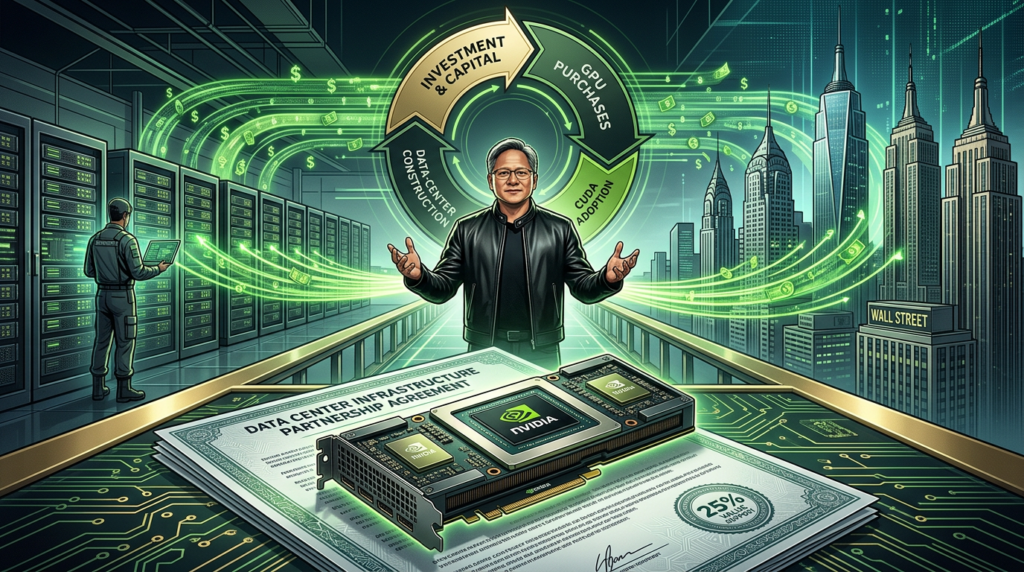
Nvidia may put some of its own financial muscle behind individual projects. Huang said the company could provide residual-value support for up to 25% of potential transactions. Reuters calculated that the option could represent as much as $125 billion if applied across the full target, although Nvidia has not committed that amount upfront.
Residual-value support addresses a stubborn question: What will today’s GPUs be worth several years from now?
If Nvidia absorbs part of that risk, lenders may offer customers cheaper financing. Lower borrowing costs could unleash more projects. More projects would buy more Nvidia equipment. More equipment would expand CUDA’s footprint. The flywheel spins, wearing an expensive leather jacket.
Critics may call this vendor financing with futuristic vocabulary. Supporters see a practical solution to an obvious bottleneck. AI demand may be strong, but many developers and specialized cloud operators cannot borrow as cheaply as Microsoft or Amazon.
Nvidia insists that the investment firms will underwrite opportunities independently. That separation matters because the AI sector already faces accusations of circular financing: technology suppliers invest in customers, which then spend the money on the suppliers’ products.
Independent lenders reduce that concern. They do not erase it.
The Neoclouds Could Be the Biggest Winners
The financing platforms could prove especially important for “neoclouds” specialized providers such as CoreWeave that build infrastructure around intensive AI workloads. These companies can move quickly and optimize clusters for large-scale training or inference. Unfortunately, speed eats money for breakfast.
They must secure land, electricity, cooling, networking, and mountains of accelerators before customer revenue fully arrives. Their borrowing costs can also exceed those of established hyperscalers, particularly when they lack investment-grade credit ratings.
The Wall Street partnerships could narrow that disadvantage. A neocloud with a long-term customer contract might take a project to one of the financing platforms. The financier would examine the operator, customer commitment, equipment, power arrangements, and expected cash flow. Nvidia could provide technology expertise and, in selected cases, residual-value support.
Reuters Breakingviews argues that Nvidia can steer unrated AI laboratories and neoclouds toward blue-chip capital providers as major technology companies approach financial limits. That connection could keep specialized operators building even as infrastructure costs climb.
For Nvidia, the attraction is deliciously straightforward. A healthier neocloud market creates more buyers, more deployed GPUs, and more alternatives to hyperscalers developing custom chips. Nvidia does not need to own the clouds if those clouds orbit its platform.
Goldman Starts Looking for the Money
The proposal has already moved beyond the ceremonial group photo. On August 14, Reuters reported that Goldman Sachs had begun discussions with potential investors.
According to people familiar with those talks, U.S. insurers, money managers, and banks could form the core investor base. Goldman’s asset-management arm can provide junior capital and private credit. Its investment bank can place debt with private funds and, eventually, public markets.
That gives the project several possible layers. Equity or junior investors could absorb early losses. Senior lenders could take lower-risk positions. Insurers could hold long-duration assets that match obligations extending years into the future. Public securities might eventually distribute the exposure even more widely.
This machinery matters because $500 billion cannot come from one heroic checkbook. The initiative needs repeatable structures that can fund many projects across different operators and regions.
Each project will still need scrutiny. Who will rent the compute? How reliable is that customer? Is power secured? Can the facility open on schedule? Will the chips retain enough value? A giant headline cannot answer those small, stubborn questions.
Wall Street excels at building pipes for capital. Whether every pipe leads somewhere profitable is another matter.
The Risks Are Real and Weirdly Familiar
But financing does not repeal physics, economics, or fashion. New chips can make older ones less attractive. Power shortages can delay data centers. Construction costs can jump. Customers can stumble. Models may become more efficient. Governments may restrict projects. Any of those changes could weaken expected revenue or collateral values.
Fortune notes the tension between long-lived institutional money and rapidly depreciating hardware. Pension funds and insurers often seek dependable assets that match obligations decades into the future. A GPU cluster is not a bridge, even when everyone calls it infrastructure with tremendous enthusiasm.
Circularity adds another concern. Nvidia helps create financing for customers that purchase Nvidia products. Those purchases strengthen Nvidia’s revenue, which reinforces confidence in Nvidia-backed assets. The loop can work beautifully while demand grows. If demand falters, the same connections may transmit stress.
None of this proves the plan is reckless. Railroads, aircraft, telecom networks, and energy projects all required financial innovation. Some created lasting prosperity. Some produced spectacular wreckage. History, annoyingly, enjoys variety.
A Hyperscaler Without the Property Deeds
So, has Nvidia secretly built its own hyperscaler? Not literally. It has not announced an AWS-style retail cloud that owns every facility behind one unified service. The financing platforms remain under development, and their $500 billion target will require many independent investment decisions.
Yet the broader interpretation deserves attention. Nvidia increasingly controls or influences the most valuable layers of AI infrastructure. It supplies processors, networking, systems, software, and standards. It supports cloud partners. Now it is helping organize the capital required to expand them.
If the model succeeds, customers could find Nvidia-based computing capacity across a network of separately owned AI clouds and facilities. Investors would finance the assets. Operators would run them. Nvidia would supply the common technological spine and help reduce financial friction.
That resembles a hyperscaler’s economic power without matching its ownership structure. It also gives Nvidia strategic flexibility. The company can encourage capacity wherever demand appears, avoid carrying every construction project on its books, and preserve relationships with established clouds rather than confronting them head-on.
The synthetic hyperscaler therefore looks less like one new corporation and more like an operating system for an industry. Nvidia provides the gravity. Capital and data centers arrange themselves around it.
The Next AI Battle May Be Fought in Credit Markets

The most important question is no longer whether Nvidia can sell advanced chips. It can. The question is whether the surrounding industry can keep financing enough buildings, power, networking, and customers to absorb them profitably.
That shifts part of the AI race from laboratories and semiconductor fabs into credit committees. Watch how quickly the six partners establish their platforms. Track the first funded projects, borrowing costs, customer commitments, Nvidia’s guarantees, and the treatment of aging GPUs. Those details will reveal whether the program creates a durable infrastructure market or simply makes an expensive boom easier to extend.
The structure could be transformative. It could give smaller operators hyperscaler-like access to capital, accelerate AI deployment, and deepen Nvidia’s platform advantage without forcing the company to become a landlord with a GPU habit.
It could also spread exposure to AI infrastructure across pension funds, insurers, banks, and public markets. That would make compute more financeable and make a future downturn harder to contain.
For now, “synthetic hyperscaler” remains a compelling interpretation rather than a confirmed corporate plan. But Nvidia has clearly expanded its ambitions. It once sold graphics chips. Then it built the defining platform of the AI boom. Now it is helping invent the financial system that pays for the next round.
Silicon, software, servers, securitization. Apparently, four S’s make a cloud.
Sources
- Nvidia: AI compute infrastructure financing announcement
- Reuters: Nvidia partners with Wall Street firms
- Reuters Breakingviews: Jensen Huang’s financing strategy
- Reuters: Goldman begins investor discussions
- Axios: GPU securitization and institutional capital
- Fortune: Private capital and retirement money
- Business Insider: Jensen Huang’s compute asset-class pitch
- TechSpot: The synthetic-hyperscaler argument
The Kingy Brief
Get future Kingy Brief editions.
Source-checked AI changes, original tests and one practical thing to try.
Free · Choose your subjects · Double opt-in · Unsubscribe anytime
Regular sending is paused; no restart date is set.