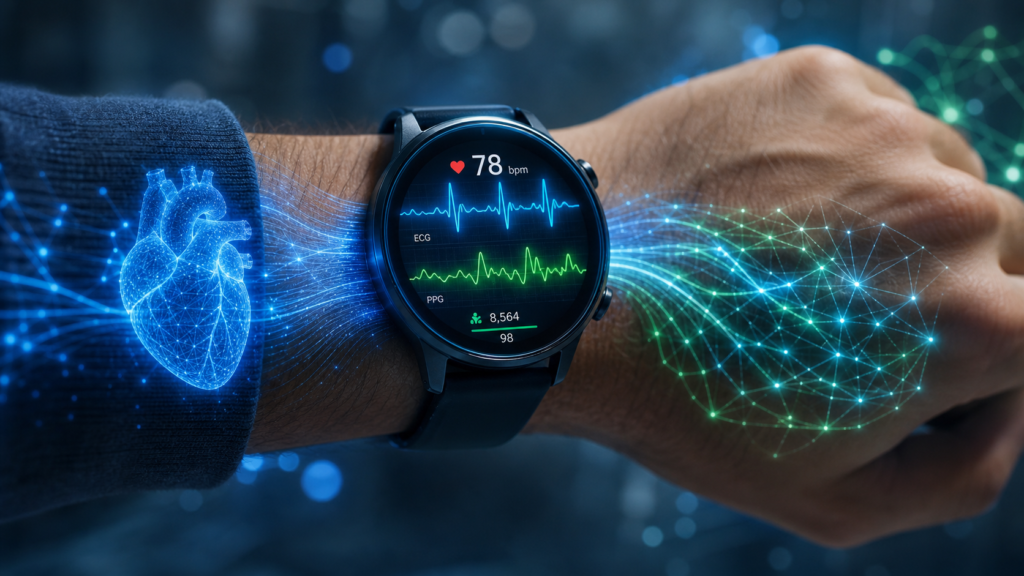
Your Wrist Is About to Get Much Smarter
Smartwatches already count steps, record workouts, inspect sleep and occasionally congratulate us for standing up. A noble achievement, apparently.
Samsung now wants wearables to do something far more ambitious: interpret the complex biological signals generated by the human body continuously, efficiently and directly on the device.
On August 14, Samsung Research introduced two health-focused foundation models called xMAE and HiMAE. Developed by the Digital Health Team at Samsung Research America, the models analyze biosignals collected by wearables. That includes signals associated with heart activity, sleep and physical movement.
The big idea isn’t simply to collect more data. Wearables already produce mountains of it. The challenge is turning those streams of numbers into useful, personalized health information.
According to Samsung’s official announcement, xMAE learns the relationship between different physiological signals. HiMAE, meanwhile, examines wearable data across several time scales and can run directly on smartwatch-class hardware.
Both models use self-supervised learning. In plain English, they can learn useful patterns from vast amounts of biosignal data without requiring a human to label every heartbeat, pulse and midnight trip to the refrigerator.
Samsung views the research as part of its broader Connected Care strategy. The company envisions technology that helps healthcare move from reacting to problems toward providing preventive, personalized and connected support.
That’s a grand pitch. But beneath the futuristic language, Samsung has produced some genuinely interesting research.
Meet the Health Foundation Model
The term “foundation model” probably makes you think of enormous chatbots that write emails, generate code and occasionally invent a confident answer from thin air.
Samsung applies the same broad concept to health data.
A health foundation model trains on a large, diverse collection of biological signals. After pretraining, researchers can adapt it to various downstream tasks instead of building an entirely separate model for every job.
Those tasks could include classifying biosignals, predicting health-related measurements, developing biomarkers or identifying patterns associated with potential health issues.
This approach matters because medical data is expensive and difficult to label. A clinician can’t realistically annotate every second of data produced by thousands of people wearing sensors around the clock. Self-supervised learning helps by hiding portions of a signal and asking the model to reconstruct what is missing.
It is essentially the biological equivalent of completing a sentence with a few words blanked out—except the “sentence” might contain thousands of pulse readings.
As AI News explains, Samsung designed xMAE and HiMAE for different but complementary purposes. xMAE studies how physiological signals relate to one another over time. HiMAE examines how the meaning of a signal changes depending on whether the model studies milliseconds, minutes or much longer periods.
Together, they could provide a more complete picture of what the body is doing.
xMAE Connects the Heart’s Electrical and Optical Clues
Samsung’s first model carries the delightfully compact name “Physiology-Aware Masked Cross-Modal Reconstruction for Biosignal Representation Learning.” Thankfully, everyone can call it xMAE and get on with their day.
The model focuses on the relationship between electrocardiogram, or ECG, data and photoplethysmography, better known as PPG.
ECG measures the heart’s electrical activity. On a smartwatch, users typically need to stop, remain relatively still and actively start a reading. PPG works differently. It uses light to detect changes in blood flow and can operate passively while someone wears the device.
Both signals reflect the same heartbeat, but they capture different stages of the event. Electrical activity occurs first. The pulse then travels through the circulatory system and appears in the optical PPG signal slightly later.
Samsung compares the delay to seeing lightning before hearing thunder. One event produces both signals, but distance and timing separate them.
xMAE learns that temporal relationship. During training, the framework receives ECG and PPG data with parts of the ECG signal hidden. It then attempts to reconstruct those missing sections using information from the continuously available PPG signal.
The goal is not to magically turn every optical sensor into a medical ECG machine. Rather, it is to teach the model richer cardiovascular representations from passive wearable data.
That distinction matters. Clever AI can uncover patterns, but it cannot repeal physics—or medical regulation.
Thousands of Hours and Nineteen Tests
Samsung’s researchers pretrained xMAE using approximately 9,400 hours of paired ECG and PPG recordings.
That scale gave the model many opportunities to learn how electrical cardiac activity relates to the pulse detected elsewhere on the body. More importantly, the team tested whether the learned representations could support tasks beyond simply reconstructing a missing signal.
According to Samsung, xMAE outperformed unimodal models and existing multimodal approaches in 15 of 19 evaluation tasks. Those tasks included cardiovascular outcome prediction, abnormal laboratory-result detection, sleep-stage classification and demographic inference.
The results are described in Samsung Research’s xMAE publication summary. The paper was accepted at the 2026 International Conference on Machine Learning, or ICML.
The researchers also tested whether the learned features could transfer across different devices, body locations and data-collection environments. That question is particularly important for wearable technology.
A clean laboratory signal is one thing. A watch bouncing on someone’s wrist during a morning jog is another. Sensors vary. Skin contact changes. Bodies move. Real life, as usual, refuses to behave like a carefully organized spreadsheet.
Samsung says xMAE showed potential to generalize across those variations. However, this remains research evidence—not confirmation that a future Galaxy Watch will diagnose diseases continuously.
The model offers a promising technical foundation. Clinical validation, regulatory review and dependable performance in consumer hardware represent additional hurdles.
HiMAE Learns When to Zoom In—and Out
While xMAE connects different types of signals, HiMAE tackles another problem: time.
Wearable data contains useful information at dramatically different scales. A short window may reveal individual heartbeats. A longer stretch might show exercise intensity. Several hours could expose sleep patterns.
Trying to understand all of that through a single fixed time scale is like judging an entire football match from one photograph. You may catch something interesting, but you will miss the flow.
HiMAE—short for Hierarchical Masked Autoencoder—uses multiple encoders to process short and long segments separately. This hierarchical design lets the model learn which temporal resolution provides the most useful information for a particular task.
During self-supervised training, HiMAE hides portions of the wearable data and reconstructs them. Through that process, it learns recurring physiological structures without depending entirely on labeled examples.
Samsung’s underlying HiMAE research says its pretraining corpus contained about 80,000 hours of green-light PPG data from 47,644 participants. The recordings came from seven studies and seven wearable devices, giving the model exposure to a broad range of people, hardware and real-world conditions.
A single pretrained model can reportedly support classification, regression and data-generation tasks. Samsung also says HiMAE surpassed foundation models that compress temporal scales together while remaining dramatically smaller.
That last part leads to the headline-grabber: the model is compact enough to run on a watch.
Less Than One Millisecond—With an Important Asterisk
Samsung reports that HiMAE can produce an inference result in under one millisecond on a smartwatch-class CPU.
Yes, a millisecond. Your watch could run the model several times before you finish wondering whether you left the stove on.
That speed attracted attention from Codingeek and several reports from The Tech Buzz, which framed HiMAE as a major step toward real-time health analysis without cloud servers.
The result is impressive, but it needs context. Sub-millisecond inference describes the model’s processing time under the researchers’ benchmark conditions. It does not necessarily include sensor collection, signal cleaning, application logic, screen updates or every other part of a finished consumer feature.
Nor does fast inference automatically guarantee negligible battery use. Model size, sampling frequency, sensor operation and how often the software runs all affect power consumption.
Still, efficiency changes what developers can realistically build.
A model that fits on smartwatch hardware can process signals without continuously uploading raw data. It can work when the watch has no internet connection. It can also reduce network delays, which matters when software needs to respond quickly.
In short, HiMAE doesn’t merely shrink health AI. It relocates it—from a distant data center to the tiny computer strapped to your wrist.
Why On-Device Processing Matters
Sending wearable information to the cloud can provide access to powerful computing resources. It also introduces trade-offs.
First comes latency. Data must travel from the watch to a phone or network, reach a server and return with an answer. That may work perfectly for a daily wellness summary. It becomes less attractive for continuous or time-sensitive analysis.
Connectivity presents another limitation. A cloud-dependent feature may struggle when the wearer loses mobile service or Wi-Fi. On-device models keep working during a hike, a flight or one of those mysterious moments when the internet decides it needs a personal day.
Then there is privacy.
Biosignals can reveal intimate information about sleep, stress, activity and cardiovascular function. Processing raw signals locally could reduce how much sensitive information must leave the device. However, local inference does not automatically make an entire service private. Apps may still store, synchronize or transmit results.
Samsung has demonstrated that HiMAE can analyze raw signals without depending on cloud servers. That is a technical capability, not a complete data-governance guarantee.
The company’s research also emphasizes limited computing resources and sensor availability. Sharanya Desai, head of Digital Health Algorithms at Samsung Research America, said the work establishes technical groundwork for efficient, precise and continuous health insights.
As another Tech Buzz report notes, bringing foundation-model techniques to edge hardware could make advanced analysis practical across future wearable products.
The wrist, it turns out, is becoming premium computing real estate.
From Occasional Readings to Continuous Context
Most consumer health devices still provide snapshots.
You open an app. You start a measurement. You receive a number. Perhaps the watch adds a cheerful chart to soften the emotional blow of learning that three hours of sleep was, scientifically speaking, not ideal.
Samsung’s research points toward something more continuous.
xMAE could extract richer cardiovascular information from PPG, a signal
Samsung’s New Health AI Wants Your Smartwatch to Understand Your Body—Without Calling the Cloud
The Next Big AI Platform Could Be Your Wrist
Generative AI may spend its days writing emails and manufacturing suspiciously enthusiastic meeting summaries, but Samsung wants artificial intelligence to tackle something more personal: the signals produced by your body.
On August 14, Samsung Research introduced two health-focused foundation models called xMAE and HiMAE. Developed by the Digital Health Team at Samsung Research America, the models analyze biosignals collected by wearable devices. These signals can reveal information about heart activity, sleep and physical movement.
The research fits neatly into Samsung’s broader “Connected Care” vision. At its July 2026 Health Forum, held during Galaxy Unpacked, the company described a future in which healthcare becomes more preventive, personalized and connected. Instead of waiting for a problem to become obvious, wearable technology could continuously watch for meaningful changes.
That sounds ambitious. It also sounds slightly like your smartwatch is applying for a medical degree.
However, Samsung has not announced a finished consumer feature, a release date or a specific Galaxy Watch that will use either model. These remain research projects. Still, their capabilities point toward a major change in wearable computing.
The key idea is simple: a watch should do more than count steps and display heart-rate charts. It should learn how different signals relate, recognize patterns across multiple time scales and potentially process that information directly on the device.
That is where xMAE and HiMAE enter the story.
A Foundation Model for the Human Body
The phrase “foundation model” usually brings enormous chatbots and GPU-packed data centers to mind. Samsung’s researchers are applying the same broad principle to wearable health data, but without trying to squeeze a tiny conversational robot into your watch.
A foundation model learns general patterns from a large collection of data. Developers can then adapt it to several downstream tasks instead of building a completely separate model for every job.
In health research, those tasks could include analyzing biosignals, developing biomarkers, estimating numerical values or predicting potential health issues. The model provides a reusable base—a kind of physiological starter kit.
Both Samsung models use self-supervised learning. During training, the system hides pieces of biosignal data and asks the model to reconstruct what is missing. Imagine handing someone a partially erased heartbeat recording and asking them to fill in the blanks. The better they understand the underlying pattern, the better their reconstruction becomes.
This approach matters because wearable devices generate oceans of raw data, yet relatively little of it carries expert-written labels. Medical annotation requires time, expertise and money. Your smartwatch, meanwhile, can collect measurements all day without complaining about overtime.
By learning from largely unlabeled data, a health foundation model can take advantage of this abundant information. It does not automatically become a doctor, of course. It becomes better at extracting useful representations—the underlying features that later applications may use.
As AI News explains, Samsung designed xMAE and HiMAE to solve different but complementary problems.
xMAE Connects Two Views of Every Heartbeat
Samsung’s xMAE model focuses on the relationship between electrocardiography, or ECG, and photoplethysmography, better known as PPG.
ECG measures the heart’s electrical activity. On a compatible smartwatch, it can support measurements such as heart rate and heart-rate variability and help identify certain rhythm abnormalities. However, wearable ECG readings commonly require the user to stop, remain still and actively take a measurement.
PPG works differently. It uses light to detect changes in blood volume beneath the skin. A smartwatch can collect this signal passively and repeatedly while sitting on the wrist.
Both signals reflect the same heartbeat, but they capture different stages of it. Electrical activation occurs first. The resulting pulse wave reaches peripheral blood vessels afterward. Samsung compares the delay to seeing lightning before hearing thunder—although your cardiovascular system is, thankfully, less likely to frighten the dog.
Many previous learning methods treated related signals as interchangeable views. xMAE pays attention to their direction and timing.
Its full name—Physiology-Aware Masked Cross-Modal Reconstruction for Biosignal Representation Learning—is a mouthful large enough to qualify as cardio. During training, xMAE learns to reconstruct masked portions of ECG data using corresponding PPG measurements.
The aim is not to declare PPG identical to ECG. It is to teach the model the physiological timing relationship between them. That could help extract more precise cardiovascular features from a signal that wearables can measure continuously.
Samsung’s xMAE research page describes this temporal structure as the model’s central innovation.
The xMAE Results Look Promising
Samsung’s researchers pretrained xMAE with approximately 9,400 hours of paired ECG and PPG data. They then evaluated its learned representations across 19 downstream tasks.
According to Samsung, xMAE outperformed both single-signal models and existing multimodal learning approaches in 15 of those 19 evaluations. The tasks included cardiovascular outcome prediction, abnormal laboratory-test detection, sleep-stage classification and demographic inference.
That is a meaningful research result, but it needs careful interpretation.
The model did not beat every alternative in every task. Nor does success on a research benchmark prove that a smartwatch can diagnose disease reliably in the wild. Real users introduce movement, loose straps, different skin contact, sensor noise and plenty of other chaos. Biology is rarely considerate enough to behave like a clean spreadsheet.
Still, the work showed another potentially valuable quality: transferability. Samsung reports that xMAE’s learned features generalized across different sensor devices, body locations and data-acquisition settings.
That matters because wearable health systems often struggle when conditions change. A model trained with one sensor or placement may lose accuracy when moved to another environment. If xMAE can preserve useful physiological information across those variations, it could provide a stronger base for future health applications.
The research earned acceptance at the 2026 International Conference on Machine Learning, or ICML. Conference acceptance does not certify a consumer medical feature, but it provides independent academic scrutiny beyond the usual corporate launch-stage fireworks.
In short, xMAE offers an intriguing bridge: use continuously available PPG data to learn richer cardiac representations informed by ECG timing.
HiMAE Learns to Zoom In and Out
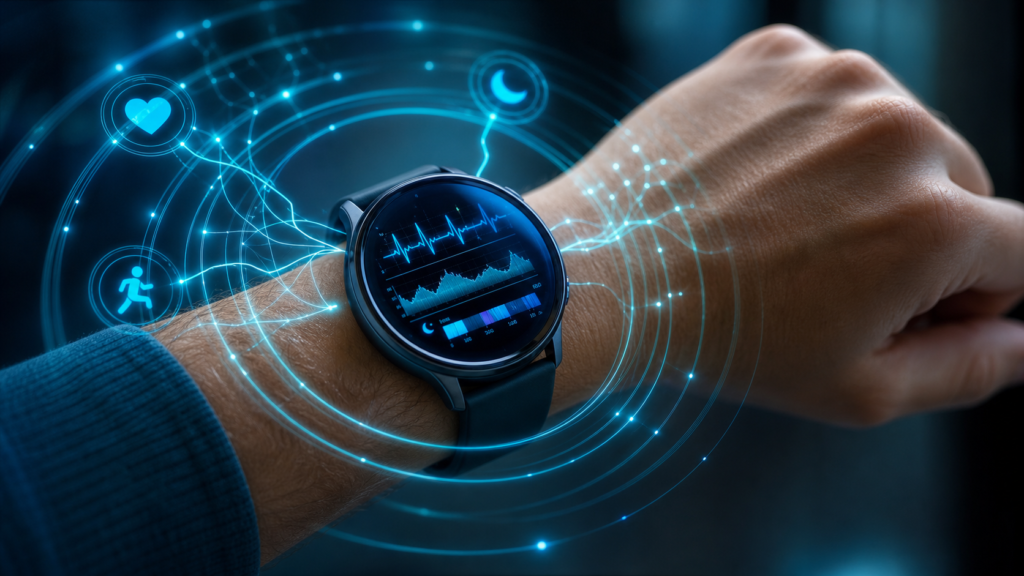
While xMAE connects two different signals, HiMAE tackles the problem of time.
Wearable data contains useful patterns at radically different scales. A short slice can reveal individual heartbeats or other rapid changes. A longer window may expose sleep cycles, exercise sessions or patterns that accumulate over hours.
A model that examines only one resolution risks missing the rest of the story. It would be like judging an entire movie from one frame—or reviewing a restaurant after eating a single pea.
HiMAE, which stands for Hierarchical Masked Autoencoder, analyzes wearable time-series data at multiple resolutions. It uses a hierarchical encoder-decoder architecture to produce representations at different temporal scales.
During self-supervised training, the system masks portions of the input and learns to reconstruct them. Multiple encoders separately process shorter and longer segments. The model can therefore associate fine-grained information with tasks such as heart-rate analysis while using broader windows for jobs such as sleep prediction.
The underlying HiMAE paper says its pretraining corpus contained roughly 80,000 hours of green PPG recordings from 47,644 participants. Those signals came from seven free-living studies and seven wearable devices, giving the dataset substantial real-world variety.
Across classification, regression and generative benchmarks, the researchers report that HiMAE surpassed foundation models that collapsed temporal information into a single scale. It also remained dramatically smaller than those comparison models.
That compact design leads to the research’s headline-grabbing claim.
Under One Millisecond—On a Smartwatch-Class CPU
Samsung says HiMAE can perform inference in less than one millisecond on a smartwatch-class central processing unit. In practical terms, the model can analyze raw signals locally at remarkable speed without relying on a cloud server for each result.
The distinction between inference and the complete health-processing pipeline is important. Sub-millisecond model inference does not mean every sensor reading instantly becomes a medically validated conclusion. Signal collection, preprocessing, application logic and user-interface updates may add their own workloads.
Even with that caveat, the result is notable. Wearables operate under brutal constraints. Their processors are modest, batteries are tiny and users become strangely unreasonable when a watch cannot survive until dinner.
A compact model can reduce the computational burden. Local processing can also eliminate network round trips and allow features to operate when a watch lacks an internet connection.
Coverage from Codingeek and TechBuzz emphasizes that edge-computing angle. The original Samsung research likewise describes HiMAE as compact enough to run entirely on a watch.
However, Samsung has not published a consumer battery-life estimate for a future implementation. Fast inference should help efficiency, but battery impact will depend on how often the model runs, what sensors remain active and how the surrounding software behaves.
“Under one millisecond” is therefore a strong technical result—not permission to throw away the charger just yet.
Why Keeping Health AI on the Watch Matters
Running a health model directly on a wearable can offer three practical advantages: speed, availability and data minimization.
First, local inference reduces latency. The device does not have to upload a signal, wait for a server and download an answer. That becomes useful when an application needs frequent or near-real-time analysis.
Second, on-device features can keep working with weak or nonexistent connectivity. A watch should not suddenly lose its analytical brain because its owner entered an elevator, boarded a plane or wandered beyond Wi-Fi range.
Third, local processing can reduce how much raw biosignal data must leave the device. Health information is deeply personal. Processing it close to the sensor may support more privacy-conscious product designs.
That does not make an on-device system automatically private or secure. A finished product could still synchronize results, store records in an app or share information with connected services. Privacy depends on the complete architecture, permissions and policies—not simply the location of one model.
Still, the technical capability gives Samsung options. It can design experiences that perform more work on the wrist and send less raw data elsewhere.
One TechBuzz report presents this as Samsung’s strategic push toward edge-based wearable intelligence. That interpretation makes sense, but Samsung’s announcement remains a research showcase rather than a detailed product roadmap.
The ingredients are on the table. The final recipe—and the watch that serves it—remain unannounced.
One Model, Many Possible Health Tasks
Today’s wearables often present health features as separate tools. One monitors sleep. Another estimates heart rate. Another records an ECG. Each occupies its own neat little box in the interface, even though the human body stubbornly refuses to organize itself into app menus.
Foundation models could connect more of those boxes.
Because HiMAE learns representations at several time scales, one pretrained model can support classification, numerical prediction and signal generation. xMAE adds another dimension by learning relationships between multiple biosignals.
Together, the models could provide a shared analytical layer for future health features. Samsung says its goal is to continuously understand a person’s health state, generate useful insights and offer suitable guidance.
That does not mean the models currently detect every condition—or that they ever will. “Foundation” describes their adaptability, not unlimited medical knowledge. Each downstream use would require additional development, testing and, where appropriate, regulatory review.
Yet the broader direction is clear. Wearables are moving from simple measurement toward interpretation.
Counting a heartbeat is useful. Understanding how multiple signals relate across minutes, nights and longer periods could be much more valuable. A system might eventually distinguish a one-off fluctuation from a developing pattern or tailor feedback to the individual rather than comparing everyone with a generic population average.
The possibility is why coverage describing 24/7 body analysis sounds exciting. But continuous sensing should not be confused with continuous diagnosis. Research capability, consumer availability and clinical validation are three different finish lines.
Samsung has crossed the first. The others remain ahead.
The Fine Print Has a Pulse Too
Health AI deserves more scrutiny than an algorithm recommending songs or deciding which holiday photo contains a bicycle.
Biosignals can vary with age, skin characteristics, physical condition, medication, sensor placement and behavior. Motion can introduce noise. A loose watch can distort measurements. Training data may underrepresent particular populations. Even a technically impressive model can perform unevenly once it meets the delightful messiness of real life.
False alarms could frighten users and burden healthcare providers. Missed warnings could create false reassurance. Clear communication will therefore matter as much as raw model accuracy.
Future products will need to explain what a result means, how certain the system is and when the user should seek professional evaluation. “Your watch noticed something” is not a complete care pathway.
Regulation will matter too. A wellness feature that summarizes activity may face different requirements from software that claims to detect or predict a medical condition. Samsung has not announced which commercial functions, if any, xMAE or HiMAE will power.
The company will also need to address data governance. On-device computation can limit cloud exposure, but researchers still need representative datasets for development and evaluation. Consumers will want clear answers about consent, retention, synchronization and sharing.
None of these issues cancels the research. They define the work required to turn it into a trustworthy product.
In healthcare, the last ten percent can consume ninety percent of the effort. Biology enjoys boss battles.
From Fitness Tracker to Quiet Health Companion
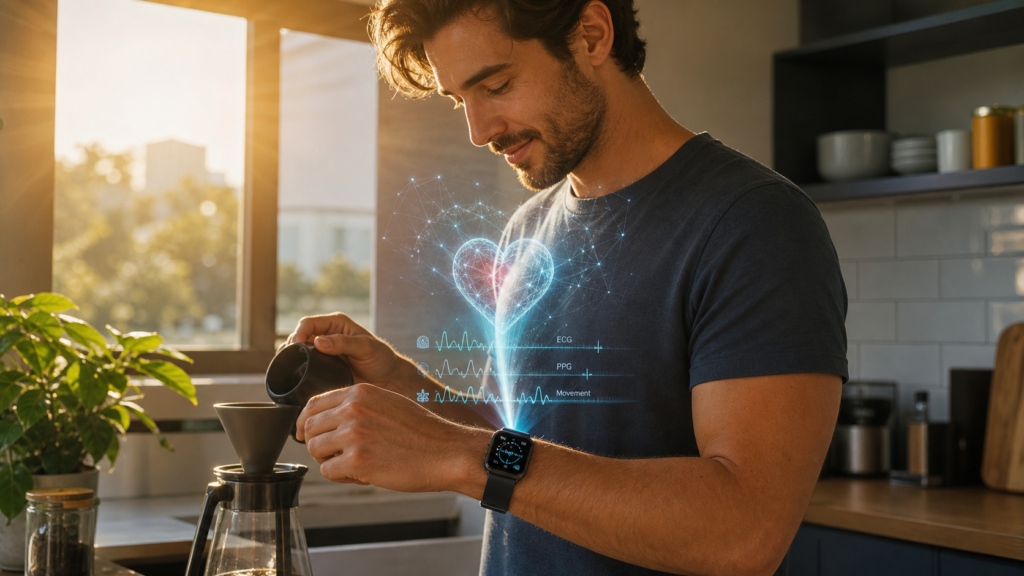
Samsung’s xMAE and HiMAE research suggests a future in which wearables understand signals instead of merely recording them.
xMAE learns how ECG and PPG reflect different stages of the same cardiac process. HiMAE studies signals across multiple time scales while remaining compact enough for sub-millisecond inference on smartwatch-class hardware. Both use self-supervised learning to extract value from large quantities of unlabeled data.
The pairing is clever. One model connects physiological signals; the other connects moments across time.
Samsung also has practical reasons to pursue this path. A useful health model that operates locally could deliver fast results, work without constant connectivity and reduce dependence on cloud processing. More importantly, it could turn passive streams of numbers into insights that people can understand and act upon.
But keep the celebratory confetti in its container. Samsung has presented research, not announced a diagnostic super-watch. No commercial deployment date, supported Galaxy Watch model or finalized consumer feature accompanied the reveal.
The real achievement is the groundwork.
If these systems survive further testing, product engineering and clinical validation, tomorrow’s smartwatch may act less like a tiny spreadsheet strapped to your arm and more like a quiet, context-aware health companion.
It will not replace a physician. It might, however, notice patterns between appointments—and do so without phoning a distant data center every time your heart says hello.
That is a much more interesting future than another step-count badge.
Sources
- Samsung Mobile Press: From Biosignals to Health Insights
- AI News: Samsung Health AI Models Analyse Wearable Biosignal Data
- Codingeek: Samsung’s HiMAE Model Brings Sub-Millisecond AI to Smartwatches
- TechBuzz: Samsung’s On-Device Health AI Runs in Under One Millisecond
- TechBuzz: Samsung Unveils On-Device Health AI Models for Wearables
- TechBuzz: Samsung Unveils Health AI Models That Read Your Body 24/7
The Kingy Brief
Get future Kingy Brief editions.
Source-checked AI changes, original tests and one practical thing to try.
Free · Choose your subjects · Double opt-in · Unsubscribe anytime
Regular sending is paused; no restart date is set.