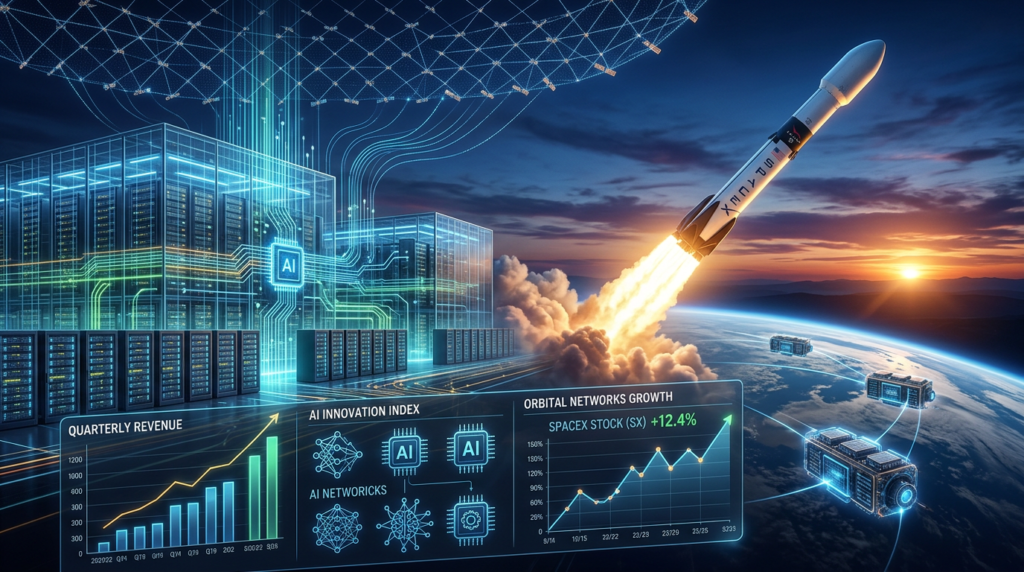
A First Report With Plenty of Thrust
SpaceX has finally opened its financial airlock.
In its first quarterly earnings report since becoming a public company, Elon Musk’s sprawling rocket, satellite, and artificial intelligence business reported $7.81 billion in second-quarter revenue. That marked a 92% increase from the same period one year earlier and beat Wall Street’s expectations by nearly $1 billion.
Those numbers provided a satisfying liftoff. The landing, however, got bumpy.
SpaceX recorded a net loss of $541 million, although that looked considerably better than its roughly $1 billion loss a year earlier. Its operating loss narrowed to $143 million. Adjusted earnings before interest, taxes, depreciation, and amortization reportedly climbed to approximately $3.5 billion.
Investors still sent the company’s shares lower in after-hours trading. Depending on when someone checked the screen and how much coffee they had consumed the decline hovered around 7% to 8%.
Why would a company beat revenue forecasts and still watch its shares retreat?
Simple. Investors did not buy SpaceX stock for an ordinary quarter. They bought tickets to a future filled with reusable rockets, global satellite internet, powerful AI models, coding agents, lunar settlements, and perhaps data centers floating above Earth.
That is a formidable wish list. It is also an expensive one.
The first report therefore offered more than a collection of financial figures. It revealed what SpaceX has become: not merely a rocket manufacturer, but a three-headed technology conglomerate trying to dominate space, connectivity, and AI simultaneously.
Ambitious? Absolutely.
Cheap? Not even remotely.
Starlink Remains the Reliable Breadwinner
For all the excitement surrounding Starship and AI, SpaceX’s most dependable business remains Starlink.
The connectivity division generated approximately $4.29 billion in second-quarter revenue, making it the company’s largest segment. Starlink also remained SpaceX’s only profitable division, according to the reports.
That makes the satellite network less of a side project and more of the family member paying everybody’s rent.
Starlink provides broadband connections through a constellation of satellites in low Earth orbit. Its customer base ranges from households in remote regions to airlines, ships, corporations, and government agencies. The service reportedly reached around 12 million subscribers, roughly twice its total from a year earlier.
That subscriber growth helped SpaceX outperform the expectations cited in a CBS News earnings preview. Analysts had anticipated quarterly revenue of around $6.8 billion to $6.9 billion, with Starlink expected to offset losses elsewhere.
It did more than offset them. It supplied the financial foundation beneath nearly every grander SpaceX ambition.
Starlink also supports the company’s government-oriented Starshield service, which provides secure communications and other satellite capabilities. SpaceX has accumulated billions of dollars in national-security contracts, giving the connectivity business a mix of consumer subscriptions and institutional revenue.
That diversification matters. Residential broadband customers may cancel or switch plans. Government contracts tend to operate on longer timelines and involve considerably larger checks.
Still, rapid growth creates new pressure. SpaceX must keep launching satellites, expanding ground infrastructure, replacing aging spacecraft, and improving network capacity.
Fortunately, the company happens to own a rocket fleet. Handy little coincidence.
AI Just Overtook the Rocket Business
Here comes the quarter’s biggest plot twist: SpaceX earned more revenue from AI than from its traditional space operations.
The AI division produced approximately $2.56 billion, more than triple its revenue from the year-earlier quarter. Meanwhile, the space segment generated $962 million.
Yes, the company named SpaceX now makes considerably more quarterly revenue from artificial intelligence than from space launches.
The AI surge came largely from selling computing capacity to other technology companies. According to The Verge, SpaceX reached agreements with Anthropic and Google to provide AI compute resources.
That places the company in the emerging “neocloud” market. Neocloud providers operate specialized infrastructure packed with advanced chips for training and running AI models. Companies such as CoreWeave built their identities around this business. SpaceX appears to have wandered into the same neighborhood while carrying several rockets and a satellite constellation.
The strategy emerged partly from necessity. SpaceX had assembled enormous computing capacity for xAI and Grok. Renting some of that infrastructure to outside customers gave the company an immediate way to turn expensive hardware into revenue.
It worked—at least on the sales side.
Profitability remains a different story. The AI division reportedly lost approximately $1.5 billion during the quarter, despite its rapidly rising revenue.
That gap explains some investor anxiety. Demand for AI computing looks enormous, but buying chips, building facilities, securing energy, and cooling the equipment require mountains of cash.
AI may print answers. It does not print free data centers.
From Rockets to a Technology Conglomerate
SpaceX entered 2026 looking very different from the focused launch company Musk founded in 2002.
In February, it acquired xAI, bringing the Grok chatbot, the X social platform, and extensive computing infrastructure under the SpaceX umbrella. The company then pursued Cursor, the popular AI coding platform, as another potential piece of its expanding technology portfolio.
During the earnings call, Musk said the Cursor transaction was close but stopped short of declaring it complete because regulatory approval remained outstanding.
The proposed acquisition could give SpaceX something it currently lacks: a major enterprise software product. Grok primarily competes as a general-purpose AI assistant. Cursor puts AI directly inside professional coding workflows, where customers often pay recurring subscription fees.
Combine that with rented computing capacity, and a broader strategy begins to appear.
SpaceX could own infrastructure at the bottom of the stack, AI models in the middle, and user-facing applications at the top. Starlink could connect those services around the world, while the rocket division eventually carries hardware into orbit.
It is vertical integration turned up until the dial snaps off.
This also explains why SpaceX’s public filings emphasized AI as a major source of its future value. The company’s rockets remain essential, but launch services alone cannot easily justify the enormous valuation investors assigned during its June initial public offering.
AI gives SpaceX access to a much larger market—or at least a much larger story.
Wall Street loves a growth story. It merely prefers that story to include margins, predictable cash flow, and fewer sentences beginning with “eventually.”
Capital Spending Reaches Escape Velocity

SpaceX’s ambitions demand staggering investment.
The company reported $18.37 billion in capital expenditures for the quarter, according to the supplied coverage. That figure reflects aggressive spending across AI infrastructure, Starlink, Starship, and related projects.
For comparison, SpaceX generated $7.81 billion in quarterly revenue. In other words, it spent far more on long-term assets than it collected from customers during the same period.
That does not automatically make the spending reckless. Capital expenditure builds the machinery that could produce future growth. A new data center may operate for years. A larger satellite constellation may support millions of additional subscribers. A reusable launch system could dramatically reduce deployment costs.
Still, the scale raises a fair question: how long will investors tolerate heavy spending before demanding stronger returns?
The AI buildout forms a major part of the bill. Advanced processors remain expensive, power-hungry, and difficult to secure in sufficient quantities. SpaceX must also build the networking, storage, cooling, and electrical systems surrounding those chips.
Starship adds another costly engineering challenge. Development expenses in the space division increased by $389 million from the previous year, with Starship serving as the main driver.
All these projects connect to one another. Starship could launch heavier Starlink satellites. A larger Starlink constellation could strengthen connectivity revenue. Future orbital data centers could use SpaceX launch services and satellite links.
The pieces fit beautifully on a presentation slide.
The challenge lies in making them work reliably, economically, and on schedule three concepts that often start wrestling whenever revolutionary hardware enters the room.
Starship Holds the Entire Puzzle Together
Starship is not simply SpaceX’s next rocket. It is the mechanical hinge connecting the company’s biggest promises.
SpaceX needs the massive launch system to deploy newer and heavier Starlink satellites efficiently. The company disclosed that it had already launched 20 heavier satellites, although full deployment could eventually involve batches of around 60.
Launching more capable satellites could improve network capacity while lowering the cost per unit delivered to orbit. That would strengthen Starlink, the division currently generating most of SpaceX’s revenue and profit.
Starship also sits at the center of NASA’s plans to return astronauts to the Moon. SpaceX aims to support a lunar landing in 2028, though the vehicle still faces substantial technical milestones. As the CBS News report noted before the results, the company had conducted its 13th Starship test flight in July, but had not yet placed a Starship into Earth orbit.
Then comes the wilder proposal: orbital data centers.
Musk argues that placing computing infrastructure in space could provide access to abundant solar power while easing some terrestrial constraints involving land, electricity, and cooling. SpaceX’s rockets would launch the equipment. Its satellites would handle communications. Its AI division would sell the resulting computing capacity.
It sounds wonderfully circular and extremely difficult.
Space-based computing must overcome radiation, maintenance, heat rejection, latency, launch costs, and hardware replacement. A broken server on Earth annoys a technician. A broken server in orbit becomes a very expensive shooting star.
Starship must therefore deliver more than spectacular test footage. It must become a dependable transportation system.
Great Results, Unimpressed Investors
SpaceX’s report exceeded most headline expectations, yet its stock declined. That apparent contradiction makes more sense when viewed against the company’s unusual market history.
SpaceX completed the largest initial public offering in US history in June, selling shares at $135 each and reportedly raising around $86 billion. Enthusiasm pushed the stock as high as $225.64 during intraday trading.
Then gravity remembered its appointment.
Ahead of the earnings release, the shares had fallen roughly 47% from that peak and traded below their IPO price. The Crypto.news preview described a market focused on Starlink growth, Starship reusability, and demand for AI computing.
The actual report answered the revenue question convincingly. SpaceX grew much faster than analysts expected. It also posted a smaller loss than many forecasts had suggested.
Investors remained uneasy because those results came with extraordinary spending and enormous promises. The market must estimate the value of projects that may require years of development before producing dependable profits.
Another source of pressure waited just around the corner. The post-IPO lockup period was due to expire, making more than 911 million shares eligible for sale. Employees and early investors could potentially cash out, increasing the available supply.
That does not guarantee a sell-off. Some short sellers may buy shares to close their positions, which could cushion the impact. Nevertheless, uncertainty rarely gives nervous traders a warm hug.
The stock’s decline therefore reflected expectations, not simply performance. SpaceX delivered a strong quarter. Investors had already priced in something closer to sorcery.
The Difference Between Losses Matters
Several figures in the reports may look contradictory at first glance. They describe different measurements.
SpaceX posted a $143 million operating loss, which reflects the result from its core business operations. Its net loss reached $541 million, or approximately nine cents per share, after accounting for additional items outside operating income.
The company’s adjusted EBITDA reportedly reached around $3.5 billion. That measurement excludes interest, taxes, depreciation, and amortization, along with certain adjustments. Businesses often use it to show how their underlying operations perform before major accounting and financing costs enter the picture.
Each figure tells a different story.
The operating loss shows that SpaceX came much closer to breaking even in its day-to-day business. The net loss confirms that the company still finished the quarter in the red. Adjusted EBITDA highlights the cash-generating strength of operations before large costs and adjustments.
None should be treated as the single “correct” number while ignoring the others.
The comparison with last year also matters. Revenue nearly doubled, while the net loss narrowed from roughly $1 billion to $541 million. SpaceX therefore improved its financial position even while funding several extremely expensive ventures.
That is encouraging. It is not the same as proving the business can produce sustainable profits.
Starlink currently does the heavy lifting. The space and AI divisions still lose money. If their losses grow faster than connectivity profits, SpaceX could remain trapped in a cycle where each new technological breakthrough requires an even larger check.
Innovation loves capital. Capital eventually asks for receipts.
The Neocloud Strategy Could Be the Real Surprise
The most consequential detail in the earnings report may not involve satellites or rockets. It may be SpaceX’s decision to rent AI computing infrastructure.
AI developers urgently need access to powerful chips, yet building a large data center requires time, technical expertise, reliable energy, and billions of dollars. A provider with ready capacity can charge companies that want computing power without owning the entire facility.
SpaceX already needed infrastructure for Grok. Renting unused or newly constructed capacity allowed it to create an additional revenue stream. Deals with Google and Anthropic validated demand almost immediately.
This business model also reduces dependence on Grok’s competitive position. If another company builds a better model, SpaceX can still make money by supplying the computers that train or operate it. That resembles selling pickaxes during a gold rush—except these pickaxes consume enough electricity to make a power grid nervous.
The strategy carries risks.
Cloud infrastructure can become commoditized. Large customers possess bargaining power and may build their own facilities. Chip shortages could slow expansion. Electricity constraints may limit where SpaceX can construct data centers. Heavy depreciation could squeeze profitability even when revenue climbs.
SpaceX must also decide how much capacity to reserve for its own AI products. Renting servers produces immediate income, but using them internally could strengthen Grok and other applications.
Still, $2.56 billion in quarterly AI revenue proves that this is no longer an experimental side business. The rocket company has become a serious computing provider.
Even by SpaceX standards, that transformation happened quickly.
A Strong Quarter With an Enormous Asterisk
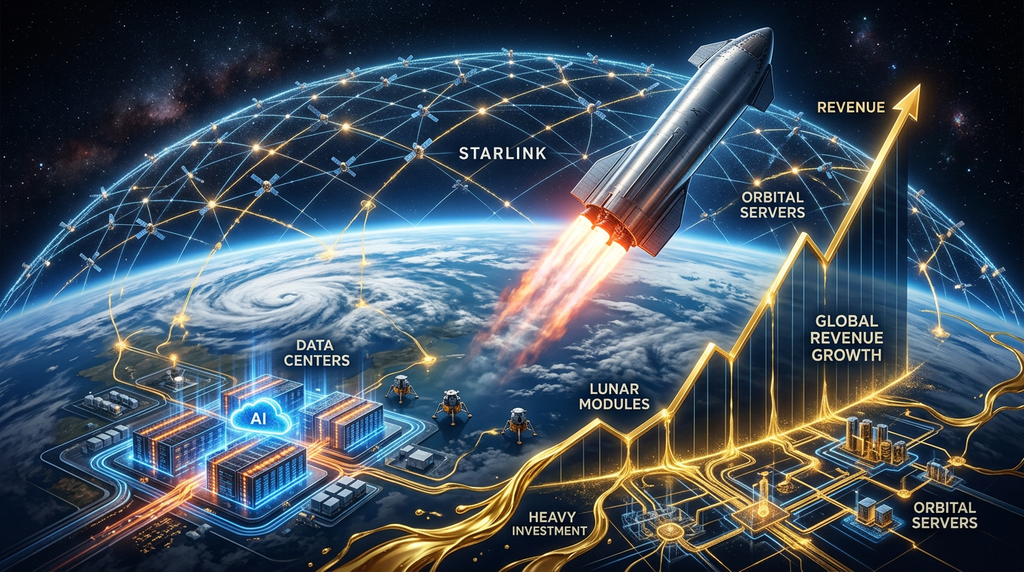
SpaceX’s first public earnings report delivered impressive growth.
Revenue climbed 92% to $7.81 billion. Starlink generated approximately $4.29 billion and remained the company’s financial anchor. AI revenue surged to $2.56 billion, overtaking the $962 million produced by traditional space operations. Losses narrowed. Analyst forecasts got thoroughly singed by the rocket exhaust.
Yet the report also exposed the scale of the gamble.
The AI division remains deeply unprofitable. Starship continues to consume development money before reaching full operational status. Capital expenditures have climbed to extraordinary levels. SpaceX’s valuation assumes that several difficult projects will succeed not just technically, but commercially.
That leaves investors judging two companies at once.
The first is the SpaceX operating today: a dominant launch provider with a fast-growing satellite network and a booming AI infrastructure business. That company generated real revenue and showed meaningful financial improvement.
The second is the SpaceX promised for tomorrow: a vertically integrated technology empire operating global communications, advanced AI models, coding software, giant reusable rockets, lunar transportation, and data centers in orbit.
That company could become one of the most valuable enterprises in history.
It could also spend breathtaking amounts of money discovering which parts of the vision refuse to cooperate.
For now, SpaceX has demonstrated that its business can grow at remarkable speed. It has not yet proved that revenue can catch its spending or that Wall Street will wait patiently while Musk tries to place the cloud above the actual clouds.
Either way, calling SpaceX merely a rocket company now feels badly outdated.
It is a satellite provider, an AI laboratory, a neocloud operator, a government contractor, and a software buyer with Mars on the mood board.
Just your average quarterly earnings story, then.
Sources
- The Verge — SpaceX Made More Revenue as an AI Company Than a Space Company
- CBS News — SpaceX Set to Release Its First Earnings Report as a Public Company
- Crypto.news — SpaceX Earnings Test AI Ambitions After 50% Stock Drop
- France 24 — SpaceX Revenue Jumps 92% in First Earnings Report, but Shares Slide
The Kingy Brief
Get the next Kingy Brief.
Source-checked AI changes, original tests and one practical thing to try.
Free · Choose your subjects · Double opt-in · Unsubscribe anytime