Microsoft Enters the AI Cyber Arms Race
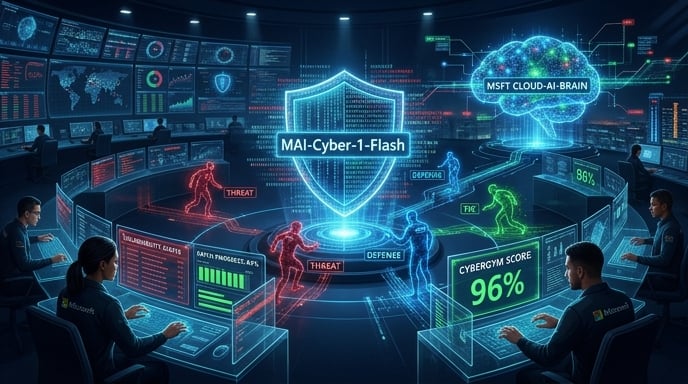
Microsoft has introduced its first in-house cybersecurity model, and its name is quite a mouthful: MAI-Cyber-1-Flash.
The model sits inside MDASH, Microsoft’s multi-agent system for identifying, validating, and remediating software vulnerabilities. Together, Microsoft says, they can uncover difficult security flaws while cutting operational costs almost in half.
That is a sizeable promise.
Cybersecurity teams already face mountains of alerts, sprawling codebases, and attackers who rarely observe office hours. Throw AI-powered hacking tools into the mix, and the traditional routine—scan occasionally, investigate manually, patch eventually—starts looking painfully slow.
Microsoft believes defenders need AI systems that operate continuously. Not just chatbots that explain a suspicious file, either. The company wants agents that can inspect code, investigate threats, prioritize risks, recommend fixes, and sometimes carry out corrective actions.
The announcement also introduces Project Perception, a broader agentic security system designed to coordinate those activities across an organization.
In short, Microsoft is not merely launching another model. It is proposing a new cybersecurity assembly line—one where several specialized AI workers share the load and call in a more powerful model when the problem gets especially gnarly.
Welcome to the age of AI defending software from other AI. Nobody said the future would be relaxing.
What Exactly Is MAI-Cyber-1-Flash?
According to Microsoft’s official announcement, MAI-Cyber-1-Flash is a compact, code-heavy model derived from the company’s MAI-Thinking-1 lineage.
Microsoft built it specifically to find vulnerabilities in complex codebases. That distinction matters.
General-purpose AI models can already read code, identify suspicious patterns, and suggest patches. However, a specialized cyber model can concentrate its training and computing budget on security-specific work. It does not need to write wedding invitations, analyze poetry, or help someone name a sourdough starter.
Its job is narrower: understand software, reason about weaknesses, and help defenders fix them.
Microsoft says it developed the model in-house and trained it using high-quality data. It also benefited from the company’s long history of handling vulnerabilities, exploits, incident investigations, and software patches.
Yet MAI-Cyber-1-Flash does not work alone. Microsoft placed it inside MDASH, the harness that organizes the entire vulnerability-discovery process.
That setup makes the launch more interesting than a simple model release. The product’s performance comes from the combination of the model, Microsoft’s security data, and the system surrounding it.
Or, as Microsoft summarizes the formula: model, data, and harness.
The model may be the shiny new engine, but MDASH is the vehicle—and security teams care whether the whole thing can stay on the road.
MDASH Is the Team Manager
MDASH is Microsoft’s multi-agent vulnerability identification and remediation harness. It coordinates more than 100 specialized agents powered by multiple models.
Those agents perform different jobs. Some scan code for possible weaknesses. Others validate the findings, eliminate duplicates, test whether a vulnerability is genuinely exploitable, or help produce a repair.
Think of it as a highly caffeinated security department squeezed into software.
This arrangement addresses a persistent weakness in autonomous AI systems: one model may confidently produce an incorrect answer and then congratulate itself for a job well done. MDASH divides the work into stages. One agent’s finding can be challenged, tested, and refined by others.
The system also gives Microsoft flexibility. MDASH does not have to send every task to the largest, slowest, and most expensive model available. It can route straightforward jobs to a smaller specialist and reserve frontier-level reasoning for the truly unpleasant puzzles.
That architecture represents the central idea behind the launch.
Microsoft is not arguing that MAI-Cyber-1-Flash can replace every frontier model. It is arguing that most cybersecurity tasks do not need one.
That is less dramatic than declaring a new all-powerful cyber brain. It is also more practical.
At enterprise scale, efficiency often wins. A slightly overqualified model running millions of repetitive tasks can turn a security budget into confetti.
The 90–10 Strategy
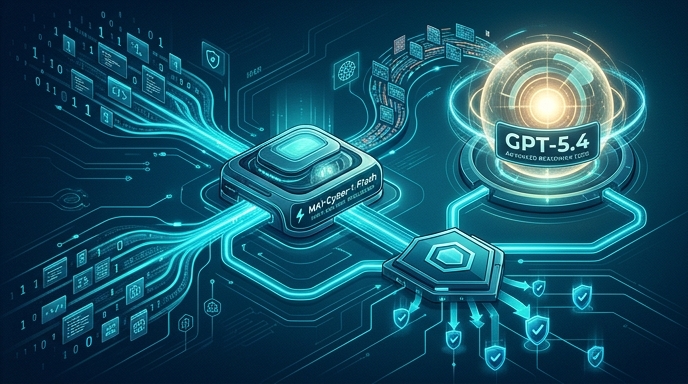
Microsoft designed MAI-Cyber-1-Flash to handle as much as 90% of MDASH’s workload.
The remaining 10%—the exceptionally difficult cases—can be escalated to GPT-5.4. That means Microsoft still relies on an OpenAI model for some of the toughest reasoning tasks, as The Decoder highlighted.
This is not necessarily a weakness. It is a routing strategy.
Imagine a hospital sending every patient directly to its most expensive specialist. The specialist might deliver excellent care, but the system would quickly become overloaded and financially miserable. A better structure directs routine cases to the right practitioner and escalates only those that require deeper expertise.
Microsoft is applying similar logic to AI.
Its compact model handles high-volume work with lower latency and cost. GPT-5.4 steps in when the smaller model encounters a problem beyond its preferred weight class.
Microsoft says this configuration costs around 50% less than its previous top MDASH setup, which used GPT-5.4, GPT-5.4 mini, and GPT-5.3 Codex.
Importantly, that comparison comes from Microsoft. The company has not published enough pricing and workload data for outsiders to reproduce the cost calculation independently.
Still, the broader principle makes sense: use a cheaper specialist whenever possible and save the digital supercomputer-sized hammer for nails that truly deserve it.
A 96% CyberGym Score—with an Asterisk
Microsoft reports that MDASH, combining MAI-Cyber-1-Flash with GPT-5.4, achieved 95.95%, rounded to 96%, on CyberGym.
CyberGym evaluates how well AI systems reason over substantial codebases and reproduce real software vulnerabilities. Microsoft’s chart places its combined system ahead of Mythos, Gemini, and GPT-based competitors. The company says its result sits roughly 12 percentage points above Mythos.
Impressive? Yes. Final proof of real-world superiority? Not quite.
The number describes the complete MDASH configuration, not MAI-Cyber-1-Flash operating independently. That distinction can disappear surprisingly quickly once benchmark charts begin making the social-media rounds.
Microsoft also reported the test itself. Outside researchers have not publicly reproduced this particular result. Benchmark performance can depend on the harness, prompts, tools, retry policies, validation process, and computing budget—not merely the intelligence of the underlying model.
In other words, 96% is an important signal, but it is not a universal cybersecurity report card.
CyberGym also focuses on a defined class of software-vulnerability tasks. Real security operations include identity attacks, cloud misconfigurations, social engineering, malicious insiders, novel malware, and incidents that refuse to resemble neat benchmark questions.
The result still demonstrates something valuable: a carefully coordinated system of specialist and frontier models can perform extremely well.
Just keep the asterisk attached. Benchmarks have a mischievous habit of becoming marketing slogans when nobody is watching.
Project Perception Expands the Mission

MAI-Cyber-1-Flash focuses on vulnerabilities in software. Project Perception aims much wider.
In its separate security announcement, Microsoft describes Perception as a continuously learning defense system that combines signals, security context, models, agents, and tools capable of taking action.
Rather than simply generating more alerts—a gift no exhausted analyst has requested—Perception is supposed to understand risk and coordinate a response.
The system organizes its agents into three broad groups.
Red-team agents examine an environment from an attacker’s perspective. They look for possible compromise paths and simulate how an adversary might exploit them.
Blue-team agents investigate suspicious activity. They combine technical findings with organizational context and decide which risks matter most.
Green-team agents perform corrective work. They can strengthen configurations, apply protections, or help repair vulnerable code.
Together, the three groups create a loop: discover, evaluate, correct, and repeat.
Microsoft says humans remain in control. That assurance is essential because an autonomous defensive action can cause its own disruption. A system that enthusiastically blocks a critical business service at noon on Monday has technically stopped all attacks—but it has also stopped accounting, sales, and Dave from opening his email.
Security automation must therefore balance speed with restraint.
Data May Be Microsoft’s Real Advantage
The new model gets the headline, but Microsoft’s data estate may be the stronger competitive weapon.
The company says it processes more than 100 trillion security signals every day and draws operational insight from approximately 1.6 million customers. Those signals span identities, endpoints, browsers, applications, networks, data, and cloud environments.
Scale alone does not automatically produce intelligence. A giant pile of telemetry can become a giant pile of noise. However, Microsoft can connect many security events with outcomes: which vulnerability proved exploitable, which attack succeeded, which control stopped it, and which remediation actually worked.
That feedback could help improve future models.
Microsoft describes cybersecurity as a live reinforcement-learning loop. Defenders investigate threats, deploy protections, observe results, and feed those lessons back into the system.
This creates a potential flywheel. More customers generate broader defensive experience. That experience improves models and agents. Better systems attract more customers, which produces more feedback.
The advantage would be difficult for a startup to reproduce quickly. A smaller company might build a superb model, but it cannot manufacture decades of enterprise security operations overnight.
Of course, enormous datasets also create enormous responsibilities. Microsoft must protect customer boundaries, prevent data leakage, maintain accurate labels, and stop the learning loop from absorbing flawed conclusions.
A feedback loop is useful only when the feedback is trustworthy.
Safety Controls Are Not Optional Decorations
A cybersecurity model occupies awkward territory. The same capabilities that help defenders discover a flaw can help attackers exploit it.
Microsoft says MAI-Cyber-1-Flash underwent security-focused calibration, evaluation by its AI Red Team, automated and expert-led adversarial testing, and an independent third-party assessment.
The company has not publicly identified that third party or released enough detail to judge the assessment fully. Consequently, the claim adds reassurance but not complete transparency.
MDASH supplies additional controls around the model. Microsoft lists role-based access, tenant isolation, encryption, auditing, and sandboxed execution environments without internet access.
Those safeguards matter because a model that can create working exploit concepts should not roam freely across production infrastructure. Sandboxing restricts what it can reach. Auditing records what it attempted. Role controls determine who can ask it to perform sensitive work.
The architecture also highlights why evaluating AI safety at the model level is insufficient.
A powerful model inside a tightly governed harness can present less practical risk than a weaker model connected to unrestricted tools, credentials, and internet access. Context changes capability.
Microsoft’s system will still face hard questions. How often do agents generate false positives? When may they apply a fix automatically? What happens if malicious code attempts to manipulate them? How quickly can a human interrupt an incorrect action?
In cyber defense, “the AI meant well” will not restore a production database.
Faster Fixes Could Change Security Work
At Microsoft’s launch event, Perception lead engineer Dave Weston said work that once required hours from several specialists could, in some cases, produce a fix within minutes, according to TechCrunch.
That could reshape the daily work of security teams.
Analysts spend substantial time gathering context, checking whether alerts are meaningful, reproducing bugs, coordinating with developers, and confirming that patches do not break something else. Agents can potentially compress many of those steps.
The goal should not be to eject humans from the security operations center. It should be to remove the mechanical toil surrounding expert judgment.
A skilled analyst becomes more valuable when an AI system assembles the evidence, traces the vulnerable component, drafts a patch, and explains the likely impact. The analyst can then focus on validating assumptions, managing risk, and making decisions that require organizational knowledge.
However, speed creates pressure of its own.
If vulnerability discovery becomes dramatically cheaper, attackers gain the same economic advantage. A flaw that once required days of manual research might surface in minutes. That shrinks the window between disclosure, discovery, and exploitation.
Organizations may need to move from periodic scanning toward continuous testing and remediation.
The patch treadmill is about to acquire a jet engine.
Microsoft Is Becoming a Model Orchestrator
The release also reveals something about Microsoft’s broader AI strategy.
The company has built its own specialized cyber model, but it has not rejected external models. Instead, MDASH combines Microsoft technology with GPT-5.4 and potentially other leading systems.
That makes Microsoft less dependent on one model while preserving access to frontier capabilities.
The approach resembles a sophisticated dispatcher. It evaluates the job, selects an appropriate model, supplies security context, and places the output inside a controlled workflow.
For customers, this can reduce the importance of which individual model “wins” this month’s leaderboard. The harness can change its routing as new models arrive.
For Microsoft, the strategy creates leverage. It can develop compact models for tasks where it possesses deep data and domain expertise, while purchasing frontier reasoning only when necessary.
The most consequential product, therefore, may not be MAI-Cyber-1-Flash by itself. It may be the layer that decides when to use it, when to consult GPT-5.4, and how to verify what either model produces.
This is also why the launch should not be framed as Microsoft defeating OpenAI. Microsoft’s best reported configuration still uses an OpenAI model for its hardest cases.
Cooperation and competition are sharing the same server rack. Awkward, perhaps, but very on-brand for modern AI.
Availability Comes with a Date Discrepancy
Microsoft says Project Perception will enter public preview on August 3, 2026.
One supplied report from TechCrunch lists November 3 instead. Because Microsoft’s official security announcement explicitly states August 3, that is the stronger date to use unless either publication issues a correction.
The discrepancy illustrates why primary-source verification matters, particularly during fast-moving product launches. A single word or digit can travel through dozens of summaries before anyone pauses to check the calendar.
Microsoft has also said it is putting the MAI-Cyber-1-Flash configuration into production immediately. That does not necessarily mean every customer can instantly access the model as a standalone service. The launch centers on its integration with MDASH and the broader Perception system.
Organizations evaluating the preview should ask for more than a demonstration.
They need workload-specific performance, false-positive rates, remediation controls, pricing assumptions, data-handling terms, incident procedures, and clear boundaries around autonomous action.
A benchmark can open the door. Operational evidence must close the deal.
Security buyers have learned this lesson repeatedly: the dazzling dashboard shown during a launch event rarely includes the 3 a.m. incident when everything is on fire and the only person who understands the legacy system is on vacation.
The Bigger Story Is Efficiency, Not Bragging Rights
MAI-Cyber-1-Flash gives Microsoft a credible in-house model for a domain where it already owns formidable data, infrastructure, and enterprise distribution.
Still, the most important idea is not that Microsoft posted a higher benchmark score than several rivals.
It is that specialized models, frontier models, data, agents, and governance controls can operate as one coordinated system.
That model-routing strategy could spread well beyond cybersecurity. Many enterprise workloads contain a large volume of predictable tasks and a smaller group of fiendishly difficult ones. Sending everything to the biggest model wastes money. Sending everything to a small model sacrifices quality. Intelligent routing tries to escape that trade-off.
Microsoft now claims it can deliver near-frontier cyber performance at roughly half the cost by letting MAI-Cyber-1-Flash handle most jobs and escalating only the hardest cases.
The numbers require independent scrutiny. The safety controls need real-world testing. Customers must decide how much authority they are willing to give defensive agents.
Even with those caveats, the direction is clear.
Cybersecurity AI is moving beyond assistants that summarize alerts. The next systems will observe, reason, coordinate, and act—ideally before an attacker does.
Microsoft has placed its bet. The smartest cyber defender may not be one gigantic model.
It may be an entire AI security team that knows exactly when to call for backup.
Sources
- Microsoft AI — Introducing MAI-Cyber-1-Flash inside MDASH
- CephaloSec — Microsoft Releasing Its Cybersecurity Model, MAI-Cyber-1-Flash
- The Decoder — Microsoft Launches Its Own Cybersecurity Model but Still Depends on OpenAI
- TechCrunch — Microsoft Launches Its First Cybersecurity Model and Agentic Security System
- Official Microsoft Blog — Rethinking Security for the Age of AI
The Kingy Brief
Get the next Kingy Brief.
Source-checked AI changes, original tests and one practical thing to try.
Free · Choose your subjects · Double opt-in · Unsubscribe anytime