A Very Expensive New Friendship
AMD and Anthropic have struck the sort of deal that makes an ordinary server upgrade look like buying a new desk lamp.
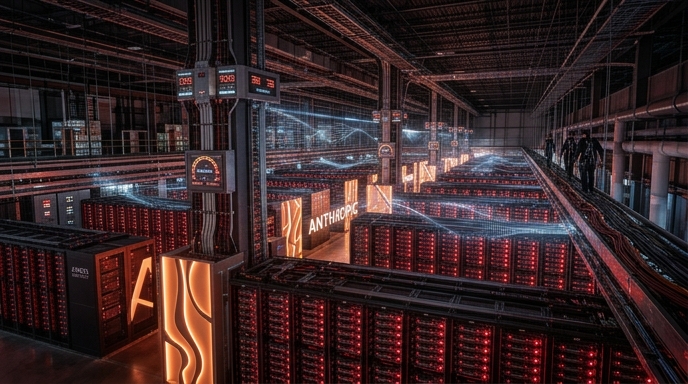
AMD plans to invest up to $5 billion in Anthropic, while the Claude developer intends to deploy as much as two gigawatts of AMD-powered AI infrastructure. The agreement covers AMD’s upcoming Instinct MI450-series accelerators, packaged inside its Helios rack-scale systems.
The first gigawatt of deployment is scheduled to begin during the first half of 2027. That phrase matters. Deployment will begin then; the companies have not promised that the entire first gigawatt will instantly roar to life on January 1.
AMD and Anthropic also described the arrangement as a strategic partnership, rather than a glorified chip order. It mixes hardware, investment and long-term engineering work into one enormous computational casserole.
According to The Wall Street Journal, the server portion could involve tens of billions of dollars. The exact purchase obligations remain undisclosed.
Still, the direction is unmistakable: Claude needs much more compute, and AMD wants to supply a meaningful chunk of it.
What Two Gigawatts Actually Means
Two gigawatts is not a measurement of raw AI performance. It describes the planned power capacity behind the infrastructure.
That distinction can get lost when technology companies start throwing around numbers large enough to require scientific notation and a supportive accountant.
At full scale, the proposed deployment would represent 2,000 megawatts of capacity. That includes far more than GPUs. A large AI facility also needs CPUs, networking gear, storage, cooling systems, power-conversion equipment and enough physical infrastructure to keep everything from turning into a remarkably costly toaster.
The actual computing performance will depend on how many systems Anthropic deploys, how efficiently it operates them and which workloads it assigns to the hardware.
Heise characterized the prospective order as involving more than one million AMD GPUs. However, AMD and Anthropic did not disclose an official accelerator count in their announcement.
That makes the million-GPU figure an estimate, not a confirmed purchase total. The solid number is the capacity ceiling: up to two gigawatts.
Meet the Hardware Behind the Deal
Anthropic plans to use AMD Helios systems built around Instinct MI455X accelerators, part of the broader MI450 series.
Those GPUs will not work alone. Helios combines them with AMD EPYC processors, code-named “Venice,” alongside AMD Pensando networking and the company’s ROCm software platform. In other words, AMD is selling a coordinated rack-scale system rather than dropping off a mountain of loose graphics cards at Anthropic’s reception desk.
Helios targets both major sides of the AI workload.
Training teaches a model by processing enormous datasets and adjusting its internal parameters. Inference happens after training, when users ask Claude to analyze a document, generate code or explain why their spreadsheet has developed opinions.
Anthropic already uses AMD’s previous-generation MI355X accelerators. The new agreement therefore expands an existing technical relationship instead of starting from scratch.
That detail matters. Moving major AI workloads between hardware ecosystems can require extensive engineering. Anthropic has already begun learning how Claude behaves on AMD’s stack, which should reduce at least some of the friction involved in scaling up.
AMD Is Buying More Than a Customer
The investment deserves as much attention as the hardware.
AMD has committed to making a strategic equity investment of up to $5 billion in Anthropic. According to reports, that investment will depend on Anthropic meeting specified deployment milestones.
This is not necessarily a $5 billion payment arriving in one cartoonishly oversized cheque. “Up to” sets a ceiling, while the milestone structure means the total may arrive in stages—or may not reach the maximum.
The investment also creates an unusual loop.
AMD may invest in Anthropic. Anthropic plans to spend heavily on infrastructure powered by AMD products. Successful deployment could strengthen AMD’s AI business, while expanded computing capacity could help Anthropic develop and serve more capable versions of Claude.
Critics often describe such arrangements as circular because infrastructure suppliers finance companies that become large buyers of their equipment. That does not automatically make the deal unsound. It does mean readers should separate the commercial commitment from ordinary customer demand.
The money and the hardware order are related. They are not the same transaction wearing two name tags.
Anthropic’s Compute Hunger Keeps Growing
Modern frontier AI models consume staggering amounts of computing capacity.
Training gets the flashy headlines, but serving millions of users can become just as demanding. Every Claude conversation requires inference. Longer prompts, advanced reasoning, coding agents and large business deployments can increase that workload quickly.
Anthropic co-founder and chief compute officer Tom Brown said access to compute is central to keeping Claude competitive and satisfying customer demand. The AMD agreement gives the company another large supply channel for training and serving its models.
Anthropic has already accumulated infrastructure arrangements involving several major providers. Amazon remains a central cloud and training partner. The company also uses Google’s tensor processing units, Nvidia GPUs and Amazon’s Trainium accelerators.
It has pursued additional data-center capacity through other operators as well.
The AMD deal does not indicate that Anthropic is abandoning those relationships. It reflects the opposite strategy: collect capacity from multiple sources and assign workloads according to cost, availability and technical suitability.
In the frontier-model business, compute has become both fuel and insurance.
Claude Becomes a Hardware Polyglot
Anthropic’s multi-chip approach could reduce its dependence on any single supplier.
That has obvious business advantages. If one vendor faces production delays, limited availability or uncomfortable pricing, Anthropic can lean more heavily on another part of its infrastructure portfolio.
Technical diversity also allows the company to match different jobs to different accelerators. One system may perform better during model training. Another may offer a stronger cost profile for high-volume inference. Specialized workloads may benefit from entirely different memory or networking characteristics.
The trade-off is complexity.
Supporting Nvidia GPUs, Google TPUs, Amazon Trainium and AMD Instinct hardware requires serious software work. Engineers must optimize kernels, manage different toolchains and ensure that models behave consistently across systems.
Anthropic appears willing to accept that complexity in exchange for flexibility.
Brown said a diversified hardware range allows the company to map suitable workloads to suitable systems. That explanation makes the deal sound less like a breakup with Nvidia and more like Claude assembling a very expensive collection of multilingual silicon friends.
The Real Rival Is Nvidia’s Software Moat
AMD has competed with Nvidia in high-performance computing for years. In AI, however, hardware specifications tell only part of the story.
Nvidia’s greatest advantage is its mature software ecosystem, particularly CUDA. Developers know it. Research tools support it. Companies have built years of internal code around it. Switching away can involve more pain than comparing two benchmark charts suggests.
AMD’s alternative is ROCm, an open software platform designed to help developers run accelerated workloads on AMD hardware. It has improved considerably, but Nvidia’s ecosystem remains deeply embedded across AI research and commercial deployment.
That is why the engineering portion of the Anthropic agreement could prove unusually important.
AMD and Anthropic plan to use Claude to optimize workloads for Instinct GPUs and accelerate ROCm development. AMD will also deploy Claude across its engineering and product-development teams.
The customer will therefore help improve the software surrounding the hardware it intends to use.
If that collaboration makes ROCm easier and more reliable, AMD could gain something more valuable than one giant order: a smoother path for future customers.
Claude Will Help Build Claude’s New Home

There is a wonderfully recursive quality to this partnership.
Claude will help AMD engineers improve the software used to run Claude on AMD hardware. The AI is, in effect, helping renovate its future computational house.
The companies have not published detailed targets for this work. Still, several practical possibilities stand out. Claude could assist engineers with code generation, debugging, documentation and workload analysis. It may also help identify inefficient routines or accelerate the process of adapting software to AMD accelerators.
Human engineers will remain responsible for verifying the results. AI-generated code has a charming habit of sounding confident even when it has quietly placed a rake on the floor.
Yet AMD has a clear incentive to make the collaboration work. Better tooling could reduce the effort required to move AI models onto Instinct hardware. Anthropic, meanwhile, could gain tighter optimization for its own workloads.
This transforms the relationship from supplier and buyer into something closer to co-engineers—with several billion dollars sitting politely in the meeting room.
One Million GPUs? Handle That Number Carefully
The most dramatic interpretations of the agreement describe Anthropic as preparing to acquire more than one million AMD GPUs.
That figure communicates the deal’s extraordinary scale, but it needs a bright yellow caution label.
Neither AMD’s announcement nor Anthropic’s quoted statement provided a total GPU count. Converting power capacity into an accelerator estimate requires assumptions about each rack’s electrical demand, supporting hardware, cooling overhead and data-center efficiency.
Change those assumptions and the estimated number changes too.
The deployment may also unfold through different ownership models. Anthropic could install some systems in facilities it controls while accessing other capacity through cloud companies or specialist infrastructure providers.
Consequently, “more than one million GPUs” should not be read as a confirmed delivery manifest.
The defensible formulation is simpler: Anthropic plans to deploy up to two gigawatts of AMD Instinct capacity, with the first gigawatt beginning in the first half of 2027.
Still enormous. Slightly fewer trumpets.
A Boost for AMD’s Nvidia Challenge
For AMD, Anthropic is more than another logo for a presentation slide.
Frontier AI companies serve as demanding customers and powerful endorsements. If Anthropic successfully trains and operates Claude at gigawatt scale on AMD systems, other developers may become more comfortable considering Instinct hardware.
AMD has already announced major infrastructure relationships involving OpenAI and Meta. Adding Anthropic strengthens its argument that the AI accelerator market does not have to remain a one-company kingdom.
Nvidia nevertheless retains a formidable position. Its hardware, networking technology and software ecosystem continue to anchor much of the AI industry. One deal—even a two-gigawatt monster—will not overturn that advantage overnight.
AMD does not need to replace Nvidia everywhere to benefit. Capturing a larger portion of a rapidly expanding infrastructure market could generate substantial business.
The Anthropic agreement gives AMD a prominent proving ground for Helios. It also demonstrates that major AI developers want alternatives.
Competition has finally entered the server room. It brought a very large electricity bill.
The Deal Is Full of Conditional Language
The headline numbers may sound definite. The underlying language is not.
AMD will invest “up to” $5 billion. Anthropic will deploy “up to” two gigawatts. The investment is reportedly tied to milestones. The first gigawatt will begin deployment in a stated window, but the companies have not released a complete construction or activation timetable.
They have also not disclosed Anthropic’s minimum purchase obligations, cancellation provisions or the precise valuation attached to AMD’s prospective investment.
Those omissions do not invalidate the partnership. Large infrastructure projects often require flexible terms because construction, energy access, chip production and financing can all change.
They do, however, limit what anyone can responsibly claim today.
The agreement represents a serious strategic commitment. It is not proof that every announced rack, dollar and watt has already changed hands.
AI infrastructure announcements increasingly describe a planned future measured at maximum scale. Readers should treat those ceilings as ambitions backed by contracts—not as completed installations.
The difference is less exciting, perhaps. It is also how reality works.
Where Will All This Hardware Live?
Two gigawatts of AI capacity cannot be squeezed into a spare office beside the break room.
The systems will require data centers with massive power connections, advanced cooling, high-speed networking and access to reliable equipment supply chains. Building or preparing such facilities can take years.
The Wall Street Journal reported that Anthropic expects to purchase some AMD systems for its own data centers while leasing other capacity through cloud providers and specialized AI infrastructure companies.
That mixed approach would give Anthropic more flexibility. Direct ownership can provide greater control, while leased capacity may help the company expand faster without building every facility itself.
Finding suitable locations will still be challenging. Data-center operators across the industry are competing for land, electricity, cooling water, grid connections and construction talent.
A cutting-edge GPU is impressive. Without a powered rack and a functioning cooling system, it is also an extremely sophisticated paperweight.
Infrastructure, not chip design alone, may determine how quickly this deal reaches full scale.
Energy Becomes Part of the AI Story
The agreement also highlights how closely AI expansion has become tied to energy policy.
A two-gigawatt ceiling places the proposed capacity in the territory of major industrial infrastructure. The eventual environmental impact will depend on facility locations, power sources, utilization rates and cooling designs—details the partnership announcement did not provide.
That uncertainty deserves attention.
Companies often discuss AI infrastructure primarily through performance and investment. Local communities encounter a broader equation involving electricity demand, transmission capacity, water use, tax incentives and construction.
The deployment will not necessarily occupy one giant campus. Capacity could be spread among several facilities and providers. Even so, the aggregate energy requirement remains substantial.
Future announcements will need to clarify where the systems will operate and how those locations plan to supply power.
Claude may live in “the cloud,” but the cloud has transformers, cooling pipes and planning permits. It also needs someone to approve the grid connection.
The AI boom is becoming a hardware race, a financing race and—very visibly—an energy race.
Why Anthropic Wants Options
Anthropic’s expanding supplier network reveals a lesson that stretches beyond chips: concentration creates risk.
Depending heavily on one platform can expose an AI company to shortages, price changes, technical bottlenecks or strategic disagreements. A diversified compute portfolio gives Anthropic more negotiating leverage and more ways to keep Claude running.
It may also encourage competition among suppliers.
AMD wants to prove Helios can handle frontier-scale workloads. Amazon wants Trainium to become a credible foundation for large models. Google continues developing its TPU ecosystem. Nvidia wants to preserve its leadership.
Anthropic can benefit as each company improves performance, tooling and commercial terms.
Of course, diversification does not make infrastructure cheap. Supporting multiple systems demands specialized engineers and careful optimization. Anthropic is exchanging simplicity for resilience.
Given the scale of Claude’s ambitions, that may be a sensible bargain. A model cannot serve customers when it lacks computing capacity, no matter how elegant its safety framework or how witty its answers.
Silicon diversity is becoming business continuity planning for AI laboratories.
What Happens Next
The first major checkpoint arrives in the first half of 2027, when deployment of the initial gigawatt is expected to begin.
Before then, AMD must prepare Helios systems at enormous scale. Anthropic must continue adapting Claude workloads to AMD hardware. Data-center partners must secure sites, power, cooling and networking. The companies must also turn their engineering collaboration into measurable improvements for ROCm.
Observers should watch several questions.
Will the first deployment start on schedule? How much of the capacity will Anthropic own directly? Which cloud or infrastructure providers will host the rest? Will AMD disclose clearer revenue expectations? Most importantly, will the systems deliver attractive performance and operating costs for Claude?
The answers could shape far more than one partnership.
A successful rollout would give AMD a landmark reference customer and provide Anthropic with a stronger, more diversified compute base. Delays or software difficulties would expose the challenges of building an alternative at this scale.
The announcement was the easy part. Now comes the wiring.
The Bigger Picture

The AMD-Anthropic alliance captures the current AI industry in one sprawling package.
Frontier-model companies need unprecedented infrastructure. Chipmakers need flagship customers. Data-center operators need power. Investors need confidence that today’s staggering spending will eventually produce equally staggering revenue.
So everyone is partnering with everyone else, often while investing in the customers that will buy or lease their systems.
AMD gets a chance to push Helios deeper into the frontier AI market. Anthropic gets another route to the computing capacity required for Claude. Both companies get a multi-year engineering relationship that could strengthen AMD’s software stack.
Yet the biggest figures remain conditional. The deployment can reach two gigawatts. The investment can reach $5 billion. The server agreement may span tens of billions of dollars. Much must happen before those ceilings become physical reality.
Even with those caveats, the deal is significant. It shows that Anthropic’s appetite for compute keeps expanding and that AMD intends to challenge Nvidia with more than benchmark slides.
The AI arms race now comes rack-sized, milestone-funded and measured in gigawatts.
Sources
- AMD — Strategic partnership announcement
- The Verge — AMD commits up to $5 billion to Anthropic
- The Decoder — Anthropic plans two gigawatts of AMD GPU capacity
- Artificial Intelligence News — AMD-Anthropic infrastructure agreement
- Heise — Anthropic’s prospective AMD GPU deployment
- The Wall Street Journal — AMD and Anthropic’s chips-and-investment deal
The Kingy Brief
Get the next Kingy Brief.
Source-checked AI changes, original tests and one practical thing to try.
Free · Choose your subjects · Double opt-in · Unsubscribe anytime