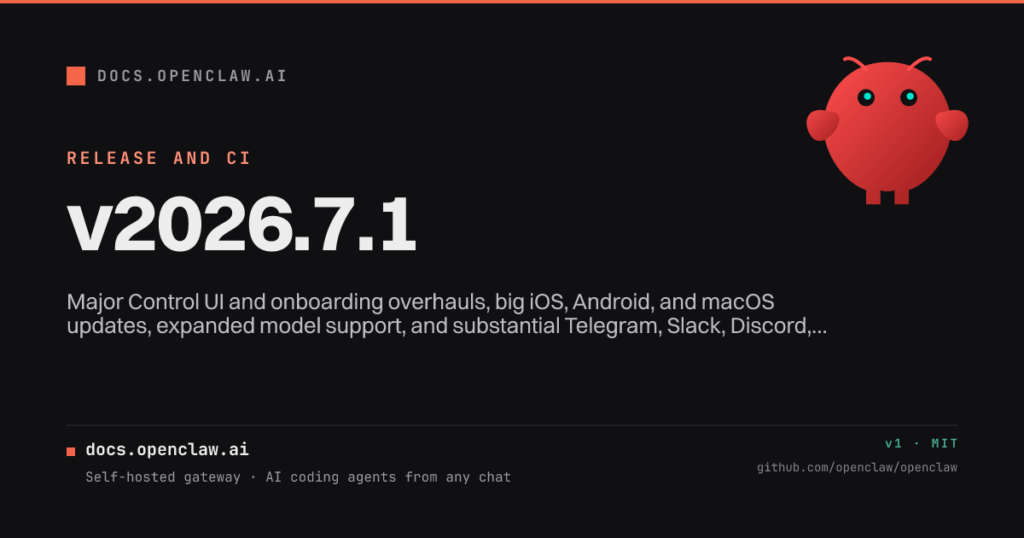
TL;DR: OpenClaw v2026.7.1 is a broad platform release, not a narrow maintenance patch. It overhauls the Control UI and onboarding, updates the official mobile and macOS apps, expands model and provider support, and strengthens Codex and connected coding-agent workflows. The software remains open source under the MIT license, but operators still need to account for model-provider, infrastructure, storage, and third-party service costs.
OpenClaw published v2026.7.1 on July 13, 2026. The official release is marked as the latest stable GitHub release, not a draft or prerelease, and points to release commit 2d2ddc43d0dcf71f31283d780f9fe9ff4cc04fe4.
What changed
The release moves several parts of the OpenClaw experience together:
- Control UI: conversations, sessions, files, usage information, background tasks, approvals, pairing, and Gateway health are easier to inspect and manage from the browser workspace.
- Onboarding and official apps: setup receives clearer validation and recovery paths, while the official iOS, iPadOS, Android, and macOS apps add work across navigation, chat, voice, permissions, files, scheduled work, offline use, and connection recovery.
- Models and providers: the release expands supported provider paths and improves compatibility across OpenAI and Codex routes, alongside broader provider and local-model work.
- Coding-agent workflows: connected-agent sessions, Codex delegation, native subagents, long-running goals, and session handoffs receive reliability and visibility improvements.
- Channels and operations: Telegram, Slack, Discord, Apple Messages, scheduled work, remote browser control, workspace terminals, Gateway restart behavior, credentials, and network safeguards all receive substantial changes.
Why this release matters
The significance is coordination rather than one headline feature. OpenClaw connects a self-hosted Gateway, model providers, messaging channels, tools, browser control, native apps, and coding agents. Improving only one layer can leave the operator with a fragmented system. v2026.7.1 addresses the interface, setup path, companion apps, provider choices, and operational recovery in the same release.
That makes the update most relevant to people already treating OpenClaw as infrastructure: developers running more than one agent or provider, operators moving work between desktop and mobile, and teams that need clearer visibility into sessions, permissions, background activity, and cost.
What to verify before upgrading
Open source does not mean zero operating cost or zero operational risk. OpenClaw’s own setup guide requires a model-provider credential for the standard onboarding path. Depending on the deployment, costs can also come from the host, storage, paid APIs, connected services, or managed network access.
Operators should review the release notes against their current channels, plugins, provider routes, and custom configuration before upgrading. They should also verify Gateway exposure, pairing rules, tool permissions, credential handling, sandbox policy, remote-browser access, and backup or rollback procedures. A release with stronger safeguards still depends on how much authority the deployment grants and where it is reachable.
Kingy verdict
v2026.7.1 is a substantive OpenClaw release because the product’s control surface and its operational plumbing advance together. The practical gain is less friction when moving among conversations, devices, providers, and coding-agent work. The tradeoff is the same one that follows any capable self-hosted agent system: broader control increases the value of disciplined permissions, network boundaries, credential hygiene, and change management.
This assessment is based on OpenClaw’s official release artifacts and documentation. It does not claim a new hands-on regression test of every v2026.7.1 change.
Related Kingy coverage
June 26, 2026 — OpenClaw on UGREEN NAS: What the Video Proves + Secure Setup
See the OpenClaw tool profile for the broader product record. Kingy’s UGREEN NAS and OpenClaw Companion Video covers one local deployment path; it should not be read as a complete test of this release.
Related coverage disclosure: UGREEN sponsored the linked Companion Video by supplying the NAS shown in the video for Kingy to keep. UGREEN paid no cash, had no editorial approval, and the original links could not earn Kingy a commission or account credit. No OpenClaw consideration is recorded in the closed evidence.
This timeline entry makes no performance, causal, conversion, revenue, retention, or outcome claim; the existing disclosure remains controlling.
Official sources
- OpenClaw v2026.7.1 release notes
- OpenClaw v2026.7.1 GitHub release
- OpenClaw getting-started documentation
- OpenClaw Gateway security documentation
- OpenClaw MIT license
The Kingy Brief
Get The Kingy Brief.
AI changes, original tests and one practical thing to try. Fridays at 09:00 Vancouver time.
Free · Double opt-in · Unsubscribe anytime
Sign up for The Kingy Brief on Beehiiv.
Signup help and newsletter schedule
Signup form provided by Beehiiv. After submitting, check your inbox for "Confirm your subscription to The Kingy Brief" and open its confirmation link. Check Spam or Promotions if you cannot find it.
Fridays at 09:00 Vancouver time: source-checked AI changes, original tests and one practical thing to try. We skip a week when there is not enough verified material. Free. Unsubscribe anytime.