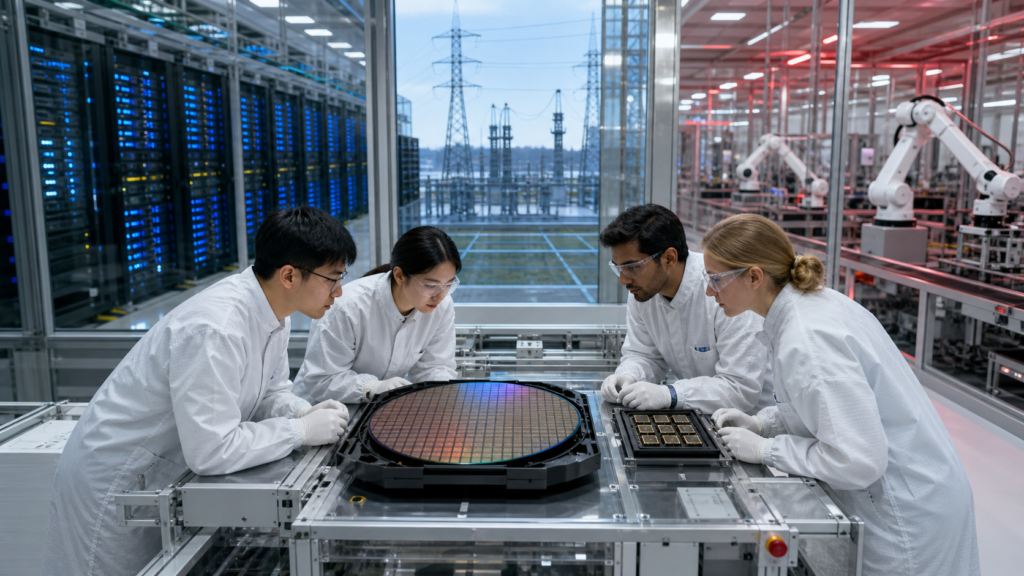
Research cutoff: July 22, 2026. This analysis distinguishes released products from promises, enacted controls from proposals, and measured data from projections. Moonshot AI said Kimi K3 weights would arrive July 27; they had not been released by this article’s research cutoff and must be rechecked before publication.
The phrase “AI Cold War” captures the severity of the United States–China technology competition, but it obscures as much as it reveals. Washington and Beijing are contesting military advantage, industrial power, standards, talent, capital and political influence. Yet the systems they are trying to command still run through the same research community, semiconductor chain, cloud market and energy economy.
Kimi K3, Moonshot AI’s new 2.8-trillion-parameter model, makes the contradiction visible. A Chinese company can now launch a near-frontier system at aggressive prices while depending on ideas, software and hardware that move through a global network. At the same time, a senior U.S. official has accused Moonshot of extracting knowledge from Anthropic’s Claude Fable 5—an allegation for which the government has not published the underlying evidence. The controversy is not merely about which chatbot is better. It is about whether advanced capability can be contained once models can teach models, weights can cross borders and algorithms can make scarce chips go further.
1. Direct answer: Is there an AI Cold War?
There is a securitized technology competition with cold-war dynamics inside a still-interdependent global AI system. “AI Cold War” is useful shorthand for the export controls, counter-controls, industrial subsidies, intelligence concerns, military planning and competing governance systems now surrounding artificial intelligence. It is inaccurate if it implies two sealed blocs, a purely state-run struggle or an inevitable replay of the twentieth-century U.S.–Soviet confrontation.
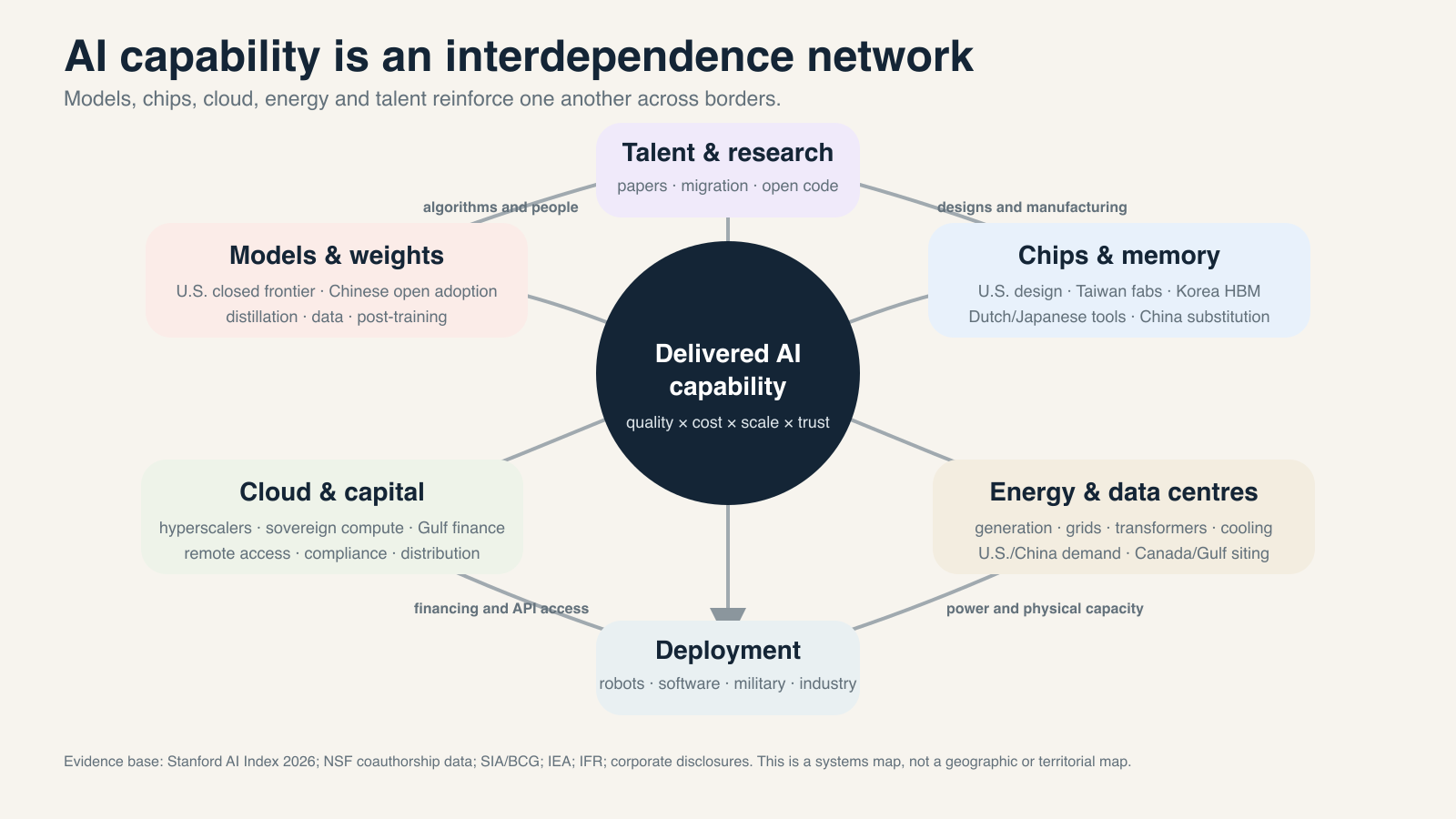
The original Cold War separated economic and technical systems more sharply. Today’s AI economy is built on multinational dependencies. U.S. firms design leading accelerators; TSMC fabricates most leading chips in Taiwan; South Korean companies supply high-bandwidth memory; Dutch and Japanese firms provide irreplaceable manufacturing tools; Gulf capital and energy support new compute hubs; Canadian and European researchers move between laboratories; Chinese developers publish models used by Western startups. A restriction at one layer can move demand, talent or innovation to another layer rather than stopping it.
The actors are also plural. The U.S. government, NVIDIA, Anthropic, OpenAI, cloud providers, universities and open-source developers do not share one interest. Neither do China’s central government, provincial funds, Alibaba, Moonshot, DeepSeek, Huawei, universities and private investors. The United States wants to restrict China’s access to advanced AI while preserving American companies’ access to the world’s largest markets. Those goals do not always point in the same direction.
2. Why Kimi K3 has intensified the debate
Moonshot AI launched Kimi K3 on July 16, 2026, presenting it as a native-vision, agent-oriented mixture-of-experts model with 2.8 trillion total parameters, 16 of 896 experts active per token and a one-million-token context window. Moonshot attributed its efficiency to techniques including Kimi Delta Attention and Attention Residuals. The model became available through Kimi products and an API; weights were promised for July 27. Moonshot recommends 64 or more accelerators for high-throughput self-hosting, a reminder that an “open” frontier-scale model is not cheap to operate. Kingy.ai’s launch coverage explains why Kimi K3 matters to the U.S.–China AI race.
The company’s own comparisons are more revealing than triumphalist headlines. Moonshot says K3 remains behind Claude Fable 5 and OpenAI’s GPT-5.6 Sol overall, while reporting a preliminary WebDev Arena score of 1,679, ahead of Fable 5 at 1,631 and GPT-5.6 Sol at 1,618. Those figures are vendor-reported and task-specific; they are not proof that K3 is the best model in general. The practical challenge is price and accessibility: Moonshot lists API rates of $3 per million cache-miss input tokens, $15 per million output tokens and $0.30 per million cache-hit input tokens.
The political temperature rose on July 22 when White House science adviser Michael Kratsios said the United States had information that Moonshot distilled Claude Fable 5 to build K3. No technical evidence accompanied that public allegation. Anthropic had previously documented a broader campaign in which it said DeepSeek, Moonshot and MiniMax created roughly 24,000 fraudulent accounts and generated more than 16 million exchanges with Claude; Anthropic attributed more than 3.4 million exchanges to Moonshot. That February 2026 disclosure predates Fable 5 and does not by itself establish that K3 was trained on Fable 5 outputs.
Claude Fable 5 is itself part of the policy story. Anthropic launched it as a highly capable model, then temporarily restricted it after a sharp demand spike before restoring access on July 1. The episode shows that frontier capability is limited not only by model ideas but by available inference capacity, safety controls and commercial deployment. Kingy.ai has separate reporting on Claude Fable 5 and Anthropic’s distillation controversy.
3. What each side is competing for
The contest has at least five overlapping objectives.
Economic value. General-purpose models can reorganize software, professional services, manufacturing, logistics, advertising and scientific research. The country whose firms capture platforms, cloud workloads and developer ecosystems can collect rents far beyond the model layer.
Industrial capacity. AI demand supports semiconductor fabs, advanced packaging, memory, networking, data centres, power equipment and robotics. Control over these industries increases resilience and creates leverage over countries that depend on them.
Military and intelligence advantage. Both governments are interested in decision support, cyber defence, logistics, autonomous systems, sensing, simulation and scientific discovery. But a capable commercial model is not automatically a deployable weapon. Reliability, secure integration, doctrine, data, communications and human command remain decisive.
Governance and political control. The United States emphasizes private innovation and market leadership while increasingly imposing national-security controls. China couples commercial development with state planning, content rules, cybersecurity review and industrial policy. Both also seek influence over technical standards, safety evaluation and procurement norms.
Prestige and alliance power. Frontier AI has become a symbol of national competence. Providing models, chips, cloud access or infrastructure can bind other countries to a technology stack. The contest is therefore about who becomes the trusted supplier to the rest of the world, not simply who tops a benchmark.
4. U.S. advantages
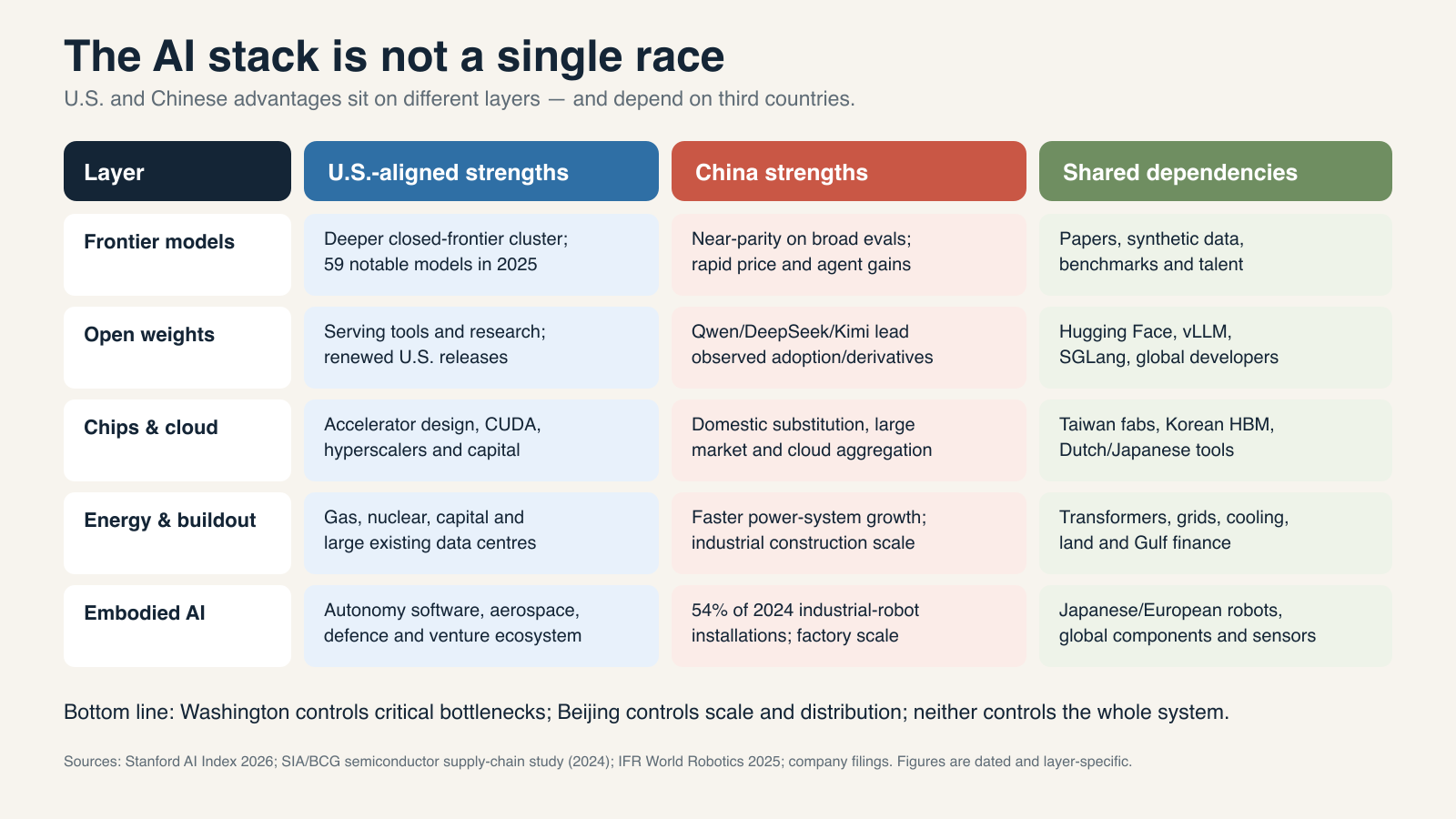
The United States still has the strongest combined position at the model, accelerator, cloud, capital and research layers. Stanford’s 2026 AI Index counted 59 notable models from U.S.-based institutions in 2025, compared with 35 from China. American firms remain prominent at the closed frontier, where access to proprietary training data, large-scale reinforcement learning, product distribution and enormous inference fleets matter.
The hardware advantage is not primarily domestic fabrication. It is design and orchestration. NVIDIA and AMD design leading accelerators; NVIDIA’s CUDA ecosystem and networking products reduce the difficulty of training at scale; Broadcom and specialist suppliers contribute networking and custom silicon; Amazon, Google, Microsoft, Meta and Oracle aggregate immense clusters. Taiwan’s fabs and Asian packaging and memory suppliers make those systems possible, but U.S. companies capture critical design, software and cloud layers.
Capital is another asymmetry. Stanford estimates U.S. private AI investment in 2025 at $285.9 billion, 23.1 times China’s $12.4 billion, although private-investment comparisons understate Chinese government-guidance funds and state-backed infrastructure. U.S. dollar markets, hyperscaler cash flows and venture networks can finance losses and construction at a scale few countries can match.
American universities, laboratories and immigration have historically concentrated global talent. That advantage is less secure than it appears: the AI Index says the inflow of AI researchers and developers to the United States has fallen sharply since 2017. Visa policy, research openness and the attractiveness of rival hubs will determine whether the talent edge persists.
5. Chinese advantages
China’s strongest position is scale: engineers, users, factories, supply networks, power-system expansion and a huge domestic market in which software can be connected to physical production. Its lead in research volume, citations and patent grants does not mean every output is equally valuable, but it creates a broad base from which companies can recruit, iterate and specialize.
China also has a more mature manufacturing ecosystem for integrating AI into devices, vehicles, drones and industrial systems. The International Federation of Robotics reported 295,000 industrial-robot installations in China in 2024, 54% of the global total, versus 34,200 in the United States. China’s installed stock reached roughly 2.03 million units, compared with about 394,000 in the U.S. Robot counts do not measure AI quality, but they do measure the environment in which machine perception, planning and control can be tested at scale.
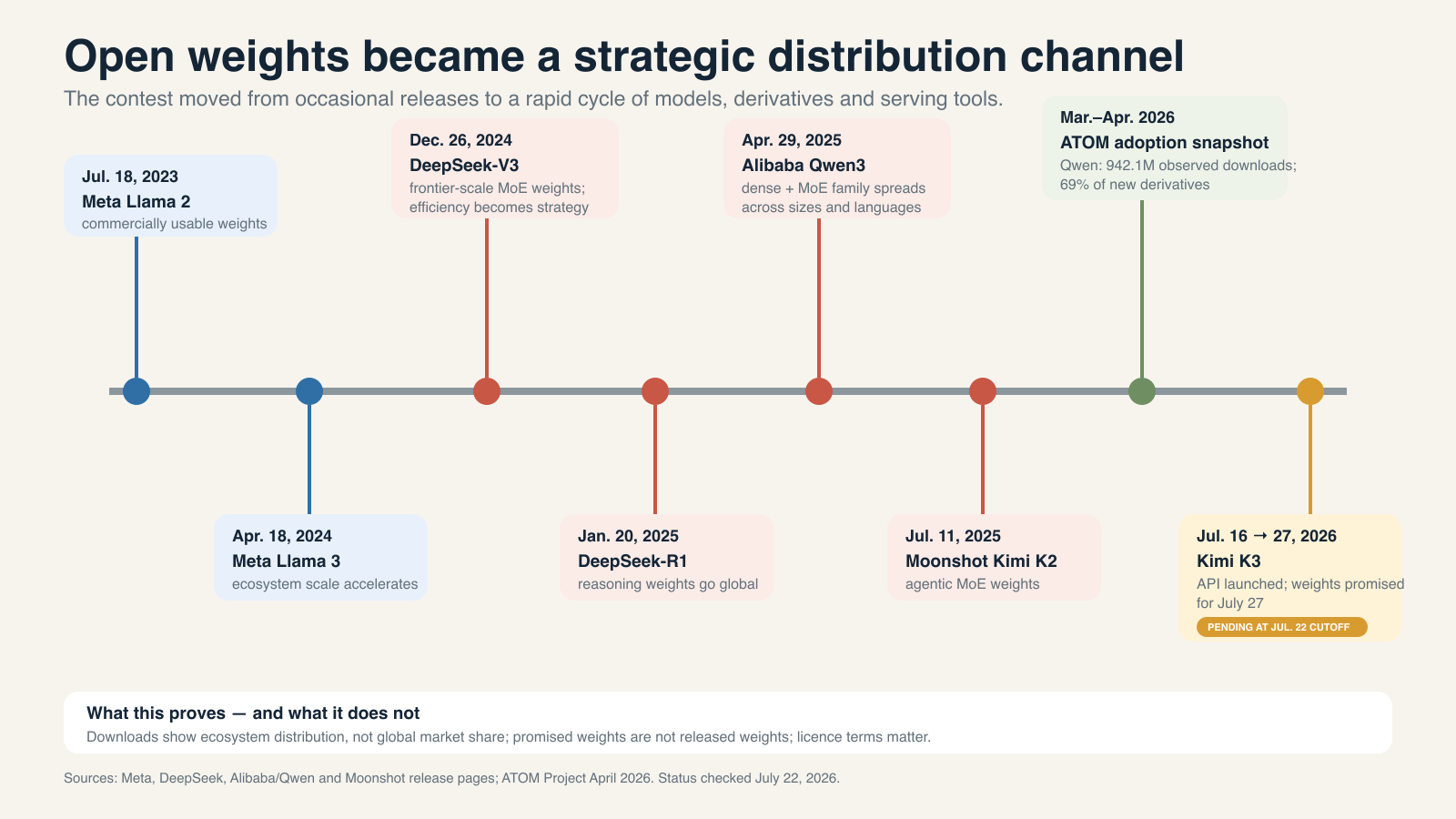
Open-weight distribution has become a distinct Chinese advantage. Alibaba’s Qwen family, DeepSeek and Moonshot have made capable weights, smaller variants and technical reports widely available. The ATOM Project’s April 2026 platform snapshot counted 1.15 billion downloads for Chinese models versus 723 million for U.S. models, with Qwen alone at 942.1 million downloads and 69% of newly observed derivative models. Those figures describe activity on observed repositories, not global market share, but they show developer momentum.
China’s power system is also expanding faster than most Western grids. That does not eliminate local transmission, water, cooling or efficiency constraints, and coal-heavy electricity creates environmental costs. It nevertheless gives developers another route to scale when accelerator efficiency improves.
6. Areas where China is closing the gap
Model quality is converging faster than manufacturing capability. Stanford found that the top U.S. model led the top Chinese model by 2.7% on its tracked performance measure in March 2026, while the best closed model led the best open model by 3.3%. These aggregates are volatile and benchmark-dependent, but the broad point is robust: developers can often choose a Chinese model that is commercially adequate even when it is not the absolute leader.
Serving efficiency is narrowing the practical gap. Sparse mixture-of-experts architectures activate only part of a model for each token. Quantization, speculative decoding, cache management, better routing and optimized inference frameworks reduce the hardware needed for a given workload. Algorithmic progress can therefore turn yesterday’s constrained accelerator into tomorrow’s useful serving chip.
Domestic accelerators and manufacturing tools are improving unevenly. Huawei and other Chinese firms are building systems that combine less-advanced components with scale and networking. Chinese manufacturing-equipment suppliers remain behind the global frontier in important categories, especially leading-edge lithography, but they are gaining share in mature-node tools. CSIS analysts Sujai Shivakumar, Charles Wessner and Thomas Howell argue that controls have disrupted access while also accelerating Beijing’s localization campaign. Both effects can be true.
7. Chips and semiconductor controls
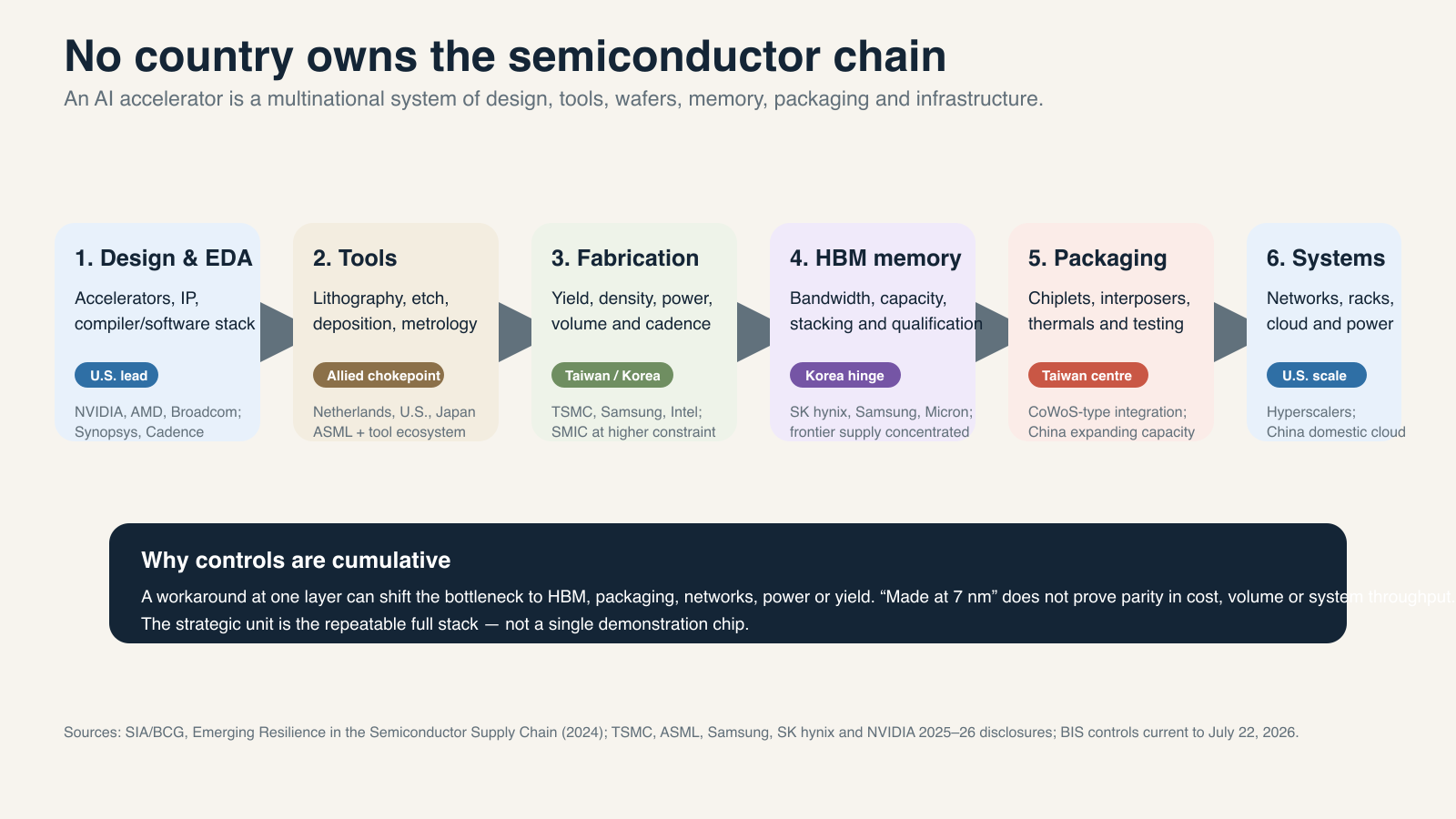
Chips remain the most important physical bottleneck because every frontier model depends on compute, memory bandwidth, interconnects, packaging and power. But “chip access” is too crude a variable. Training a large model requires a repeatable system: accelerators with compatible software, high-bandwidth memory, reliable packaging, high-speed networking, storage, cooling, technicians and electricity. A single demonstration chip does not prove that a country can build or operate thousands of them efficiently.
The supply chain is geographically concentrated. TSMC began high-volume production of its N2 process in the fourth quarter of 2025 and reported that advanced nodes of seven nanometres and below generated 74% of 2025 wafer revenue. South Korea remains central to high-bandwidth memory; ASML in the Netherlands controls extreme-ultraviolet lithography systems; Japanese firms supply critical materials and equipment; U.S. companies lead important design software and process tools.
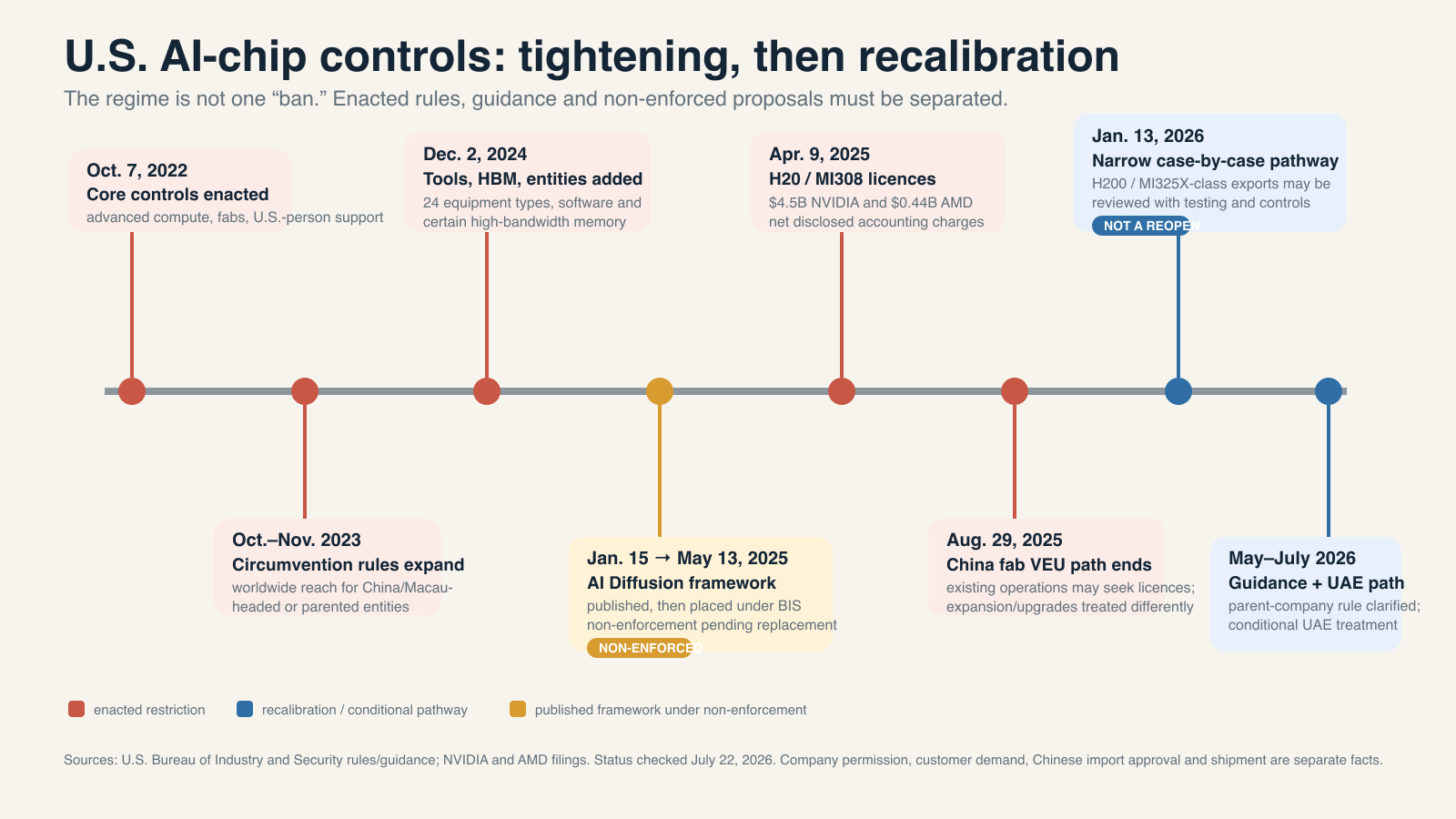
U.S. controls since October 2022 have targeted advanced computing chips, systems, semiconductor-manufacturing equipment, software, high-bandwidth memory and certain U.S.-person support. Rules expanded in 2023 and December 2024. The January 2025 AI Diffusion framework was later placed under non-enforcement pending replacement, while existing China-focused controls remained. In January 2026, the Commerce Department created a narrow case-by-case path for certain H200- and MI325X-class shipments to approved Chinese customers with testing and safeguards. That is not a blanket reopening.
The controls raise the cost, uncertainty and time required to assemble frontier-scale systems in China. They also encourage stockpiling, smuggling, design-arounds, cloud substitution and domestic investment. Their success depends on allied cooperation because many bottlenecks sit outside U.S. territory.
8. Why software and algorithms can offset hardware constraints
Hardware controls assume that more compute produces better models and that constraining compute therefore slows capability. The first relationship remains real, but it is not fixed. A developer can improve data quality, training objectives, expert routing, post-training, tool use, retrieval, inference-time search and system architecture. Each improvement changes the amount and type of hardware needed.
DeepSeek-V3 and R1 demonstrated the strategic importance of efficiency, even where outside estimates of training cost were often misreported as total development cost. Kimi K3 continues the pattern with sparse expert activation and attention mechanisms designed to extend context efficiently. None of this makes chips irrelevant. Efficient software often increases total demand because it makes more applications economical—a version of the rebound effect.
The correct question is not whether software can “replace” hardware. It is whether algorithmic gains arrive faster than controls can widen the hardware gap. A material shortage may prevent the largest experiments while still allowing a country to deploy strong models across millions of users. Conversely, a clever model without reliable production clusters may win benchmarks but fail to serve customers at low latency and cost.
9. Open-weight models as a strategic weapon
Open weights turn capability into distribution. A company can release model parameters that developers fine-tune, quantize, translate and deploy without sending every prompt to the original provider. That supports local privacy, national sovereignty, academic research and cost competition. It can also weaken the leverage of countries that dominate proprietary cloud APIs.
“Open-weight” is not synonymous with open source. Training data, code and reproducible recipes may remain undisclosed, and licences may restrict use. Kimi K3 illustrates why the distinctions matter: an API launch is different from a downloadable checkpoint; a promised release is different from an actual release; and a large checkpoint that requires dozens of accelerators is not equally accessible to every user.
NVIDIA chief executive Jensen Huang has argued that general-purpose open models should run best on the U.S. technology stack, framing ecosystem adoption as a source of American influence rather than a concession. That logic explains the strategic tension: Washington can restrict hardware while American vendors still want the world’s models to depend on CUDA, U.S. networking and U.S. cloud services.
For practical model selection, see Kingy.ai’s guides to the best open-weight AI models and open-source model specifications and hardware requirements.
10. Distillation and model diffusion
Distillation transfers behaviour from a teacher model to a smaller or cheaper student. It can be legitimate when the teacher’s owner permits it or when an organization distils its own system. It becomes controversial when developers evade access controls, create fraudulent accounts or use outputs in ways prohibited by service terms.
Anthropic’s February report described coordinated traffic patterns it attributed to three Chinese labs. The report is a primary account from the targeted provider, not an independent adjudication. Moonshot’s alleged K3 use of Fable 5 remains a government claim without public technical evidence as of the cutoff. The distinction matters because model resemblance can arise from shared public data, common benchmarks, convergent engineering, permitted synthetic data or prohibited extraction.
Even perfect account enforcement cannot contain all model knowledge. Papers, evaluation sets, open-source training code, employee movement and the behaviour of public APIs diffuse information. Providers can slow extraction with rate limits, identity checks, anomaly detection, watermarking research and legal action. They cannot turn a globally accessible model into a sealed weapons laboratory.
Kingy.ai’s explainer on AI distillation covers the technical mechanism and its legal ambiguity in more detail.
11. Cloud computing and foreign access
Cloud access complicates territorial controls. A developer blocked from buying advanced accelerators may rent compute abroad, use a foreign subsidiary, buy API access or employ intermediaries. Governments can impose know-your-customer rules, end-user restrictions and reporting requirements, but cloud capacity is distributed across jurisdictions with different laws and incentives.
The United States has an advantage in hyperscale cloud infrastructure and the software needed to schedule giant clusters. The 2026 AI Index counted 5,427 U.S. data centres, more than ten times the tally for any other country, though site counts do not measure accelerator density or available power. China has large domestic clouds and can direct infrastructure through state-linked financing and regional projects.
Foreign access is not only a leakage risk; it is a source of influence. Countries that build on U.S. clouds adopt U.S. security controls, billing systems and APIs. Countries that deploy Qwen or DeepSeek locally may avoid U.S. jurisdiction. The contest is therefore partly about making a technology stack attractive enough that others choose it voluntarily.
12. Data centres and electricity
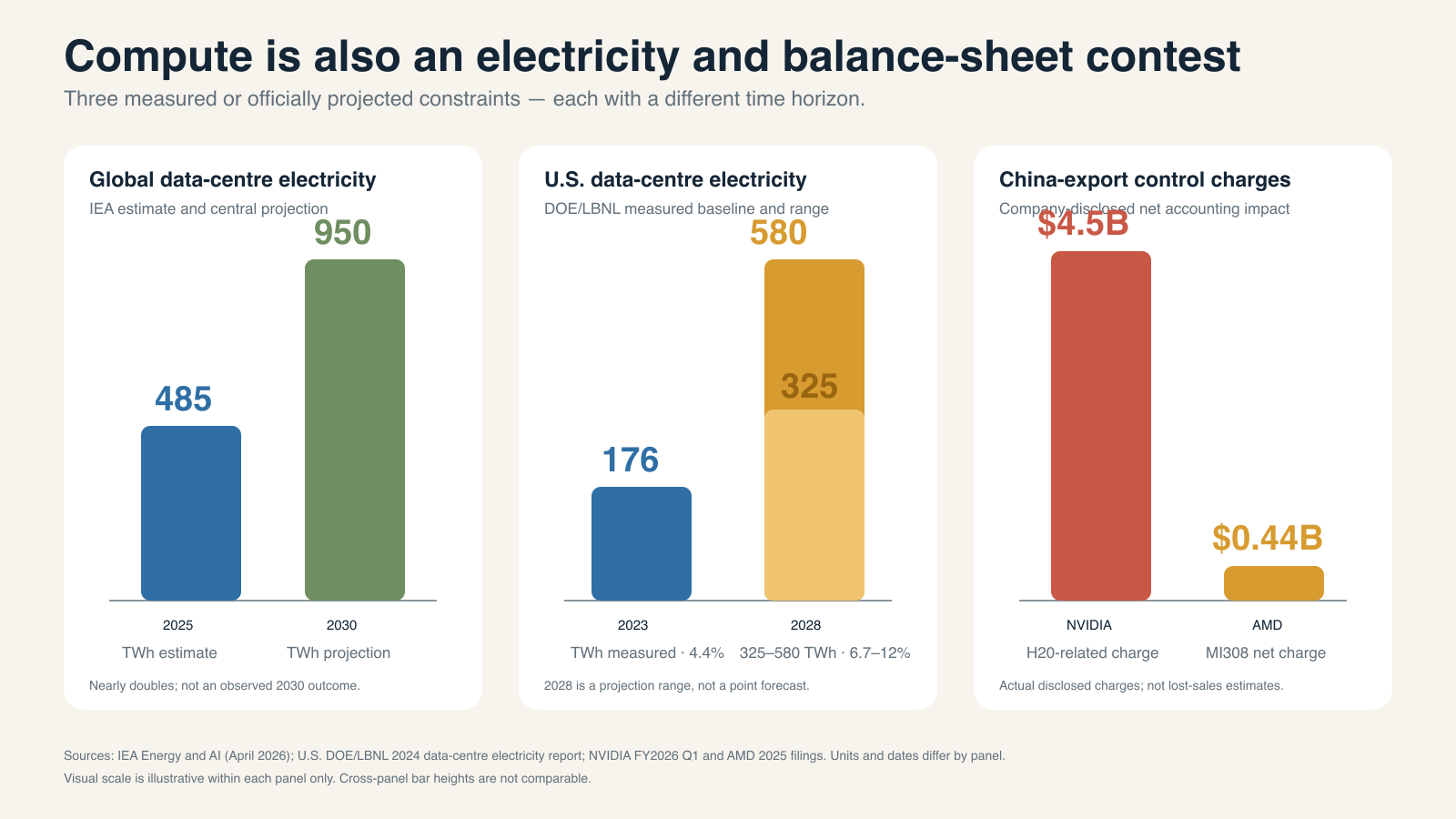
AI competition has become a grid-planning problem. The International Energy Agency estimated global data-centre electricity consumption at 485 terawatt-hours in 2025 and projected roughly 950 TWh by 2030. The U.S. Department of Energy and Lawrence Berkeley National Laboratory estimated U.S. data-centre consumption at 176 TWh, or 4.4% of national electricity, in 2023 and projected 325–580 TWh, or 6.7%–12%, by 2028. The ranges reflect uncertainty; they are not measured future outcomes.
The limiting factors vary by region: generation, transmission queues, transformers, water, cooling, land, permitting, natural-gas supply and public tolerance for rates and emissions. China can build generation and transmission quickly but must balance local constraints and decarbonization. The United States has abundant gas, deep capital and existing hyperscaler regions, but slow interconnection and equipment shortages can delay projects. Canada offers hydroelectricity and proximity to U.S. markets. Gulf states combine capital, land and energy with ambitions to become neutral compute hubs.
Efficiency changes the denominator but not the political problem. A more efficient model can lower electricity per task while generating more total demand. Competitive advantage will come from usable, contracted power delivered on schedule—not national generation totals alone.
13. Robotics and embodied AI
Robotics is where China’s manufacturing scale may matter most. Language-model leadership can be rented through an API; a dense network of suppliers, factories, technicians and deployment sites is harder to reproduce. Industrial robots, vehicles, drones and warehouse systems create streams of physical-world data and opportunities for rapid iteration.
The United States retains strong autonomy software, aerospace, defence research and venture-backed robotics companies. Japan and Europe lead important robot and automation suppliers. China has the largest installation market and a broad electronics and battery supply chain. The likely outcome is not one national winner but specialized advantage: U.S. software and compute, Chinese manufacturing and deployment, Japanese and European machinery, and multinational components.
Embodied AI also exposes benchmark limits. A model that plans a web task correctly may still fail when sensors drift, lighting changes or a machine encounters an unexpected object. Safety certification, maintenance and liability can matter more than raw model scores.
14. Military and cybersecurity implications
AI can improve intelligence analysis, logistics, predictive maintenance, cyber defence, simulation, targeting support and autonomous navigation. It can also produce confident errors, expand attack surfaces and accelerate low-quality decision-making. Public evidence about deployment is fragmentary, and claims about secret capabilities are difficult to verify.
The U.S. strategy increasingly treats frontier models and compute as national-security assets. The White House’s April 2026 National Security Technology Memorandum links advanced AI to security and supply-chain controls, while the U.S. AI Action Plan emphasizes infrastructure, adoption and international technology leadership. China’s official global AI governance action plan emphasizes development, sovereignty and international cooperation while supporting domestic capacity.
Neither strategy should be read as proof of a specific operational capability. Model developers, cloud providers and military agencies must still solve secure deployment, classified-data handling, evaluation under adversarial conditions and command accountability. The largest risk may be compressed decision time: leaders could trust machine-generated assessments during a crisis before institutions understand their failure modes.
15. Can export controls stop capability diffusion?
They can delay and reshape diffusion; they are unlikely to stop it. Controls work best on physical bottlenecks with few suppliers, clear serial numbers and allied enforcement. Extreme-ultraviolet lithography, high-end manufacturing tools, HBM and frontier accelerators fit that pattern better than software or model behaviour.
The evidence suggests at least four effects. First, controls raise prices and uncertainty for Chinese buyers. Second, they can prevent some frontier-scale experiments or force smaller clusters. Third, they create incentives for diversion, stockpiling and foreign cloud access. Fourth, they accelerate investment in indigenous substitutes.
Success therefore requires a realistic objective. If the goal is to prevent China from ever building a useful near-frontier model, the policy is failing. If the goal is to increase the time and cost of assembling the largest reliable systems for military or intelligence use, controls can still have value. Measuring effectiveness requires comparing the capability that would exist without controls, a counterfactual that cannot be directly observed.
Allied coordination is essential. Gregory Allen and Isaac Goldston of CSIS have documented how differences in legal authority among allies can create implementation gaps. A U.S.-only restriction is weaker when a comparable tool, component or service is available elsewhere.
16. Costs imposed on American firms
Restrictions are not costless to the country imposing them. NVIDIA disclosed a $4.5 billion H20-related charge after April 2025 licensing requirements. AMD reported a net $440 million MI308-related charge after a later reversal. These are accounting charges tied to inventory and purchase commitments, not complete estimates of lost sales or long-run strategic cost.
Lower China revenue can reduce research budgets and cede customer relationships to local rivals. Compliant, downgraded products also consume engineering resources. At the same time, continued sales can support Chinese capability and create dependence on a market subject to sudden policy change. There is no frictionless balance.
Controls can also fragment standards. If Chinese developers optimize for Huawei accelerators and domestic serving software, U.S. vendors may lose ecosystem influence even when they preserve a short-term hardware lead. That is why Huang’s argument about keeping global civil AI on the U.S. stack is strategically relevant, even though NVIDIA has a direct commercial interest in wider market access.
For the investment dimension, see Kingy.ai’s analysis of open-weight models and AI capital spending, its AI hardware coverage and the comparison of Alibaba’s Zhenwu chip with NVIDIA systems.
17. Role of allies and third countries
Taiwan is the pivotal fabrication centre. Its importance creates both economic leverage and geopolitical risk. TSMC’s expansion in Arizona adds resilience but does not quickly reproduce Taiwan’s full supplier network.
South Korea is central to high-bandwidth memory and advanced semiconductor manufacturing. Japan supplies materials, tools and robotics. Their export-control choices determine whether U.S. restrictions bind across the chain.
Europe is not a single actor. The Netherlands controls ASML’s critical lithography technology; the European Union shapes privacy, competition and AI regulation; France and Germany pursue compute and model capacity. Europe can align with U.S. security policy while resisting dependence on U.S. cloud providers.
Gulf states offer capital, energy and strategic geography. The United Arab Emirates and Saudi Arabia want major compute hubs and relationships with both American and Chinese technology suppliers. Conditional U.S. access arrangements can pull them toward a controlled U.S. stack, but only if capacity and terms are attractive.
Canada contributes research talent, hydroelectric power and geographic integration with U.S. markets. India brings a large developer base, data-centre demand and a tradition of strategic autonomy. It is likely to buy from multiple ecosystems rather than join a sealed bloc.
Third countries are not passive territory. They can bargain over data localization, technology transfer, pricing, security guarantees and domestic investment. A strategy that asks them to choose sides without offering affordable infrastructure may push them toward open-weight Chinese models by default.
18. Possible scenarios through 2030
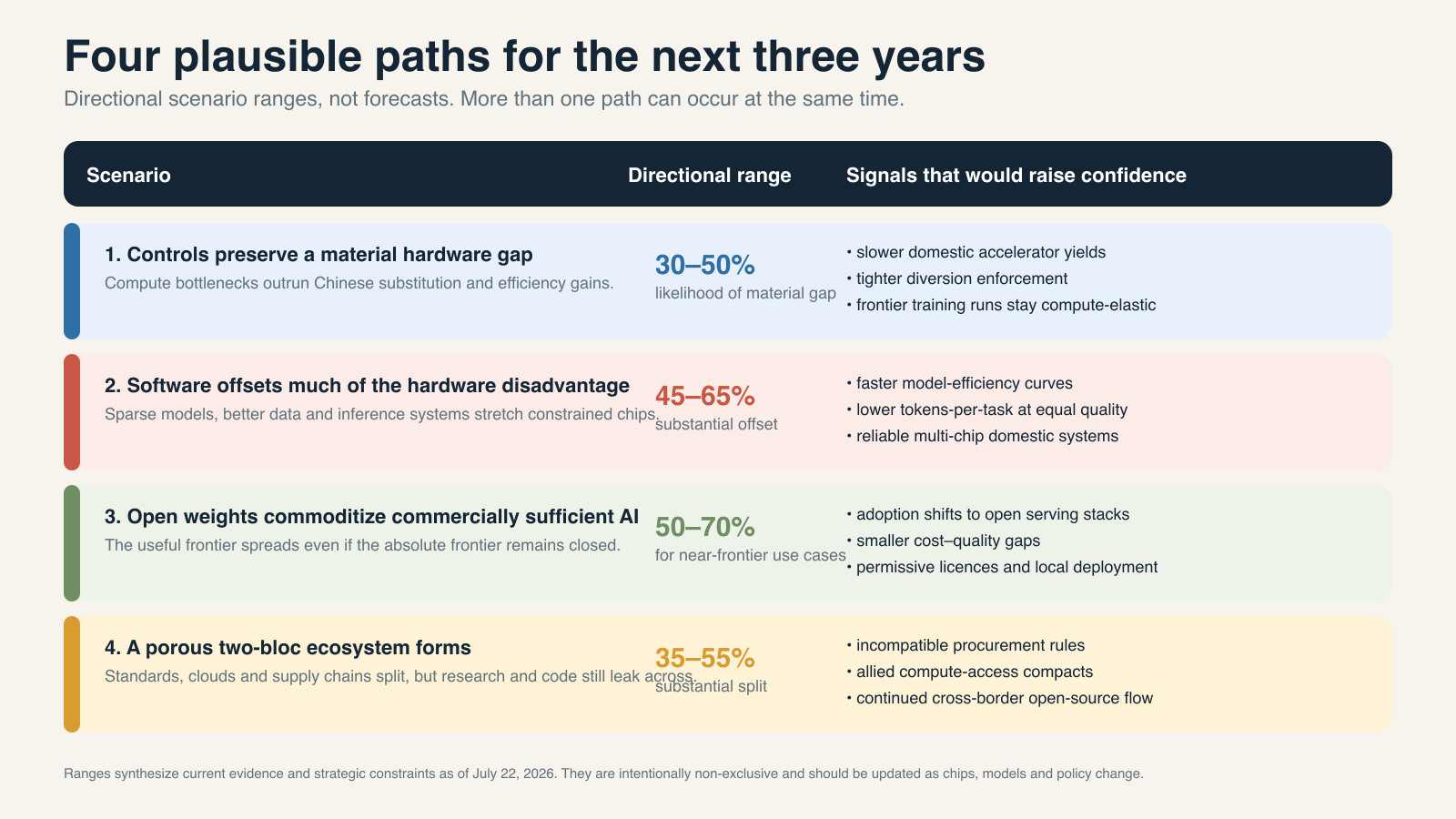
These scenarios are non-exclusive. The ranges are judgments grounded in current evidence, not statistical forecasts.
Scenario 1: U.S. hardware controls remain effective
Probability range: 30%–50% for a material and persistent frontier-compute gap; below 15% for controls preventing useful near-frontier Chinese models. Trigger: allied enforcement tightens, diversion becomes harder, domestic Chinese accelerator yields improve slowly and frontier training remains strongly compute-sensitive. Evidence: concentration in lithography, HBM, packaging, EDA and accelerator systems. Business implications: premiums rise for approved compute, cloud access and compliant supply chains. Policy implications: governments must invest in allied capacity and enforcement rather than expanding product lists indefinitely. Signals: domestic accelerator availability, cluster reliability, HBM supply, leading-node yields and enforcement actions.
Scenario 2: China offsets hardware limits through software efficiency
Probability range: 45%–65% for substantial offset; 20%–35% for fully neutralizing the absolute frontier disadvantage. Trigger: sparse architectures, better data, inference systems and domestic multi-chip networking improve faster than restrictions tighten. Evidence: the rapid efficiency gains visible in DeepSeek, Qwen and Kimi families. Business implications: Chinese models compete aggressively on price and deployment; accelerator demand broadens rather than disappears. Policy implications: controls buy less time, increasing the importance of research, talent and energy policy. Signals: tokens per task at equal quality, utilization rates, memory efficiency and performance on production workloads.
Scenario 3: Open-weight models commoditize frontier capability
Probability range: 50%–70% for commoditizing most commercially sufficient near-frontier capability; 15%–30% for open models continuously matching the absolute frontier. Trigger: performance gaps stay small, licences remain usable and local serving costs fall. Evidence: Qwen, DeepSeek and Kimi distribution plus a large derivative ecosystem. Business implications: model API margins compress; value moves to data, workflow, chips, hosting and distribution. Policy implications: weight-release governance and procurement security become more important than API nationality. Signals: enterprise migration, derivative counts, local inference cost, licence changes and independent evaluations.
Scenario 4: AI ecosystems split into separate geopolitical blocs
Probability range: 35%–55% for a substantial but porous split; 10%–20% for a near-complete separation. Trigger: incompatible procurement rules, cloud-access controls, sanctions and security standards accumulate. Evidence: existing chip controls, sovereign-cloud initiatives and national model programmes. Business implications: suppliers build duplicated products and compliance systems; third countries gain bargaining power. Policy implications: interoperability and crisis communication become security issues. Signals: divergent standards, blocked repositories, cloud identity rules and exclusive infrastructure agreements.
19. What investors and companies should watch
Independent capability and cost curves. Vendor benchmarks should be separated from evaluations of reliability, latency and total serving cost. Watch whether Kimi K3’s claimed gains survive third-party testing.
Weight availability and licence terms. A released checkpoint under a restrictive licence has different strategic value from an API or a permissively licensed model. Verify hashes, repositories and serving requirements.
System availability, not chip announcements. Track HBM, advanced packaging, networking, yields, rack power and customer deployments. Prototype specifications are not shipment volume.
Policy implementation. Distinguish enacted rules, non-enforcement notices, licence reviews and political statements. Track allied controls and Chinese import decisions as well as U.S. announcements.
Power delivery. Signed interconnection agreements, transformers and generation schedules are more useful than headline gigawatts. Grid delays can determine which promised data centres actually operate.
Ecosystem distribution. Downloads, derivatives, cloud listings, developer tools and enterprise deployments reveal influence. No single metric equals global share.
Talent movement. Immigration policy, research collaboration and new hubs in Canada, Europe, Singapore, India and the Gulf may alter both national positions.
20. Kingy.ai assessment
The United States retains the stronger full-stack position: more leading closed models, dominant accelerator design, the deepest hyperscale clouds, superior private capital and substantial alliance leverage. China has built the more credible challenge: near-frontier model quality, an influential open-weight ecosystem, unmatched industrial deployment scale, fast infrastructure buildout and a state-supported localization campaign.
Kimi K3 does not prove that export controls have failed, that China has taken the overall lead or that frontier models can be built without advanced chips. It does show that capability is harder to contain than hardware. Software efficiency, model diffusion and global developer adoption can convert constrained infrastructure into strategic influence.
The most plausible 2030 outcome is neither American dominance nor Chinese replacement. It is a layered system in which U.S.-aligned firms retain key hardware and closed-frontier advantages, Chinese models capture a large share of open deployment, and third countries arbitrage between the two. The ecosystem becomes more political and more redundant, but not truly separate.
The policy implication is uncomfortable: restrictions can buy time, yet time has value only if it is used. The United States must pair controls with faster energy and infrastructure construction, research funding, talent attraction, allied capacity and products the rest of the world wants to adopt. China must convert model and manufacturing scale into reliable frontier systems while managing dependence on foreign tools and markets. Neither side can assume the other will remain static.
21. FAQ
What does “AI Cold War” mean?
It describes the growing U.S.–China competition over models, chips, data centres, standards, talent and military applications. The term is imperfect because the two countries remain connected through global research, trade and supply chains.
Does the United States still lead China in AI?
The U.S. leads in the combined strength of closed frontier models, accelerator design, hyperscale cloud and private investment. China leads or competes strongly in open-weight adoption, research volume, industrial robotics and manufacturing deployment. Leadership depends on the layer being measured.
What is Kimi K3?
Kimi K3 is Moonshot AI’s native-vision, mixture-of-experts model launched through an API and Kimi products on July 16, 2026. Moonshot promised weights for July 27; they were not available at this article’s July 22 research cutoff.
Was Kimi K3 distilled from Claude Fable 5?
A U.S. official alleged that Moonshot used Fable 5 outputs, but the government had not released supporting technical evidence as of July 22. Anthropic previously attributed millions of suspicious Claude exchanges to Moonshot, but that earlier report predates Fable 5 and does not independently prove the K3 allegation.
Do U.S. AI chip restrictions work?
They increase the cost and difficulty of building leading systems and can delay the largest training runs. They do not stop software diffusion, and they also encourage diversion, efficiency work and Chinese investment in domestic substitutes.
Why are open-weight Chinese models strategically important?
They allow global developers and governments to deploy capable systems locally without relying on a U.S. API. That can shift influence from proprietary model providers toward hosting, hardware and developer ecosystems.
Could export controls hurt U.S. companies?
Yes. Controls can create inventory charges, reduce sales, force redesigns and push customers toward non-U.S. platforms. Policymakers weigh those costs against the national-security value of delaying access to advanced compute.
Will the world split into two AI blocs?
A partial split is plausible in procurement, clouds and standards. A complete split is less likely because semiconductor production, research, capital, open-source software and developer communities remain multinational.
22. Sources and methodology
This article uses primary sources wherever possible and applies a July 22, 2026 cutoff. Model specifications and prices come from vendor release pages and are identified as vendor claims. Policy status comes from enacted U.S. Bureau of Industry and Security rules and guidance, not summaries of proposed frameworks. Company costs come from filings and are described as accounting charges rather than estimated lost sales. Energy figures distinguish measured baselines, estimates and projections.
- Moonshot AI: Kimi K3 launch and technical overview
- Anthropic: Claude Fable 5 product information
- Anthropic: detecting and preventing distillation attacks
- Stanford HAI: 2026 AI Index, research and development
- Stanford HAI: 2026 AI Index, technical performance
- Stanford HAI: 2026 AI Index, economy
- U.S. Bureau of Industry and Security: advanced semiconductor controls
- CSIS: controls and China’s semiconductor localization drive
- International Energy Agency: energy and AI
- Columbia Center on Global Energy Policy: data-centre energy context
- International Federation of Robotics: World Robotics 2025 data
- SIA and BCG: semiconductor supply-chain resilience
- TSMC: 2025 fourth-quarter results and advanced-node data
- NVIDIA: fiscal 2026 first-quarter results
- AMD: 2025 second-quarter results