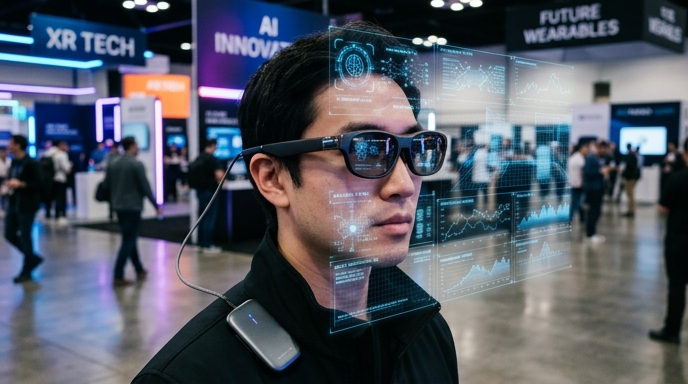
The Smart Glasses Race Just Got Spicier
Smart glasses have spent years trapped in an awkward middle school phase. Some look normal but do little more than play audio, take calls, and answer voice prompts. Others can show proper mixed-reality visuals, but they look like someone strapped a gaming laptop to your eyebrows.
Qualcomm wants to help end that compromise. Its new Snapdragon Reality Elite chip arrives with a clear job: give smart glasses and XR headsets more power, more AI, better visuals, and fewer hot-face problems. That last bit matters. Nobody wants their futuristic eyewear to double as a panini press.
The chip debuted at Augmented World Expo, and it already has a first big customer: Xreal’s Aura Android XR glasses. The fun twist? Reviewers had already tried Project Aura at Google I/O before Qualcomm publicly named the silicon inside. The mystery chip was Reality Elite all along.
That matters because Xreal Aura is not just another pair of display glasses. It points toward a bigger idea: glasses that can run immersive apps, understand the world around you, and still feel portable enough to use outside a demo booth.
What Qualcomm Actually Announced
Snapdragon Reality Elite is Qualcomm’s new XR platform for more powerful headsets and display-equipped smart glasses. The company did not simply nudge last year’s chip forward and toss confetti. It aimed at a more demanding product category: wearable spatial computers with serious AI.
The headline numbers do the shouting. Qualcomm says the chip brings up to 60 percent faster GPU performance, up to 30 percent faster CPU performance, and up to 160 percent higher NPU performance compared with earlier XR chips. Translation: better graphics, snappier general computing, and much more muscle for on-device AI.
It also supports up to 4.4K resolution per eye at 90 frames per second. That is the sort of spec XR needs if it wants to feel crisp rather than “I am reading a spreadsheet through aquarium glass.”
The platform also promises lower latency, better video see-through performance, up to 20 percent longer battery life, and cooler operation under heavy workloads. Qualcomm says devices can run up to 12 degrees Celsius cooler than last-generation XR chips while handling demanding tasks.
That is not glamorous. It is vital.
Why the Xreal Aura Connection Matters
The first device expected to use Reality Elite is Xreal Aura, a pair of Android XR glasses scheduled for fall. The Verge reported that the chip will first arrive in Aura, while Tom’s Guide noted that Project Aura was already running on it during earlier hands-on testing.
Aura matters because it represents a different route from giant mixed-reality headsets. Instead of cramming everything into the glasses, Xreal uses a split-compute design. The glasses stay lighter. A separate compute puck handles the heavy lifting.
That design sounds less elegant than magic glasses with no cable, sure. But engineering is where dreams meet battery chemistry and quietly cry. Moving heat, compute, and battery load away from the face can make the wearable part more comfortable.
Tom’s Guide framed this as part of a possible convergence between VR headsets and AR glasses. The idea is simple: take the richer experiences people associate with headsets and shrink them toward something closer to everyday eyewear.
Will Aura be the final form? Almost certainly not. First-wave products rarely are. But it could become an important bridge product. Bridges are not glamorous either. They still get you across the river.
The AI Part Is Not Decoration
The most important number may not be the GPU gain. It may be the NPU jump. Qualcomm claims up to 160 percent higher neural processing performance, and that tells us where this market is going.
Smart glasses without AI are basically tiny monitors with ambition. Smart glasses with strong local AI can become something more useful: a visual assistant that can respond to what you see, what you say, and what you are trying to do.
That does not mean every demo will be useful. Some will be silly. Some will be cursed. Someone will absolutely build an app that identifies sandwich ingredients in real time, and society will survive.
But the serious use cases are obvious. A wearer could ask what a sign says in another language. A technician could get help identifying a part. A traveler could receive contextual directions without staring at a phone. A student could ask questions about an object in front of them.
The key word is “local.” More on-device AI can reduce cloud dependence, cut lag, and protect experiences from feeling like a slow phone call to a distant server. For glasses, latency is not a minor annoyance. It is the line between magic and nausea.
Better Graphics, Fewer Face-Melting Vibes
XR has a brutal technical checklist. It needs high-resolution visuals. It needs smooth frame rates. It needs fast tracking. It needs responsive hand input. It needs enough battery to last longer than a coffee break. And it needs to avoid cooking the user.
Reality Elite attacks several of those problems at once. The 60 percent faster GPU should help render richer scenes. The 4.4K-per-eye support at 90 frames per second gives device makers headroom for sharper displays. The 10 percent latency improvement noted by Tom’s Guide should make interactions feel tighter.
The thermal claim might be the sleeper feature. Heat ruins wearables. It makes devices uncomfortable, forces chips to throttle, and gives designers fewer options. If Qualcomm’s cooler-running claims hold up in shipping products, manufacturers can push harder without building chunky eyewear.
Battery improvements also matter because smart glasses live or die by convenience. A headset can ask users to plan a session. Glasses ask for a place in daily life. That bar is much higher.
No one wants to charge their face computer five times before dinner.
The Compute Puck Is Not a Failure
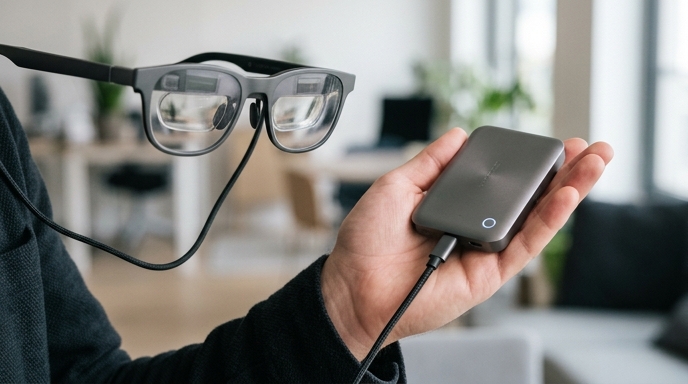
Some people will see Aura’s puck and cable and declare defeat. That is too harsh. It is also historically lazy.
Early mobile computing always made ugly compromises. Laptops got lighter over time. Phones lost their weird antennas. Smartwatches needed years to become genuinely useful. XR glasses will likely follow the same messy road.
A puck lets Xreal and Qualcomm move powerful compute out of the glasses while keeping the glasses closer to something wearable. It also gives designers more thermal breathing room. The tradeoff is obvious: you gain power and comfort, but you lose the clean simplicity of a totally self-contained device.
That tradeoff may be worth it, at least for now. Tom’s Guide said Project Aura still uses a fan in the puck, which shows the category has not escaped cooling challenges. But the puck also explains how Aura can chase headset-like performance in a glasses format.
Think of it as training wheels for the future. Slightly nerdy training wheels, yes. But training wheels with ray tracing.
Android XR Gets a Real Hardware Push
The Reality Elite story is also an Android XR story. Xreal Aura is built around Google’s Android XR platform, which gives developers a familiar ecosystem instead of asking them to build for a tiny island.
That matters. Hardware launches create attention. Software ecosystems create staying power.
A beautiful pair of XR glasses with no useful apps becomes a drawer ornament with a premium charger. Android XR gives Google, Qualcomm, Xreal, and developers a shared target. It also gives Gemini a natural home in glasses, where voice and vision can matter more than tapping icons.
The Verge noted that Qualcomm’s chip work also pairs with its broader wearable roadmap. The company previously introduced Snapdragon Wear Elite for AI-focused wearable devices. Reality Elite appears aimed at more power-hungry display glasses and XR headsets.
That split makes sense. Audio-only AI glasses need one kind of silicon. Immersive display glasses need another. Qualcomm wants to sell picks and shovels to everyone in the gold rush.
The Market Is Still Weird, but Less Theoretical
Smart glasses have hype. They also have baggage. Google Glass made people nervous. VR headsets sold promise, then ran into the hard wall of comfort, price, and limited everyday use. Many AR glasses have appealed mainly to enthusiasts, developers, and people willing to explain their eyewear at parties.
Reality Elite does not magically fix all of that. Silicon cannot solve social acceptance by itself. It cannot make killer apps appear. It cannot guarantee that people want a computer in their field of view.
But better chips can remove several boring blockers. Boring blockers matter. They decide whether a product feels magical or half-baked.
More AI performance can make glasses more useful. Better graphics can make displays more convincing. Cooler operation can make devices wearable. Longer battery life can make them practical. Developer platforms can give builders a reason to care.
That is the less flashy truth: the smart glasses race may not turn on one killer feature. It may turn on dozens of small improvements finally arriving together.
What This Means for Meta, Google, Snap, and Everyone Else
Qualcomm rarely builds chips in a vacuum. It builds for partners. The Verge pointed out that Qualcomm’s wearable chips offer clues about what device makers may ship in late 2026 and 2027.
That puts Reality Elite in the middle of a broader platform fight. Google wants Android XR to become a real ecosystem. Xreal wants Aura to be more than a niche display gadget. Meta keeps pushing smart glasses and headsets. Snap has its own AR ambitions. Samsung has already moved into Android XR hardware.
The question is not whether smart glasses are coming. They are already here. The better question is which kind wins.
Do people want light AI glasses with cameras and audio? Do they want display glasses with a puck? Do they want full mixed-reality headsets? Or will the market split into several categories, each with different compromises?
Reality Elite leans toward the more powerful end of that spectrum. It is not just for “tell me the weather” glasses. It is for devices that want immersive visuals, computer vision, and local AI in one wearable system.
That is a bigger swing.
The Catch: Shipping Products Must Prove It
Chip announcements always sound heroic. Then real products arrive and remind everyone that physics has a vote.
Qualcomm can claim faster graphics, stronger AI, better efficiency, and cooler workloads. Those claims matter. But buyers will judge the actual glasses and headsets. They will care about weight, price, comfort, field of view, app quality, setup, battery life, heat, and whether the device solves a real problem.
That is where many XR products stumble. They impress in a demo. Then they struggle in daily life.
Aura will face that test. So will every Reality Elite device after it. The chip gives manufacturers more room to work, but it does not guarantee good design. A fast engine still needs a good car around it. Otherwise, congratulations, you built a very expensive lawn dart.
Still, this feels like a meaningful step. Not because it proves smart glasses have arrived, but because it attacks the exact weaknesses that have kept them stuck.
The Bottom Line
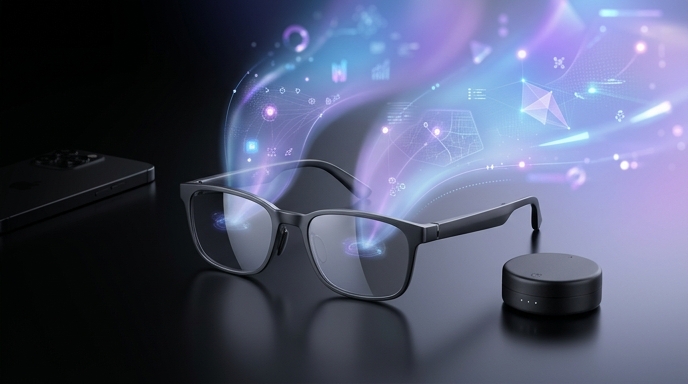
Snapdragon Reality Elite gives the next wave of XR glasses and headsets a stronger foundation. Qualcomm boosted graphics, CPU performance, AI processing, display support, latency, battery life, and thermals. Xreal Aura will be the first major showcase, and its split-compute design gives us an early look at how powerful smart glasses may evolve before fully self-contained versions become practical.
The real story is not just faster chips. It is the slow collapse of the wall between VR headsets and smart glasses.
That future will not arrive cleanly. It will arrive with cables, pucks, fans, developer kits, weird demos, awkward first-generation compromises, and at least one person wearing smart glasses in a coffee shop like they are piloting a moon rover.
But the direction is clear. The computer wants to leave your pocket. Qualcomm just gave it a stronger passport.
Sources
- The Verge: “Qualcomm’s latest chip hints that more powerful smart glasses could be on the way”
- Tom’s Guide: “Snapdragon Reality Elite is here…”
- CNET: “Qualcomm Snapdragon Reality Elite chip…”
- Android Headlines: “Qualcomm just announced the chip that will power the next wave of smart glasses and headsets”
AI Smart Glasses
- Gucci and Google AI smart glasses
- Meta Hypernova smart glasses comparison
- Apple AI smart glasses roadmap
- Alibaba Quark AI glasses versus Meta
Meta Smart Glasses
Apple Wearables
The Kingy Brief
Get the next Kingy Brief.
Source-checked AI changes, original tests and one practical thing to try.
Free · Choose your subjects · Double opt-in · Unsubscribe anytime