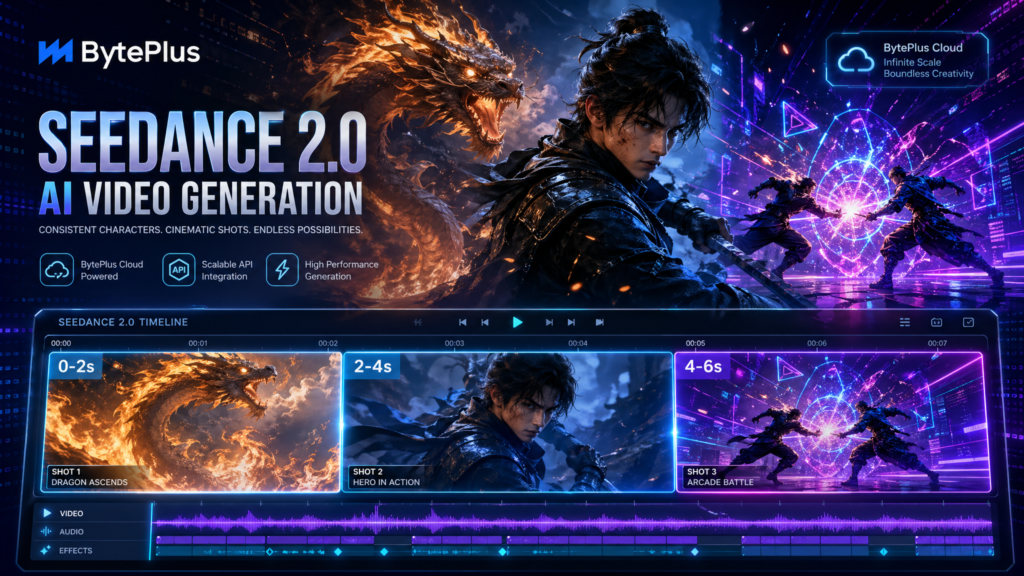
BytePlus has always been easiest to understand as the enterprise technology arm connected to ByteDance’s infrastructure, machine learning, media, and growth stack. But the most important reason to pay attention to BytePlus right now is Seedance 2.0. With Dreamina Seedance 2.0 now available through BytePlus ModelArk, BytePlus is no longer just a broad cloud-and-AI platform with infrastructure, recommendation, media, communication, and data products. It is now one of the more interesting gateways for businesses, developers, creators, and workflow builders who want official API access to a high-end multimodal video generation model.
BytePlus’ official blog describes Dreamina Seedance 2.0 as available through ModelArk with API access for businesses and developers, and the official Seedance page says Seedance 2.0 uses a unified multimodal audio-video generation architecture that supports text, image, audio, and video inputs.
That matters because AI video is quickly moving from “fun demos” into actual production workflows. Seedance 2.0 is introduced as available on BytePlus, including official API access, and the workflow moves directly into the ModelArk interface, Playground, Media section, model settings, generation controls, and output configuration. The demo also highlights 1080p generation, video extension, smart lengthening, character consistency, and 15-second outputs. In the showcased demo, the outputs were strong on the first attempt, with no rerolls needed in those specific generations.
For me, that is the headline of this BytePlus review: BytePlus is becoming a practical production layer for AI-native media generation. The platform is not only selling access to a model. It is wrapping that model in a developer platform, pricing/resource packs, documentation, API keys, authentication, Playground testing, and broader cloud services. The official ModelArk docs include video generation API pages for creating, retrieving, listing, and cancelling or deleting video generation tasks, which is exactly the kind of task-based API flow teams need if they want to build Seedance into apps, pipelines, creative tools, ad workflows, or automated content systems.
What BytePlus Actually Is
BytePlus describes itself as an AI-native cloud platform for enterprise growth. Its homepage positions the platform around model access, apps and agents, model-as-a-service, and cloud infrastructure. It also presents use cases such as media agents, deep research agents, AI knowledge search, video understanding, and AI application firewall.
The company’s own “About” page explains the broader thesis: BytePlus uses ByteDance’s research and engineering, including machine learning and big data, to help customers build digital experiences that engage and convert. BytePlus says the idea originated in 2018, officially launched in March 2021, and began with Personalization, AR, and Data Intelligence services.
That background matters because BytePlus is not positioned like a narrow AI startup. It is closer to a multi-product enterprise platform. The official product list includes media services such as BytePlus Live, MediaLive, RTC, Video On Demand, and VideoOne, plus networking services such as load balancing, Cloud Enterprise Network, Direct Connect, Elastic IP, NAT Gateway, and PrivateLink.
This gives BytePlus a different feel from a standalone AI video tool. A creator may come for Seedance 2.0. A developer may stay for ModelArk. A media company may care about RTC, MediaLive, Video On Demand, CDN, and analytics. A larger enterprise may care more about API keys, regional infrastructure, security, privacy, content filtering, usage controls, and compliance.
Seedance 2.0 Is the Priority Feature
The biggest reason BytePlus is worth reviewing right now is Seedance 2.0. The official Seedance 2.0 page says the model supports text, image, audio, and video inputs through a unified multimodal audio-video joint generation architecture. It also describes the model as supporting creator control over references, performance, lighting, shadows, and camera movement.
That matches the actual creative experience shown in the transcript. The demo does not treat Seedance 2.0 like a one-line prompt toy. It uses detailed prompting, image references, shot-by-shot timing, video extension, smart lengthen, character consistency testing, and a video game fight scene. The most useful practical prompting advice in the transcript is to structure generations in 2–3 second chunks, describing each shot clearly. That is exactly the sort of workflow professional creators already use when building AI video sequences.
The demo also shows why official API access matters. If Seedance 2.0 only existed as a consumer-facing web app, it would be useful for creators but less interesting for teams. With BytePlus ModelArk, the model becomes something developers can test, call, automate, price, and integrate. The official docs show an API key workflow, recommend storing the API key as an environment variable instead of hardcoding it, and explain that API keys are isolated by region.
That means BytePlus is not just offering a model page. It is offering an integration surface. For AI video startups, creative automation companies, ad-tech teams, e-commerce media teams, social content platforms, and internal enterprise creative teams, that is the real value. Seedance 2.0 is exciting because of output quality. BytePlus is interesting because it gives that output quality a path into actual products and workflows.
ModelArk: The Developer Layer
ModelArk is the center of the AI experience on BytePlus. The official docs position it around model discovery, model invocation, Playground access, API documentation, pricing, foundation models, PromptPilot, agent builder, image generation, video generation, fine-tuning, evaluation, and API tooling. The ModelArk quick-start documentation says users can browse released models in Model Square, view model descriptions, parameters, supported tasks, pricing, free trial quotas, technical specs, usage examples, and API documentation.
The developer experience looks especially important because BytePlus is clearly trying to reduce switching friction. The ModelArk documentation says its model invocation APIs are compatible with the OpenAI API protocol and that users can call ModelArk models or applications through OpenAI-compatible multi-language community SDKs. Another official page says ModelArk APIs are largely compatible with the OpenAI SDK, allowing integration with minimal code changes.
That is a smart move. Developers do not want every AI platform to require a completely new integration pattern. If a team already has an OpenAI-style client architecture, a compatible API surface makes BytePlus easier to test. It does not guarantee effortless migration in every case, but it does lower the psychological and engineering barrier.
The video generation API structure also makes sense. BytePlus separates task creation, retrieval, listing, and cancellation/deletion. For AI video, asynchronous task handling is normal because video generation can take time. A task-based API model is practical for dashboards, queues, background workers, content pipelines, and user-facing products where the UI needs to show progress or retrieve completed generations later.
Pricing and Resource Packs
BytePlus’ Seedance 2.0 pricing is handled through token/resource-pack logic. The official Seedance product page lists a Light Plan and Production Plan with token-based pricing, including a Light Plan at $30.10 for 7 million tokens, described as generating around 28 x 480p videos, and a Production Plan at $43.00 for 10 million tokens.
The ModelArk resource pack documentation gives more detail. It lists Dreamina Seedance 2.0 resource packs at $4.30 for 1 million tokens, $43 for 10 million tokens, and $430 for 100 million tokens. It also lists Dreamina Seedance 2.0 fast packs at $3.30 for 1 million tokens, $33 for 10 million tokens, and $330 for 100 million tokens. The same document explains that token deduction varies depending on whether video input is included and whether the output is 480p/720p or 1080p.
My review of the pricing model is mixed but mostly positive. On the positive side, token packs make sense for developers and teams because they can budget usage, test workflows, and separate “standard” from “fast” usage. On the negative side, token-based pricing for video can be less intuitive for casual creators. A creator wants to know: “How many usable 15-second clips can I make for $50?” A developer is more comfortable calculating usage, input type, resolution, retry rate, and cost per successful asset.
That is why BytePlus feels more naturally suited to teams and builders than to purely casual users. The pricing is not impossible to understand, but it is clearly designed for usage-based production rather than a simple consumer subscription.
The Broader BytePlus Stack
Seedance 2.0 is the hook, but BytePlus becomes more compelling when you look at the rest of the stack. For example, BytePlus RTC is positioned around real-time audio and video communication, with claims of ultra-low latency, one-to-one and group communications, interactive effects, 10,000 free minutes per month, under 400 ms average global latency, 3,000+ available nodes, 40,000+ compatible devices, and 50 billion monthly call minutes.
BytePlus MediaLive focuses on broadcast-quality live and on-demand streams. The official product page highlights ultra-low latency live streaming, secure and stable cloud-based service, multi-codec support, less than one second end-to-end latency, 3,000+ global PoPs, stream pull and push across protocols such as RTP, RTMP, UDP, HLS, and HTTP-MP4, plus features like URL authentication, IP whitelisting, livestream encryption, HTTPS configuration, smart transcoding, analytics, and smart subtitles.
BytePlus CDN is another major piece. The official CDN page says it offers a reliable, scalable, high-performance global CDN, supports WAF, bot protection, API security, DDoS protection, global edge functions, 1,300+ PoPs, 120+ Tbps, 70+ locations, and under 40 ms latency. It also highlights use cases such as media live streaming, game downloading, web and app acceleration, and social entertainment.
BytePlus VideoOne is positioned as an all-in-one video experience suite that integrates live streaming, RTC, VOD, and enhancement capabilities. It includes Live SDK, RTC SDK, Player SDK, Enhancement SDK, effects, and video editor capabilities.
This broader stack matters because AI video generation alone is only one part of the future media workflow. Teams also need storage, delivery, streaming, real-time communication, moderation, analytics, editing, and app infrastructure. BytePlus is trying to cover more of that surface area than a single-purpose AI generation tool.
Security, Privacy, and Governance
For enterprise AI, security and governance cannot be an afterthought. BytePlus has official ModelArk documentation on data processing, content pre-filtering, region availability, API keys, and trust/compliance.
The ModelArk data processing documentation says BytePlus ModelArk is an LLM development platform that provides model invocation, training, inference, fine-tuning, and evaluation. It says ModelArk processes customer data for the purpose of providing services, acts as a data processor under customer instructions, and will not use customer data for its own model training without prior authorization. It also describes HTTPS transmission encryption, optional application-layer encryption, access control, customer data isolation, and internal access restrictions.
The content pre-filter documentation says BytePlus offers a content pre-filter system that can detect risky content in input prompts and output completions, then apply measures such as refusing to answer or returning a safer response. It also says the feature is integrated into ModelArk and is enabled by default when creating a new endpoint.
The content pre-filter FAQ also says ModelArk includes a feature designed to block generation of images resembling public figures across categories such as politics, sports, business, entertainment, and media, with the goal of helping prevent fraud and deepfakes.
For compliance, BytePlus’ trust center lists certifications and frameworks including ISO 27001, ISO 27017, ISO 27701, ISO 27018, CSA STAR, SOC2, PCI DSS, Singapore MTCS Level 3, Singapore Data Protection Trust Mark, APEC CBPR, and APEC PRP.
The takeaway: BytePlus is making the right enterprise noises around security and governance. The caveat is that any company adopting generative AI video still needs its own review process around rights, likeness, brand safety, regional law, acceptable use, consent, and training data questions. BytePlus provides platform-level safeguards, but the customer is still responsible for how generated media is used.
Strengths
BytePlus’ biggest strength is that it now combines frontier creative AI access with real developer infrastructure. Seedance 2.0 gives the platform cultural and technical momentum. ModelArk gives developers a place to test, call, and integrate models. The video API gives teams a more practical workflow than a pure web UI. The pricing/resource-pack model makes more sense for builders than one-off hobbyists. The rest of BytePlus’ stack gives media, streaming, CDN, RTC, and video teams more reasons to consider the platform.
The second strength is the output quality shown in the recorded workflow. In the demo transcript, the model performed well across cinematic dragon-style generation, character consistency, video extension, and game-fight-scene creation, with outputs generated in one attempt. That does not prove every user will get perfect first-generation results, but it does show that the tool can handle structured creative prompting and reference-based workflows in a way that feels meaningfully useful.
The third strength is multimodal control. Seedance 2.0’s official positioning around text, image, audio, and video inputs is important because the future of AI video will not be only text-to-video. Professional workflows need references, continuity, extension, camera direction, audio alignment, shot structure, and iterative control.
Before spending credits, block the intended camera path and copy a precise direction.
Weaknesses and Caveats
The biggest weakness is complexity. BytePlus is powerful, but it is not the simplest possible experience. Product pages, docs, ModelArk, tokens, resource packs, API keys, regions, inference endpoints, and task-based video generation are normal for developers, but they may overwhelm casual creators.
The second caveat is that the official documentation is broad and sometimes fragmented. BytePlus has many products, and the ModelArk docs contain a lot of adjacent functionality: text generation, image generation, video generation, files, responses, endpoints, evaluation, fine-tuning, coding tools, PromptPilot, and more. That is good for breadth, but it means new users may need time to understand where to start.
The third caveat is governance. AI video is powerful, and Seedance 2.0’s realism and multimodal capabilities make policy, rights, and brand safety especially important. BytePlus has content filtering and public-figure safeguards, but brands and developers still need internal review processes before deploying generated media publicly.
Who BytePlus Is Best For
BytePlus is best for developers, AI video workflow builders, creative automation companies, e-commerce media teams, enterprise marketing teams, app developers, social platforms, and media companies that want official access to advanced AI models inside a broader infrastructure environment.
It is also a strong fit for creators who want to move beyond manual prompting and into repeatable workflows. In your demo, the strongest practical use case is not “make one cool clip.” It is “build a repeatable system for controlled, high-quality AI video outputs.” That is where BytePlus and Seedance 2.0 feel genuinely compelling.
It is probably less ideal for someone who only wants the easiest consumer AI video app with no pricing math, no API setup, no docs, and no technical decisions. Those users may prefer a simpler front-end experience. But for anyone building products or professional workflows, BytePlus is much more interesting.
Final Verdict
BytePlus is a serious AI and cloud platform that has become significantly more compelling because of Seedance 2.0. The platform already had a broad enterprise foundation across media services, RTC, CDN, video infrastructure, AI products, and developer tools. But Seedance 2.0 gives it a sharper identity: BytePlus is now one of the most important places to watch for production-grade AI video workflows.
The official Seedance 2.0 integration through ModelArk is the core reason to care. The model supports multimodal inputs, the docs provide API-based task workflows, pricing/resource packs are available, and the recorded demo shows a practical creator workflow with 1080p generation, shot-by-shot prompting, smart lengthening, character consistency, and strong first-pass outputs.
My overall review: BytePlus is not the simplest AI video option, but it may be one of the more useful ones for serious builders. If you are a solo creator who only wants quick clips, the platform may feel more technical than necessary. But if you are a developer, workflow builder, AI startup, media team, or enterprise experimenting with AI-generated video at scale, BytePlus deserves a close look—especially now that Seedance 2.0 is available through ModelArk with official API access.
Related coverage timeline
April 27, 2026 — BytePlus / Seedance 2.0 video
This video documents Seedance 2.0 availability through BytePlus ModelArk. It is availability coverage only.
This timeline entry records linked public coverage. It reports no view or reach metric, makes no performance, causal, conversion, revenue, retention, or outcome claim, and makes no sponsorship inference.
Latest News
Compare
- Best AI Video Generator in 2026: Which Model Should You Actually Use?
- Grok Imagine Video 1.5 Preview: xAI’s New #1 Image-to-Video Model, and How to Use It via API
Related Guides
Continue Reading
Compare your options: Place Seedance alongside Veo, Sora, Kling, Runway and Luma in our broader 2026 AI video generator comparison.
The Kingy Brief
Get the next Kingy Brief.
Source-checked AI changes, original tests and one practical thing to try.
Free · Choose your subjects · Double opt-in · Unsubscribe anytime