Kingy Video Test
fal Agent campaign workflow: references, revisions and current cost scenarios
The recorded winter-coat campaign, useful revision steps, and qualified generation-cost scenarios.
The stored evidence separates the recording from dated official observations. Each record retains its own source dates and scope.
Video
Full evidence
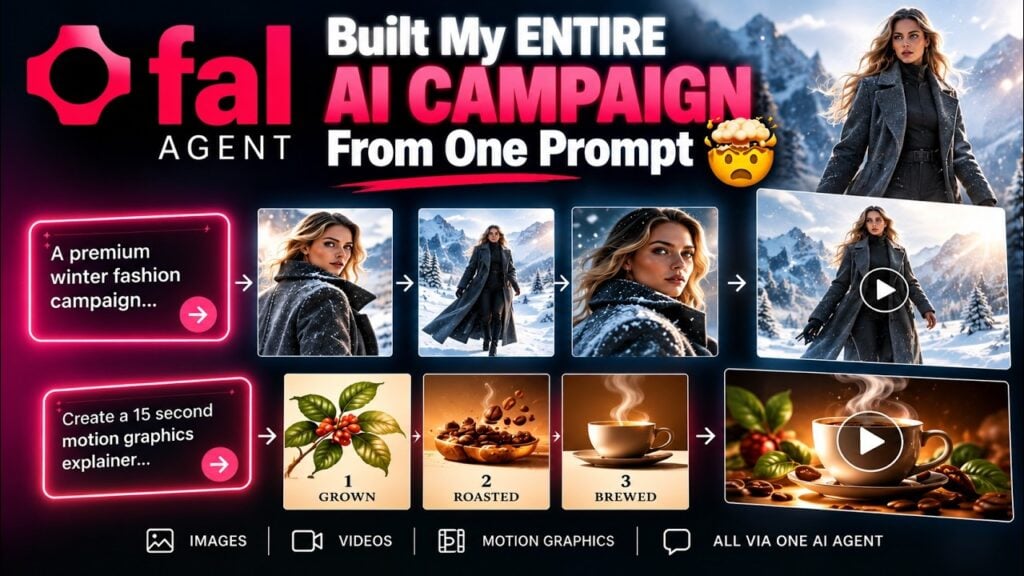
fal Agent makes this workflow easier to follow: establish one strong reference, approve a production plan, build the campaign frames, and animate the selected images. The winter-coat demonstration shows useful human control at each stage. One frame needs a replacement, and the first video clips need a duration revision. Keep those review steps in your own plan.
This companion follows Kingy AI’s October 2 video, its transcript, and targeted frame checks. The recording shows a paid-promotion label. The sponsorship terms, any affiliate commission and any sponsor review of the video are unverified. The creator’s existing fal link remains available on YouTube. No new generation test was performed for this article.
Watch the useful steps
- 1:49: Sign in and open fal Agent
- 2:03: Give the winter-fashion brief
- 2:36: Review the proposed models and approve the plan
- 2:57: Lock the hero reference
- 3:10: Replace a weak campaign frame
- 3:23: Choose the frames to animate
- 3:53: Request two ten-second clips
- 4:23: Ask for the generation-cost breakdown
- 4:44: Start the coffee explainer
- 5:37: Add music and sound effects
Follow the campaign from reference to revisions
Start with the coat, the person wearing it, the environment, and the intended visual style. In the recording, the creator asks for a premium winter campaign with a long, elegant coat and snowy settings. fal Agent proposes the production sequence and selects Nano Banana Pro for the hero image. The creator inspects that image before approving it as the reference.
The next step produces four campaign frames. The fourth needs a different prompt. That correction matters: accepting a plan does not mean accepting every generated asset. Inspect the coat’s shape, the subject’s identity, the hands, and the scene before spending on animation. These are suggested review criteria, rather than separately measured scores from this demonstration.
Choose the frames with a clear motion idea. Here, the agent suggests a street walk and a close collar portrait. The creator accepts those choices, then asks for ten-second versions of both clips. The inspected recording identifies the video model as H3 Max Image to Video and shows a 1080p revision. It does not establish that other video models were tested.
Keep the reference and the approved directions attached to revisions. Ask what changed, what stayed fixed, and which new generations incur charges. A replacement clip can add to your spend while the earlier attempt remains part of the project’s cost.
Prompts you can adapt
The following briefs summarize the requests in the video. They are editable starting points, not exact hidden model prompts or a promise of matching output.
Create a premium winter fashion campaign around a model wearing a long, elegant coat. Use snowy settings and a consistent high-end fashion style. Establish the coat and model first. Propose a production plan for several campaign images, then suggest which approved frames to turn into video. Ask me to approve each stage.
Replace the fourth campaign frame with a different composition. Keep the approved coat, subject and visual direction. Explain the proposed change before generating it.
Make both selected clips ten seconds long, using the same source frames and approved prompts. Show the expected extra generation cost before running the revision.
For the second project, the creator requests a fifteen-second coffee explainer covering growing, roasting, and brewing. The recording shows the illustration sequence, a resulting animation, and an audio revision. The transcript does not name the animation or audio models, so those identities remain unverified.
Create a fifteen-second coffee explainer covering grown, roasted and brewed. Use clean infographic illustrations, warm coffee colours, readable typography and smooth transitions. Show the stages for review. After the visuals are approved, propose subtle music and sound effects.
Tools, models and the sign-in provider
| Tool | Role in this video | Scope |
|---|---|---|
| fal | Hosts Agent and the model routes used in this workflow. | The hosting platform and the underlying model developer are distinct identities. |
| fal Agent | Plans the creative workflow and coordinates revisions. | Human approvals are visible in the recording. |
| Nano Banana Pro | Generates the hero image and campaign frames. | Google image model served through fal; the precise internal generation/edit route is not exposed here. |
| H3 Max Image to Video | Animates selected reference frames. | fal’s H3 Max variant; the official image-to-video endpoint is distinct from Turbo and reference-to-video. |
| GitHub | Used to sign in to fal. | The recording does not demonstrate Copilot or GitHub coding features. |
Why the recorded $3.30 estimate differs from published rates
The cost frame totals six images at $0.15 each and thirty generated video seconds at $0.08 per second. That gives $0.90 + $2.40 = $3.30. The thirty seconds include the earlier two five-second clips and the later two ten-second revisions. Counting only the final twenty seconds would omit the first attempts.
The same frame says its $0.08 rate was a launch promotion ending September 30. The video was published on October 2; its filming date is unknown. The stated promotion had therefore ended before publication. The frame describes these numbers as per-run estimates, not settled charges. Treat $3.30 as the recorded agent estimate. This mismatch does not establish what the account was actually charged.
When checked at 05:43 UTC on October 3—October 2 Pacific time, after the video was published— fal’s exact H3 Max image-to-video page listed 1080p at $0.096 per generated second, under a different promotion ending October 15. It listed $0.16 per second after that promotion. Nano Banana Pro’s generation page listed $0.15 per image, double for 4K, and an extra $0.015 when web search is used.
Using those published endpoint rates, six standard images and thirty video seconds produce a $3.78 planning scenario. Using the listed later video rate produces $5.70. These calculations exclude any Agent-specific billing differences, search add-ons, audio, tax, credits, or plan discounts. Confirm your project’s approved estimate and account billing before running it.
The video description refers to side-by-side model comparison. The inspected cost frame explicitly says this campaign used one chosen model at each stage and ran no model comparisons. This page therefore makes no A/B quality, speed, or cost claim.
Plan attempts, not only finished assets
Change the counts in the calculator to budget new images, repeated takes, and total generated video duration. The calculator uses the reviewed published endpoint rates while they remain current. Enter the image count, total generated video seconds, a revision reserve and any 4K image requirement. If its pricing evidence expires, it withholds the estimate until the rates have been reviewed again. Compare its estimate with the recorded $3.30 breakdown above; they use different video rates.
Plan your image and video budget
This is an endpoint-rate scenario for Nano Banana Pro images and H3 Max image-to-video at 1080p. Your fal Agent invoice may use different billing. Inputs stay in your browser.
Nano Banana Pro pricing · H3 Max endpoint pricing · Checked rate data
Rates reviewed 2026-10-03T05:50:03Z. Preset expires 2026-10-04T04:00:03Z.
Standing Answer: should you animate every campaign frame?
Approve your reference and review the stills first. Animate the frames with a useful motion plan, then budget revisions as additional attempts. This demonstrated workflow supports that sequence; it does not establish a universal cheapest model. Read the maintained answer on planning an AI campaign and its generation budget for the current source checks and calculator assumptions.
What this demonstration leaves open
The retained evidence covers two creative projects and targeted frames. It does not establish repeatability across a larger sample, failure rates, output rights for a particular client project, settled charges, or comparative performance. Before client delivery, review the finished files, reference permissions, branding and the provider’s applicable terms.
Official references: fal Agent, Nano Banana Pro editing, H3 Max Image to Video, and GitHub’s product explanation. The creator’s video remains the source for the recorded workflow and historical estimate.
The Kingy Brief
Get future Kingy Brief editions.
Source-checked AI changes, original tests and one practical thing to try.
Free · Choose your subjects · Double opt-in · Unsubscribe anytime
Regular sending is paused; no restart date is set.
Keep checking the evidence
Current Product Facts
These links resolve only to approved public Product Facts records. Unresolved records are omitted.
Recorded workflow and publication-day evidence
View the stored pricing, workflow and sources for the linked tools
fal Agent
- Recorded estimate and publication-day observations
- The Agent cost frame gives a $3.30 project estimate, rather than settled charges. It combines six images and thirty video seconds and uses a video promotion marked as ending September 30. Agent account billing and discounts remain unverified.
- Workflow evidence
- The recording shows a production plan, human approvals, a reference image, campaign stills and duration revisions. No A/B model comparison was run. Official Agent page observed on October 2 Pacific describes human review at each step.
Video publication date: October 2, 2026. Evidence review date: October 3, 2026. Official observations were captured after publication on the same Pacific calendar day; filming date is unknown.
Nano Banana Pro on fal
- Recorded estimate and publication-day observations
- The recording estimates $0.15 per image. The generation and editing endpoints observed at 05:43 UTC October 3 (October 2 Pacific, after video publication) also list $0.15 per standard image, double for 4K and +$0.015 for web search. Internal Agent route per image, resolution and settled account billing are unverified.
- Workflow evidence
- The recording names Nano Banana Pro for the approved hero reference and campaign stills. Generation and editing routes are distinct. No comparative performance or new independent Kingy test is claimed.
Video publication date: October 2, 2026. Evidence review date: October 3, 2026. Official observations were captured after publication on the same Pacific calendar day; filming date is unknown.
H3 Max Image to Video on fal
- Recorded estimate and publication-day observations
- The recorded $0.08 per second estimate used a promotion marked as ending September 30. The exact 1080p image-to-video endpoint observed at 05:43 UTC October 3 (October 2 Pacific, after video publication) listed $0.096 per second under a different 40% promotion ending October 15, then listed $0.16 afterward. These are separate published observations, not proof of a settled Agent bill.
- Workflow evidence
- The recording names H3 Max Image to Video, chooses two frames, and shows two earlier five-second clips followed by two ten-second revisions at 1080p. The exact official endpoint is minimax/h3-max/image-to-video, distinct from Turbo and reference-to-video.
Video publication date: October 2, 2026. Evidence review date: October 3, 2026. Official observations were captured after publication on the same Pacific calendar day; filming date is unknown.
Current endpoint prices
The calculator uses separately reviewed endpoint rates. Its checked data lists the models, resolution, units and expiry. Check the current KAPI rates and expiry.
The linked profiles retain the scope of their verified facts. Endpoint observations cover only their specified models, resolution and units; check your provider account for credit charges and invoice totals.
Canonical tool guides
Use the canonical tool, pricing, and comparison pages for the latest entity-level guidance.