Kingy Video Test
I Made Motion Graphics With Codex — No After Effects Needed
This video contains a sponsored segment for Agent Opus. The Codex/HyperFrames workflow and Kingy’s analysis are editorially independent. The primary CTA goes to the companion workflow, not the sponsor. Codex can author and revise code-driven motion graphics. The companion should ship the prompt contract and verification loop—not imply that a coding agent removes the need for design judgment, footage editing, colour work, or final render QA.
Disclosure: this video was sponsored.
Video published June 20, 2026. The snapshot records below are tied to that publication date; their latest verification date is July 26, 2026. Live data is labeled separately and updates from current KALI records.
Watch it. Try it. · Motion graphic
Direct the brief. Take the source.
Change the headline and cards, replay the result, and take an editable HTML source or the verified reproduction files.
Watch the workflow on this pageAI tools are becoming creative teams
Runs in this browser. Your inputs are not sent or saved.
Video
Exact moments from this test
Sponsored by Agent Opus — Commercial terms and supplied access are unknown.
Was the Codex motion-graphics video sponsored?
Yes. Kingy explicitly identifies Agent Opus as the sponsor before the main Codex demonstration.
Evidence boundary: This establishes sponsorship, not the amount or terms.
Sponsored by Agent Opus — Commercial terms and supplied access are unknown.
What Codex plan prices did Kingy show?
The video shows a free tier and individual plans at $8, $20, and $100 per month.
Evidence boundary: Historical in-video pricing; recheck before treating it as current.
Historical — amount stated or shown in the video; not a current-price claim.
Sponsored by Agent Opus — Commercial terms and supplied access are unknown.
Where did Kingy open the first exported Hyperframes video?
At 5:51, Kingy opens the exported MP4 and begins reviewing the generated motion graphic.
Evidence boundary: Caption-supported moment; the visual output was verified during the ten-video evidence review.
Sponsored by Agent Opus — Commercial terms and supplied access are unknown.
What defects did Kingy find in the first generated motion graphic?
He identifies overlapping elements and an unwanted 00:10 marker, then prompts the system to correct them.
Evidence boundary: This is a limitation of that generated result, not a measured failure rate.
Sponsored by Agent Opus — Commercial terms and supplied access are unknown.
Full evidence
Codex can direct a code-based motion-graphics workflow without asking you to hand-edit After Effects keyframes. The useful part is not a magic phrase. It is the contract around the prompt: duration, resolution, exact text, timed scenes, deterministic animation, render commands and a human pixel-level review.
Verdict: excellent for repeatable graphics, not a full post-production replacement
Use Codex with HyperFrames for structured title cards, sponsor bumpers, animated charts, interface explainers and templated product sequences. It is a poor substitute for an editor when the job depends on footage selection, detailed audio work, colour grading or frame-by-frame compositing.
You are replacing some manual timeline work with code, constraints and review—not removing creative judgment. The source remains editable as HTML, CSS and JavaScript, while HyperFrames previews and renders it as video.
Best for: YouTubers, educators, product marketers and small creative teams who want versioned, reusable motion systems and are willing to inspect every render. Skip it: if you expect one-click production or need a fast tactile finishing workflow across lots of live-action footage.
Useful chapters
- 00:00 — What “without After Effects” actually means
- 02:00 — Sponsored Agent Opus segment
- 03:33 — The Codex workflow begins
- 04:21 — Find and install HyperFrames
- 04:43 — The first motion-graphics prompt
- 05:31 — Generate and inspect the first result
- 06:39 — Revise with measurable natural-language changes
- 08:17 — Create and compare multiple variants
What Curtis tested versus what the sources say
Visible in Curtis’s recorded test
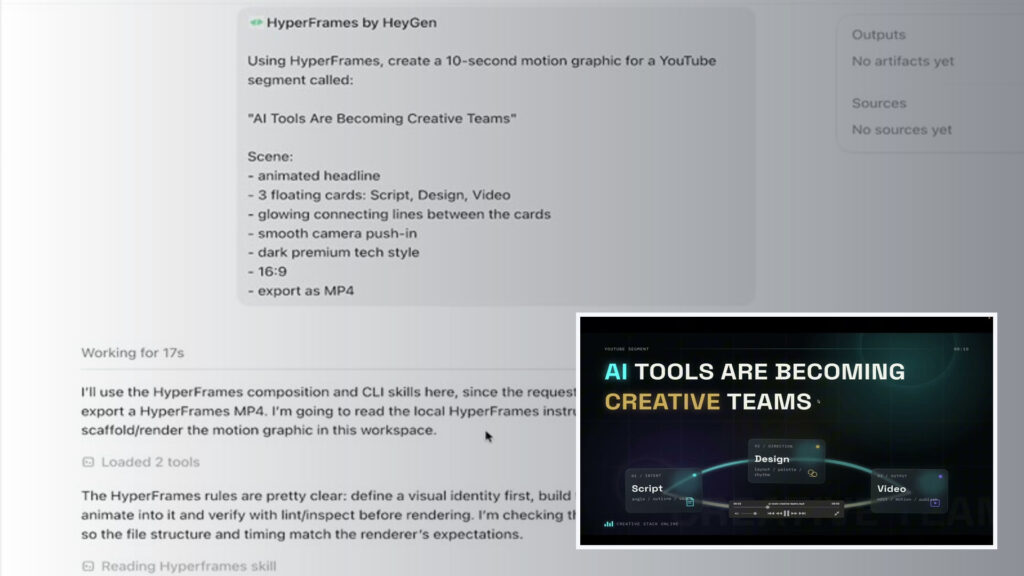
- Curtis opened Codex on macOS, chose HyperFrames and submitted a 10-second brief titled “AI Tools Are Becoming Creative Teams.”
- The prompt specified three cards—Script, Design and Video—plus connecting lines, a camera push-in, a dark visual treatment and an MP4 output.
- He opened the first MP4, identified overlap, small text and an unwanted
00:10marker, then requested larger text, stronger glow, slower camera movement, a 1.5-second end hold and removal of the marker. - He reviewed the rerender and showed a folder he described as containing 25 variants.
Not independently established
The original project, lockfile, HyperFrames version, model identity, run logs, machine specification, MP4 metadata and verified inventory of all 25 outputs were not preserved. The footage therefore does not prove batch reliability, generation speed, cost savings or 25 simultaneous successful renders. The download below is a new July 28 reproduction contract—not the missing filmed project.
Current sourced facts
OpenAI’s current documentation establishes Codex access, plans, permissions and remote-control boundaries. HyperFrames’ current documentation establishes its code-based composition model, CLI commands, Studio timeline, Docker render path and Apache-2.0 licence. Those sources describe the products today; they do not retroactively verify the filmed run.
Exact reproducible workflow
- Install Node.js 22 or later, FFmpeg/FFprobe and npm/npx. Install Docker if you want the deterministic render route.
- Install the current HyperFrames agent skills with
npx skills add heygen-com/hyperframes. - For this dated recipe, pin HyperFrames CLI
0.7.80. - Open a fresh Codex task in an empty project folder and provide the download’s
settings/project-spec.jsonandprompts/01-build-prompt.md. - Require a 10-second, 1920×1080, 30 fps composition with four timed beats, no random or time-dependent animation, no visible timer and a static final hold from 8.5 to 10 seconds.
- Run HyperFrames
doctor,lintandcheck. Preview in Studio and inspect the exact title, card labels, connecting lines, camera move, text fit, contrast and final hold. - Submit the bounded revision prompt. It specifies measurable changes instead of “make it better.”
- Run
npx hyperframes@0.7.80 check . --strict --snapshotsand review the rendered snapshots. - Render with
npx hyperframes@0.7.80 render --docker --output renders/creative-teams-v2.mp4. - Capture FFprobe metadata and SHA-256 hashes with the included script, then complete the visual QA checklist before importing the MP4 into the main edit.
Copyable build prompt
Using HyperFrames, create a 10-second 1920x1080 motion graphic at 30 fps titled:
“AI Tools Are Becoming Creative Teams”

Beat 1 (0.0–2.0s): introduce the exact headline with high YouTube readability.
Beat 2 (2.0–5.0s): reveal three cards labelled Script, Design and Video.
Beat 3 (5.0–8.5s): connect the cards with restrained glowing lines and a smooth camera push-in.
Beat 4 (8.5–10.0s): hold the final composition completely static.

Use deterministic animation only. Do not add logos, a fake player, a visible timer or extra claims.
Run doctor, lint and strict snapshot checks before rendering an MP4. Report the output path and any failed check.
Copyable revision prompt
Revise only the existing composition:
- increase headline and card-label size until readable at a 640px-wide preview;
- remove every overlap and all clipped text;
- add a restrained soft glow behind each card without reducing contrast;
- slow the camera push-in by 25%;
- remove any timer or player-like icon;
- keep the final frame unchanged from 8.5s through 10.0s.

Rerun strict snapshots, render a new versioned MP4, and preserve the previous render.
What changed after filming
- HyperFrames CLI is now 0.7.80, checked July 28, 2026. The filmed version was not preserved.
- The current QA path is clearer: HyperFrames now documents
doctor,lint,check, snapshots, inspection and Docker rendering. The video concentrated on prompt, preview and MP4 output. - “No timeline” needs qualification: Curtis did not manually manipulate an After Effects-style timeline. Current HyperFrames Studio documentation does include a visual timeline, seeking, frame stepping and edits that can persist to HTML.
- The reproducible install route is command-line based: the current HeyGen setup guide recommends
npx skills add heygen-com/hyperframes. Graphical plugin-directory availability can vary by Codex surface and rollout. - Mobile is a remote control: OpenAI documents controlling a connected Mac or Windows host from mobile. The host supplies files, tools and compute; plugins are not directly available on mobile.
Current pricing and access — checked July 28, 2026
- Codex Free: $0/month for quick coding tasks.
- Codex Go: $8/month for lightweight coding.
- Codex Plus: $20/month, including web, CLI, IDE extension and iOS access subject to current limits.
- Codex Pro: from $100/month with higher usage limits.
- Business: $20/user/month billed annually or $25 monthly, with a two-user minimum.
- Enterprise and Edu: contact sales. API-key use is metered separately.
- HyperFrames: Apache-2.0 open source, with no HyperFrames seat fee or per-render licence charge. Hardware, storage, paid assets and third-party services can still cost money.
Prices, limits, models, regional availability and workspace controls can change. This section records what was checked, not a permanent price promise.
Download the Codex + HyperFrames motion-graphics pack
The pack includes the exact build and revision prompts, a machine-readable 1920×1080/30 fps project specification, ten bounded variation briefs, version-pinned workflow, evidence ledger, render-and-capture script and human release checklist.
Download the free motion-graphics pack
Official sources
- OpenAI Codex pricing
- OpenAI plugin documentation
- OpenAI remote connections
- HeyGen HyperFrames setup guide
- HyperFrames CLI documentation
- HyperFrames rendering guide
- HyperFrames Studio documentation
- HyperFrames source and licence
Related links
The Kingy Brief
Get The Kingy Brief.
AI changes, original tests and one practical thing to try. Fridays at 09:00 Vancouver time.
Free · Double opt-in · Unsubscribe anytime
Sign up for The Kingy Brief on Beehiiv.
Signup help and newsletter schedule
Signup form provided by Beehiiv. After submitting, check your inbox for "Confirm your subscription to The Kingy Brief" and open its confirmation link. Check Spam or Promotions if you cannot find it.
Fridays at 09:00 Vancouver time: source-checked AI changes, original tests and one practical thing to try. We skip a week when there is not enough verified material. Free. Unsubscribe anytime.
Keep checking the evidence
Current Product Facts
These links resolve only to approved public Product Facts records. Unresolved records are omitted.
As of publication
These values come only from the verified, write-once snapshot stored for this video. Current tool values are never substituted here.
Codex
- Pricing at publication
- Status: not_recorded; Note: No verified price is stored for June 20, 2026; current official pricing must be checked separately.
- Features at publication
- The Codex app coordinates agent work in project threads and supports review of agent changes; The demonstrated motion-graphics workflow also depends on HyperFrames; Codex is not the renderer; The video does not establish cross-machine reproducibility, benchmark parity or unattended batch reliability.
Historical record date: June 20, 2026. Snapshot verification date: July 26, 2026.
Live now
These modules read the current KALI tool records. Their verification dates are current-record dates, not historical evidence.
Codex
Current pricing
- Pricing
- Canada, public list: Plus $20/month; currency code and local checkout unconfirmed.
- Free plan
- Yes
Current record verification date: July 14, 2026. This identifies the current record only; it is not historical evidence.
Current feature summary
- What it does
- Codex writes and revises code and files; the retained creator workflow uses HyperFrames to turn that code into motion graphics.
- Best for
- Creators building reusable motion graphics, small creative tools and code-based assets who can inspect files and renders.
- API
- Yes
- Open source/open weight
- Unknown
Current record verification date: July 14, 2026. This identifies the current record only; it is not historical evidence.
Verification & Sources
- Evidence state
- Recheck due
- Sources
- 3 sources
- Freshness
- Needs recheck: checked July 14, 2026
- Last verified
- July 14, 2026
- Last updated
- October 23, 2026
What this evidence state means
- Definition
- The claim was previously checked, but its review window expired or a material change may have invalidated it.
- Required provenance
- The prior evidence and check date are retained, together with the expiry or change signal that triggered recheck.
- Owner
- Kingy freshness queue owner and assigned editorial reviewer
- Freshness rule
- This is already outside its freshness rule. It must not be presented as current until reviewed against current evidence.
- Disputes and corrections
- Use “Suggest a correction” on the record. Kingy editorial reviews the cited evidence, records material corrections, and changes or removes the state when it is not supported.
Key source checks
Suggest a correction
What's changed since this video
Compare the verified publication snapshot with the current KALI record. This side-by-side view does not claim changes that the evidence cannot verify.
Codex
At publication
Codex
- Pricing at publication
- Status: not_recorded; Note: No verified price is stored for June 20, 2026; current official pricing must be checked separately.
- Features at publication
- The Codex app coordinates agent work in project threads and supports review of agent changes; The demonstrated motion-graphics workflow also depends on HyperFrames; Codex is not the renderer; The video does not establish cross-machine reproducibility, benchmark parity or unattended batch reliability.
Historical record date: June 20, 2026. Snapshot verification date: July 26, 2026.
Current record
Current pricing
- Pricing
- Canada, public list: Plus $20/month; currency code and local checkout unconfirmed.
- Free plan
- Yes
Current record verification date: July 14, 2026. This identifies the current record only; it is not historical evidence.
Current feature summary
- What it does
- Codex writes and revises code and files; the retained creator workflow uses HyperFrames to turn that code into motion graphics.
- Best for
- Creators building reusable motion graphics, small creative tools and code-based assets who can inspect files and renders.
- API
- Yes
- Open source/open weight
- Unknown
Current record verification date: July 14, 2026. This identifies the current record only; it is not historical evidence.
Canonical tool guides
Use the canonical tool, pricing, and comparison pages for the latest entity-level guidance.