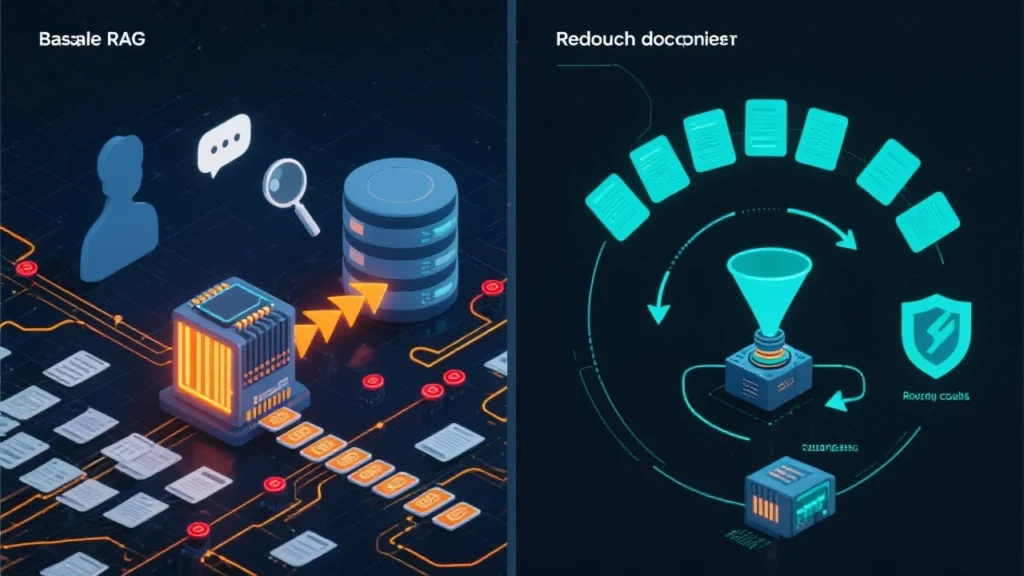
The REFRAG paper from Meta researchers reports faster retrieval-augmented generation through selective context compression. Its headline result is up to 30.85× lower time-to-first-token latency in the authors’ benchmark configuration, not a measured speedup for every application or complete response. Kingy did not reproduce the experiment.
The RAG Efficiency Crisis
RAG systems have become integral to modern AI applications, enabling LLMs to leverage external knowledge for enhanced responses. However, they face a critical bottleneck: processing long contexts from retrieved passages creates substantial latency and memory overhead. As noted by the researchers, this leads to:
- Quadratic increases in time-to-first-token (TTFT) latency with context length
- Linear growth in memory requirements for key-value caches
- Reduced throughput that limits real-world applications
The REFRAG Innovation
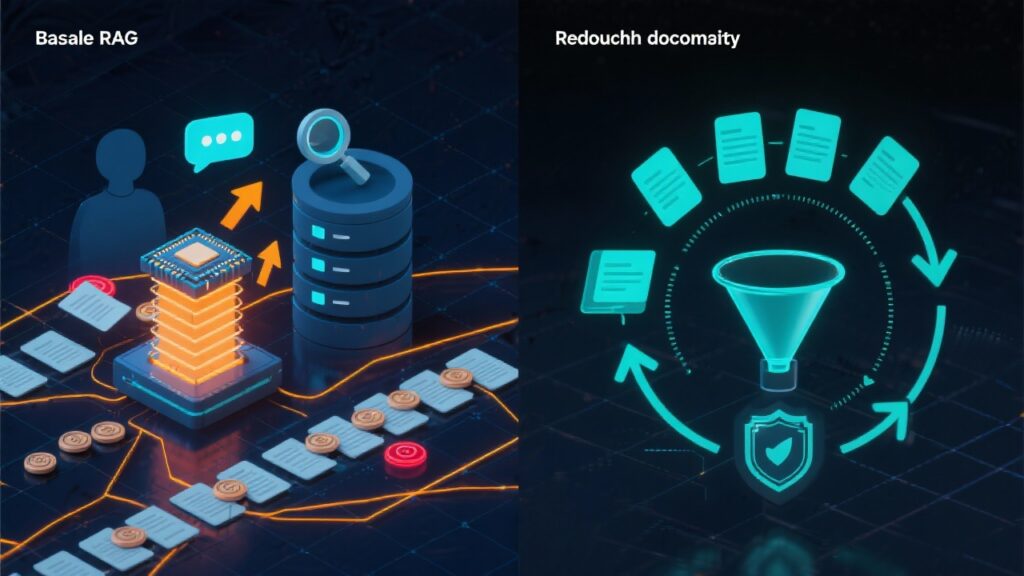
The researchers identified a crucial insight: in RAG applications, much of the context consists of retrieved passages with low semantic similarity due to diversity and deduplication. This creates block-diagonal attention patterns that differ fundamentally from standard LLM tasks.
REFRAG exploits this unique structure through three key innovations:
- Compressed Chunk Embeddings: Instead of processing full token sequences, REFRAG compresses chunks of tokens into compact embeddings using a lightweight encoder (like RoBERTa)
- Selective Compression: An RL-trained policy intelligently decides which chunks to compress versus keep as full tokens
- Flexible Positioning: Unlike previous approaches, REFRAG can compress chunks at any position while preserving the decoder’s autoregressive nature
Remarkable Performance Gains
The results are stunning:
- Up to 30.85× faster time to first token in the authors’ measured configuration.
- 3.75× improvement over previous state-of-the-art methods
- No loss in perplexity or downstream accuracy
- 16× extension of effective context window size
Technical Deep Dive
The system architecture consists of several innovative components:
Encoder-Decoder Framework
REFRAG uses a two-stage approach:
- A lightweight encoder (e.g., RoBERTa) processes input chunks into compressed embeddings
- A projection layer maps these embeddings to match the decoder’s token space
- The decoder (e.g., LLaMA) processes the compressed representations
Curriculum Learning
The researchers discovered that naive training failed to produce good results. They developed a sophisticated curriculum learning approach:
- Start with reconstruction of single chunks
- Gradually increase complexity to handle multiple chunks
- Use geometric scheduling for data mixture ratios
- Employ careful initialization and frozen parameters
Reinforcement Learning Policy
The selective compression policy is trained using:
- PPO-style optimization
- Perplexity-based rewards
- Grouped rewards to reduce variance
- Sequential decision making for chunk selection
Real-World Applications
REFRAG shows impressive results across multiple applications:
RAG Performance
- Matches or exceeds LLaMA performance with 5.26× speedup
- 1.22% average improvement across 16 RAG tasks at equal latency
- Superior handling of weak retrievers due to expanded context
Multi-Turn Conversations
- Outperforms baselines on 2 out of 3 datasets with 5 passages
- Excels on all datasets with 10 passages
- Maintains performance with increasing conversation length
Document Summarization
- Achieves state-of-the-art results on long document tasks
- Effectively processes documents beyond standard context windows
- Maintains coherence across extended contexts
Technical Implementation Details
The researchers provide specific parameters that enabled these results:
Training Configuration
hyperparameters = {
    'reconstruction_lr': 2e-4,
    'prediction_lr': 5e-5,
    'instruction_lr': 2e-5,
    'warmup': '4%',
    'optimizer': 'AdamW',
    'scheduler': 'cosine',
    'batch_size': 256
}
Reported experimental hardware
- Training: 8 nodes with 8 H100 GPUs each
- Inference: Single A100 GPU for benchmarking
- BFloat16 precision
Comparative Analysis
REFRAG significantly outperforms existing approaches:
Reported k = 16 results
- The paper reports 16.53× TTFT acceleration versus LLaMA with caching.
- The paper reports 8.59× TTFT acceleration versus LLaMA without caching.
- The authors report a 9.3% average improvement over CEPE in their normalized log-perplexity comparison across four datasets at k = 16; the metric label was clarified in the October 2025 revision.
Versus LLaMA
- Up to 30.85× TTFT acceleration in the paper’s comparison.
- Maintains accuracy while extending context
- Better handling of diverse retrieved passages
Architectural Innovations
Several key design choices enable REFRAG’s performance:
- Flexible Compression
- Can compress chunks at any position
- Maintains autoregressive properties
- Enables multi-turn applications
- Efficient Processing
- Reduces attention computation quadratically
- Minimizes memory overhead
- Enables context reuse
- Scalable Design
- Works with various encoder-decoder combinations
- Supports different compression rates
- Adapts to different applications
Future Implications
The researchers highlight several promising directions:
- Integration Opportunities
- Compatible with other optimization techniques
- Can be combined with prompt compression
- Supports various retrieval methods
- Potential Applications
- Web-scale search systems
- Real-time conversational agents
- Document processing systems
- Research Directions
- Dynamic compression rates
- Multi-modal extensions
- Further latency optimizations
Implementation Considerations
For practitioners looking to implement REFRAG, several factors are crucial:
System Requirements
- The paper’s single-A100 inference benchmark does not establish a minimum GPU requirement.
- Compatibility with a chosen ML framework is not verified here.
- Released implementation and dependency requirements are not verified here.
Integration Points
- Integration with an existing RAG pipeline needs workload-specific validation.
- The reported benchmark does not establish compatibility with a particular retrieval system.
- Compatibility with a particular LLM-serving framework is not verified here.
Optimization Options
- Configurable compression rates
- Adjustable policy parameters
- Flexible training options
Limitations and Considerations
The researchers acknowledge several important considerations:
- Training Complexity
- Requires careful curriculum design
- Needs substantial computational resources
- Benefits from pre-training
- Application Constraints
- Performance varies with retrieval quality
- Requires tuning for specific use cases
- May need domain adaptation
- Technical Boundaries
- Practical limits on compression rates
- Trade-offs at extreme context lengths
- Resource requirements for training
Best Practices
Based on the research findings, several best practices emerge:
- Implementation
- Start with lower compression rates
- Use curriculum learning
- Validate on domain-specific data
- Optimization
- Monitor attention patterns
- Adjust compression policies
- Balance latency and accuracy
- Deployment
- Cache common embeddings
- Monitor resource usage
- Implement fallback options
Conclusion
The authors report speed and accuracy gains under their tested conditions. Their system measurements use batch size 1 on a single A100; training settings and the best reported speedup are not guarantees for another workload.
The combination of innovative architecture, careful training procedures, and practical optimizations makes REFRAG a compelling solution for organizations looking to deploy efficient RAG systems. As noted by the researchers, this work “provides a practical and scalable solution for deploying LLMs in latency-sensitive, knowledge-intensive applications.”
Looking Forward
The success of REFRAG points to several exciting future developments:
- Technical Advances
- Further compression techniques
- Enhanced selection policies
- Multi-modal extensions
- Application Areas
- Real-time search systems
- Interactive AI assistants
- Document processing
- Research Directions
- Dynamic compression
- Cross-modal attention
- Efficiency optimizations
The paper demonstrates that specialized solutions for RAG applications can dramatically improve performance while maintaining accuracy. This suggests a broader principle: targeted optimizations for specific use cases may be more effective than general-purpose solutions for large language models.
For practitioners and researchers alike, REFRAG opens new possibilities in building efficient, knowledge-intensive AI systems. Its success suggests that similar specialized approaches might yield comparable benefits in other areas of AI deployment.
Related Guides
- Understanding LLMs: A Comprehensive Overview from Training to Inference – Summary
- Introducing Meta’s Llama 3.3 Explained: A High-Performance Model for Efficient AI Workflows
- Llama 4: The New Frontier in Multimodal AI – Includes Benchmarks
- A Comprehensive Survey of Self-Evolving AI Agents – A New Paradigm Bridging Foundation Models and Lifelong Agentic Systems (Summary)
Continue Reading
The Kingy Brief
Get the free AI price sheet.
25 AI plans and models on one page, from official pricing pages, updated every month. Free when you join The Kingy Brief: AI changes, original tests and one practical thing to try, Fridays at 09:00 Vancouver time.
Free · Unsubscribe anytime
Signup help and newsletter schedule
After submitting, look out for the welcome email from The Kingy Brief. If the form asks you to confirm, open the confirmation email too. Check Spam or Promotions if you cannot find it.
Fridays at 09:00 Vancouver time: source-checked AI changes, original tests and one practical thing to try. We skip a week when there is not enough verified material. Free. Unsubscribe anytime.