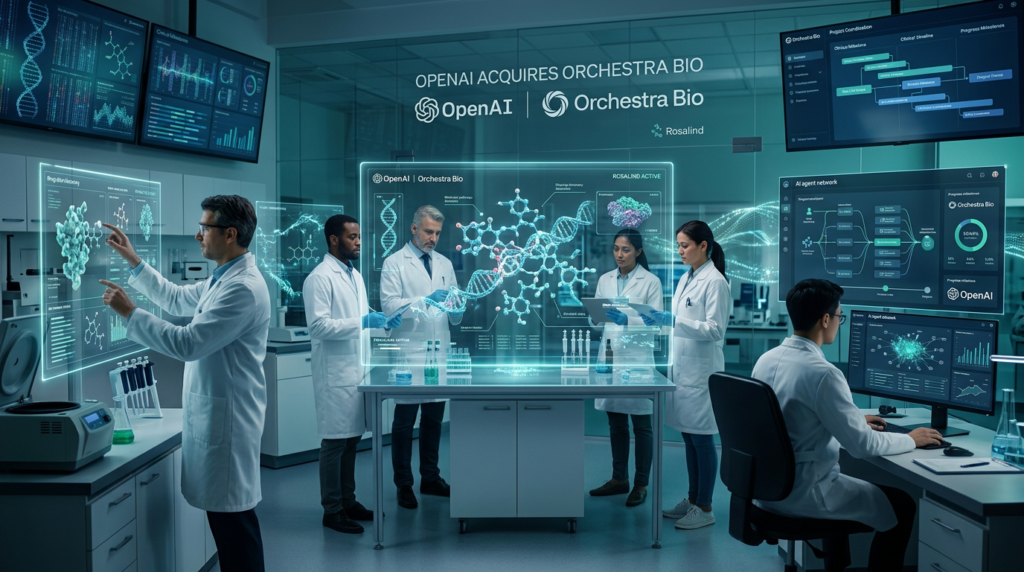
OpenAI is making a major move into biotechnology by acquiring Orchestra Bio, an AI-powered drug development platform. By combining the startup’s technology with its Rosalind ecosystem, the ChatGPT developer wants to help pharmaceutical researchers coordinate complex projects, accelerate scientific workflows, and bring promising medical treatments closer to patients.
OpenAI Is Taking Its AI Ambitions Into Biotechnology
Artificial intelligence has already transformed software development, digital creativity, and everyday productivity. Now, OpenAI wants to tackle something considerably more complicated: developing new medicines.
On October 20, 2026, OpenAI announced its acquisition of Orchestra Bio, a biotechnology software startup specializing in AI-powered drug development coordination.
The acquisition represents another step in OpenAI’s expansion beyond general-purpose artificial intelligence.
Instead of concentrating exclusively on chatbots and coding assistants, the company is building specialized technologies for scientific research.
Orchestra Bio will become part of Rosalind, OpenAI’s collection of AI models and research tools designed for the life sciences industry.
The goal is to help pharmaceutical companies manage the complicated journey from scientific discovery to potential medical treatment.
That journey involves researchers, clinical teams, manufacturing specialists, regulatory professionals, and countless moving parts.
OpenAI believes AI agents could help coordinate these activities more efficiently.
Financial terms were not disclosed, leaving the acquisition’s price unknown.
Nevertheless, the deal illustrates OpenAI’s growing interest in transforming sophisticated AI capabilities into practical tools for industries where mistakes are expensive and delays can have significant consequences.
Why Developing New Medicines Takes So Long
Creating a new pharmaceutical treatment is rarely a straightforward process.
Even after researchers discover a promising biological target, years of scientific investigation may follow.
Scientists must identify potential therapeutic compounds, evaluate their properties, conduct laboratory experiments, and examine whether those compounds demonstrate acceptable safety profiles.
Promising candidates may eventually advance into clinical trials.
Those studies require extensive preparation.
Researchers must recruit eligible participants, coordinate trial sites, manufacture investigational medicines, analyze results, and prepare documentation for regulatory review.
According to OpenAI, progressing from target discovery to regulatory approval in the United States takes approximately 10 to 15 years on average.
Not every experimental treatment survives that journey.
Many projects fail because of safety concerns, insufficient effectiveness, manufacturing difficulties, or other scientific and operational challenges.
Even successful programs can experience substantial delays.
A missing report or unexpected manufacturing problem might disrupt several interconnected activities.
This complexity creates opportunities for better coordination.
OpenAI is betting that AI systems capable of managing information and monitoring workflows can reduce avoidable administrative friction.
Importantly, faster coordination does not automatically mean faster regulatory approval or successful drug discovery.
Scientific evidence will still determine whether an experimental treatment deserves to advance.
Meet Orchestra Bio: The Startup Behind the Acquisition
Orchestra Bio approaches drug development from an operational perspective.
Rather than focusing exclusively on identifying new molecules, the startup developed technology to help biopharmaceutical teams coordinate complicated research programs.
Founded in 2022, Orchestra Bio combines expertise in biotechnology, software development, and artificial intelligence.
Its platform allows scientists and program managers to work alongside AI agents that monitor project activities.
These agents can help track studies, development schedules, operational dependencies, and potential disruptions.
Imagine a pharmaceutical company managing several experimental treatments simultaneously.
Each project involves researchers, manufacturing partners, laboratories, contractors, and clinical teams.
Coordinating everything manually can quickly become exhausting.
Orchestra’s technology is designed to help organize those interconnected responsibilities.
When a problem emerges, the system can gather relevant information and help teams understand which activities might be affected.
Human specialists can then evaluate possible responses.
This distinction is important.
Orchestra Bio is not simply another chatbot offering medical answers.
Its value lies in connecting information with the operational decisions required to move pharmaceutical programs forward.
That capability attracted OpenAI’s attention.
Rosalind Is Becoming OpenAI’s Scientific AI Ecosystem
The acquisition becomes more interesting when considering what OpenAI has already built.
Earlier in 2026, the company introduced Rosalind, a specialized ecosystem intended to support scientific research in biology, chemistry, and drug discovery.
Rosalind includes two important components.
The first is GPT-Rosalind, an AI model designed to help researchers reason through complex scientific questions.
Scientists can use its capabilities to explore hypotheses, interpret relevant information, and investigate biological or chemical problems.
The second is Rosalind Workbench, which connects AI capabilities with scientific tools and research data.
Workbench aims to help researchers analyze results, plan experiments, and move between scientific questions and practical research activities.
Together, these technologies address important parts of scientific investigation.
However, laboratory discovery represents only one stage of pharmaceutical development.
Orchestra Bio adds a different capability.
Its platform specializes in coordinating the activities that follow or accompany scientific discoveries.
By combining these technologies, OpenAI hopes to connect scientific reasoning with operational execution.
The result could eventually become a more integrated environment for pharmaceutical research.
For now, that remains a development objective rather than a fully demonstrated end-to-end system.
AI Agents Could Become Digital Research Coordinators
One of the acquisition’s most important elements involves AI agents.
Unlike conventional chatbots that primarily respond to questions, AI agents can be designed to perform sequences of tasks using connected software tools.
In pharmaceutical development, these systems could potentially monitor complex workflows and identify emerging operational problems.
Consider a research program involving multiple laboratories.
One team handles experimental testing.
Another oversees manufacturing preparations.
Meanwhile, clinical researchers organize an upcoming study.
An AI agent could help monitor whether the various activities remain aligned with the project’s schedule.
If an important dependency changes, the system might identify tasks requiring reassessment.
Researchers would still decide how to respond.
This approach could reduce time spent manually checking spreadsheets, reviewing fragmented reports, and reconciling updates from different departments.
However, AI agents must operate within carefully defined boundaries.
Incorrect information or automated actions could create serious complications in regulated research environments.
For that reason, successful deployment will require dependable data access, appropriate permissions, and human supervision.
The objective is to support qualified professionals, not remove them from scientific decision-making.
When One Manufacturing Problem Delays Everything
Drug development resembles an elaborate chain of interconnected activities.
A disruption in one area can create unexpected consequences elsewhere.
OpenAI offered a practical example when explaining Orchestra Bio’s technology.
Suppose a manufacturing batch fails quality requirements.
The immediate problem affects production.
However, researchers might also need to reconsider the schedule for a clinical trial that depends on that batch.
Additional testing, replacement production, or revised delivery arrangements could become necessary.
Those changes may affect trial sites, research teams, budgets, and contractual commitments.
Traditionally, identifying every consequence can involve numerous meetings and manual investigations.
Orchestra’s AI agents are designed to help teams identify which activities are affected.
The system can also collect relevant information and compare possible responses.
That does not mean AI can decide whether a manufacturing batch is safe.
Qualified specialists must make those determinations under applicable quality standards.
Instead, the technology could help teams understand the operational consequences more quickly.
For pharmaceutical companies managing complicated development programs, that kind of coordination could be valuable.
Bringing Scientific Discovery and Project Management Together
Scientific discoveries rarely become useful treatments without extensive coordination.
A promising laboratory result might lead researchers toward additional experiments.
Those experiments may require specialized materials, external collaborators, revised budgets, or new study protocols.
Every decision creates additional responsibilities.
OpenAI wants Rosalind and Orchestra Bio to work across this divide.
GPT-Rosalind could help scientists investigate biological questions.
Rosalind Workbench could support experiment planning and analysis.
Orchestra’s technology could then help coordinate related activities and monitor project dependencies.
Together, these systems could create a more connected research workflow.
Picture a scientist identifying a promising experimental direction.
The research team would still need to validate the finding and determine appropriate next steps.
However, AI tools might help organize the supporting documentation, related activities, and program schedules.
This could potentially reduce the gap between generating scientific ideas and executing well-planned research programs.
Still, integrating separate technologies presents challenges.
Scientific information must remain accurate, traceable, and appropriately interpreted.
Operational systems must also respect established quality processes.
The promise is greater continuity between research and development, not automatically better scientific results.
Could AI Help Pharmaceutical Companies Save Money?

Developing medicines requires substantial financial investment.
Pharmaceutical companies spend resources on laboratories, specialized equipment, research personnel, clinical operations, and manufacturing infrastructure.
Unexpected delays can increase those expenses.
A postponed clinical trial might require changes to contractor agreements, staffing plans, or production schedules.
Administrative inefficiencies can create additional costs.
That makes operational coordination an attractive target for AI development.
If Orchestra’s agents help teams detect scheduling conflicts earlier, companies could potentially reduce some avoidable expenses.
More efficient information gathering could also free specialists to concentrate on important scientific decisions.
However, potential savings should not be confused with demonstrated financial outcomes.
OpenAI has not published verified figures showing how much the Orchestra acquisition will reduce pharmaceutical development costs.
Implementing AI systems also introduces expenses.
Organizations may need to invest in software integration, cybersecurity, employee training, and ongoing validation.
Savings will depend on whether the technology actually improves operations enough to justify those investments.
The strongest business case would involve measurable gains without compromising patient safety or research integrity.
OpenAI’s Relationships With Moderna and Novo Nordisk
Orchestra Bio is not OpenAI’s first move into pharmaceutical research.
The company has already established relationships with major industry participants, including Moderna and Novo Nordisk.
These partnerships demonstrate how OpenAI is attempting to adapt advanced AI systems to specialized scientific and commercial environments.
At Moderna, OpenAI has described work involving the conversion of complex scientific information into experimental workflows.
Such applications could help researchers organize insights and connect analysis with laboratory activities.
Meanwhile, OpenAI’s relationship with Novo Nordisk explores how AI might support research, development, and commercial execution.
The companies have emphasized maintaining appropriate governance while investigating efficiency opportunities.
These collaborations provide OpenAI with opportunities to understand how pharmaceutical organizations actually operate.
That experience could influence the development of Rosalind and its integration with Orchestra’s platform.
However, partnerships do not automatically establish that AI accelerates drug approvals or improves patient outcomes.
Their significance lies in creating practical environments where specialized tools can be developed and evaluated.
OpenAI is assembling technology and industry relationships that could support a broader life sciences business.
Why OpenAI Wants More Than Chatbots
For years, most consumers have associated OpenAI with ChatGPT.
However, the company’s commercial strategy increasingly involves specialized AI applications.
Scientific research offers an opportunity to develop tools addressing complex professional problems.
Drug development is particularly attractive because it involves large volumes of information, highly specialized expertise, and complicated operational processes.
Traditional AI assistants can help summarize documents or generate explanations.
Pharmaceutical organizations often need considerably more.
They require systems that work with technical data, understand dependencies, interact with approved software, and maintain reliable records.
Orchestra Bio provides capabilities designed around those needs.
For OpenAI, acquiring an existing specialist platform may also offer advantages over building every component internally.
The company gains technology and personnel familiar with pharmaceutical development workflows.
That experience could help it design more practical industry-specific products.
The acquisition therefore represents a strategic shift from providing intelligence as a general-purpose service toward embedding AI in specialized operational systems.
Success will depend on whether customers find these integrated tools trustworthy, useful, and economically worthwhile.
The Competition for AI-Powered Scientific Research Is Growing
OpenAI is not alone in pursuing scientific applications for artificial intelligence.
Competing AI developers are also building tools for researchers and pharmaceutical companies.
Anthropic, for example, has expanded its activities in scientific AI.
In 2026, the company introduced Claude Science, a research-oriented platform designed to connect AI capabilities with scientific tools and databases.
The company has also pursued biotechnology-focused initiatives.
Other technology firms and specialized startups are investigating applications ranging from molecular modeling to laboratory automation.
This growing activity reflects a wider change in the AI industry.
Developers increasingly want their systems to accomplish specialized tasks rather than merely demonstrate impressive benchmark performance.
Pharmaceutical research provides an opportunity to test whether AI can deliver meaningful results in demanding professional environments.
However, competition brings additional responsibilities.
Healthcare and biotechnology applications require substantial attention to safety, reliability, and regulatory expectations.
Companies cannot treat scientific validity as a secondary consideration.
The most valuable systems will be those that improve research productivity while remaining dependable enough for professional use.
Acquiring Orchestra Bio gives OpenAI another platform for competing in this emerging market.
Why Human Scientists Will Remain Essential
AI-powered research platforms can process information rapidly.
They can identify relationships, summarize documents, and help organize complicated workflows.
Nevertheless, pharmaceutical development requires much more than efficient information processing.
Scientists must evaluate experimental results.
Clinical researchers must protect study participants.
Manufacturing specialists must verify that medicines satisfy quality requirements.
Regulatory professionals must ensure that submissions accurately reflect the available evidence.
These responsibilities involve judgment, accountability, and established standards.
AI can support these activities but cannot simply replace the professionals responsible for them.
OpenAI’s description of Orchestra emphasizes collaboration between people and AI agents.
Scientists and program leaders remain responsible for guiding projects and deciding how to address important problems.
This human-centered approach is especially important when technology produces uncertain or incorrect outputs.
An inaccurate summary might misrepresent a study.
An incomplete dependency analysis could overlook an important scheduling problem.
Organizations will therefore need procedures for reviewing, correcting, and documenting AI-supported work.
The most useful systems may be those that handle repetitive coordination while giving experts more time for scientific reasoning.
That is a practical form of automation worth investigating.
Data Security and Research Integrity Are Major Challenges
Biotechnology companies work with valuable intellectual property and sensitive information.
Research programs may involve confidential molecular structures, unpublished findings, manufacturing details, and clinical information.
Introducing AI agents into these environments creates important security and governance questions.
Organizations must decide which systems an agent can access.
They must also define what information can be processed, retained, or shared.
An AI system that connects several research platforms could potentially improve coordination.
However, those connections may also introduce cybersecurity risks if poorly controlled.
Another challenge involves research integrity.
Scientific records must remain traceable and accurately reflect what actually occurred.
AI-generated summaries cannot substitute for verified experimental evidence.
Drug developers must also consider applicable regulatory expectations and computerized-system validation requirements.
Not every research activity carries the same level of risk.
An assistant organizing routine meeting schedules differs considerably from a system influencing manufacturing or clinical decisions.
The appropriate safeguards should reflect those differences.
OpenAI and its pharmaceutical partners will need to demonstrate that integrated AI tools can operate reliably within demanding research environments.
Strong governance could become a major factor in whether customers adopt the platform.
Will AI Actually Accelerate the Arrival of New Medicines?
The possibility of developing treatments faster naturally attracts attention.
For patients facing serious illnesses, delays in medical innovation can have significant consequences.
Yet pharmaceutical development involves scientific uncertainty that cannot simply be automated away.
An experimental medicine must demonstrate appropriate safety and effectiveness.
That evidence requires rigorous testing.
AI cannot guarantee that a promising molecule will work in humans.
It cannot eliminate the need for carefully conducted clinical trials.
What it might do is reduce some of the operational inefficiencies surrounding those activities.
Better scheduling, earlier identification of project disruptions, and improved information coordination could potentially prevent avoidable delays.
Those improvements would still need to be measured.
Researchers could examine whether AI-supported programs experience fewer administrative bottlenecks or complete specific milestones more efficiently.
They could also assess whether the technology introduces new errors or additional verification work.
Importantly, no evidence accompanying the acquisition establishes that Orchestra and Rosalind have already shortened the overall timeline for developing an approved medicine.
The distinction between a promising capability and a proven healthcare outcome remains essential.
The Acquisition Could Shape OpenAI’s Next Scientific Chapter
OpenAI’s purchase of Orchestra Bio brings together two complementary approaches to pharmaceutical technology.
Rosalind focuses on scientific reasoning, research data, and experimental workflows.
Orchestra concentrates on coordinating the operational processes involved in advancing drug programs.
Combining them could help OpenAI develop a broader platform serving different stages of pharmaceutical research and development.
The acquisition also gives the company additional expertise in biotechnology operations.
That knowledge may prove valuable as OpenAI expands its relationships with life sciences organizations.
However, significant work remains.
The technologies must be integrated.
Customers must determine how the tools fit their research processes.
Developers must establish reliable safeguards and demonstrate practical benefits.
Competition from other AI providers and specialized biotechnology software companies will continue.
For OpenAI, the challenge is no longer simply producing impressive scientific answers.
It is building systems that researchers can depend on when managing demanding, interconnected projects.
If the company succeeds, the acquisition could become an important milestone in its transformation from a general-purpose AI developer into a supplier of specialized scientific technology.
A Future Where AI Helps Science Move Forward

The acquisition of Orchestra Bio illustrates how the AI industry is entering a more demanding phase.
Generating text, images, and software code has already demonstrated the versatility of modern AI models.
Helping scientists develop medicines introduces a different set of challenges.
Here, success depends on accuracy, coordination, scientific evidence, and long-term reliability.
OpenAI’s strategy brings together GPT-Rosalind, Rosalind Workbench, and Orchestra’s AI agents to address different parts of pharmaceutical research.
The vision is compelling.
Scientists could potentially spend less time monitoring fragmented processes and more time investigating meaningful scientific questions.
Program leaders could gain better visibility into project dependencies.
Research teams might identify operational problems before they create costly disruptions.
Nevertheless, these outcomes remain goals that require practical validation.
The acquisition itself does not establish that new medicines will reach patients faster.
What it does establish is OpenAI’s intention to become a more significant participant in the biotechnology software industry.
For researchers, the development is worth watching.
For pharmaceutical companies, it introduces another potential approach to managing complex development programs.
And for patients, the long-term hope is that more effective scientific workflows will eventually contribute to the discovery and development of useful treatments.
The ultimate achievement would not be AI replacing scientists.
It would be AI helping scientists accomplish more.
Sources
- OpenAI — OpenAI Acquires Orchestra Bio
- Axios — Exclusive: OpenAI Acquires Biotech Startup as AI Race Moves Into Drug Development
- TechCrunch — OpenAI Acquires Startup Orchestra Bio to Beef Up Its Biotech Business
- Pharmaceutical Technology — OpenAI Bets on Accelerating Drug Development Timelines With Orchestra Bio
- The Information — OpenAI Buys Drug Development Company Orchestra Bio
The Kingy Brief
Get The Kingy Brief.
AI changes, original tests and one practical thing to try. Fridays at 09:00 Vancouver time.
Free · Double opt-in · Unsubscribe anytime
Sign up for The Kingy Brief on Beehiiv.
Signup help and newsletter schedule
Signup form provided by Beehiiv. After submitting, check your inbox for "Confirm your subscription to The Kingy Brief" and open its confirmation link. Check Spam or Promotions if you cannot find it.
Fridays at 09:00 Vancouver time: source-checked AI changes, original tests and one practical thing to try. We skip a week when there is not enough verified material. Free. Unsubscribe anytime.