
OpenAI dropped something big. And no, it’s not another chatbot upgrade. This one’s for the scientists.
The Name Says It All
Let’s start with the name — because it’s a good one.
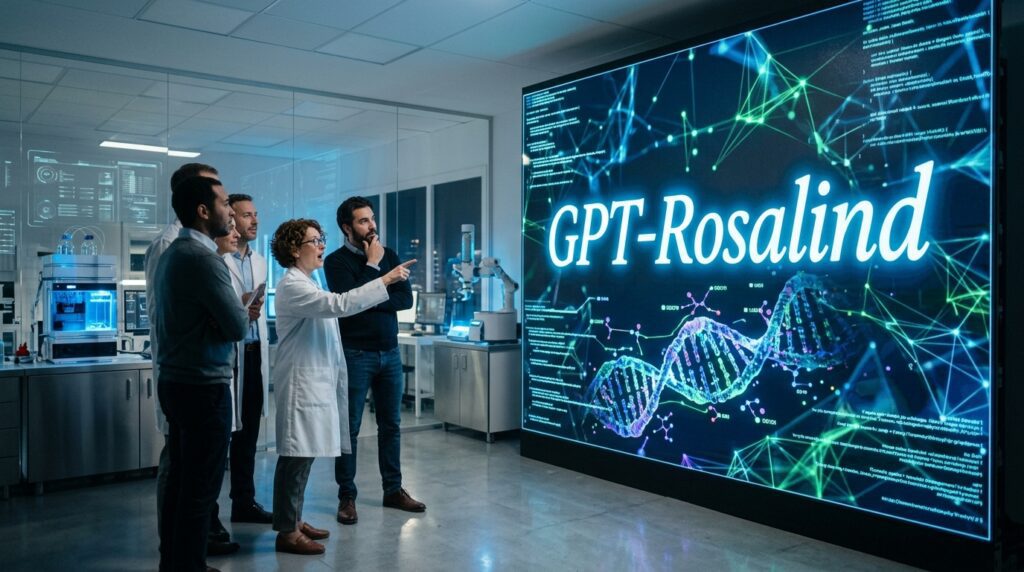
GPT-Rosalind is named after Rosalind Franklin, the British chemist whose X-ray crystallography work helped crack the structure of DNA. She didn’t get nearly enough credit in her lifetime. But her science? It changed everything.
So when OpenAI decided to name its first-ever life sciences AI model after her, they weren’t just being poetic. They were making a statement. This model is meant to carry that same spirit of discovery — the kind that reshapes how we understand life itself.
And honestly? The ambition matches the name.
What Exactly Is GPT-Rosalind?
Here’s the short version: GPT-Rosalind is a large language model that OpenAI trained specifically for biology. Not science in general. Not medicine broadly. Biology. Specifically.
That’s a big deal. Most AI models from major tech companies take a wide-angle approach — they try to be good at everything. GPT-Rosalind goes narrow and deep. It was trained on 50 of the most common biological workflows, It knows how to talk to major public biological databases. It can suggest likely biological pathways, prioritize potential drug targets, and infer structural or functional properties of proteins.
Think of it like this. You’ve got a brilliant research assistant who has read every biology paper ever published, memorized every database, and never sleeps. That’s the idea.
Ars Technica described it well: “Biological systems have large webs of interactions that the human brain can struggle to process.” GPT-Rosalind is built to handle exactly that.
The Two Big Problems It’s Trying to Solve
Yunyun Wang, OpenAI’s Life Sciences Product Lead, laid it out clearly in a press briefing. Biology researchers face two massive roadblocks right now.
Problem one: data overload. Decades of genome sequencing and protein biochemistry have created mountains of data. No single researcher can absorb it all. It’s not a matter of intelligence — it’s a matter of scale. The data is simply too vast.
Problem two: extreme specialization. Biology has splintered into dozens of highly specialized subfields. Each one has its own techniques, its own jargon, its own culture. A geneticist who stumbles onto a gene that’s active in brain cells suddenly has to wade through an enormous neurobiological literature they’ve never touched before. That takes time. A lot of it.
GPT-Rosalind attacks both problems head-on. It synthesizes evidence across fields, It connects the dots between genotype and phenotype. It leverages known pathways and regulatory mechanisms to make inferences that would take a human researcher weeks to piece together.
As Wang put it: “We’re connecting genotype to phenotype through known pathways and regulatory mechanisms, infer likely structural or functional properties of proteins, and really leveraging this mechanistic understanding.”
That’s not a small thing. That’s potentially transformative.
What Can It Actually Do?
Let’s get specific, because the capabilities list is genuinely impressive.
GPT-Rosalind handles evidence synthesis — pulling together findings from across the literature and making sense of them. It does hypothesis generation — suggesting new directions for research based on what’s already known. It supports experiment planning — helping researchers design protocols from scratch. And it handles data analysis — interpreting complex biological outputs that would normally require specialized expertise.
The Decoder reports that the model can reason about molecules, proteins, genes, signaling pathways, and disease biology more accurately than earlier GPT versions. It also makes better use of scientific tools and databases across multi-step workflows.
Here’s a real-world example. Imagine a researcher working on a new gene therapy. They need to survey hundreds of recent papers. they need to identify patterns in protein structures, they need to design a cloning protocol. Then they need to predict how a particular RNA sequence will behave inside a cell. Traditionally, each of those steps requires different tools, different experts, and significant time.
GPT-Rosalind can handle all of that within a single interface. It queries specialized databases, parses recent scientific literature, interacts with computational tools, and suggests new experimental pathways — all in one go.
That’s not just convenient. That’s a genuine acceleration of the scientific process.
The Benchmark Numbers Are Turning Heads
Okay, let’s talk performance. Because OpenAI didn’t just make big claims — they backed them up with numbers.
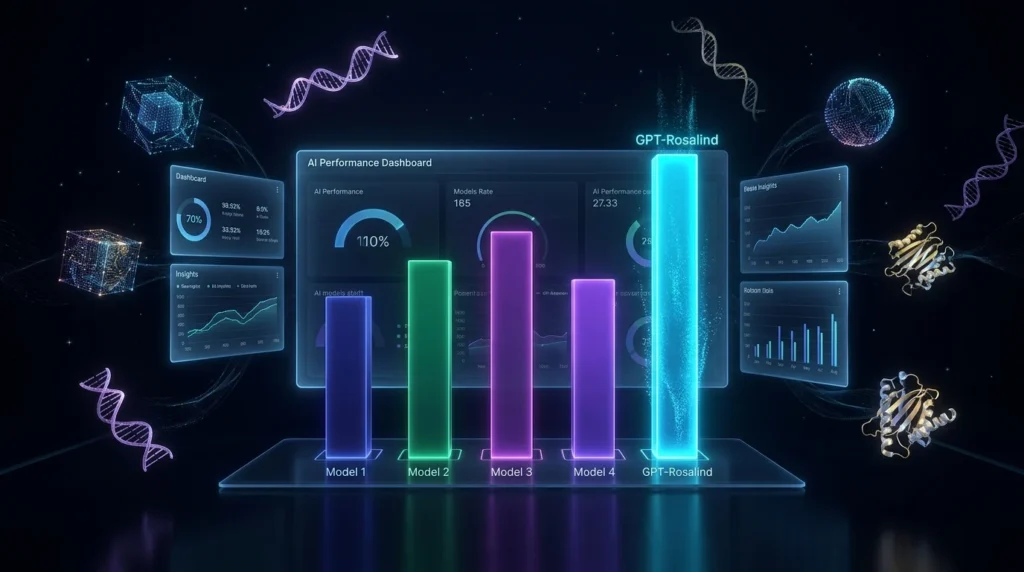
On BixBench, a benchmark designed around real-world bioinformatics tasks, GPT-Rosalind scored 0.751 on Pass@1. For context, that puts it ahead of GPT-5.4 (0.732), Grok 4.2 (0.698), GPT-5 (0.728), and Gemini 3.1 Pro (0.550). That’s not a marginal win. That’s a clear lead across the board.
On LABBench2 — which covers literature research, database access, sequence manipulation, and protocol design — GPT-Rosalind beat GPT-5.4 on 6 out of 11 tasks. The biggest jump came in CloningQA, a task that requires fully designing DNA and enzyme reagents for molecular cloning protocols. That’s highly specialized work. And GPT-Rosalind nailed it.
MarkTechPost highlighted perhaps the most striking result of all. In a partnership with Dyno Therapeutics, the model was tested on RNA sequence-to-function prediction using unpublished sequences — data that had never been part of any public training set. No memorization tricks possible here.
The result? GPT-Rosalind’s best-of-ten submissions ranked above the 95th percentile of human experts on prediction tasks. For sequence generation, it hit the 84th percentile. On novel biological data. That’s remarkable.
The Free Plugin That Opens the Door
Here’s something that often gets buried in the headlines: OpenAI isn’t just releasing a gated enterprise model. They’re also dropping a free life sciences research plugin for Codex on GitHub.
This plugin connects models to more than 50 public multi-omics databases, literature sources, and biology tools. It spans human genetics, functional genomics, protein structure, biochemistry, clinical evidence, and public study discovery. It includes access to tools like AlphaFold, Bgee, and BindingDB.
Think of it as an orchestration layer. It helps researchers handle broad, ambiguous, and multi-step questions by routing them to the right tools and databases automatically. Enterprise users can pair it with GPT-Rosalind. Everyone else can use it with standard OpenAI models.
That’s a genuinely generous move. It means even researchers without enterprise access get something useful out of this launch.
Who’s Already Using It?
GPT-Rosalind isn’t just a demo. Real organizations are already putting it to work.
OpenAI has confirmed partnerships with Amgen, Novo Nordisk, Moderna, Thermo Fisher Scientific, Oracle Health and Life Sciences, NVIDIA, the Allen Institute, Benchling, and the UCSF School of Pharmacy. These aren’t small players. These are some of the biggest names in life sciences and biotech.
The company is also working with Los Alamos National Laboratory on AI-guided design of proteins and catalysts. That’s a partnership that signals serious scientific intent — not just commercial ambition.
The Safety Question Nobody’s Ignoring
Here’s where things get real. Biology is powerful. And powerful tools can be misused.
OpenAI knows this. That’s exactly why GPT-Rosalind is launching under a Trusted Access Program — restricted to qualified US-based enterprise customers only. The company has built in technical safeguards, including systems to flag potentially dangerous activity.
Ars Technica noted the concern directly: the model could theoretically be asked to do something like optimize a virus’s infectivity. OpenAI is taking that risk seriously. Access is limited to organizations doing legitimate scientific research with clear public benefit, proper governance and compliance controls, and secure, managed environments.
To get in, organizations must meet three requirements: legitimate scientific research with clear public benefit, proper governance and abuse-prevention controls, and access limited to approved users in secure environments.
That’s a tight gate. But given the stakes, it makes sense.
The Hallucination Problem — Still Lurking
Let’s be honest about the elephant in the room. LLMs hallucinate. They make things up. And in biology, a hallucinated drug target or a fabricated protein interaction isn’t just embarrassing — it could waste years of research and millions of dollars.
OpenAI says it has tuned GPT-Rosalind to be more skeptical. The model is designed to push back. It’s more likely to tell you when something is a bad drug target, rather than just agreeing with whatever you suggest. That’s a meaningful design choice.
But as Let’s Data Science points out, the closed-access nature of the model limits community auditing and independent benchmarking. Practitioners need transparency on data sources, negative controls, confidence calibration, and integration pathways with lab workflows.
The honest truth? We won’t know how well the hallucination problem is solved until researchers start using it in the wild and reporting back. History suggests we’ll see a mix — some genuinely surprising discoveries, and some obviously wrong suggestions. The key is building workflows that catch the errors before they cost anyone anything.
Why Domain-Specific AI Is the Next Big Wave
Step back for a second and look at the bigger picture. GPT-Rosalind isn’t just a product launch. It’s a signal.
The AI industry is shifting. General-purpose models are still important. But the next frontier is domain-specific models — AI systems that go deep on a single field rather than trying to be good at everything.
MarkTechPost put it well: “Just as fine-tuning and RLHF allowed language models to specialize for code generation or instruction-following, OpenAI is now applying similar strategies to make models that can reason meaningfully about genomic sequences, chemical structures, and experimental protocols.”
Life sciences is one of the clearest proving grounds for this approach. The search spaces are vast. The data is high-dimensional. The societal stakes are enormous. If domain-specific AI can work anywhere, it can work here.
And if it works here — if GPT-Rosalind genuinely helps compress the 10-to-15-year drug discovery timeline — the implications are staggering. Faster cures. Cheaper treatments. More lives saved.
What Comes Next

GPT-Rosalind is just the beginning. OpenAI has explicitly said this is the first in a planned series of life sciences models. The company plans to keep expanding biochemical reasoning capabilities for tool-heavy, long-horizon research workflows.
During the current research preview, usage won’t eat into existing credits or tokens for enterprise customers. Pricing and broader availability will come later.
The scientific community is watching closely. Independent evaluations and reproducible benchmarks will ultimately determine whether GPT-Rosalind becomes a reliable lab assistant or just another proprietary black box. The early signs are promising. But science demands proof, not promises.
One thing is certain: the era of AI as a genuine scientific collaborator has arrived. And it’s wearing Rosalind Franklin’s name.
Sources
- Ars Technica — OpenAI starts offering a biology-tuned LLM
- The Decoder — OpenAI launches GPT-Rosalind, a reasoning model built for life sciences research
- MarkTechPost — OpenAI Launches GPT-Rosalind: Its First Life Sciences AI Model
- AI Base News — GPT-Rosalind
- Let’s Data Science — OpenAI launches GPT-Rosalind, a biology-tuned LLM
- OpenAI Official Announcement
The Kingy Brief
Get The Kingy Brief.
Every week: what launched, what changed price, and what scored well — built on KALI.
Weekly · Double opt-in · Unsubscribe anytime