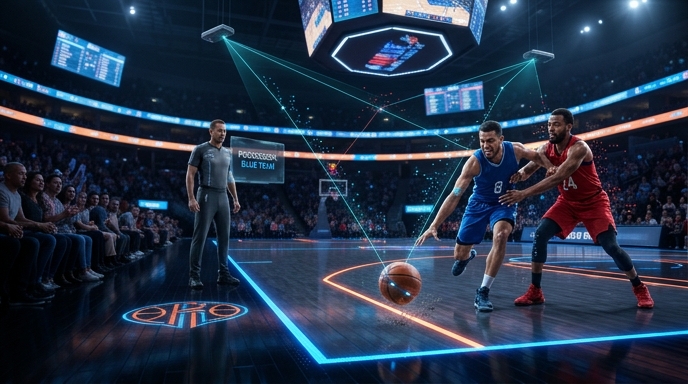
The League Wants Fewer Guessing Games
The NBA may be getting a new official soon. It will not wear stripes. It will not jog up the sideline. It will not get booed by 19,000 people while pretending not to hear them.
It will be an automated system powered by artificial intelligence and court-side cameras.
Commissioner Adam Silver says the league plans to move toward using AI-assisted technology for certain objective calls, especially out-of-bounds decisions. In plain English: when the ball ricochets off three elbows, one sneaker, and somebody’s shin in the final two minutes, the NBA wants a machine to say whose ball it is.
Silver’s idea is simple. Take the clean, measurable calls away from human officials. Let technology handle them instantly. Let referees focus on the messy stuff: contact, intent, advantage, rhythm, and whether a player just got clobbered or performed community theater.
What Silver Actually Said
Silver laid out the plan during an appearance on The Pat McAfee Show, where he compared the future system to Hawk-Eye, the electronic line-calling technology used in tennis. Tennis fans know the drill. A ball lands near the line. The system shows the result quickly. The crowd gasps. The argument ends.
Silver wants basketball to borrow that concept.
The proposed NBA version would use cameras placed around the court to decide objective plays. Out-of-bounds calls sit at the top of the list because they often involve a clear physical question: who touched the ball last?
That does not mean AI will suddenly call every foul, technical, travel, carry, screen, flop, and “what exactly was that?” possession. Silver drew a line between objective calls and judgment calls. Out-of-bounds can be measured. Contact cannot always be reduced to pixels.
A camera can help determine whether a ball brushed a fingertip. It cannot easily decide whether a defender’s bump actually impeded a shooter, whether a player exaggerated contact, or whether two seven-footers colliding in the paint counts as normal playoff weather.
So the robot ref is not taking over the whole game. Not yet. It is being invited to handle the obvious stuff humans keep arguing about anyway.
Why Out-of-Bounds Became the Test Case
Out-of-bounds calls make sense as the opening act because they are supposed to be binary. Ball off Team A. Ball to Team B. That is the theory.
Basketballs spin. Hands swipe. Feet slide. Players are enormous, fast, and inconveniently attached to limbs. In tight playoff moments, a ball can graze one player’s finger and bounce off another player’s leg before anyone in the building has a clean view.
That is how a “simple” possession call becomes a national debate.
AI News connected Silver’s comments to a disputed Western Conference finals sequence between the Oklahoma City Thunder and San Antonio Spurs. On that play, Victor Wembanyama was ruled to have touched the ball last, while replay appeared to show the ball coming off Chet Holmgren’s foot. The call stood after officials conferred, and the Thunder took a 3-2 series lead.
That is exactly the kind of mess Silver wants to clean up.
If the league can automate that category, it could remove one of the sport’s most annoying rituals: the late-game replay séance.
The Replay Problem Nobody Loves
Replay was supposed to fix things. In some ways, it has. It gives officials a second look. It corrects some obvious mistakes. It creates accountability.
It also eats time like a hungry raccoon in a pantry.
The NBA currently uses a Coach’s Challenge system for many replay situations. A team starts with one challenge and can earn a second if the first succeeds. That adds strategy, but it also creates absurdity. A coach may have to burn a challenge on a call that technology could identify automatically.
Silver’s pitch is that automated calls would remove the need to challenge certain plays at all. If the AI system can instantly say “Laker ball” or “Thunder ball,” the game moves on. No huddle at the scorer’s table. No five-angle courtroom drama. No announcer saying, “This may come down to whether the pinky bent backward.”
That matters because basketball depends on flow. The NBA sells pace, athleticism, and momentum. Stoppages drain all three.
A fast automated decision would not just improve accuracy. It would protect the entertainment product. Nobody buys a ticket to watch referees operate a touchscreen.
Hawk-Eye, but Make It Basketball
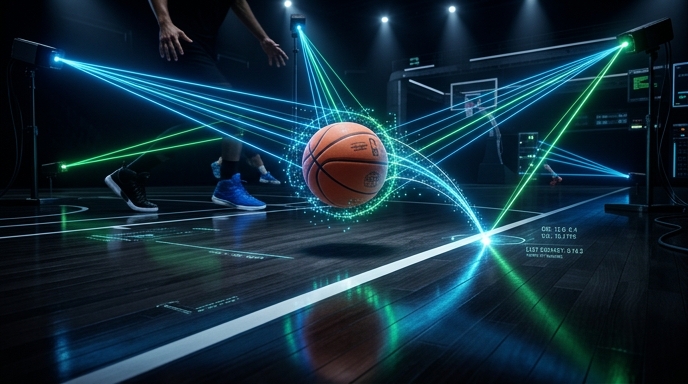
Silver’s Hawk-Eye comparison gives the plan instant shape.
In tennis, electronic line-calling works because the court has defined lines and the ball’s position can be tracked with precision. Fans trust the animation because it arrives fast and appears final. There is no philosophical symposium about whether the ball “wanted” to be in.
That means the NBA’s version needs more than line detection. It needs object tracking. It must understand the ball, the players, the boundary, and the exact moment of last touch.
The league has already been moving in this direction. AI News reported that the NBA announced a multi-year partnership with Sony’s Hawk-Eye Innovations in 2023 to deploy 3D optical tracking technology after testing at Summer League and NBA arenas. That background makes Silver’s comments sound less like science fiction and more like the next step in a project already underway.
The machine is not walking in cold. It has been warming up in the tunnel.
Fans Are Not Exactly Throwing a Parade
Of course, the reaction has not been universal applause.
Heavy reported that fans online quickly blasted Silver’s AI idea. Some argued that officiating problems run deeper than out-of-bounds calls. Others complained about flopping, foul baiting, and the general style of NBA officiating. One theme came through clearly: many fans do not believe a camera system solves the league’s real credibility problem.
If fans are angry because a ball touched the wrong shoe, automation helps. If fans are angry because they think stars get different whistles, automation barely touches the issue. If fans are tired of offensive players snapping their heads back like haunted Pez dispensers, AI possession calls will not fix that either.
That is the danger for the NBA. The league may introduce a useful tool and still disappoint people who expected a cure-all.
AI can answer “who touched it last?” It cannot answer “why does this game feel over-officiated?” It cannot make fans trust every foul call. It cannot make a block-charge decision painless. It cannot stop a superstar from selling contact like rent is due.
So yes, the plan could help. No, it will not end referee discourse. Nothing ends referee discourse. Referee discourse is basketball’s mold. It returns after every cleaning.
What Referees Still Have to Do
Silver has been careful to defend the human officials. He has said referees still need to handle subjective calls, especially contact and fouls.
Did it impede movement? Did it affect the shot? Did the defender beat the player to the spot? Did the offensive player create the collision? Did the player exaggerate? Did the contact occur before, during, or after the gather?
These are not always clean data problems. They are basketball judgment problems.
That is why Silver’s plan works best as subtraction, not replacement. Remove objective clutter from the referees’ workload. Give them fewer small fires to stomp out. Let them focus on the calls where human context still matters.
In that version, AI does not become the boss. It becomes the intern with perfect eyesight. Annoyingly useful. Never tired. Very bad at vibes.
The Upside Is Bigger Than It Sounds
A faster out-of-bounds system may sound minor. It is not.
Late-game possessions decide playoff series. One wrong call can swing momentum, strategy, and public trust. Even when the call is correct, the delay can damage the viewing experience. Basketball rhythm is fragile. Stop it too often and the whole thing starts to feel like a committee meeting with dunks.
Automated objective calls could improve three things at once.
First, accuracy. If the system works, it should identify last touch better than a referee blocked by bodies.
Second, speed. Instant decisions would reduce replay delays and coach’s challenge drama.
Third, focus. Officials could spend more attention on live judgment calls instead of being blamed for missing physics experiments in the corner.
That combination is why the idea deserves a fair hearing, even from fans who roll their eyes when a sports league says “AI.” The term has become corporate glitter. Sprinkle it on anything and executives start smiling. But this use case is practical.
Track the ball. Track the players. Identify the last touch. Award possession. Keep playing.
The Risks Are Real, Too
The NBA should not oversell this.
Automated systems can fail. Cameras can have blind spots. Algorithms can struggle with unusual angles, clustered bodies, sweat, reflections, speed, and chaos. The league will need transparent standards for when the system is trusted, when humans can override it, and how errors get explained.
Fans will not accept “because the computer said so” forever. They will want proof. They will want a replay graphic. They will want consistency. They will want to know why one call was automatic and another was not.
The NBA also needs to avoid creating a new kind of stoppage. If automation replaces a two-minute review with a ten-second review, terrific. If it creates a fresh ritual where everyone waits for a machine verdict while the arena plays suspense music, the league will have invented replay with extra wires.
The Bigger Sports Trend
The NBA is not wandering into uncharted territory by itself.
Other sports already use automated or semi-automated systems for specific decisions. Tennis uses electronic line calling. Soccer has used semi-automated offside technology. Baseball has moved toward automated ball-strike challenges.
Was the ball in or out? Was the runner safe or out? Was the player offside? Did the ball cross a line? These questions may still be complicated, but they are more measurable than “was that enough contact?”
The NBA is following that same path. Start with defined calls. Build trust. Expand only if the technology proves itself.
That measured approach is smarter than a grand AI revolution. Basketball does not need a digital overlord. It needs fewer obvious mistakes and fewer dead minutes.
The league also has a commercial incentive. Faster games are easier to watch. Cleaner endings travel better on social media. Fewer officiating controversies protect the product. Silver is not just solving a referee problem. He is protecting the show.
So, Is This Good for Basketball?
Yes, if the NBA keeps the promise narrow.
Automating objective calls is a sensible move. It attacks a real pain point. It borrows from proven models in other sports. It could speed up games and reduce one category of controversy.
It will not solve flopping. It will not settle debates over star treatment. It will not make every whistle feel fair. It will not prevent fans from blaming referees after a loss by 23 points. Some traditions are eternal.
Still, this is probably where basketball officiating has to go. The sport is too fast, the stakes are too high, and the cameras are too good for the league to rely only on human eyesight for objective calls.
Let people judge the human parts of the game. Let machines handle the measurable parts.
That is not anti-referee. It is pro-sanity.
And if it means fewer five-minute debates over whose fingernail grazed the ball before it bounced into the third row, bring on the camera brain.
The robot may never understand playoff intensity. It may never appreciate a perfectly timed weak-side rotation. It may never know the joy of a petty fan chant.
But if it can tell us whose ball it is and then get out of the way, welcome to the crew.
Sources
- Digital Trends: NBA will put AI in charge to tackle bad ref calls and fan fury
- Artificial Intelligence News: NBA plans AI system for automatic out-of-bounds calls
- Heavy: NBA Fans Blast Adam Silver’s AI Plan To Help Referees
- Yahoo Sports: Adam Silver plans to implement AI
- Lakers Nation: Adam Silver: NBA Will Begin Using Automated Systems For Objective Calls
The Kingy Brief
Get The Kingy Brief.
AI changes, original tests and one practical thing to try. Fridays at 09:00 Vancouver time.
Free · Double opt-in · Unsubscribe anytime
Sign up for The Kingy Brief on Beehiiv.
Signup help and newsletter schedule
Signup form provided by Beehiiv. After submitting, check your inbox for "Confirm your subscription to The Kingy Brief" and open its confirmation link. Check Spam or Promotions if you cannot find it.
Fridays at 09:00 Vancouver time: source-checked AI changes, original tests and one practical thing to try. We skip a week when there is not enough verified material. Free. Unsubscribe anytime.