
The AI pilot has a new problem: Monday morning
An AI demonstration can be delightful. Ask a question, watch an answer appear, and imagine all the work it might save.
Then Monday arrives. The system needs access to the right records. It must follow company rules, cope with a customer who switches languages halfway through a message, and know when to hand the conversation to a person. Someone also has to keep it working after launch.
That practical gap is where Singapore-based OneByZero wants to build its business. On October 5, 2026, the company announced a US$20 million Series A round led by Jungle Ventures. It is OneByZero’s first external funding.
The money will support engineering teams across its existing markets, further development of its NEO platform, and a planned entry into Japan. The Philippines is one of the nine markets where the company says it already operates.
The announcement is a funding story. It is also a useful window into what enterprises want from AI now: systems that can perform a real task, work within existing operations, and remain manageable once the launch presentation is over.
What OneByZero actually does
OneByZero describes itself as an AI deployment company. Its engineers work with customers to identify a business process, connect AI to the systems involved, and help operate and improve the result.
That makes the work more involved than handing a company access to a chatbot. A customer-service system, for example, may need to recognize what someone is asking, retrieve the right information, draft a response, record what happened, and alert a human agent when the question needs one.
The company calls some of these systems “AI Coworkers.” The name is friendly, though the software does not become an employee. Each system has a defined role, permissions and controls. People remain responsible for the decisions and results.
Co-founders Niket Vaidya, the chief executive, and Vibhore Kumar, the chief technology officer, argue that useful AI must operate inside a business’s own workflows. Their company focuses on sectors where that can be especially demanding, including financial services, telecommunications and retail.
OneByZero says it has spent three years building and running systems for large enterprises. The new round gives it capital to take that approach into more projects and industries.
The $20 million plan
OneByZero has outlined several uses for the Series A funding.
It intends to expand the engineering teams and customer relationships it has across Australia, India, Indonesia, Malaysia, the Philippines, Singapore, Thailand, the United States and Vietnam. It also plans to establish a local team in Japan. That would be a new market for its stated operating footprint, rather than one of the nine it currently lists.
The company wants to work beyond its established strengths in finance and telecommunications, targeting conglomerates, healthcare and the public sector. It will also invest in NEO and develop templates that could help it adapt systems to particular industries.
Jungle Ventures led the round. In OneByZero’s announcement, managing partner Yash Sankrityayan pointed to the company’s experience putting AI into operation inside complex organizations.
There is a distinction between the plans and their outcome. The funding is announced; a Japanese team and expansion into new sectors are goals. Customers will ultimately judge whether OneByZero can deliver the same quality of work as it grows.
Meet NEO, the control layer
NEO is OneByZero’s platform for deploying and managing its AI systems. Think of it as the place where an organization can define a system’s job, set boundaries and review what it has done.
The company says NEO records agent actions and allows teams to specify when human judgment is required. Its product materials describe tools for building workflows, monitoring live systems and checking how they perform. It also says the platform can be deployed inside a customer’s cloud environment.
Those features address a sensible concern. If an AI system answers thousands of customer questions or helps change a data pipeline, its operators need visibility. They must be able to investigate a mistake, adjust a process and decide when to stop or escalate an action.
OneByZero says its engineers can reuse parts of NEO across projects. If that works well, a new deployment may require less construction from scratch. Each customer will still bring its own data, processes and rules.
The appeal is easy to understand: businesses want the speed of AI without losing track of what the software is doing.
Why the engineers stay close
OneByZero’s approach relies on what it calls forward-deployed engineers. They work alongside a customer’s team during design and implementation, then remain involved as the system runs.
There is a practical reason for that model. Enterprise software rarely lives in one tidy box. Information may sit across several databases. Staff may follow different procedures depending on a product, customer or market. A process that looks simple in a flowchart can become complicated when real people use it.
An engineer working close to the customer can discover those details. They can help decide which information an AI tool needs, where it should connect, and which situations must go to a human.
Local knowledge matters too. A response that works in one language or market may sound wrong in another. Regulations and customer expectations also differ.
This hands-on approach can produce useful systems. It takes skilled people and time, however. As OneByZero expands, an important test will be how well its platform and templates help teams deliver without rebuilding every solution from the ground up.
The Philippine connection is already real
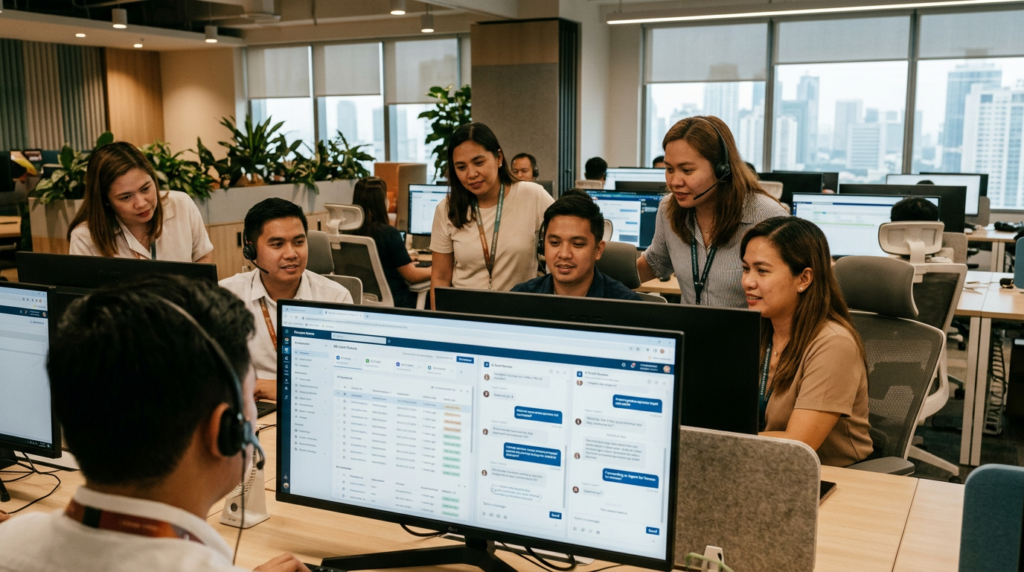
For Philippine readers, this story reaches beyond a funding announcement in Singapore. OneByZero lists the Philippines among its operating markets and has published a case study involving PLDT and Smart.
The company says it built Airyn, an AI system that helps respond to public customer messages on social media. According to its case study, Airyn works with English, Tagalog and Taglish, classifies incoming posts, and passes conversations to human agents when needed.
OneByZero reports a 93.7% automation rate for public-facing social media responses in that deployment. It also reports a 2.6-fold increase in customer engagement and ₱3.38 million in annualized savings.
These are OneByZero’s reported results, not figures independently verified for this article. They describe a specific customer-service workflow; they should not be read as a promise that every business could achieve the same outcome.
Still, the example shows the kind of detail that determines whether an AI tool feels useful locally. Filipino customers may shift between languages naturally. A service system has to keep up, and it has to recognize when a person should take over.
A reply is only part of customer service
Imagine posting about a billing problem. A fast response is welcome. A fast response that misunderstands the problem? Less so.
OneByZero says Airyn first checks an incoming post for details such as intent, urgency and language. It then generates an appropriate reply or alerts a human agent. The case study describes escalation for situations requiring personal attention, with context passed along to the staff member.
That workflow explains why the company talks so much about controls. Automation can handle volume, but a customer’s experience depends on the quality of the answer and the ease of getting help when the issue becomes complicated.
The system uses Amazon Bedrock and Anthropic’s Claude Sonnet, according to OneByZero. Those underlying tools are part of the deployment; OneByZero’s work includes connecting them to the customer’s channels and processes.
A company evaluating a similar system would want to ask more than “How many replies can it send?” It would also examine response quality, escalation rates, customer satisfaction and how staff correct mistakes. Speed matters. Resolution matters more.
Indonesia shows a different scale of operation
OneByZero has also published a case study about a large Indonesian telecommunications provider. It says its Neo system supports more than 50 automated customer journeys, including information requests, complaints and service tickets.
According to the company, the deployment uses Amazon Bedrock and Claude Sonnet, with tools for customer conversations, staff assistance and oversight. OneByZero says the customer’s first-contact resolution rate rose from 59% to 92%, while ticket-handling costs fell 34%.
Again, those are company-reported figures for one engagement. The client is unnamed in the published case study, so readers cannot readily compare its account with a public statement from the operator.
The example is valuable for another reason. It shows how much sits behind the phrase “AI chatbot.” A large telecom needs systems that can recognize different requests, connect to records, create tickets, transfer conversations and show operators what is happening.
That is considerably more work than writing a clever opening greeting. If OneByZero can reliably repeat that kind of integration, it has a stronger case for its engineering-led business model.
AI can tackle work customers never see
Some of OneByZero’s work happens far from the customer-service screen. In another published case study, the company describes helping a Southeast Asian bank modernize data pipelines during a cloud migration.
A data pipeline moves and transforms information so other systems can use it. Banks can have many such pipelines, built over years. Moving them to a new environment may require engineers to rewrite code and test whether the new version still produces the right results.
OneByZero says it developed a three-agent system to help coordinate the work, rewrite code and run checks. Its case study reports a 50% reduction in project completion time and human effort. It says the bank independently migrated 60% of its pipelines using the approach.
The bank is unnamed, and the measures come from OneByZero. The underlying problem, though, is familiar to large organizations: old systems are costly to change, and careful testing matters.
This is an instructive AI use case. There is no chat window for a customer to admire. The potential benefit is in helping technical teams complete difficult, repetitive work while checking that the finished system behaves as intended.
Why Japan is next
OneByZero says the funding will help it establish a team in Japan. The company has not announced a completed Japanese deployment as part of this funding news.
Entering a new market involves more than translating a website. Enterprise customers may need local technical support, familiarity with their industry and a team that understands how they make decisions. OneByZero’s emphasis on engineers working alongside clients makes a local presence particularly relevant to its approach.
The company also plans to develop industry templates on NEO. A template could provide a starting point for a familiar workflow while leaving room to adapt it for a specific customer. OneByZero says it wants to support systems built with smaller and open-weight language models as well as other AI tools.
That flexibility may appeal to customers weighing performance, cost and control. The best model for answering product questions may differ from the one suited to a technical migration task.
Japan will be a test of OneByZero’s expansion strategy. The company must show that its hands-on delivery method can travel while remaining attentive to local requirements.
The numbers need context
OneByZero says its revenue has more than doubled annually over the past three years. It also says some deployments automate more than 90% of certain customer-facing interactions and that its systems have shortened complex data-modernization work by as much as 50%.
Those statements point to momentum, but the company has not disclosed revenue totals in its funding announcement. The percentages describe selected applications, not an average across all customers.
That context matters when comparing AI companies. A striking result in one workflow can be useful evidence that a method works there. It cannot settle how the same method would perform in another company with different data, staffing and systems.
Prospective customers would want to examine the full process: what counted as an automated interaction, how quality was measured, which tasks still needed people, and what the system cost to build and maintain.
The funding itself is a concrete milestone. The next measure of progress is whether OneByZero can turn its existing deployments into a repeatable business across more markets without sacrificing the close engineering work it says makes those deployments effective.
From a promising demo to a working system

There is something refreshingly unglamorous about much of this story. The money will pay for engineers, market expansion and platform development. The product concerns permissions, records of agent actions, customer-service handovers and data pipelines.
That is also why it matters. Businesses have no shortage of AI tools to try. They need ways to make those tools useful in the systems they already depend on.
OneByZero’s $20 million Series A gives it more room to pursue that job across Asia Pacific. Its Philippine case study offers a local example, while its planned Japanese expansion and move into new industries set out what comes next.
The company’s claims about performance deserve the normal scrutiny given to supplier case studies. Its ambitions now face a practical test: can it deliver reliable results for more organizations, in more places, with people still able to understand and control the work?
A great AI demo gets applause. A dependable system earns another Monday morning.
Sources
- OneByZero’s Series A announcement
- DealStreetAsia’s report on the funding
- Digital News Asia’s coverage
- Entrepreneur Asia-Pacific’s analysis
- OneByZero’s NEO platform overview
- OneByZero’s PLDT and Smart case study
- OneByZero’s Indonesian telecom case study
- OneByZero’s bank data-migration case study
The Kingy Brief
Get The Kingy Brief.
AI changes, original tests and one practical thing to try. Fridays at 09:00 Vancouver time.
Free · Double opt-in · Unsubscribe anytime
Signup help and newsletter schedule
Signup form provided by Beehiiv. After submitting, check your inbox for "Confirm your subscription to The Kingy Brief" and open its confirmation link. Check Spam or Promotions if you cannot find it.
Fridays at 09:00 Vancouver time: source-checked AI changes, original tests and one practical thing to try. The weekly restart begins October 9, 2026. We skip a week when there is not enough verified material. Free. Unsubscribe anytime.