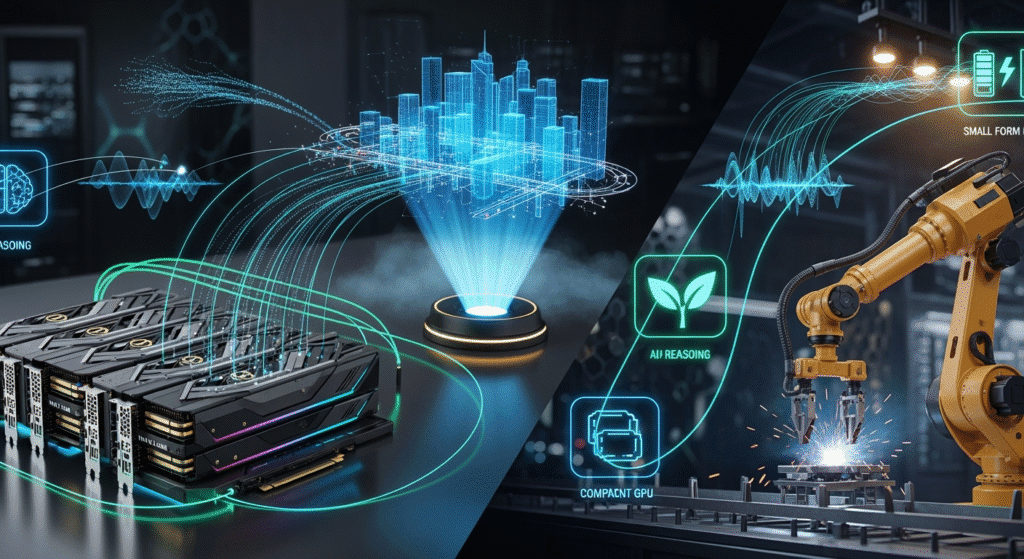
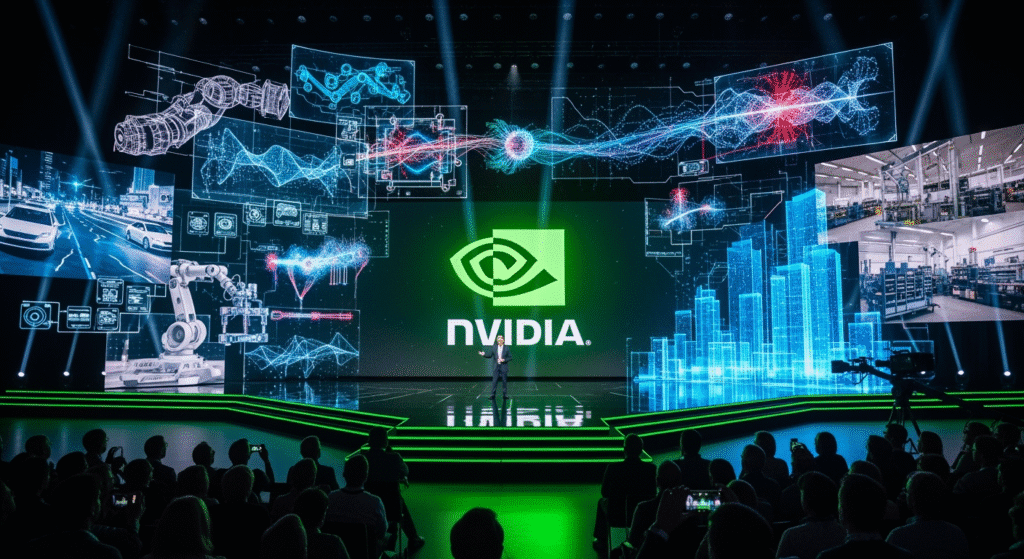
The future of artificial intelligence isn’t just about chatbots and language models anymore. It’s about AI that can see, think, and act in the physical world. At SIGGRAPH 2025, Nvidia unveiled a comprehensive ecosystem that’s pushing the boundaries of what they call “Physical AI” a convergence of artificial intelligence and computer graphics designed to create systems that can operate in real-world environments.
This isn’t just another tech announcement. It’s a fundamental shift toward AI that understands physics, reasons about the world, and can control everything from robots to autonomous vehicles. The implications are staggering.
The Blackwell Revolution: Power Meets Efficiency
Nvidia’s new Blackwell architecture is the foundation of this Physical AI revolution. The company has introduced a range of hardware that’s both more powerful and more efficient than ever before.
For data centers, the RTX PRO 6000 Blackwell Server Edition GPU is making waves. These aren’t just incremental improvements we’re talking about systems that deliver up to 45 times higher performance and 18 times better energy efficiency compared to CPU-only systems. That’s not a typo. Forty-five times faster.
The secret sauce? Fifth-generation Tensor Cores with support for the FP4 format. This technical advancement increases inference performance sixfold compared to the previous-generation L40S GPU. System partners including Cisco, Dell Technologies, HPE, Lenovo, and Supermicro are already lining up to offer servers based on this technology.
But here’s where it gets interesting. Nvidia isn’t just focusing on massive data center deployments. They’re bringing this power to compact workstations too.
Small Form Factor, Big Impact
The RTX PRO 4000 SFF Edition and RTX PRO 2000 Blackwell represent a different kind of revolution. These compact graphics cards are designed to bring AI acceleration to smaller, more energy-efficient form factors. Think engineering workstations, design studios, and 3D visualization setups that don’t have room for massive GPUs.
The RTX PRO 4000 SFF delivers up to 2.5 times higher AI performance while maintaining the same 70-watt power consumption as its predecessor. That’s efficiency at its finest. Meanwhile, the RTX PRO 2000 offers 1.4 times faster computer-aided design performance and 1.6 times quicker rendering speeds.
These aren’t just numbers on a spec sheet. Real companies are already seeing dramatic improvements. The Mile High Flood District in Denver uses these GPUs for complex flood simulations and massive 3D visualizations. Jon Villines, their innovation manager, notes that the RTX PRO 2000 Blackwell represents “a big step up in performance” for handling increasingly larger geographic information systems.
Physical AI: Where Simulation Meets Reality
But hardware is only half the story. Nvidia’s vision of Physical AI centers on something revolutionary: the ability to train AI systems in highly realistic digital environments before deploying them in the real world.
“Computer graphics and AI are converging to fundamentally transform robotics,” explained Rev Lebaredian, Vice President of Omniverse and Simulation Technologies at Nvidia. This convergence is creating what the company calls “digital twins” virtual environments so realistic that robots can learn through trial and error without any risk to real-world equipment or people.
The technological foundation comes from Nvidia’s Omniverse and Isaac platforms. New software libraries like Omniverse NuRec enable the reconstruction of real-world environments from sensor data using 3D Gaussian splatting. It sounds technical, but the implications are profound: AI systems can now train in perfect replicas of real environments.
Amazon Devices & Services is already implementing this “simulation-first” approach for zero-touch manufacturing. They load CAD models of new products into Nvidia Isaac Sim to generate over 50,000 synthetic images for training AI models. These models then control robotic arms that autonomously perform quality checks or integrate new products into production lines all based on skills learned entirely in simulation.
The Cosmos Models: AI That Reasons About Physics
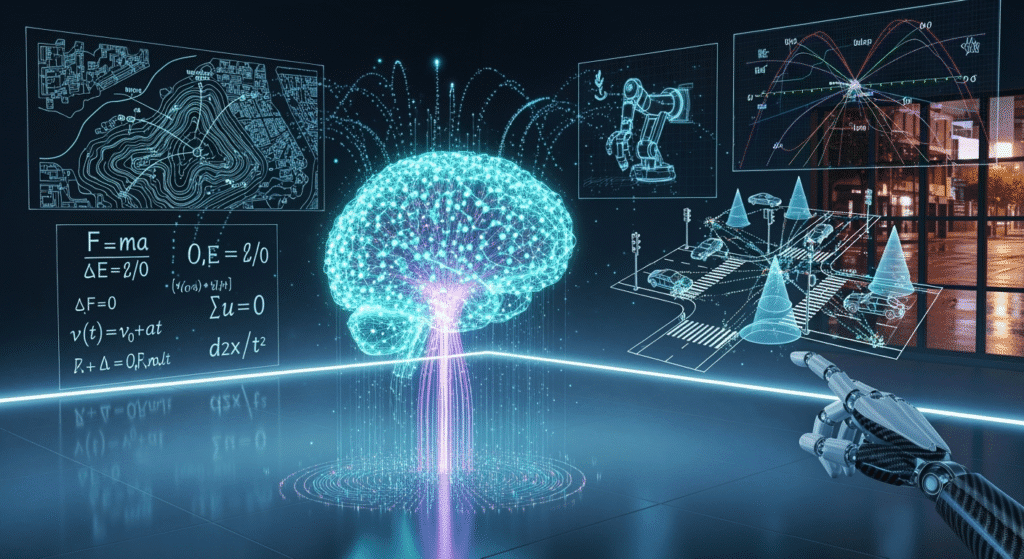
Hardware and simulation platforms are impressive, but they need intelligent models to drive them. Enter Nvidia’s Cosmos family, particularly the new Cosmos Reason model.
Cosmos Reason is a 7-billion-parameter Vision Language Model specifically designed for Physical AI applications. Unlike traditional AI models that work with text or images in isolation, Cosmos Reason understands physics, incorporates prior knowledge, and applies what Nvidia calls “common sense” reasoning.
This isn’t just marketing speak. The model can analyze video footage of autonomous vehicles, help robots plan their actions, and automatically annotate training data. Uber is already using Cosmos Reason to analyze the behavior of autonomous vehicles, while companies like VAST Data and Milestone Systems employ it for intelligent traffic monitoring.
The Cosmos family also includes Cosmos Transfer-2, which accelerates synthetic data generation from 3D simulation scenes. There’s even a distilled version optimized for speed. These models work together to create synthetic text, image, and video datasets for training robots and AI agents.
Real-World Applications: From Flood Control to Smart Strollers
The practical applications of Physical AI are already emerging across diverse industries. The Government of Cantabria’s Geospatial Office tested the RTX PRO 2000 Blackwell for analyzing high-resolution geographic information system data. Gabriel Ortiz Rico, their chief of service, reported that AI model fine-tuning is twice as fast compared to previous generation hardware.
In London, Studio Tim Fu uses the RTX PRO 2000 Blackwell to power their UrbanGPT application for real-time text-to-3D urban design. This technology can generate dynamic city layouts, track vital metrics like program and floor areas, and produce realistic massing distribution across complex urban design scenarios.
Perhaps most intriguingly, Glüxkind is creating AI-powered smart baby strollers. Kevin Huang, their CEO, explains that the RTX PRO 2000’s enhanced AI and graphics performance provides “the real-time processing power needed to make our smart strollers safer, more responsive and more convenient for families everywhere.”
The Metropolis Platform: Smart Cities and Factories
Nvidia bundles many of these technologies into their Metropolis platform, designed for intelligent infrastructure applications. The platform has been enhanced with Cosmos Reason integration, new vision foundation models, and extensions for Isaac Sim to generate rare training scenarios.
Partners are developing fascinating solutions. Accenture and Belden are creating “smart virtual fences” simulated in Omniverse to enhance worker safety around industrial robots. DeepHow is using the Metropolis VSS blueprint for a “Smart Know-How Companion” that transforms work instructions into visual guides. Beverage giant Anheuser-Busch InBev has reportedly reduced onboarding time for new employees by 80 percent using this solution.
Enterprise AI Gets Smarter
For enterprise applications, Nvidia has expanded their Nemotron family with Nemotron Nano 2 and Llama Nemotron Super 1.5 models. These are designed to enable AI agents to handle complex, multi-step tasks in areas like customer service and cybersecurity.
Companies including CrowdStrike, Uber, and Zoom are already testing or planning to use these models. The efficiency comes from a hybrid architecture and quantization techniques that allow powerful AI reasoning in compact form factors.
The Software Ecosystem That Powers Innovation
None of this would be possible without Nvidia’s comprehensive software ecosystem. The NVIDIA AI Enterprise software suite delivers enterprise-grade tools for building, deploying, and scaling production AI across virtually any infrastructure.
The Cosmos platform offers world foundation models optimized for fast, efficient inference and edge deployment. Remarkably, the Cosmos-Reason1-7B model can run seamlessly on the RTX PRO 4000 SFF, bringing powerful physical AI reasoning capabilities to edge devices and compact workstations.
Nvidia’s graphics and visualization tools, including the Omniverse platform, facilitate digital twins and visual workflows for 3D design teams. The Blackwell platform builds on Nvidia’s ecosystem of development tools, CUDA-X libraries, over 6 million developers, and nearly 6,000 applications.
Looking Ahead: The Physical AI Future
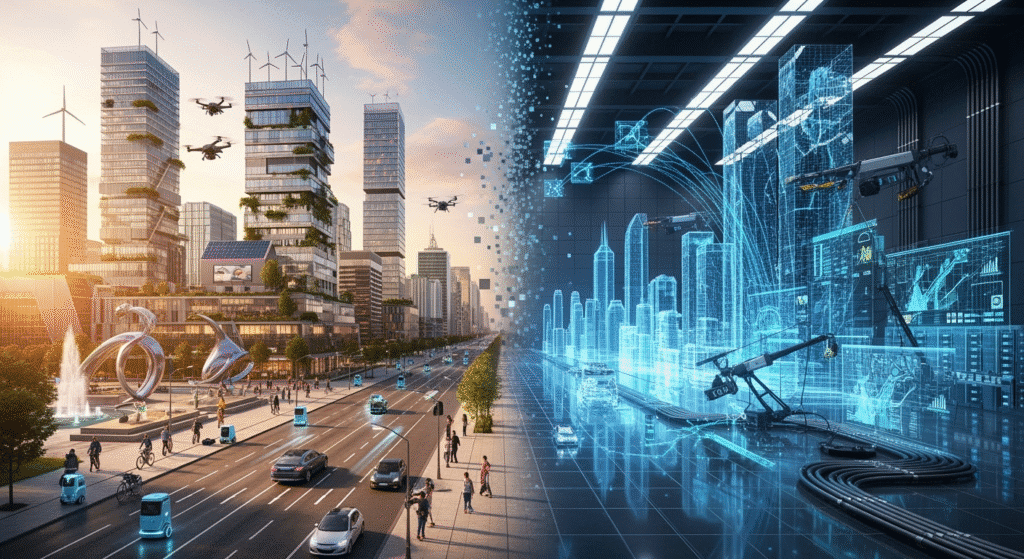
What we’re witnessing isn’t just another product launch it’s the emergence of a new category of AI that can understand and interact with the physical world. The convergence of powerful hardware, sophisticated simulation platforms, and reasoning-capable AI models is creating possibilities that seemed like science fiction just a few years ago.
The implications extend far beyond robotics. We’re talking about autonomous vehicles that can reason about complex traffic scenarios, manufacturing systems that can adapt to new products without human intervention, and smart cities that can optimize everything from traffic flow to energy consumption in real-time.
As Sanja Fidler, Vice President of AI Research at Nvidia, puts it: “AI is advancing our simulation capabilities, and our simulation capabilities are advancing AI systems.” This virtuous cycle is accelerating the development of AI that doesn’t just process information it understands the world and can act within it.
The RTX PRO 2000 Blackwell and RTX PRO 4000 Blackwell SFF Edition GPUs are expected to be available later this year, marking the beginning of a new era where Physical AI becomes accessible to a broader range of developers and organizations.
We’re standing at the threshold of a world where the line between digital simulation and physical reality becomes increasingly blurred and that’s exactly where the future of AI is heading.
Sources
- Nvidia pushes “Physical AI” with new Blackwell hardware and AI models – The Decoder
- Mini Footprint, Mighty AI: NVIDIA Blackwell Architecture Powers AI Acceleration in Compact Workstations – NVIDIA Blog
- Nvidia unveils new Cosmos world models, other infra for physical applications of AI – TechCrunch
Related Guides
Compare
Latest News
The Kingy Brief
Get future Kingy Brief editions.
Source-checked AI changes, original tests and one practical thing to try.
Free · Choose your subjects · Double opt-in · Unsubscribe anytime
Regular sending is paused; no restart date is set.