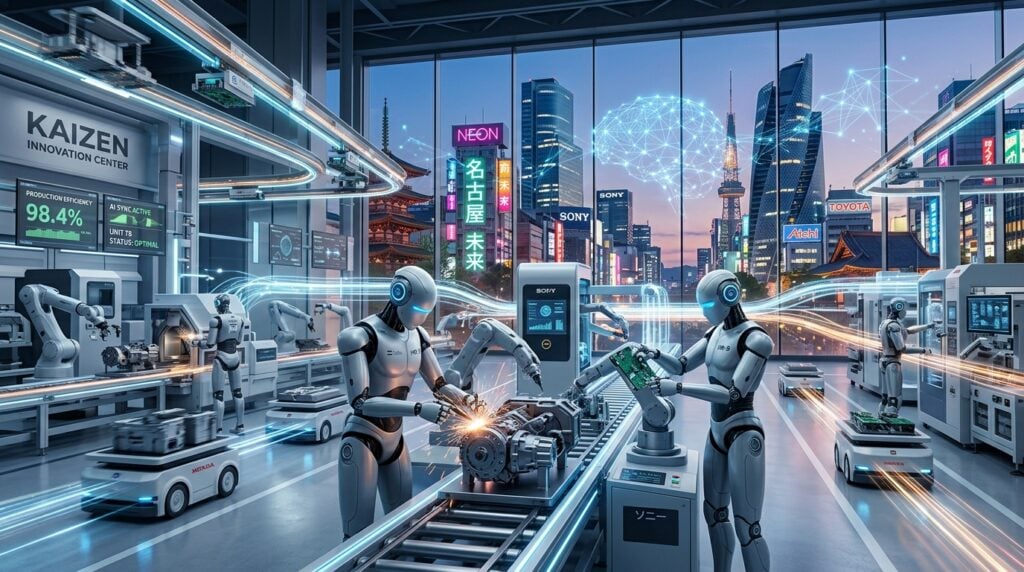
SoftBank, Sony, Honda, and NEC have joined forces to build a trillion-parameter Physical AI model. The target? Robots, factories, and autonomous machines. The deadline? 2030. The stakes? Enormous.
Japan Has Entered the Chat — But Not the Way You Think
Forget everything you know about AI assistants. Japan isn’t here to build the next ChatGPT. It’s not interested in writing your emails or summarizing your meeting notes. Japan has a much bigger, much bolder plan, and it just made its move.
On April 13, 2026, some of the most powerful names in Japanese tech officially announced a joint venture with one singular, laser-focused mission: build a trillion-parameter AI model designed to run machines, not conversations. We’re talking robots. Autonomous vehicles. Factory floors humming with intelligence. This is Physical AI, and Japan just bet the house on it.
The players? SoftBank, NEC, Honda, and Sony Group. Four giants. One goal. And billions of dollars in government backing to make it happen.
This isn’t a startup story. This is a national strategy.
What Exactly Is “Physical AI” — And Why Should You Care?
Let’s break it down. Most of the AI you interact with daily lives in the digital world. It reads text, It generates images. It answers questions. It’s brilliant at that stuff. But it can’t pick up a box. It can’t drive a car through a rainstorm. It can’t weld a steel beam on a factory floor.
Physical AI changes that equation entirely.
Physical AI refers to systems that don’t just think, they act. These are AI models embedded in robots, autonomous vehicles, and industrial machines that perceive the real world and respond to it in real time. No prompts. No chat windows. Just intelligent machines doing physical work.
Think of it this way: if ChatGPT is a brilliant brain in a jar, Physical AI is that brain with a body, and a job to do.
The global race for Physical AI is already heating up. Tesla is building humanoid robots. OpenAI is backing robotics startups. China has made massive investments in the space as part of its national AI strategy. And now Japan, with its legendary robotics heritage and deep industrial base, is stepping into the ring with a trillion-parameter model and a government-backed war chest.
Meet the Dream Team Behind Japan’s AI Moonshot
So who exactly is building this thing? Let’s run through the roster, because it’s genuinely impressive.
SoftBank is leading the charge. The Tokyo-based tech conglomerate is no stranger to big bets, it famously led OpenAI’s $40 billion funding round in 2025. Now it’s anchoring a domestic AI venture that aims to be completely independent of the American AI ecosystem it’s been bankrolling. That’s a fascinating pivot, and we’ll get to why in a moment.
NEC joins SoftBank on the actual AI development side. NEC brings decades of enterprise tech experience and serious AI research chops to the table. Together, SoftBank and NEC will be the engine room of this operation.
Honda is the first in line to deploy the model. The automaker plans to integrate the trillion-parameter AI into its autonomous driving systems. Honda has been quietly building out its self-driving capabilities for years. This partnership gives it a massive technological leap forward.
Sony Group brings something different to the mix, robotics and gaming hardware expertise. Sony’s experience building sophisticated hardware systems, from PlayStation controllers to camera sensors, makes it a natural fit for the physical layer of this AI stack.
And then there’s Preferred Networks, a Tokyo-based AI startup focused on deep learning and Internet of Things applications. They’re a respected name in Japan’s AI research community, and their inclusion signals that this venture is serious about technical depth, not just corporate branding.
The new company, whose name roughly translates to “Japan AI Foundation Model Development” plans to hire around 100 AI engineers, with a senior SoftBank executive serving as president. According to SiliconAngle, the companies are targeting the launch of practical Physical AI applications by 2030.
Banks and Steelmakers Showed Up Too — This Is Bigger Than Tech
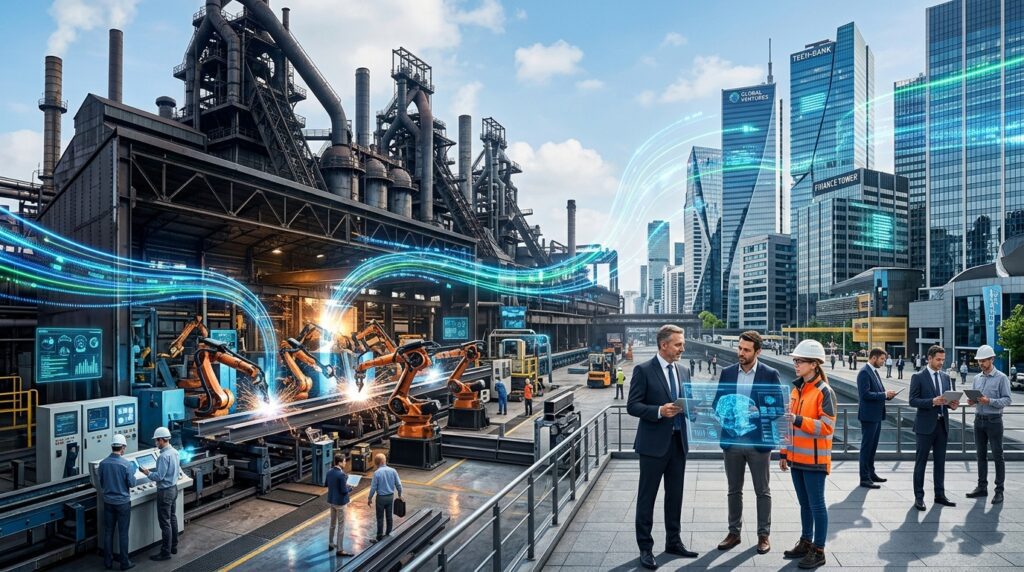
Here’s where things get really interesting. This isn’t just a tech company story. Japan’s biggest industrial players are all in.
Nippon Steel and Kobe Steel are listed as investors. So are three of Japan’s largest banks: MUFG Bank, Sumitomo Mitsui Banking, and Mizuho Bank. When steelmakers and megabanks start writing checks for an AI venture, you know this has moved beyond Silicon Valley-style hype and into genuine national economic strategy.
Think about what that combination represents. You have the companies that build the machines, the companies that finance the machines, and now the companies that will make those machines intelligent, all sitting at the same table. That’s a vertically integrated AI ecosystem unlike anything we’ve seen assembled this quickly, anywhere in the world.
This is Japan playing the long game. And it’s playing it smart.
$6.7 Billion in Government Fuel
No moonshot flies without fuel. Japan’s government is providing plenty of it.
The country’s New Energy and Industrial Technology Development Organization (NEDO) has earmarked roughly ¥1 trillion, approximately $6.28 billion, in AI support over the next five years, starting fiscal 2026. Japan AI Foundation Model Development is expected to apply for this funding and is considered a near-certain recipient, according to Decrypt.
NEDO began accepting proposals for the funding program in late March 2026. The clock is already running.
This level of government commitment puts Japan’s Physical AI initiative in the same league as major national infrastructure projects. It’s not a grant. It’s not a pilot program It’s a five-year, multi-billion-dollar commitment to building sovereign AI capability from the ground up.
And that word sovereign is key to understanding why this matters so much.
Japan’s “Digital Deficit” Problem — And Why It’s Driving Everything
Here’s a story that doesn’t get told enough. For years, Japanese companies have been sending their data to American cloud infrastructure, AWS, Google Cloud, Microsoft Azure, and paying handsomely for the privilege. Capital has been flowing out of Japan and into Silicon Valley at a steady, quiet pace.
The Japanese call this the “digital deficit.” And it’s been a source of real frustration for Japanese industry and policymakers alike.
The new joint venture is a direct response to that problem. The company intends to train its AI on Japanese data, keep that data in Japan, and build infrastructure that doesn’t feed into OpenAI’s or Google’s pipelines. This is sovereign AI, the idea that a nation’s most valuable data assets should stay within its borders and serve its own economic interests.
It’s a pointed contrast to SoftBank’s own global moves. The firm has been one of the biggest funders of American AI, pouring billions into U.S. companies. Now it’s on the other side of the table, helping to build a domestic model that charts a path independent of the very ecosystem it’s been bankrolling.
That’s not a contradiction, it’s a hedge. And it’s a smart one.
Why Japan Has a Natural Edge in Physical AI
Here’s the thing about Physical AI: it’s not just about having the best model. It’s about having the right context for deploying that model. And Japan has context that Silicon Valley simply can’t replicate.
Japan has one of the world’s most sophisticated robotics industries. Companies like Honda have been building humanoid robots for decades, Honda’s ASIMO robot debuted back in 2000. Sony has deep experience in hardware engineering. Japanese manufacturers have been automating factory floors longer than most AI companies have existed.
That industrial heritage matters enormously when you’re building AI that needs to understand physical systems, mechanical constraints, and real-world environments. Japan doesn’t just have the data, it has the domain expertise to make sense of that data in ways that are genuinely useful for Physical AI applications.
Silicon Valley builds brilliant software. Japan builds brilliant machines. The new joint venture is betting that the future belongs to whoever can combine both.
The Global Race Is On — And the Stakes Are High
Japan isn’t alone in recognizing the Physical AI opportunity. The competition is fierce and accelerating fast.
Tesla’s Optimus robot program is advancing rapidly. OpenAI has been actively supporting AI and robotics startups. China’s national AI strategy includes massive investments in robotics and autonomous systems. Even stablecoin company Tether recently invested in humanoid robotics startup Generative Bionics, which markets its machines as “Physical AI” systems designed to fuse robotics with real-world intelligence.
The race isn’t just about who builds the best robot. It’s about who controls the AI infrastructure that powers the next generation of industrial automation. Whoever wins that race will have enormous leverage over global manufacturing, logistics, transportation, and defense.
Japan understands this. That’s why the government is involved That’s why the banks are involved. That’s why steelmakers are writing checks alongside tech companies.
This is about economic sovereignty as much as it is about technology.
What Happens Next?
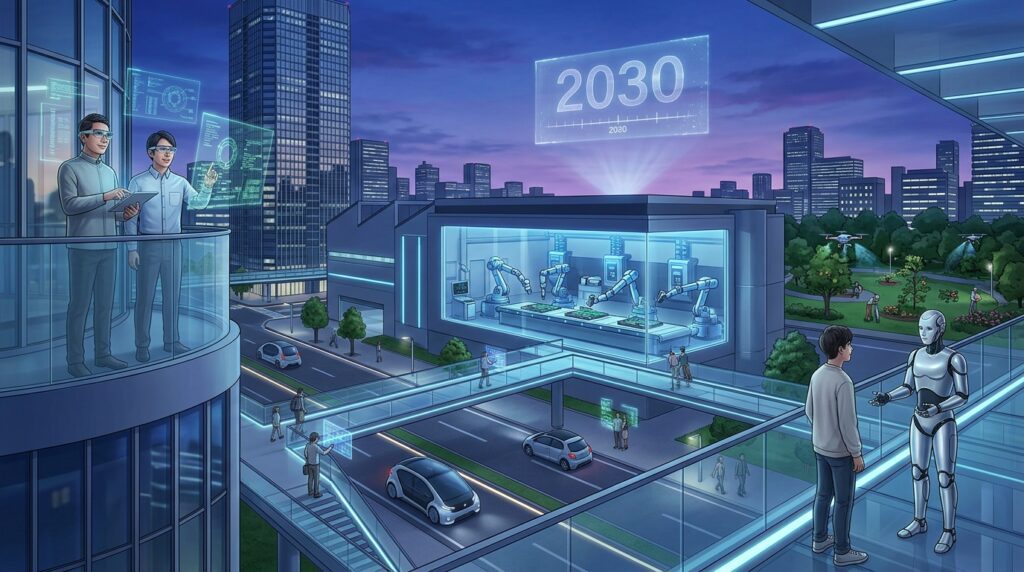
The joint venture hasn’t announced an exact launch date for operations. But the 2030 target for practical Physical AI applications gives us a clear timeline. That’s four years to go from formation to deployment, an aggressive but achievable schedule given the resources being committed.
The next major milestone will be the NEDO funding application. With the government program already accepting proposals, Japan AI Foundation Model Development is expected to move quickly. Once that funding is secured, the real work begins: hiring 100 AI engineers, building the training infrastructure, and developing a trillion-parameter model that can actually run in the physical world.
It won’t be easy. Trillion-parameter models are extraordinarily complex and expensive to train. Physical AI introduces challenges that language models don’t face, real-time decision-making, sensor fusion, safety constraints, and the messy unpredictability of the real world. These are hard problems.
But Japan has assembled a team that knows hard problems. And it has the funding, the industrial base, and the national will to see this through.
The AI world has been watching Silicon Valley and Beijing for years. It might be time to start watching Tokyo.
Sources
- Decrypt — Japan’s Tech Titans Just Teamed Up to Build a Trillion-Parameter AI
- SiliconAngle — Japanese Tech Giants Launch Joint Venture Targeting Physical AI for Robots and Machines
- Nikkei Asia — Japan’s SoftBank Launches Unit to Develop Homegrown AI
- Decrypt — SoftBank Leads OpenAI’s $40B Funding Round
- Decrypt — Beijing’s Ambitious Targets for Nationwide AI Integration
- NEDO — New Energy and Industrial Technology Development Organization
Physical AI Strategy
Physical AI Infrastructure
Japan AI Strategy
Related Companies
The Kingy Brief
Get The Kingy Brief.
AI changes, original tests and one practical thing to try. Fridays at 09:00 Vancouver time.
Free · Double opt-in · Unsubscribe anytime
Signup help and newsletter schedule
Signup form provided by Beehiiv. After submitting, check your inbox for "Confirm your subscription to The Kingy Brief" and open its confirmation link. Check Spam or Promotions if you cannot find it.
Fridays at 09:00 Vancouver time: source-checked AI changes, original tests and one practical thing to try. The weekly restart begins October 9, 2026. We skip a week when there is not enough verified material. Free. Unsubscribe anytime.