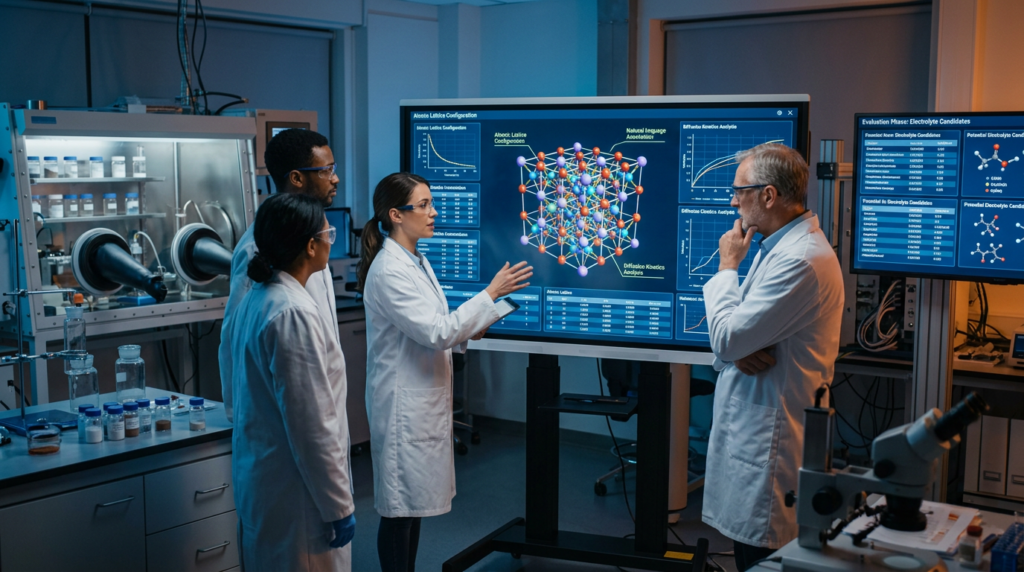
Giving AI a Better View of Matter
Ask an AI chatbot to describe a promising battery material, and it may produce a confident paragraph filled with scientific vocabulary.
The harder question is whether it can connect those words to the arrangement of atoms that gives a material its properties.
MIT researchers have developed an approach aimed at strengthening that connection.
In an October 18 research announcement, MIT described a system that brings three-dimensional crystal structures and natural-language descriptions into a shared computational framework.
The goal is to help researchers search for materials by describing the characteristics they want.
Think of it as improving the conversation between scientific questions and structural data.
The development offers an encouraging direction for materials research, where choosing which candidates to investigate can be a substantial challenge.
The laboratory bench, however, still has plenty of work waiting on it.
The Announcement and the Paper Have Different Dates
An important detail sits behind this latest news.
MIT published its explanatory announcement on October 18, while the underlying paper appeared in Nature Communications on August 26.
The October development therefore brings fresh public attention to previously published research.
The study introduces CLaC, short for Contrastive Language-Crystal model.
Its authors are Yang Jeong Park, Mayank Kumaran, Chia-Wei Hsu, Elsa Olivetti, and Ju Li.
That publication history matters because an institutional news story and a research paper perform different jobs.
The announcement explains why a project could interest a wider audience, while the paper provides the methods, evaluations, and qualifications needed to assess it.
Reading both helps preserve the excitement without accidentally moving the research several steps further along than the evidence supports.
Science already has enough difficult measurements without stretching the calendar.
Why Materials Search Matters
Materials research begins with practical questions that can sound deceptively simple.
Can a component tolerate more heat?
Can an electrode store energy effectively, or can a structural material deliver the required performance with less weight?
Answering those questions involves connecting composition, processing, structure, and behavior.
NIST identifies these relationships as central challenges in materials science and engineering.
Changing one part of that chain can affect the others, which makes selecting a promising material more complicated than finding a familiar chemical formula.
An improved search tool could help researchers organize possibilities before committing resources to detailed investigation.
The potential value lies in better decisions about where to look next.
Even a useful shortlist would still need expert interpretation, but a more focused starting point could make that interpretation easier and more productive.
A Formula Cannot Tell the Whole Story
A chemical formula identifies the elements present and their proportions.
A crystal structure adds information about how atoms occupy positions within a repeating arrangement.
For an everyday analogy, imagine receiving a list of construction materials without seeing the building plans.
Knowing that a project uses glass, steel, and concrete tells you something useful, but it does not reveal the structure those ingredients form.
Materials researchers face a far more precise version of that distinction.
The Materials Project documentation treats structures and calculated properties as connected information, with attention to how structures originate and how calculations describe them.
This helps explain the appeal of connecting language with geometry.
A researcher’s question often concerns performance, while a database may express the relevant evidence through structural records and numerical properties.
A useful interface needs to bridge those representations.
Connecting Two Scientific Languages
MIT describes its approach as multimodal, meaning it works with more than one kind of information.
Here, the important pairing involves atomic structures and text about materials.
The researchers use descriptions that extend beyond composition to discuss properties, processing considerations, and possible uses.
An intuitive way to picture the task is a specialist library with two incompatible filing systems.
One organizes records by structural information, while the other organizes descriptions by concepts researchers recognize.
Connecting those systems could make relevant records easier to retrieve.
That analogy does not mean the model understands a crystal as a scientist does.
It explains the practical objective: making a relationship between different representations useful enough to support scientific search.
Success would let researchers ask meaningful questions while retaining access to the structural information behind the answers.
How Contrastive Learning Helps
CLaC uses contrastive learning to align crystal information with language.
The broad idea is to teach a model which examples belong together and which should remain distinguishable.
Imagine learning the contents of an unfamiliar museum by repeatedly matching objects with appropriate descriptions.
Over time, useful associations could emerge even when a new label uses slightly different wording.
In computational terms, the model develops representations that make related inputs easier to associate.
The scientific challenge is ensuring that those associations reflect relevant material characteristics.
A system could otherwise learn shortcuts that look convincing in a narrow test but prove unhelpful elsewhere.
For a researcher, the resulting representation is valuable when it supports a real task, such as locating candidates that match a stated requirement.
The machinery matters because of the decisions it can improve.
Why the Researchers Generated Training Descriptions
The team trained its model using synthetic narratives grounded in computed material properties.
These are AI-generated descriptions constructed from scientific information.
MIT explains that relying only on published literature can concentrate attention on heavily studied materials, leaving a less balanced picture of the broader search space.
The approach attempts to provide more consistent connections between structural records and meaningful descriptions.
A useful analogy is preparing standardized catalog entries for objects whose existing documentation varies widely.
One item may have pages of commentary, while another has only technical measurements.
A more consistent description could make comparison easier.
The important design principle is the connection to underlying information.
Generated prose becomes useful scientific training material only when its content preserves relevant evidence and supports the task the researchers want the model to learn.
What the Evaluations Actually Suggest
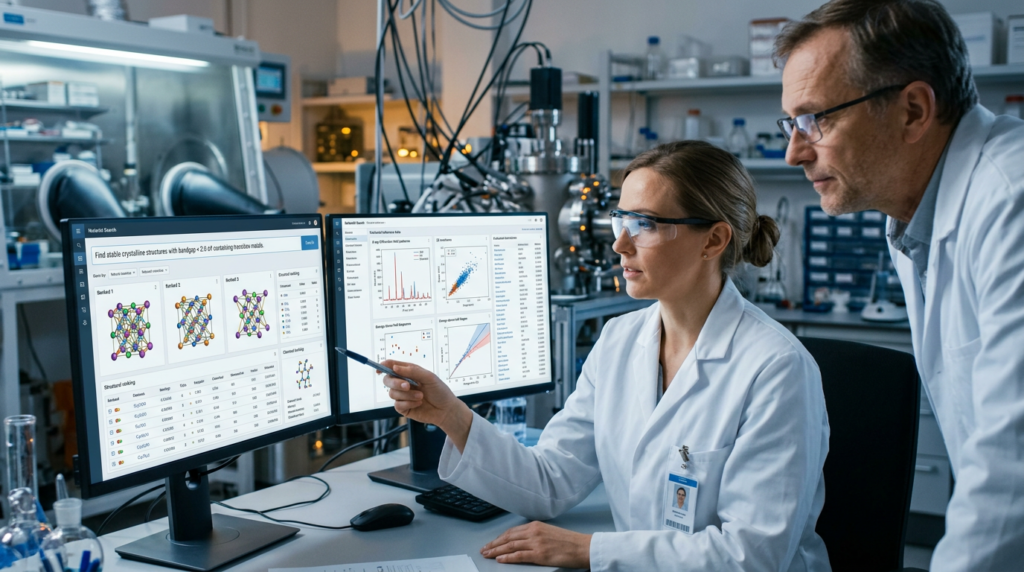
The paper reports that training on property-conditioned synthetic descriptions produced stronger language–structure alignment than training on text extracted from academic papers.
It also evaluates language-guided retrieval, where the model ranks candidate structures in response to a query.
Those findings support the narrower claim that the training strategy can improve this kind of computational matching.
They do not establish universal scientific reasoning.
To assess practical usefulness, an outside researcher would want to examine unfamiliar materials, different query styles, and comparisons with alternative search methods.
The question is whether the system helps make better selections under realistic conditions.
That could involve testing how often relevant candidates appear near the top and whether the results remain useful when requirements become more demanding.
A good evaluation should reveal where the method helps and where another approach remains preferable.
The Battery Example Makes the Idea Concrete
The research includes an example involving potential solid-state battery electrolyte materials.
The U.S. Department of Energy explains that batteries rely on the movement of ions through an electrolyte and electrons through an external circuit.
Those different routes are essential to how a battery delivers electricity.
For researchers investigating an electrolyte, a desirable material must support the required ionic movement while satisfying other operating demands.
The paper’s example contains an important qualification: ionic conductivity was absent from the synthetic narrative dataset.
The researchers therefore retrieved candidates using a high-band-gap condition rather than evaluating the complete electrolyte requirement.
Some returned candidates had support in earlier independent work.
That is an encouraging screening result.
It provides a reason to investigate further, while leaving the essential performance questions open for additional analysis and measurement.
A Shortlist Is the Start of an Investigation
Imagine a hypothetical research team receiving thirty candidates from an AI-assisted search.
Its next task would be deciding which deserve closer attention.
The team might examine existing evidence, run additional calculations, or identify practical barriers before attempting synthesis.
Materials Project documentation emphasizes that many database properties are computational predictions whose typical and systematic errors need consideration.
That makes the origin of a result important.
A measured property, a calculated estimate, and a model’s similarity score provide different kinds of evidence.
A well-designed workflow would keep those distinctions visible rather than blending them into a single confident recommendation.
The useful outcome is a better-informed investigation.
A shortlist becomes scientifically valuable when researchers can understand its basis, challenge its assumptions, and decide what evidence would justify the next step.
Better Searches Could Change Everyday Research
The practical appeal of language-guided search is easier to appreciate through a hypothetical workflow.
A scientist could begin with a broad description, inspect candidate structures, refine the requirement, and compare the resulting lists.
That process might reveal that an initial request was too vague or combined incompatible priorities.
The interaction could help sharpen the research question as well as retrieve records.
Materials Project already provides tools for searching and analyzing computed materials information.
A language interface would therefore need to demonstrate what it adds to existing capabilities.
Its advantage might involve translating a loosely expressed need into useful structural associations or helping users explore an unfamiliar class of materials.
The strongest application would make the reasoning and evidence easier to inspect while reducing unnecessary steps between a question and a defensible research decision.
Manufacturing Adds Another Layer of Difficulty
A promising computational candidate still faces questions about how it can be made.
The Materials Project’s Synthesis Explorer illustrates a separate part of that challenge by organizing synthesis recipes extracted from scientific literature.
Identifying a useful property and identifying a workable preparation route are related tasks with different information needs.
Consider a hypothetical material that performs well under carefully controlled conditions but requires expensive processing or unusually sensitive handling.
Its scientific interest could remain high while its suitability for a particular product stays limited.
Researchers would need to consider the intended application and the available manufacturing process together.
This is why materials development benefits from several tools working in sequence.
Search can guide attention, calculations can test assumptions, and synthesis research can explore whether a candidate can become a reproducible physical sample.
Experiments Remain an Active Partner
The most productive relationship between AI and laboratory work runs in both directions.
Predictions can suggest measurements, while measurements can expose weaknesses in predictions.
NIST describes the deliberate development of experimental measurements alongside computational models as central to materials discovery and validation.
That perspective offers a useful way to judge future extensions of language-guided search.
Suppose an experiment finds that a highly ranked candidate behaves unexpectedly.
The result could reveal missing information, an unsuitable approximation, or a feature the model did not adequately capture.
Recording that outcome would help researchers improve the next round of decisions.
A failed prediction can therefore contribute useful knowledge when the workflow preserves it.
The long-term opportunity involves building a system that learns from the physical world through careful feedback, with scientists choosing what to test and interpreting what happens.
The Broader Lesson Is About Scientific Data
This project also illustrates a wider design question for scientific AI: how should specialized evidence be presented during training?
More text does not automatically create better connections between words and measurements.
A hypothetical dataset could contain millions of paragraphs yet describe some materials inconsistently and others barely at all.
Another dataset might be smaller but offer clearer, more relevant pairings for a particular task.
The useful comparison concerns what a model learns and how reliably it applies that learning.
Materials Project notes that machine learning can support complex activities such as synthesis and crystal-structure determination.
Those applications depend on the information available and the problem being addressed.
The broader lesson is practical: organize data around the scientific relationship a tool needs to capture, then evaluate whether that relationship survives outside the training examples.
What Would Make the Next Advance Convincing?
The next meaningful progress would connect promising retrieval results with stronger evidence of research usefulness.
Independent teams could examine how well the method works on their own questions and datasets.
Comparisons should include established tools so researchers can understand when the added complexity is worthwhile.
It would also help to test queries involving several requirements rather than one favorable characteristic.
A hypothetical industrial request might combine performance, stability, cost, and processing constraints.
Evaluating such requests would reveal whether the system helps resolve realistic trade-offs.
Clear reporting should also explain when a result depends on incomplete information.
A tool becomes easier to trust when researchers can identify the limits of its evidence and choose suitable follow-up work.
The goal is dependable assistance across a useful range of questions, with failures documented carefully enough to guide improvement.
A Clearer Connection Between Questions and Crystals

MIT’s announcement highlights an encouraging effort to connect the language of scientific goals with the structural information needed to investigate them.
That connection could help researchers explore materials databases more naturally and choose more informative next steps.
Its immediate contribution belongs to computational representation and search.
The eventual importance will depend on how well the approach supports wider research workflows, including calculations, synthesis, and experimental validation.
For readers hoping for better batteries, the sensible takeaway is interest in a potentially useful research tool.
A successful materials technology must satisfy many demands before reaching a device.
CLaC addresses an earlier challenge in that journey: helping a researcher connect a desired characteristic with candidates worth examining.
That is a worthwhile scientific ambition, and its progress will become clearer through the investigations it helps others pursue.
SOURCES
- MIT News — Giving AI a “crystal clear” view of the materials world (Massachusetts Institute of Technology)
- Nature Communications — Scaling multimodal materials representation learning with synthetic narratives (Nature Communications)
- Materials Project — Frequently Asked Questions (Materials Project Documentation)
- Materials Project — Understanding Structures and Properties (Materials Project Documentation)
- Materials Project — Machine Learning and AI Applications (Materials Project Documentation)
- Materials Project — Synthesis Explorer (Materials Project Documentation)
- U.S. Department of Energy — DOE Explains Batteries (Department of Energy)
- NIST — Data and AI-Driven Materials Science Group (NIST)
- NIST — Integrated Nanoscale Experimentation, Prediction, and Validation (NIST)
The Kingy Brief
Get The Kingy Brief.
AI changes, original tests and one practical thing to try. Fridays at 09:00 Vancouver time.
Free · Double opt-in · Unsubscribe anytime
Sign up for The Kingy Brief on Beehiiv.
Signup help and newsletter schedule
Signup form provided by Beehiiv. After submitting, check your inbox for "Confirm your subscription to The Kingy Brief" and open its confirmation link. Check Spam or Promotions if you cannot find it.
Fridays at 09:00 Vancouver time: source-checked AI changes, original tests and one practical thing to try. We skip a week when there is not enough verified material. Free. Unsubscribe anytime.