Last updated: 2026-07-10
Last verified: 2026-07-10
TL;DR: Robostral Navigate is Mistral’s 8-billion-parameter robot-navigation model. It follows plain-language route instructions using a single RGB camera rather than a LiDAR sensor, depth camera, or multicamera rig. Mistral reports a 76.6% success rate on the R2R-CE validation-unseen benchmark, but the result has not been independently replicated for this article. Mistral has not released public weights, an API, integration documentation, or pricing, so this is a promising research and enterprise-demo story rather than a product most readers can try today.
What Mistral announced
Mistral’s official news index dates Robostral Navigate to July 7, 2026. The company calls it its first model built for embodied navigation: the task of turning visual observations and a route instruction into physical movement through an environment.
The model has 8 billion parameters and was trained entirely in simulation. Mistral says it can run on wheeled, legged, and flying robots and can generalize across different robot sizes and camera configurations. Its demonstrations include navigation through an occupied office using one long instruction rather than a sequence of manually issued waypoints.
The central claim is hardware simplicity. Many navigation systems combine RGB cameras with depth sensors, LiDAR, or several camera views. Robostral Navigate uses one ordinary RGB camera and no depth sensor, while still posting the benchmark results Mistral reports in its launch material.
How Robostral Navigate chooses where to move
The model receives a natural-language task and a history of camera observations. Its primary action representation is pointing: Robostral predicts the image coordinates of the next target location in the current camera view, along with the robot’s desired orientation when it arrives.
Mistral argues that this image-based target is naturally robust to changes in camera intrinsics and world scale. The model does not need to translate every instruction into a fixed metric movement when the destination is visible.
Pointing cannot represent a destination outside the current field of view. In that case, the model falls back to a displacement in the robot’s local coordinate frame, such as moving forward and left by specified distances and rotating by a specified angle. That hybrid action design lets the system handle both visible targets and route segments that require turning toward an unseen destination.
The benchmark results Mistral reports
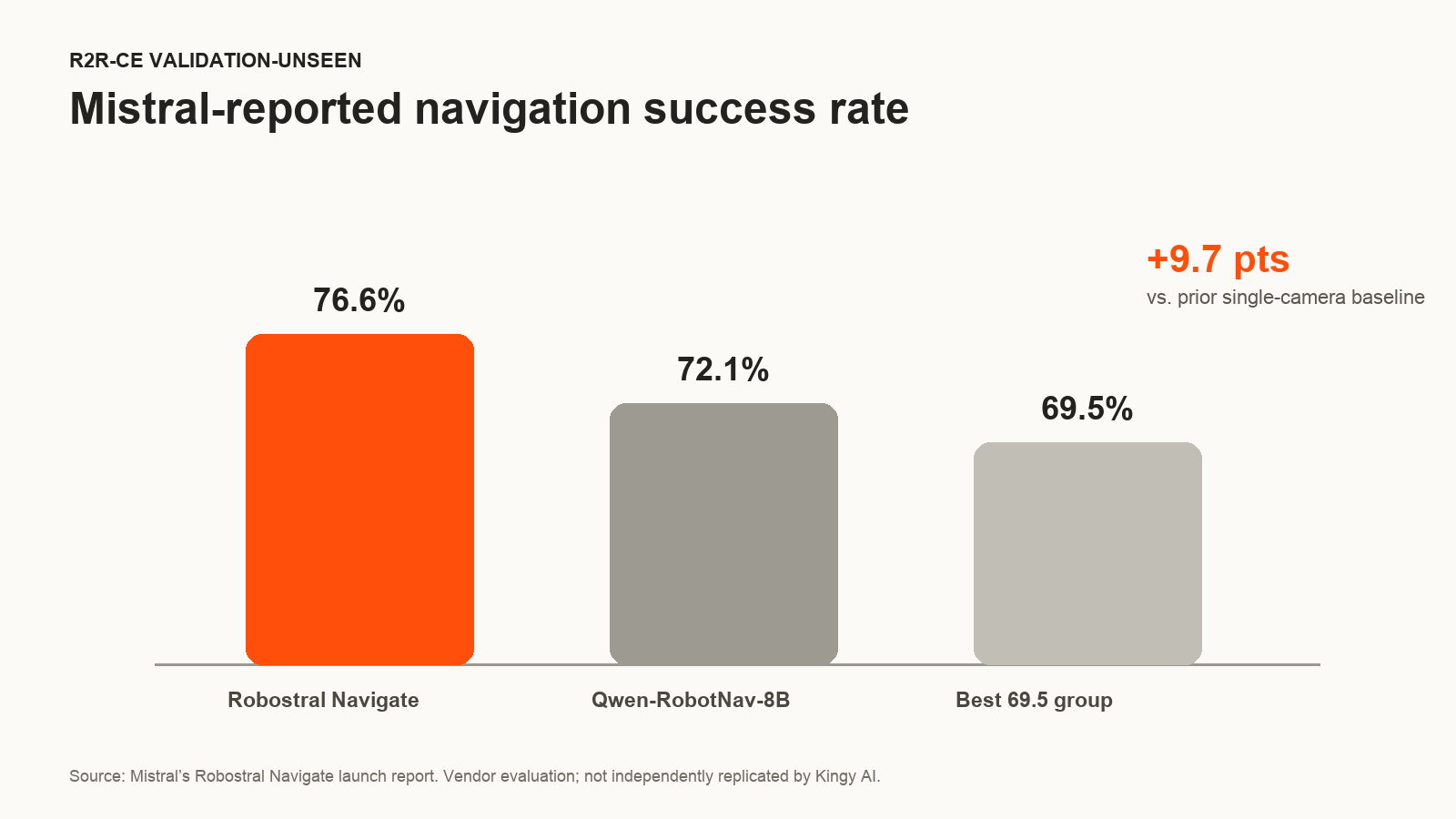
Mistral evaluates Robostral Navigate on R2R-CE, or Room-to-Room in Continuous Environments. The benchmark tests whether an agent can follow language instructions through continuous 3D environments. “Validation unseen” refers to environments held out from training.
| Mistral-reported measure | Result | What it means |
|---|---|---|
| Validation seen success rate | 79.4% | Success in validation environments represented in the training distribution. |
| Validation unseen success rate | 76.6% | Success in held-out validation environments. |
| Lead over the cited single-camera approach | 9.7 percentage points | Mistral’s comparison with the strongest single-camera baseline in its launch material. |
| Lead over the cited depth or multicamera system | 4.5 percentage points | Mistral’s comparison despite Robostral using neither depth nor multiple cameras. |
These figures come from Mistral’s own announcement and charts. Kingy AI did not run the benchmark or test a robot with the model, so the numbers should be treated as vendor-reported until reproducible artifacts or independent evaluations are available.
How the model was trained
Mistral says it built Robostral Navigate in-house rather than adapting an existing open-source vision-language model. The starting point was a model specialized in visual grounding tasks such as pointing, counting, and object localization.
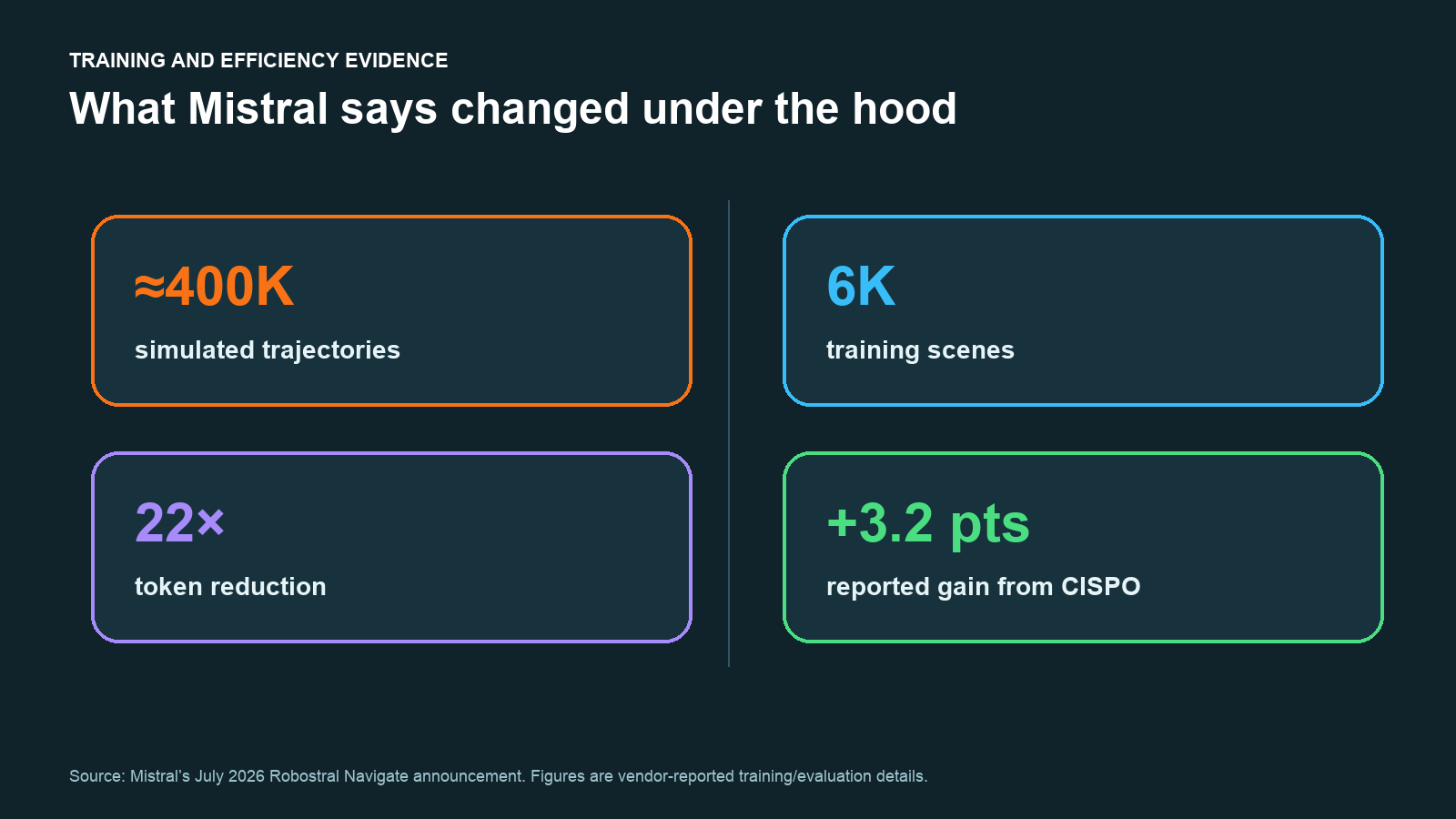
The training data was generated in simulation: approximately 400,000 trajectories across 6,000 scenes. A prefix-caching method compresses an episode into one sequence and trains on all time steps in a single forward pass while using attention masks to prevent information from leaking between steps. Mistral says this reduces training-token requirements by 22 times compared with treating every time step as a separate sample.
After supervised training, Mistral applied CISPO, an online reinforcement-learning method. The company reports that this stage improved success rate by 3.2 percentage points by helping the model recover from mistakes and explore alternatives.
Why a single-camera model matters
If the approach transfers reliably from benchmarks to deployments, a single RGB camera could reduce sensor cost, calibration work, and integration complexity. It could also make the same high-level navigation policy easier to adapt across robots with different bodies.
Mistral points to manufacturing, delivery, logistics, and hospitality as potential application areas. Examples include guiding a service robot through a hotel, moving materials through a facility, or navigating an office delivery route. Those are proposed applications, not confirmed customer deployments in the launch announcement.
The model also addresses only part of an operational robotics stack. A deployed system still needs low-level motion control, obstacle handling, safety logic, mapping or localization decisions where required, fleet management, hardware monitoring, and an escalation path when the navigation policy is uncertain.
Access and pricing
Mistral has not published downloadable weights, a hosted API, public integration documentation, or a price for Robostral Navigate. The launch page directs interested organizations to speak with Mistral’s team. The company also published an official Robostral Navigate demonstration on its YouTube channel.
Because there is no public product package, Mistral’s general model-token pricing is not a price for Robostral Navigate and should not be used as one. Hardware requirements, inference latency, supported control interfaces, licensing terms, and deployment support remain open questions for a prospective customer.
What the benchmark does not establish
- Production reliability: a navigation benchmark does not reproduce every lighting condition, floor plan, crowd pattern, moving obstacle, or camera failure.
- Safety certification: the announcement does not describe a certified safety system or the controls required around the model.
- Simulation-to-real robustness: Mistral shows real-world demonstrations, but the training data was generated in simulation and broad deployment evidence is not public.
- Compute requirements: an 8B model can be compact relative to larger frontier systems, but the company does not publish deployment hardware, power, or latency targets.
- Ease of integration: no public SDK, robot-control interface, or supported-hardware matrix is available.
- Independent comparison: the launch page provides Mistral’s evaluation; outside replication is still needed.
Who should pay attention
Robotics research groups, robot manufacturers, and teams evaluating embodied-AI navigation should watch the model closely. The combination of a compact parameter count, one-camera input, language instructions, and cross-form-factor claims makes it a technically meaningful launch.
It is less actionable for a general AI application developer today. Without an API, weights, documentation, or a defined product package, there is no straightforward implementation path. Organizations that need a deployable system now should evaluate complete navigation stacks and safety requirements rather than assume that a promising model announcement is a finished robotics product.
Verdict
Robostral Navigate is worth covering because it proposes a simpler sensing approach to a difficult robotics problem and supports that proposal with concrete, if vendor-reported, benchmark results. Its most important test comes next: whether Mistral can turn the research into a documented, supportable product that performs reliably outside selected demonstrations.
For now, the sensible action is to review the official evidence and request a technical briefing if robot navigation is central to your work. It would be premature to describe Robostral Navigate as a generally available tool or to make a purchasing decision without hardware, safety, licensing, and integration details.
FAQ
What is Robostral Navigate?
It is Mistral’s 8B robot-navigation model. It takes RGB camera observations and a natural-language route instruction and predicts where a robot should move next.
Does it require LiDAR or a depth camera?
Mistral says Robostral Navigate operates with one RGB camera and no LiDAR or depth sensor.
Can I download or call the model through an API?
No public download, model weights, or hosted API were available in Mistral’s launch materials as of July 10, 2026.
Is Robostral Navigate independently benchmarked?
The results discussed here are reported by Mistral. Kingy AI did not reproduce them, and independent evaluation remains an important next step.
Which robot types does Mistral say it supports?
Mistral says the model can run on wheeled, legged, and flying robots and can generalize across robot sizes.
Official sources
- Mistral’s Robostral Navigate announcement and evaluation
- Official Robostral Navigate demonstration from Mistral
Related Kingy AI coverage
The Kingy Brief
Follow The Kingy Brief.
One consequential launch, one pricing, limit, or shutdown change, one hands-on test, one exact prompt or Test Pack, and one try / watch / skip verdict.
Free · Choose your subjects · Double opt-in · Unsubscribe anytime