OpenAI Opens the Text-Chat Floodgates
ChatGPT’s free tier just became far more generous.
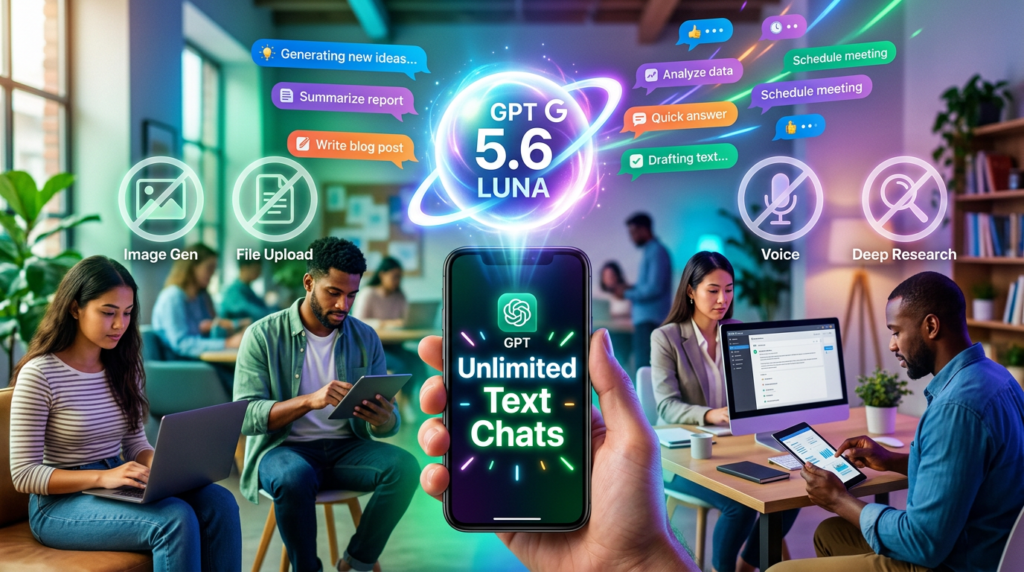
OpenAI is removing the regular message cap from everyday text conversations for Free and Go users. In practical terms, people can keep typing questions, requesting rewrites, brainstorming ideas, or asking follow-ups without suddenly hitting the familiar “come back later” barrier.
That is a major change. It also arrives with an asterisk wearing a very large hat.
“Unlimited” applies to ordinary text chats powered by GPT-5.6 Luna. It does not mean unlimited file analysis, image generation, voice conversations, deep research, coding tools, or every other compute-hungry feature inside ChatGPT. Those capabilities retain separate usage limits.
The rollout began during the week of August 10, following OpenAI’s August 6 announcement, according to Engadget and The Verge.
Even with those boundaries, the upgrade changes the basic experience. Free users no longer need to ration routine prompts as if they were the last biscuits on a camping trip. They can revise an email five times, explore competing ideas, or ask the AI to explain something again without watching an invisible meter tick toward zero.
The barrier has not disappeared everywhere. But for text, OpenAI has opened the gate.
What “Unlimited” Actually Means
The word “unlimited” can become slippery in technology marketing. Mobile carriers taught us that lesson years ago.
OpenAI’s version is relatively straightforward: Free and Go users receive unlimited everyday text chats with GPT-5.6 Luna. According to ChatGPT’s current plan information, that access remains subject to abuse-prevention safeguards.
So, yes, users can hold extended text conversations. They can ask questions, draft content, summarize pasted text, practice languages, plan projects, generate ideas, and request revisions. Normal usage should no longer trigger the old text-message ceiling.
However, attaching a document changes the equation. Uploading an image changes it too. The moment a conversation calls on a separately metered tool, that tool’s limit still applies.
Inc. highlights this distinction clearly: text questions and text answers can continue freely, while image input, voice input, file analysis, image creation, and other demanding features remain constrained.
That means a student can ask 30 follow-up questions about a pasted concept. A writer can keep polishing a paragraph. A small-business owner can brainstorm promotional angles all afternoon.
Upload a stack of PDFs, though, and the velvet rope reappears.
The upgrade therefore removes a major limit without turning the entire ChatGPT platform into an all-you-can-compute buffet. OpenAI is serving unlimited breadsticks, not handing over the restaurant.
GPT-5.6 Luna Takes the Wheel
Free users are not merely getting more messages. OpenAI is also changing the model answering them.
GPT-5.6 Luna now serves as the default model for Free and Go accounts. Luna is the smallest member of OpenAI’s GPT-5.6 family, sitting below the more capable Terra and Sol variants. It focuses on speed, volume, and routine work rather than the heaviest reasoning assignments.
Smallest does not mean trivial.
OpenAI positions Luna as an improvement over the previous default experience, particularly in factual accuracy. Inc. reports that OpenAI claims responses containing factual errors occur about 62 percent less frequently than with GPT-5.5 Instant.
That figure comes from OpenAI’s evaluation, so users should treat it as a company-reported result rather than a guarantee that Luna will never confidently wander into the weeds. AI models can still misunderstand questions, mishandle context, or produce incorrect details.
Nevertheless, improving the default model matters enormously. Free users represent a huge portion of ChatGPT’s audience. Even a modest reduction in errors could affect an enormous number of homework explanations, business drafts, social posts, and everyday decisions.
Luna also makes unlimited access economically plausible. A lighter model requires fewer computing resources than OpenAI’s highest-end systems. That gives the company room to remove text caps without offering its most expensive intelligence layer free of charge.
Generous? Yes. Financially reckless? Apparently not.
A Think Button for Tougher Questions
Sometimes a quick answer works beautifully. Sometimes a question needs the AI equivalent of leaning back, squinting at the ceiling, and whispering, “Hang on.”
Free and Go users are therefore getting a new Think button. When activated, it gives GPT-5.6 Luna more time to work through a difficult problem before producing an answer.
The feature targets prompts involving deeper reasoning. That might include comparing several options, constructing an argument, debugging a logical problem, developing a detailed plan, or evaluating a decision with competing constraints.
According to The Verge, the button lets users request “higher reasoning for harder questions.” Free users receive a single reasoning option rather than the adjustable control available on higher subscription tiers.
That separation is important. The Think button does not transform Luna into GPT-5.6 Sol. It tells Luna to devote more effort to the current question.
Used wisely, it could improve the free experience considerably. Users no longer need to accept the first speedy response when a prompt deserves more care. They can signal that the task involves nuance.
Still, additional thinking time does not equal automatic truth. A carefully reasoned wrong answer remains wrong—just with better posture. Important claims, especially in medical, financial, legal, or academic work, still require verification.
The button gives users more control. It does not retire the fact-checker.
The Limits That Haven’t Gone Anywhere
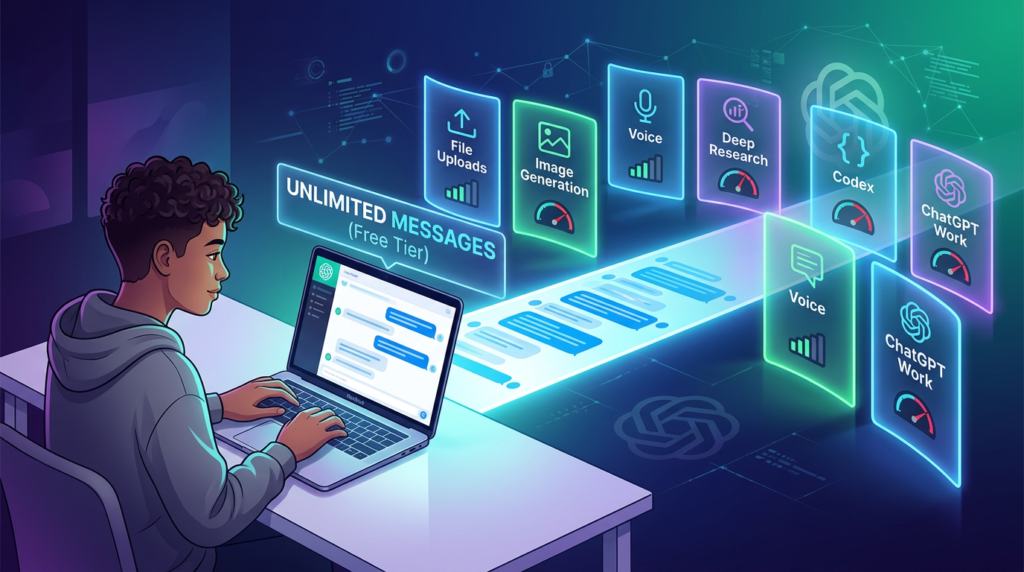
Unlimited text makes an excellent headline. The remaining restrictions make a more useful user manual.
Free accounts still face separate allowances for file and image uploads, image generation, Deep Research, voice conversations, Codex, and ChatGPT Work. Memory and context capacity are also more limited than on paid subscriptions, according to Engadget’s breakdown.
These restrictions reflect the uneven cost of AI features. A short text exchange consumes resources, but analyzing a large spreadsheet, generating several high-resolution images, conducting a multi-source research task, or running a coding agent can demand substantially more computing power.
Users may therefore experience two very different versions of “free.”
In one conversation, they could exchange text messages for hours. In another, they might hit a limit after repeatedly uploading files or creating images. ChatGPT should notify them when an applicable tool allowance runs out.
This distinction also affects workflow design. Someone who wants to maximize free access can paste a manageable amount of plain text directly into the conversation instead of uploading a formatted document. They can use regular chat for planning before spending a limited Deep Research request. They can refine an image prompt completely before generating the picture.
In other words, text is now the wide highway. Specialized tools still have toll booths.
That arrangement gives free users considerably more room while protecting OpenAI from the enormous cost of offering every premium capability without limits.
Free, Go, Plus, and Pro Still Serve Different Jobs
The upgrade raises an obvious question: if Free now offers unlimited text, why pay?
For many casual users, the honest answer may be that they do not need to.
The Free plan can handle everyday questions, writing assistance, brainstorming, learning, basic research, and long text conversations. That covers a surprisingly large portion of normal chatbot use.
ChatGPT Go, priced at $8 per month in the United States, includes the same unlimited text access but raises allowances for uploads, tool-assisted messages, image creation, and voice chats. It also provides longer memory than the Free tier. Go may include advertising, depending on availability and market.
Plus and Pro move further up the capability ladder. They offer access to more advanced reasoning models, expanded tool limits, larger memory and context, and stronger options for research, coding, and professional workloads.
OpenAI is also updating GPT-5.6 Sol for Plus and Pro users. The company says the revised model should deliver more direct answers, tighter formatting, and better factual reliability when questions depend on dates, numbers, sources, rules, or assumptions. Paid users also receive a slider for controlling how much reasoning effort the model applies.
Free users get a capable everyday engine. Paying customers get more horsepower, more tools, and a larger fuel tank.
The free car is now quite usable, though. That changes the sales conversation.
Why OpenAI Would Give Away More
Unlimited text chats sound like a gift to users. They also function as a sharp business move.
Removing the message ceiling reduces one of the biggest frustrations associated with free AI services. A user can now build a habit around ChatGPT without repeatedly being interrupted. More conversations mean more opportunities for ChatGPT to become part of studying, writing, planning, customer support, and daily problem-solving.
Habit matters.
Once people rely on a service, some naturally want more. They start uploading documents. Then they want larger context windows, deeper research, faster image creation, stronger coding capabilities, or access to more powerful models. The free tier introduces the workflow; paid plans remove the next set of obstacles.
Inc. argues that unlimited text could encourage more meaningful and frequent use while tempting a portion of those users to upgrade for advanced capabilities.
GPT-5.6 Luna makes that strategy more sustainable. Its lighter design allows OpenAI to support high-volume text conversations while reserving its costlier models and tools for subscriptions.
The move also places pressure on competing AI services. When a major chatbot offers unlimited everyday text at no charge, message caps elsewhere become more noticeable. Rivals must respond through better models, lower prices, unique features, or their own expanded free allowances.
OpenAI is not simply removing a restriction. It is moving the baseline.
A Quietly Significant Upgrade for Work and Education
The practical value of unlimited text may appear mundane beside flashy AI videos or autonomous agents. Yet mundane tools often change behavior fastest.
Students can ask for multiple explanations of a difficult concept without worrying about exhausting their allowance. They can request examples, quizzes, counterarguments, and simplified versions. The conversation can continue until the idea clicks—or until calculus files a restraining order.
Writers can explore headlines, restructure passages, test tones, and challenge weak arguments. Job seekers can revise résumés and practice interview questions. Small businesses can draft customer replies, product descriptions, internal checklists, and marketing ideas without buying seats immediately.
For organizations, however, “free” should not mean “upload everything.”
Businesses still need clear policies about confidential information, customer data, unpublished financial material, trade secrets, and regulated records. Unlimited prompts create more opportunities for productive work, but also more chances for employees to paste information they should not share.
Accuracy remains another concern. Luna may produce fewer factual errors than its predecessor, but fewer is not zero. Companies should treat chatbot output as a draft or analytical aid, not an unquestionable authority.
The strongest benefit may be experimentation. Teams can test low-risk text workflows before deciding whether a paid plan offers enough value.
That makes adoption cheaper, faster, and a little less intimidating.
Ads, Data Controls, and the Price of Free
When a digital product costs nothing, users should still ask how the economics work.
Engadget reports that Free users may see advertisements presented in a sponsored section beneath ChatGPT’s main response. Go accounts may also include ads, while higher-priced subscriptions remain ad-free.
OpenAI has said ads should not appear around sensitive discussions, including certain health and mental-wellbeing conversations. Even so, advertising introduces a new consideration: users must distinguish the assistant’s answer from sponsored material connected to the prompt.
Data settings deserve attention too.
Consumer ChatGPT accounts may allow conversations to be used to improve OpenAI’s models unless the user changes the relevant control. People who do not want their chats used for model improvement can visit Settings, open Data Controls, and disable “Improve the model for everyone.”
That choice becomes more important when unlimited access encourages longer and more frequent conversations. Users may reveal personal routines, creative ideas, work details, or private concerns simply because chatting feels effortless.
The upgrade does not automatically make ChatGPT unsafe. It does make informed settings more important.
Unlimited conversation can feel casual. The information inside that conversation may not be casual at all.
A quick tour through privacy and data controls remains one of the smartest prompts users never need to send.
The New Free Tier Is Strong—Not Limitless
OpenAI has made ChatGPT dramatically easier to use without paying. That conclusion survives every asterisk.
Free and Go users can now hold unlimited everyday text conversations with GPT-5.6 Luna, subject to abuse safeguards. They also receive a Think button for questions that need more reasoning effort. Those changes remove friction from the most common way people interact with ChatGPT: typing something and reading the reply.
But the boundaries remain clear.
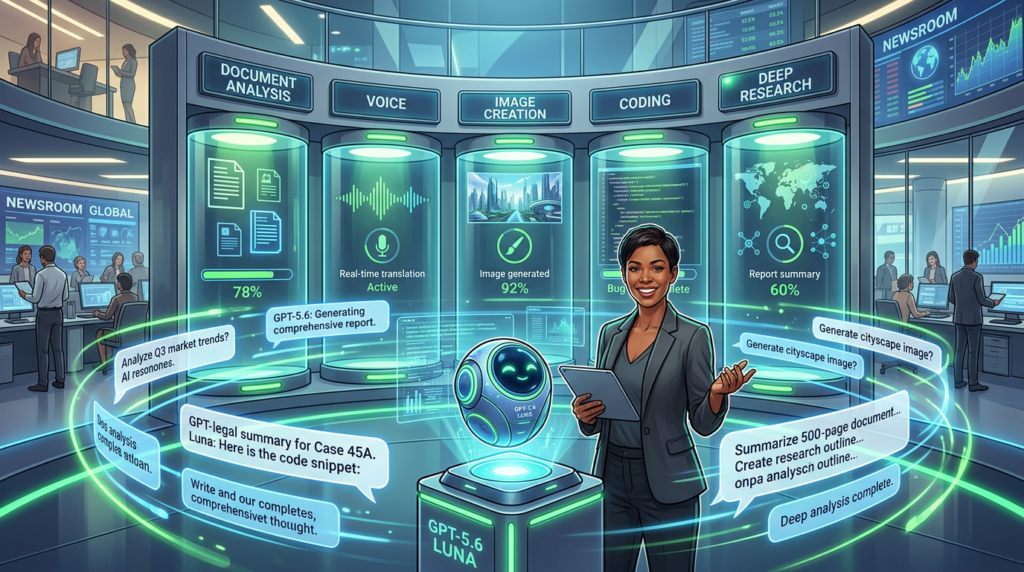
Files, images, voice, Deep Research, Codex, ChatGPT Work, memory, and other advanced capabilities still carry separate restrictions. Free users do not receive unrestricted access to GPT-5.6 Sol or the full reasoning controls available on paid plans.
As XOOMAR’s coverage emphasizes through the central unlimited-text development, the change significantly broadens access to conversational AI. It does not erase the commercial structure surrounding more expensive AI work.
For everyday users, the update is excellent news. For competitors, it is a warning shot. For OpenAI, it is a calculated bet that wider access will create stronger habits—and eventually more customers.
The free tier no longer feels like a brief demonstration. It feels like a complete text assistant with premium doors surrounding it.
You can talk all day. Just expect the meter to wake up when you bring files, voices, images, or heavier machinery into the conversation.
Sources
- Engadget — ChatGPT: What’s Free in 2026 and What Isn’t?
- The Verge — OpenAI Is Giving ChatGPT Free Users Unlimited Text Chats
- Inc. — ChatGPT’s Latest Upgrade Isn’t Just a New Model
- XOOMAR — ChatGPT Free Unlimited Text Chats
The Kingy Brief
Get the next Kingy Brief.
Source-checked AI changes, original tests and one practical thing to try.
Free · Choose your subjects · Double opt-in · Unsubscribe anytime