
Last updated: June 13, 2026. Editor note: This is an explainer, not legal advice. The public record does not include the full directive text, so enforcement scenarios below are framed as possible compliance paths, not confirmed Anthropic plans.
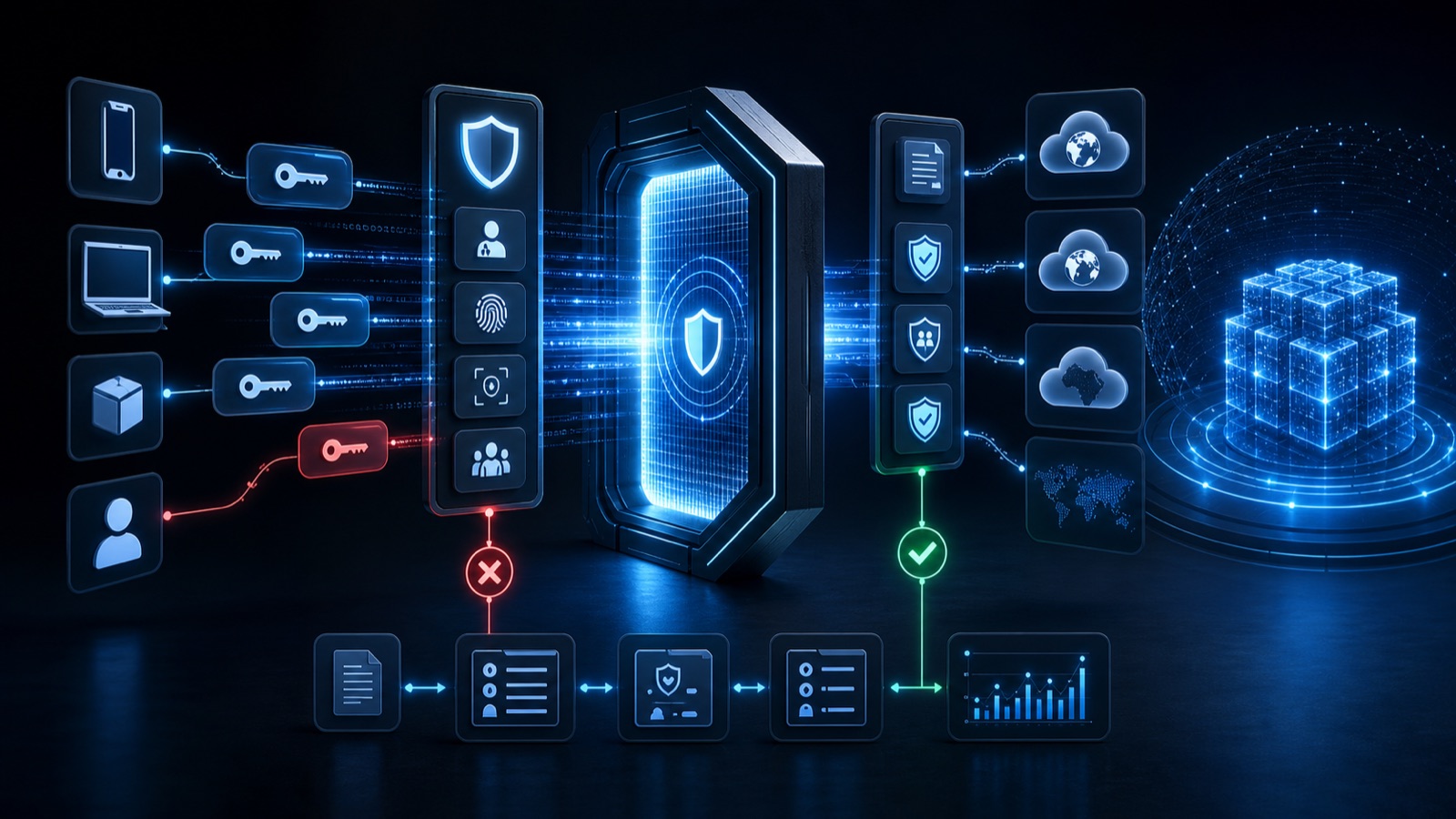
Image note: AI-generated editorial image: a model access gate where identity and authorization decide who gets through.
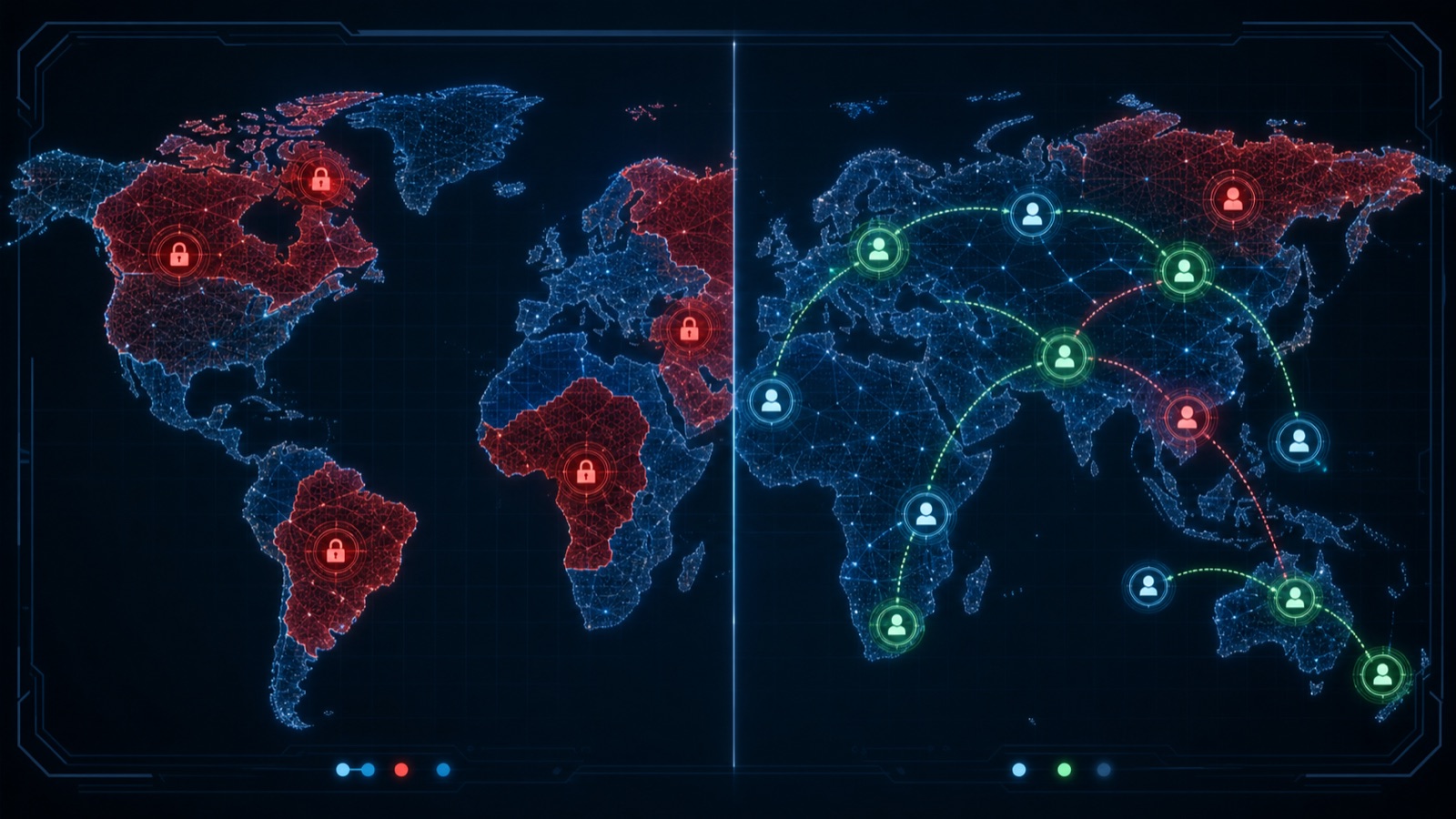
The new AI border may not be geographic. It may run through the employee badge system.
That is the strangest part of Anthropic’s sudden Fable 5 and Mythos 5 shutdown. The obvious headline is that foreign users outside America may lose access to Anthropic’s newest and most capable models. The deeper problem is weirder: Anthropic says the U.S. government directive applies to any foreign national, whether inside or outside the United States, including foreign-national Anthropic employees.
That changes the enforcement problem completely.
Geofencing asks: where is the user? A foreign-national restriction asks: who is the user, what is their citizenship or immigration status, what organization are they acting through, and can the model provider prove it kept restricted people out?
For an AI lab, that is not a simple country block. It is a compliance architecture problem. It could touch employee identity systems, contractors, enterprise customer contracts, cloud tenants, API keys, support accounts, eval harnesses, model debugging tools, red-team workflows, sales demos, and internal research environments.
Kingy AI already covered the wider shutdown question in our first look at the Fable 5 and Mythos 5 export-control shock. This piece is about the part that deserves its own microscope: if access is restricted by nationality rather than location, how is a frontier model company supposed to enforce that in the real world?
What Anthropic Says The Directive Covers
Anthropic’s public statement says it received a U.S. government export-control directive on June 12, 2026 at 5:21 p.m. ET. According to the company, the directive told Anthropic to suspend all access to Fable 5 and Mythos 5 by foreign nationals, including foreign-national Anthropic employees. Anthropic also says access to its other models is not affected.
Two caveats matter.
First, Anthropic says the government letter did not provide specific details of the national security concern. The company says its understanding is that the concern involves a possible method of bypassing, or jailbreaking, Fable 5, but Anthropic disputes the severity and calls the action a misunderstanding.
Second, the full legal text of the directive is not public in the sources reviewed for this article. That means nobody outside the government and Anthropic should pretend to know every operative definition, exception, license path, deadline, or enforcement standard.
Still, the public facts are enough to expose the core problem. Anthropic did not say the directive merely blocks traffic from certain countries. It said the directive applies to people based on foreign-national status, including inside the United States. The Associated Press described the move as the U.S. government’s most significant step so far to restrict access to advanced AI models. Reuters reported, citing Axios and noting it could not immediately verify the report, that the Trump administration was blocking foreign governments, companies, and individuals from accessing Anthropic’s most advanced models. Axios reported that Commerce Secretary Howard Lutnick sent Anthropic a letter putting Mythos 5 and Fable 5 under export controls for foreign persons inside the U.S. and for access outside the U.S.
Why This Is Not Ordinary Geofencing
Most consumer internet companies know how to block a country. They can use IP addresses, billing addresses, phone numbers, device signals, sanctions-screening databases, and region-specific terms of service. Those systems are imperfect, but the basic question is familiar: is this account or request coming from a restricted place?
A foreign-national rule asks a harder question: is this person permitted to access the controlled model?
Those are not the same.
A Canadian engineer in San Francisco may appear to every ordinary location filter as a U.S.-based user. A German contractor may connect through an American enterprise VPN. A Singaporean employee may use an internal Anthropic laptop on a U.S. office network. A multinational enterprise customer may call the API from a U.S. cloud region while routing the outputs to staff around the world. A U.S. citizen may work for a foreign-owned company. A foreign national may be a lawful permanent resident, a visa holder, a contractor, a visiting researcher, or a customer admin.
That is why this story lands so differently from a normal product outage. Anthropic’s public language points toward person-based access control, not simple geography.
It also explains why Anthropic disabled Fable 5 and Mythos 5 for all customers, at least initially. If a lab cannot rapidly verify every user’s status and every downstream access path, a universal shutdown may be the fastest way to avoid an accidental violation while lawyers and engineers translate a directive into production controls.
What “Foreign National” Restrictions Mean In Plain English
In export-control discussions, the government often talks about “foreign persons” and “deemed exports.” The Bureau of Industry and Security, which administers the Export Administration Regulations, explains that a deemed export is the sharing or release of controlled technology or source code to a foreign person inside the United States. BIS’s deemed export explainer says releases of controlled technology to foreign persons in the U.S. are treated as exports to the person’s country or countries of nationality.
That concept is old. Universities, defense contractors, semiconductor companies, labs, and biotech firms have lived with deemed-export compliance for years. The new question is how well that framework maps onto live access to a powerful hosted AI model.
Traditional export-control examples often involve source code, technical data, manufacturing know-how, lab equipment, controlled materials, or design documentation. Fable 5 and Mythos 5 are not source-code downloads in the ordinary SaaS sense. They are remote model services. Users submit prompts and receive outputs. Employees may also access model weights, eval tools, internal dashboards, incident systems, debug traces, red-team environments, safety classifiers, or deployment tooling, depending on their role.
That makes the compliance surface broader than “can this person log into Claude?”
It may include whether a foreign-national employee can run internal evals against the model, review failure cases, join a live debugging session, access prompt/output logs, use a model gateway for a customer demo, or participate in post-training and safety work. None of those details are confirmed by Anthropic as enforcement mechanisms. They are examples of why a person-based model restriction likely creates operational complexity inside an AI lab.

Why Foreign-National Employees Create An Enforcement Nightmare
Anthropic is a frontier AI lab. Like its peers, it almost certainly employs and works with people from many countries. The AI talent market is global. Model labs hire researchers, infrastructure engineers, policy experts, security researchers, product managers, support specialists, sales engineers, data workers, red-teamers, and contractors across borders.
If the directive applies to foreign-national employees, Anthropic may have to treat access to Fable 5 and Mythos 5 like a controlled internal resource. That could mean checking which employees are U.S. persons, which are foreign nationals, which have license coverage if any license path exists, and which systems could expose the model or controlled technical information.
That is difficult for at least six reasons.
First, identity systems are not usually built around export-control nationality. Corporate access systems typically know role, team, manager, device, location, employment status, and security group. They may not cleanly encode citizenship, permanent residency, protected status, visa category, or country-of-nationality rules in the same permission engine that controls model access.
Second, internal AI tooling is messy. Frontier model access is not one button. There are APIs, chat products, batch eval tools, monitoring dashboards, logs, synthetic data pipelines, code repositories, model cards, deployment systems, safety review queues, and customer support tooling. If any of those paths lets a restricted person query or meaningfully access the model, it could become part of the control perimeter.
Third, “access” may need definition. Is it only direct inference? Does viewing a Fable 5 output count? What about reviewing a bug report generated by another employee? What about running a harness that compares Fable 5 against Opus 4.8? What about seeing aggregate eval scores? The public statement does not answer those questions.
Fourth, contractors and vendors complicate the perimeter. A lab can restrict its own employees more easily than every outside vendor, cloud support team, annotation partner, security consultant, and enterprise integrator. But if those people can touch the model, the organization may need attestations, contractual restrictions, and audit trails.
Fifth, enterprise customers may not know the nationality of every end user. A customer may be incorporated in the United States and call the model from a U.S. cloud region, while its employees and contractors sit across many countries. A person-based restriction could require the customer to certify who can use the model, not merely where the API key is hosted.
Sixth, speed matters. Anthropic says it received the directive late Friday afternoon. A large model provider cannot safely redesign identity, product, sales, and compliance systems in a few hours. That is the practical reason a blunt shutdown may have been the least risky immediate move.
Why Enterprise Customers May Also Be Affected
Enterprise buyers should pay attention because this is not just a consumer Claude story.
Fable 5 was launched as a high-end model for hard reasoning, coding, long-context work, and agentic workflows. Kingy AI’s Claude Fable 5 launch tracker entry framed it as a major model release, while our Claude Fable 5 vs GPT-5.5 comparison looked at the model’s capability and platform tradeoffs. Those are exactly the kinds of models enterprises want to put behind coding assistants, research agents, cybersecurity copilots, legal-review tools, and internal knowledge systems.
But enterprise AI access usually flows through layers. A company may buy a seat-based plan, create API keys, connect a model to a private cloud tenant, expose it through an internal application, let employees invoke it through an agent platform, and log outputs into support, security, or analytics systems. If a restriction follows the human user, the provider and customer may both need controls that track who is using the model, not just which account pays the bill.
Possible enterprise impacts include customer attestations, API-key scoping by permitted user group, stronger identity federation, location plus nationality checks, contractual user restrictions, audit-log retention, and emergency model fallback policies. Again, none of those are confirmed Anthropic enforcement steps. They are plausible compliance mechanisms if a model provider needs to prove that restricted persons did not access a controlled model.
How Enforcement Could Work In Practice
If Anthropic or any other lab had to enforce a nationality-based model restriction over time, several layers could come into play.
Citizenship or residency verification. The most direct route would be asking users, employees, or enterprise admins to verify eligibility. That could involve identity documents, employer records, immigration status records, or third-party compliance vendors. It would also create privacy, security, and user-trust problems.
Employee access controls. Anthropic could create internal permission groups for restricted models, separate Fable/Mythos access from ordinary Claude access, and require export-control clearance before employees can use production, staging, or research endpoints.
Model gateway permissions. A central gateway could check every request before it reaches the model. The gateway could enforce user eligibility, organization policy, cloud region, model ID, API key scope, and whether the request comes from approved internal tooling.
API key scoping. API keys might be limited to certain users, products, tenants, workloads, or geographies. Enterprise customers might have to bind keys to identity providers so a model call is associated with a verified user, not merely a server-side credential.
Cloud tenant restrictions. If models run through cloud partners, access might depend on tenant location, customer country, identity federation, and contractual commitments from the cloud provider. That is cleaner for geography and messier for nationality.
Enterprise attestations. Customers may be asked to certify that only eligible users can access a model and that they will not route outputs to restricted users. This is common in compliance-heavy industries, but it is only as strong as the customer’s own controls.
Audit logs. Providers may need request-level logs showing who accessed which model, from which organization, through which key, at what time, under what policy. Logs help prove compliance after the fact, but they do not prevent every violation in real time.
Session monitoring. For high-risk models, providers could monitor suspicious routing patterns, shared accounts, VPN anomalies, or mismatches between declared identity and usage behavior. This raises obvious privacy and false-positive concerns.
Licensing workflows. If a license path exists, a provider could build workflows for employee exceptions, customer approvals, or government-authorized use. Nothing in the public sources confirms that such a path is available here, so this should be read only as a generic export-compliance possibility.
The common thread is that enforcement is not just one product toggle. It is an identity, infrastructure, legal, and operations stack.
Why This Could Reshape AI Hiring And Model-Team Structure
If the Anthropic directive remains narrow and temporary, hiring may not change much. If person-based controls become a recurring policy tool for frontier models, the effect could be much larger.
AI labs may need to separate teams by access eligibility. Some employees could work on general models, tooling, product surfaces, or safety research while being locked out of specific controlled systems. Sensitive model teams could start to resemble defense-contractor programs, where access depends on clearance-like eligibility, project need, and auditable controls.
That would be a major cultural shift. The frontier AI industry grew out of a software and research culture where global talent is normal and internal collaboration is prized. Defense-style access segmentation would make some workflows slower, more bureaucratic, and more exclusionary. It could also make U.S. labs less attractive to international researchers if the most important projects become inaccessible to them.
There is a product-market consequence too. If export controls make closed frontier models harder to buy or integrate, some customers may look harder at open-weight models, foreign providers, or smaller models they can run under their own compliance regime. That connects directly to the broader open-versus-closed debate covered in Kingy AI’s guide to choosing GPT, Claude, Gemini, and open-source AI models.
Why AI Labs May Drift Toward Defense-Contractor Compliance
The phrase “defense contractor” sounds dramatic, but the compliance pattern is familiar: classify sensitive assets, control who can access them, require records, limit foreign-person exposure, audit usage, train employees, and document exceptions.
Advanced AI models already sit near that world. They can be dual-use. They can help with code, cyber analysis, persuasion, science, automation, and intelligence-style workflows. Governments are increasingly treating frontier AI as strategic infrastructure rather than ordinary software.
That does not mean every model becomes a munition or every AI startup becomes Lockheed Martin. It does mean the compliance burden for frontier labs may grow faster than the product teams expected. Kingy AI has warned before that AI regulation can create monopoly-friendly compliance costs. Nationality-based model restrictions would push in that direction because small labs are least able to build the identity, legal, and audit machinery required for selective enforcement.
The Counterargument: This May Be Temporary, Narrow, Or Misunderstood
The strongest counterargument is simple: this may not become the new normal.
Anthropic itself calls the directive a misunderstanding and says it is working to restore access as soon as possible. The public statement says the concern may relate to a specific jailbreak technique, not a general conclusion that all foreign nationals must be permanently barred from all advanced AI models. AP’s coverage also frames the event around a specific new export-control action, not a complete public rulebook for AI model access.
Another possibility is that Anthropic shut everything down because selective compliance was not immediately practical. If the company received a late-day directive with broad person-based language and no easy way to verify every user, then disabling Fable 5 and Mythos 5 globally may have been an emergency compliance response rather than the intended long-term policy design.
There is also a public-reporting gap. We have Anthropic’s statement, major media reporting, and BIS background on deemed exports. We do not have the full directive, a public license analysis, or a detailed government explanation of the national security concern. That is why this article does not claim that Anthropic will adopt any one enforcement method, or that every enterprise customer will be forced into citizenship verification tomorrow.
What AI Companies Should Do Now
AI companies do not need to panic. They do need to inventory reality.
First, know which models, tools, logs, eval systems, and internal dashboards count as sensitive access paths. Second, know whether your identity system can separate geography, citizenship, residency, organization, role, and contractor status. Third, know which enterprise products allow customers to route model access to downstream users you cannot see. Fourth, document fallback plans if a model must be disabled quickly without breaking customer workflows. Fifth, talk to qualified export-control counsel before making compliance representations to customers or regulators.
For developer teams, the operational lesson is similar to the one we see in agent infrastructure: model access needs governance. In Kingy AI’s guide to Codex, Claude Code, and AI workflow loops, the core theme is that advanced AI systems become production infrastructure once teams depend on them. The Fable/Mythos shutdown shows the policy version of the same truth. If your product depends on a frontier model, you need fallback models, customer notices, logging, and contract language ready before the emergency.
Verdict
The Fable 5 and Mythos 5 shutdown is not just an AI safety story. It is a preview of what happens when export-control logic meets cloud-hosted frontier models.
If the restriction were only geographic, Anthropic could lean on familiar country-blocking tools. But Anthropic says the directive reaches foreign nationals inside and outside the United States, including its own foreign-national employees. That likely creates a much harder problem: model access by personal eligibility, not just network location.
The policy may be temporary. The directive may be clarified. Anthropic may restore access. The government may narrow its approach. But the underlying issue will not disappear. The most powerful AI models are becoming strategic assets, and strategic assets tend to attract identity checks, licensing workflows, audit logs, and access controls.
That is the real lesson for AI founders, developers, enterprise buyers, and policy teams. The next AI border may not sit at the edge of a country. It may sit inside the model gateway, the enterprise SSO system, and the employee badge database.
The Kingy Brief
Get The Kingy Brief.
AI changes, original tests and one practical thing to try. Fridays at 09:00 Vancouver time.
Free · Double opt-in · Unsubscribe anytime
Sign up for The Kingy Brief on Beehiiv.
Signup help and newsletter schedule
Signup form provided by Beehiiv. After submitting, check your inbox for "Confirm your subscription to The Kingy Brief" and open its confirmation link. Check Spam or Promotions if you cannot find it.
Fridays at 09:00 Vancouver time: source-checked AI changes, original tests and one practical thing to try. We skip a week when there is not enough verified material. Free. Unsubscribe anytime.