Earlier recorded update: 2026-07-23
Original review checked: 2026-07-23
TL;DR: Amazon Bedrock AgentCore Web Search is a managed, MCP-compatible search connector for agents using AgentCore Gateway. AWS says queries stay within AWS infrastructure and results include current snippets, source URLs, titles, and publication dates. The service launched at $7 per 1,000 searches in US East (N. Virginia), with Gateway and related AWS costs considered separately.
What launched?
AWS announced general availability in June 2026. Developers can add Web Search as a target on an AgentCore Gateway, let an agent discover it through the standard MCP tool flow, and receive structured web observations without provisioning a separate search API or storing third-party search credentials.
AWS says the connector uses an Amazon-operated index spanning tens of billions of documents, refreshed continually, with semantic snippet extraction and a knowledge graph for some entity queries. Those are service claims that still need workload-specific evaluation for relevance, coverage, and freshness.
How the connector works
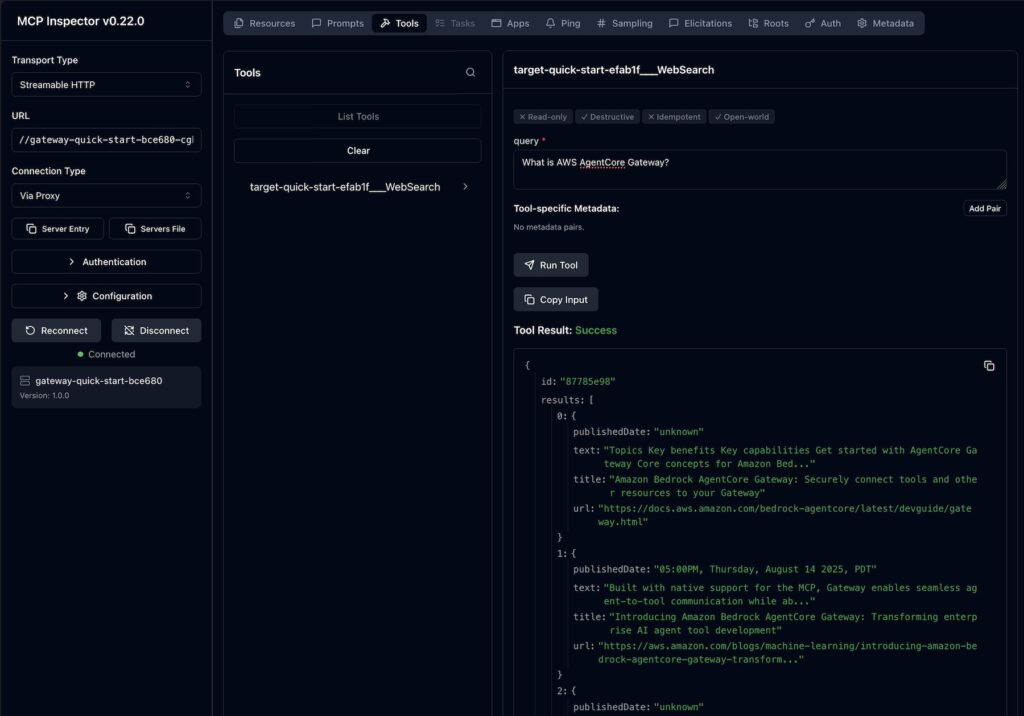
The gateway target uses the connector ID web-search. The application authenticates to AgentCore Gateway, which invokes the AWS-owned Web Search tool. The tool returns a serialized set of observations with text, title, URL, and publication date fields that the agent can use when composing an answer.
This is public-web grounding, not enterprise document retrieval. AWS positions Bedrock Knowledge Bases for private organizational data and Web Search for information that changes outside the organization. Teams following related AI News should keep those retrieval paths and their access controls separate.
Where it fits
- Research agents that need current product, policy, market, or release information.
- Customer-support assistants that must cite changing public documentation.
- AWS-governed agent systems that do not want third-party search credentials.
- MCP-compatible applications already routing tools through AgentCore Gateway.
- Workflows that combine public-web search with a separate private knowledge base.
Pricing and availability
AWS still publishes $7 per 1,000 Web Search queries, with other Gateway, model, log and infrastructure costs considered separately. The June 2026 launch was in US East (N.Virginia); AWS’s August 19, 2026 announcement added eu-west-1 (Dublin) and ap-northeast-1 (Tokyo). Check the actual current Region and connector-version support before deployment; the launch Region is not the whole later availability picture.
There is no standalone free-plan promise for the connector. New AWS customers may have general account credits, but credits are not the same as a permanent Web Search tier. Check the current AgentCore pricing page before committing traffic.
Setup outline
- Create or select an AgentCore Gateway in a supported Region.
- Add a target with
connectorIdset toweb-search. - Review inbound and outbound permissions separately. AWS’s August 19 guide assigns
bedrock-agentcore:InvokeGatewayto the calling application andbedrock-agentcore:InvokeWebSearchto the Gateway service role. The detailed Web Search target example also lists InvokeGateway on that role. The blog summary links that complete policy; the examples differ in detail, but they do not by themselves establish that the extra service-role grant is unnecessary. This source review has not established the exact minimum permission set. Resolve the exact connector/version policy using current documentation and least privilege before applying it; no IAM policy or live invocation was tested during this maintenance source check. - Discover the tool through MCP and run a small set of known-answer queries.
- Log returned sources, latency, empty results, and downstream model citations.
What to measure
Evaluate source quality, long-tail coverage, freshness, citation accuracy, latency, and the number of searches an agent issues per task. Agent loops can call tools repeatedly, so a nominal per-query price can grow if prompts or orchestration encourage redundant searches.
Test queries that should fail as well as those that should succeed. A good connector needs predictable behavior for obscure topics, conflicting sources, missing dates, unsafe pages, and queries that include sensitive customer information.
Risks and controls
Public webpages can contain errors, adversarial instructions, copied content, and prompt injection. Keeping the query path inside AWS does not make every retrieved page trustworthy. The application should separate retrieved text from system instructions, constrain tool permissions, and retain the source list for review.
Region and data handling still matter. The August 2026 announcement adds Dublin and Tokyo to the original N.Virginia launch, but a regional entry point is not by itself a complete residency or compliance guarantee. Confirm where the gateway, model, logs and connector operate and what each query contains. Do not put private records into a public-web query.
Alternatives
Alternatives include other managed grounding services, specialist search APIs, self-operated crawlers, and retrieval pipelines built over approved sources. AgentCore Web Search is most attractive when the application already uses AWS identity, AgentCore Gateway, and MCP tooling. A standalone search API may be simpler for a product outside that stack.
Kingy AI verdict
Test the connector if an AWS-based agent needs recent public information and the team wants search governed through AgentCore. Start with a capped evaluation workload. Measure citation quality and query count before assuming the managed path is cheaper or more reliable than the current search integration.
FAQ
How much does AgentCore Web Search cost?
AWS announced a price of $7 per 1,000 search queries. Other AgentCore and AWS usage may be billed separately.
Does the query leave AWS?
AWS says Web Search queries are served within its infrastructure and are not sent to a third-party search engine.
Is Web Search the same as a Bedrock Knowledge Base?
No. Web Search covers the public web. Knowledge Bases are designed for content an organization ingests and controls.
Official links
- AWS technical launch guide
- AWS availability announcement
- AgentCore Gateway documentation
- AgentCore pricing