

On Sunday, November 15, Alessandro Maria Masullo says he spent four and a half hours at a blackboard with number theorists Peter Sarnak and Brian Conrad at the Institute for Advanced Study. He had sent Sarnak an outline of his methods in October. Late that Sunday night, Anthropic mathematician Levent Alpöge says he messaged Anthropic CEO Dario Amodei about announcing a breakthrough he had reached with Claude. Five days later, both proposed proofs were public. Masullo’s manuscript, acknowledgements and §1.7 · Alpöge’s account, p. 2
Alpöge’s files were public first that Friday. Masullo’s account records private circulation of his method weeks earlier. Those dates answer two different questions about who shared what. The independent checkers have now replayed and accepted Alpöge’s formal proof. Masullo’s draft is open for wider review after months of scrutiny by Conrad, according to Stanford mathematician Ravi Vakil. Early archive check · MIT verification report · Vakil’s announcement
Who shared what, and when
November 20 times are Vancouver local time (UTC−7). Dates for private work come from the researchers’ published accounts.
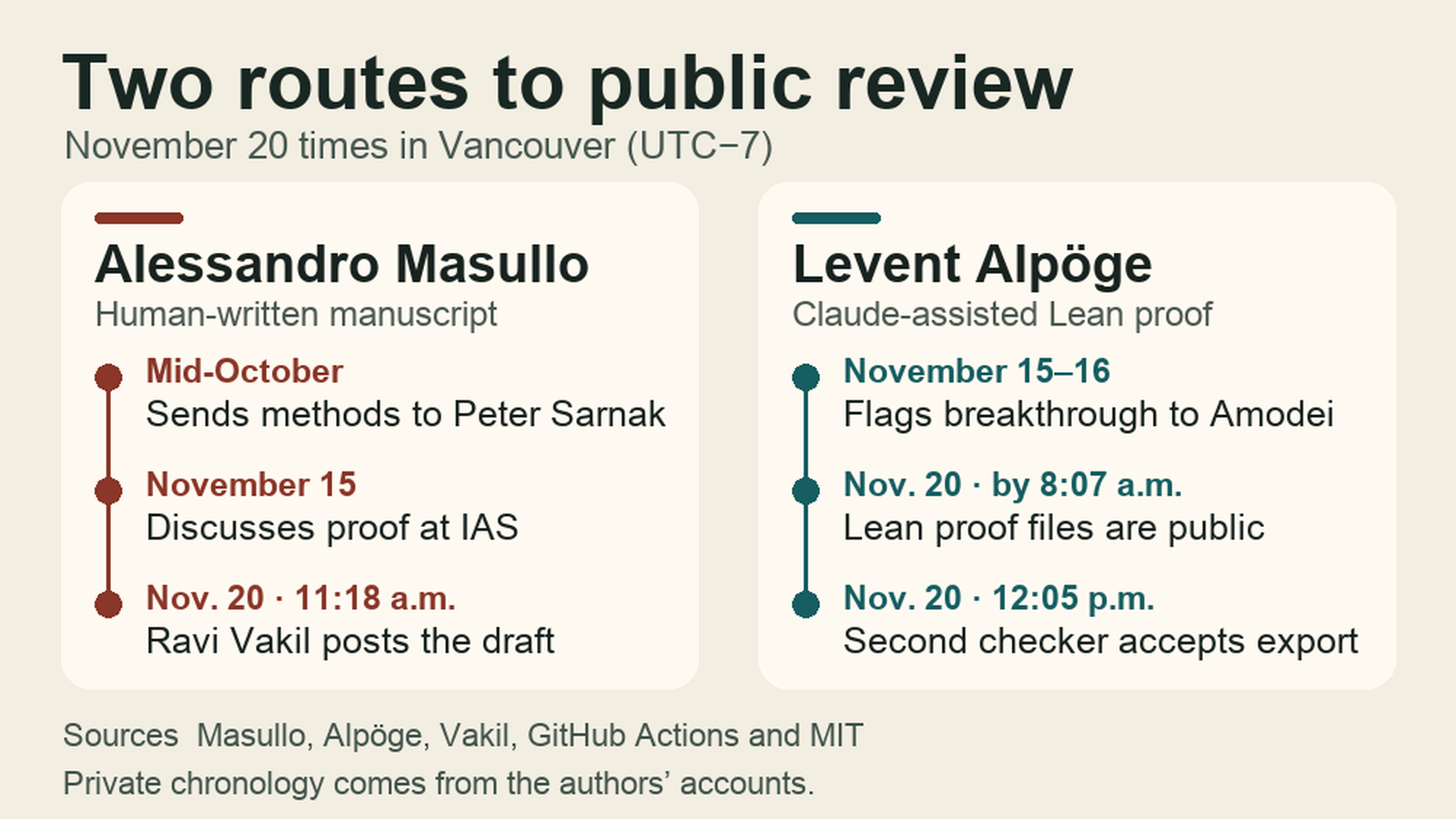
- Mid-October. Masullo says he sent Sarnak a letter outlining his methods. Excerpts appear in his public draft. Vakil separately says Conrad had been examining the proof for months and had given extensive feedback. Vakil gives no exact date for when that review started. Masullo’s draft, §1.7 · Vakil’s announcement
- November 15–16. Masullo recalls the Sunday blackboard session with Sarnak and Conrad. Alpöge says he contacted Amodei late Sunday about announcing his result. Alpöge’s rough chronology puts several technical steps on November 15 and the entry for the generalized hypothesis on November 16. Masullo’s acknowledgements · Alpöge’s announcement and dated notes
- November 20, by 8:07 a.m. Alpöge had posted a four-page account and linked 14 parts of a Lean archive on his personal site. By 8:07 a.m., an outside team had checked the archive against its mirror and compiled its own formal statements of the results it expected the submission to prove. Alpöge’s release · Initial GitHub run
- November 20, 9:43 a.m. MIT mathematician Andrew Sutherland’s independent build finished without errors across all 175,187 modules. By about 11:17 a.m., the modules had passed replay through Lean’s proof-checking kernel. Sutherland’s verification report
- November 20, 11:18 a.m. Vakil posted Masullo’s 940-page manuscript, The Music of the Primes. He said the plan had been to give Masullo a year to polish the write-up and circulate it further. Instead, he released the current version and invited mathematicians to check and formalize it. Vakil’s timestamped post · Masullo’s manuscript
- November 20, 12:05 p.m. A separately implemented proof checker called nanoda accepted the full proof export from Sutherland’s build. His 12:45 p.m. report still listed an end-to-end Comparator run and additional Lean checks on the export as in progress. Sutherland’s verification report and logs
What has been verified
The classical Riemann hypothesis concerns the zeros of one function, the zeta function. Its generalizations ask whether the same pattern holds for families of related functions. Both proposals cover wider claims that include the classical problem. Clay’s problem description · The scope of Sutherland’s verification · Masullo’s proposed scope
Alpöge and Claude. Sutherland checked the formal statement against the standard Riemann hypothesis in Mathlib, Lean’s shared library. His audit reports that all five headline theorems rely only on Lean’s three standard axioms. A second checker’s acceptance adds evidence that the deductions hold for those formal statements. The scope he checked includes the classical hypothesis and its generalization to Dirichlet L-functions. A human-readable explanation of the strategy is still a task Alpöge says he intends to take on. Sutherland’s report · Lean’s proof validation guide · Alpöge’s announcement
Masullo. Vakil describes the argument as human-written and says Conrad’s feedback is being incorporated. In the manuscript, Masullo says he considers the mathematics complete and acknowledges unresolved issues in the draft and an unfinished introduction. His stated scope covers Hecke L-functions for unitary characters over all number fields, a wider family than the Dirichlet case checked in Alpöge’s release. Kingy.ai found no public end-to-end verification of Masullo’s draft as of November 20. Vakil’s post is an invitation to do that work. Vakil’s announcement · Masullo’s acknowledgements and outline · Scope of the MIT checks
What the dates establish about credit
The October letter matters because it records what Masullo says he had communicated by then. The published excerpts outline a strategy, and the public record gives no exact date when he first shared a complete argument. Alpöge’s release has a public timestamp. By Friday morning, anyone could obtain the source files and start examining them. A firm claim about who finished a correct proof first would need dated evidence of what was complete and a verdict on each argument. The public records currently establish earlier documented private circulation for Masullo’s strategy and earlier public release for Alpöge’s proof files. Masullo’s letter excerpts · Alpöge’s release · Vakil’s post
Clay still lists the classical Riemann hypothesis as unsolved. Its $1 million prize has its own timetable. Clay requires publication in a qualifying outlet, a wait of at least two years after that publication, and general acceptance by the global mathematics community before it will consider a proposed solution. The next public milestones are closer at hand. For Alpöge, they include results of the remaining checks and a write-up other number theorists can work through. For Masullo, the next evidence would be a public review that identifies which parts of the wider argument have been checked and which steps still need work. Clay’s problem page · Clay’s prize rules · MIT verification report · Vakil’s request for review
Sources
For the mathematical statement and the contents of the Lean archive, see Kingy.ai’s original Alpöge report. This timeline uses the two authors’ releases, Vakil’s announcement, the initial GitHub check and Sutherland’s published logs. Kingy.ai reviewed those records for this story.
Trending on Kingy
Keep reading with the stories getting the most attention now.