

Professional designers had two answers to the same brief in front of them. One came from Claude Fable 5.2, the other from a stealth AI model called Gestalt. With both names hidden, the designers chose Gestalt in 78% of their head-to-head votes. Contra Labs published the result as a rounded percentage. Its chart doesn’t give the number of votes in that particular matchup. Contra Labs’ head-to-head results

Gestalt took first place on the Frontier Design Benchmark from Contra Labs and BenchFlow. When Kingy.ai checked on November 19, 2026, Gestalt had 1,931 Elo, a 218-point lead over Fable at 1,713. The closest entry overall was the human reference work at 1,739, a gap of 192 points. The blind votes give designers a reason to pay attention. What the scoreboard leaves out is how many attempts, tools or dollars it took to produce the winning work. Official leaderboard
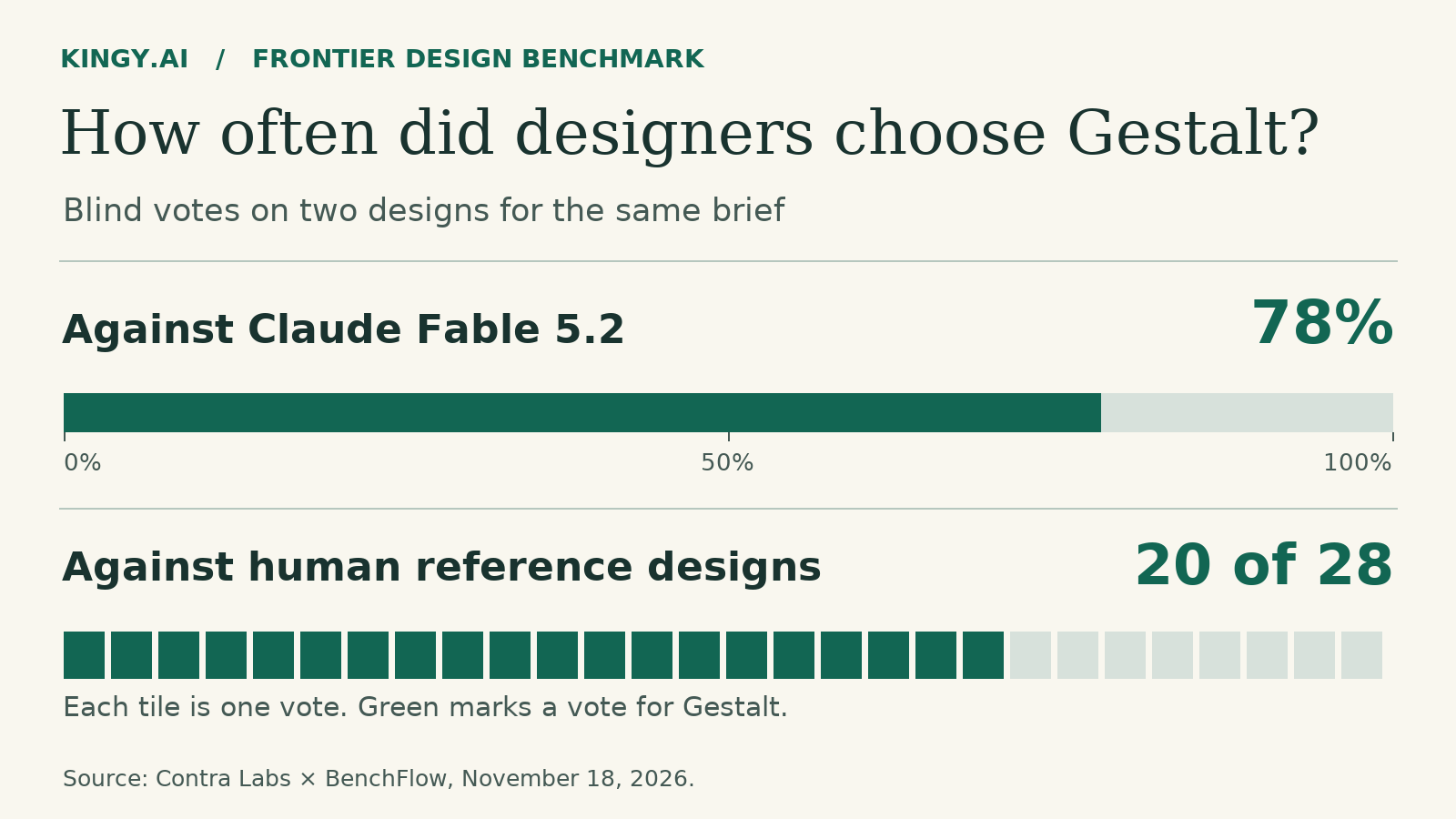
Direct matchups from Contra’s November 18 launch report. The Claude comparison is published as a rounded percentage. Contra gives a vote count for the human comparison. Matchup chart · Research report
Elo turns results across matchups into a relative rating. Contra fits that rating to the panel’s choices across the field. The 90% win rate beside Gestalt’s name covers 420 votes across all its opponents. The launch chart shows why the opponent matters. Gestalt won 78% against Fable, 70% against GPT-6 Astra and a reported 100% against Kimi K3. Matchup chart
Contra’s November 18 write-up records a slightly different tally, 378 wins in 423 votes and a rating of 1,928. Contra gives no explanation for the difference between the two snapshots. Both put Gestalt first. Launch report · Leaderboard
What the designers were voting on
Take Carafe, a hospitality design studio in the public gallery. Its audience includes restaurant owners looking to hire a studio and journalists looking for work to cover. The brief asks for an image-led portfolio with room for individual projects, publications and lectures. It calls for strong typography and generous white space, and it asks the designer to preserve the layouts on smaller screens. A homepage that looks good on a monitor addresses only part of that job. Carafe brief and gallery
You can open the human reference and browse outputs from 15 named models, including Fable. The gallery doesn’t list a Gestalt site for this brief, so there’s no public Carafe matchup there to explain why judges chose it. Across the study, Contra used 27 briefs adapted from marketplace jobs and six projects supplied by startups. Thirty-five professional designers cast 4,311 votes over five rounds, comparing work for the same brief with the names hidden and the sides shuffled. Carafe gallery · Methodology · Voting procedure
Claude edged ahead on the checklist
Contra graded the work a second way. Its design rubric covers typography, layout, consistency, copy, usability and accessibility. On the rounded scores, Fable 5.2 and Claude Opus 5.5 earned 84 out of 100. Gestalt scored 83. The panel had a clear favorite when asked to pick a design. Grade those same systems for execution and all three finish within a point. Design critique rubric
The human work illustrates how a design can win a vote and still lose points. Contra describes a button label with too little contrast and a wordmark partly obscured by the section above it. Those are specific faults a designer can fix. Across their matchups, the human references still won roughly three quarters of the votes. We can see what the checklist penalized. The published totals can’t tell us which feature of a Gestalt site persuaded a judge to pick it over Fable. Contra’s research report
How many attempts did Gestalt get?
Contra co-founder Gajus Kuizinas says Contra didn’t build Gestalt. The research team says it works with Gestalt’s developers and gives them feedback. Its report describes running AI agents in a sandbox and recording the work and cost of each run. For Gestalt specifically, the report confirms the same blind voting procedure but leaves its maker unnamed and gives no comparable account of how a design went from brief to ballot. Blind judging protects the comparison from name recognition. It does not establish that entries were generated under equal conditions. Kuizinas’s comment · Research report
Did judges see the first completed design for each brief? And did Claude and Gestalt follow the same selection rule? A studio can send a client the first version it makes or choose its favorite after trying five directions. The client can fairly judge either submission. A studio planning its next job still needs to know how many attempts it will pay for. Contra hasn’t disclosed enough about Gestalt’s tools, retries, selection process or cost to answer that question. Contra asks researchers to request access to the full dataset, which includes model outputs and individual votes. Methodology · Dataset access
What the win against human designers tells us
The human designs were commissioned for the benchmark. Designers proposed three moodboard directions, received feedback, built the site and revised their work. When judges saw a Gestalt entry alongside a human reference, they picked Gestalt in 20 of 28 votes. Those are votes on finished designs. They tell us very little about how well Gestalt would respond when a client changes the audience, rejects the imagery or needs a second revision by Friday. Contra’s account of the human references and results
For a studio deciding whether it could deliver work like this, the next test is straightforward. Give Gestalt and Fable a brief neither team has seen. Set the same budget and the same rule for choosing the submission, then keep every attempt. Invite the client back with one revision. The most useful figure from that test would be the cost of getting from the first brief to a design the client accepts.
Sources and further reading
The benchmark report gives the panel’s direct vote counts against human work. The head-to-head chart breaks results down by opponent. For access to the strongest named model on the board, see Kingy.ai’s guide to Claude Fable 5.2.