
An unverified claim about Rockstar says a game can turn your thumb on a trigger into a risk score for insurers. Researchers have found clues to personality in video games. Predicting who will crash a car is a much harder test.
In Vice City, you might run a red light because you want to see what happens when you hit a bus. On the drive home from work, you might brake hard because a cyclist has fallen in front of you. A computer can record both maneuvers with exquisite precision. Give it only the timestamp and the force of your input, though, and it will miss the most important fact about each decision. Why did you do it?
That gap is where the AI claim about Grand Theft Auto VI lives. On November 20, an X account claiming to belong to a fired Rockstar North engineer alleged that a system called Lens scores traits such as impulse control from gameplay. The writer claimed that a company called Vantage Analytics trains predictive models on those profiles and licenses them to insurers and other clients. We found no independently verified evidence that an insurer uses GTA 6 gameplay to assess drivers. The writer’s identity, the alleged training data and the customer list remain unverified. Original X post · Reporting on the purported termination email
Still, there’s a good reason to take the underlying question seriously. Researchers who tried to predict personality from World of Warcraft found one of their strongest clues in a choice players made before their characters took a single step. Read the research paper
What an AI learned from a character’s name
Jianqiang Shen and colleagues at the Palo Alto Research Center studied data from 1,040 World of Warcraft players. The players supplied personality survey answers. The researchers then tried to predict those scores from the traces players left in the game, including achievements, combat statistics, social connections and the names of their characters and guilds. The names were especially revealing. Combining the different sources produced the strongest results across all five personality traits the team studied. Shen et al., Inferring Personality of Online Gamers by Fusing Multiple-View Predictions
The researchers had an answer to check. Each volunteer had filled out a survey. A prediction about conscientiousness could be compared with the score that person actually received. Even then, the researchers measured how closely the predictions tracked scores across the sample. An individual player could land a long way from the model’s guess. Study methods and results
Now change the question to “Will this person file an at-fault collision claim in the next year?” The questionnaire has ceased to be the answer key. So has the game. To learn whether an algorithm can answer that question, somebody has to find out what happened on actual roads.
Has anyone followed gamers onto real roads?
One research team got closer than you might expect. A study published in Media Psychology followed people who were 17 or 18 and still unlicensed at the outset. Those who said they played “drive’em up” games at least a few times a month had higher odds of reporting a car crash five years later. Frequent music-video viewing was also associated with later crashes in the same study. The findings held after the researchers accounted for factors including gender, personality characteristics and overall media exposure. Read the prospective cohort study
Look closely at what the researchers knew, though. They knew how often someone said they played a genre of game. They didn’t have a trace of how that person took a corner, and the study didn’t test whether adding controller data improved a forecast for an individual driver. A music-video habit showed up in the results, too. You’d want considerably more evidence before letting either habit change a premium. Study design and findings
Here’s the test I’d want to see for the GTA hypothesis. Recruit drivers who agree to link their play to a clearly defined outcome, such as an at-fault claim in the following year. Make predictions for people the model has never seen. First use ordinary information such as prior claims and miles driven. Then add the gameplay. Does knowing how someone drives in Vice City improve the forecast once you know how much they drive on real roads?
The mistakes deserve as much attention as the average result. Imagine two people share a console account. Or a careful commuter spends Saturday trying to land the same impossible jump. The telemetry could be accurate down to the millisecond in both cases. Whose score follows them out of the game? How would either driver challenge it?
What Take-Two discloses, and what a real insurance trail looks like
Take-Two’s privacy policy makes the starting point clear. Across its services, the company says it collects gameplay information that can include platform IDs, IP addresses, achievements and scores, including from people who never register. It also describes using personal information to infer which products might interest someone, and says it has sold or shared certain inferences and activity data with advertising providers for personalized ads. The policy leaves the method unspecified. It supplies no evidence of a GTA 6 model trained to predict insurance claims. Take-Two’s privacy policy
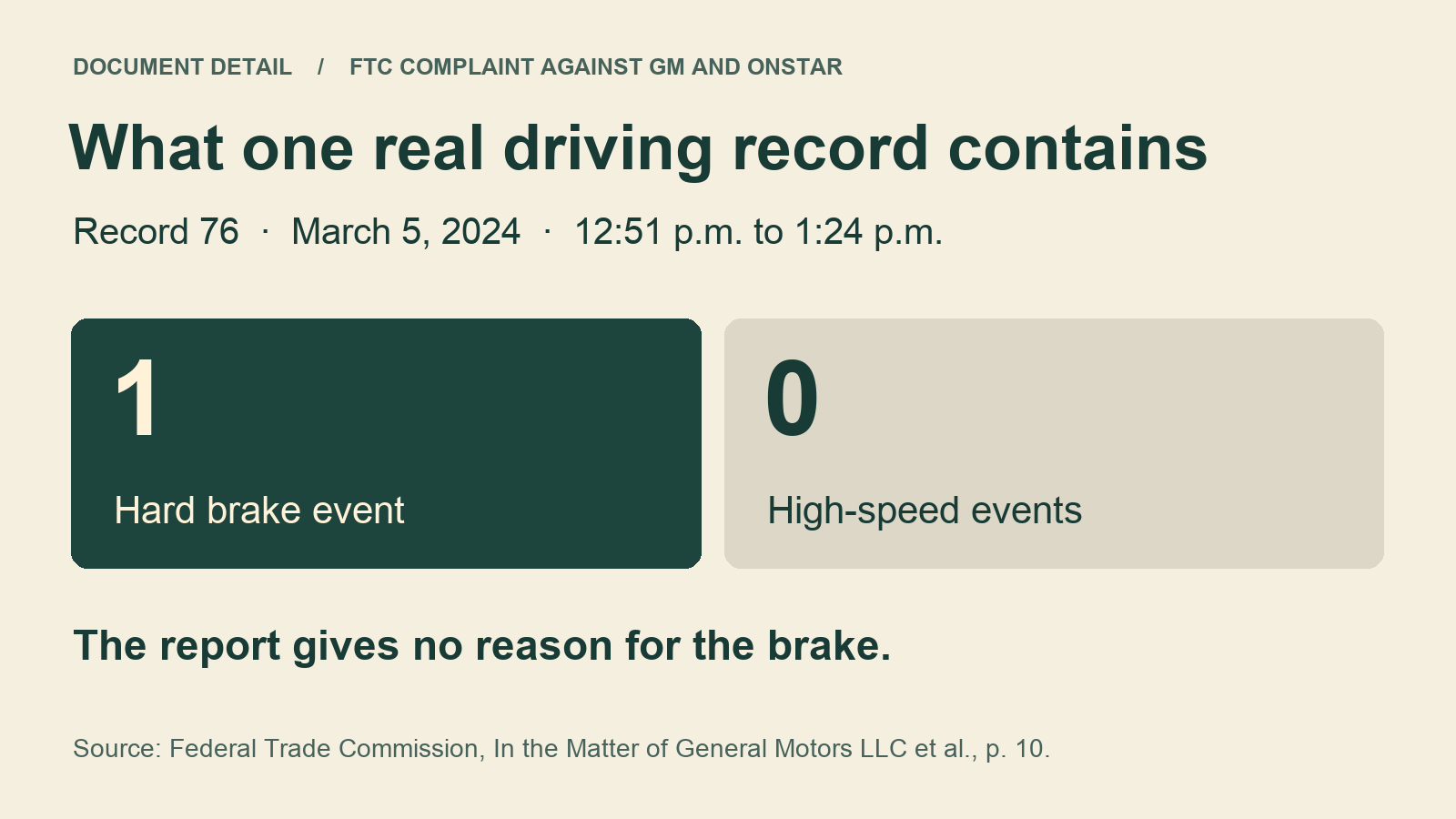
For a sense of what evidence would look like, turn to page 10 of the Federal Trade Commission’s complaint against General Motors and OnStar. There’s a redacted entry labeled Record 76. A trip began at 12:51 p.m. and ended at 1:24 p.m. The report records one hard brake and zero high-speed events. You can see exactly which facts survived the trip from a car to a consumer report. The reason the driver braked is absent. FTC complaint, page 10
According to the FTC, OnStar Smart Driver offered motorists badges and driving streaks. Behind that experience, the agency alleged, vehicle data reached consumer reporting agencies. Some drivers learned about the reports when insurers raised premiums, denied coverage or canceled policies. In January 2026, the FTC finalized a settlement that bars GM from disclosing covered driving and location data to consumer reporting agencies for five years. FTC complaint and final order
Record 76 is the detail I’d keep in mind the next time someone claims an AI can price a person from a game. Even with an actual car, a named data supplier and a documented recipient, one hard brake leaves room for opposite interpretations. It could be the moment a driver nearly caused a crash. It could be the moment they prevented one.
Before anyone attaches a price to a red light in Vice City, they owe the player two answers. Who received the score? And what happened on a real road that showed the score was right?
Sources
- Original allegation from the X account
- Contemporaneous reporting on the claimed dismissal email
- Palo Alto Research Center study of player personality
- Prospective study of gaming and crash involvement
- Take-Two privacy policy
- FTC complaint and Record 76, page 10
- FTC case file and January 2026 final order