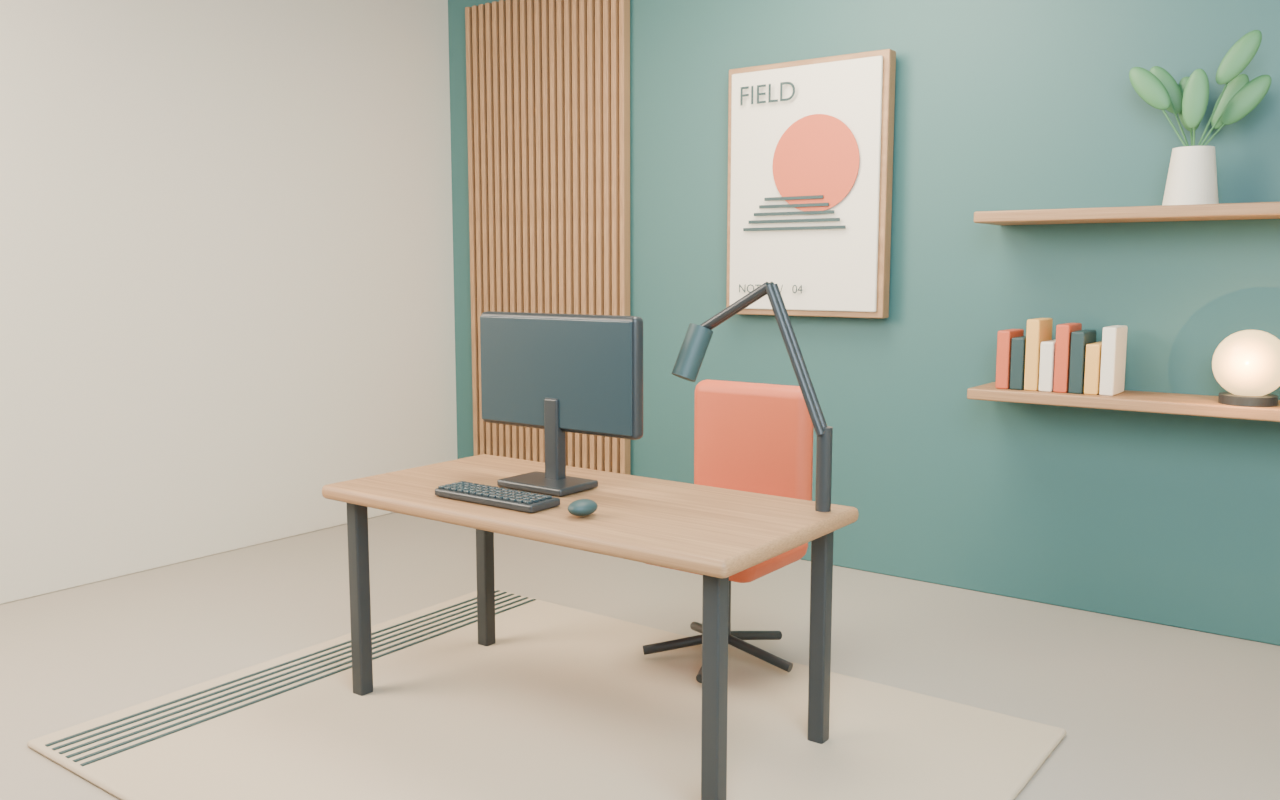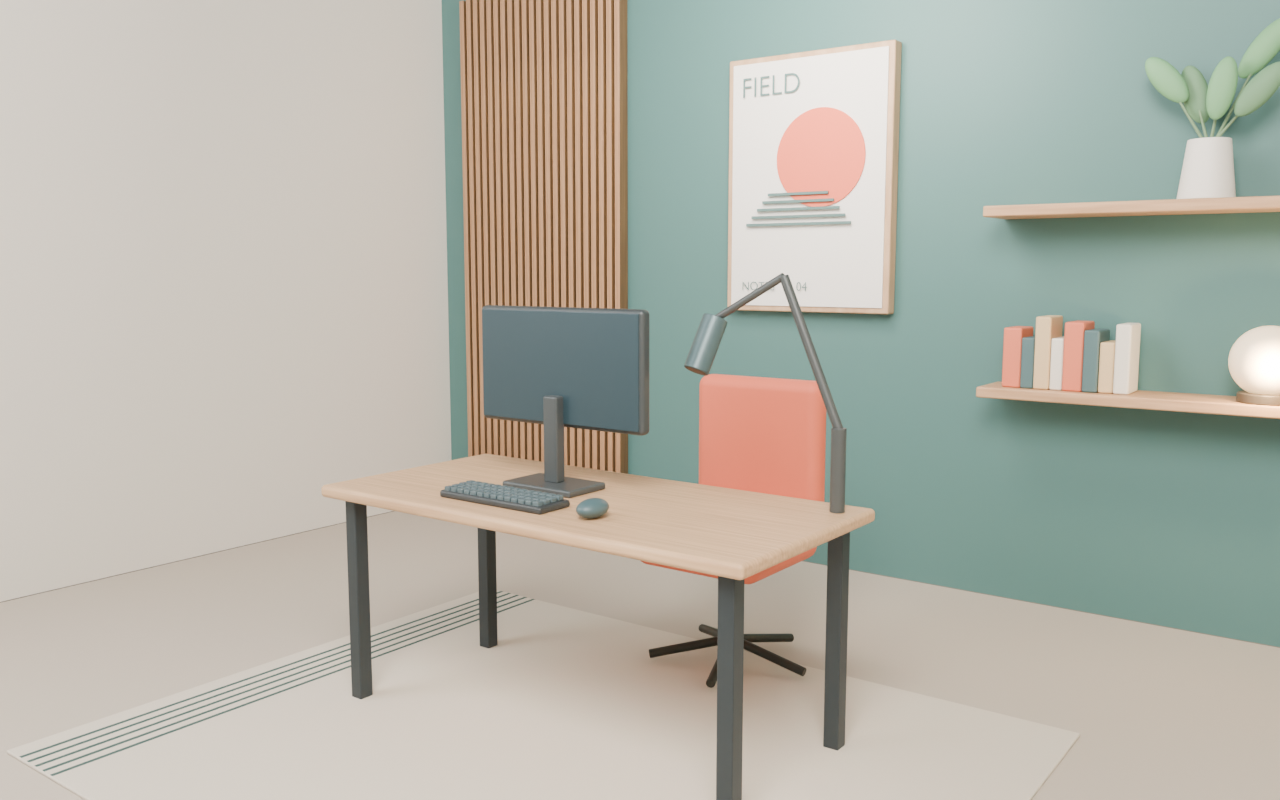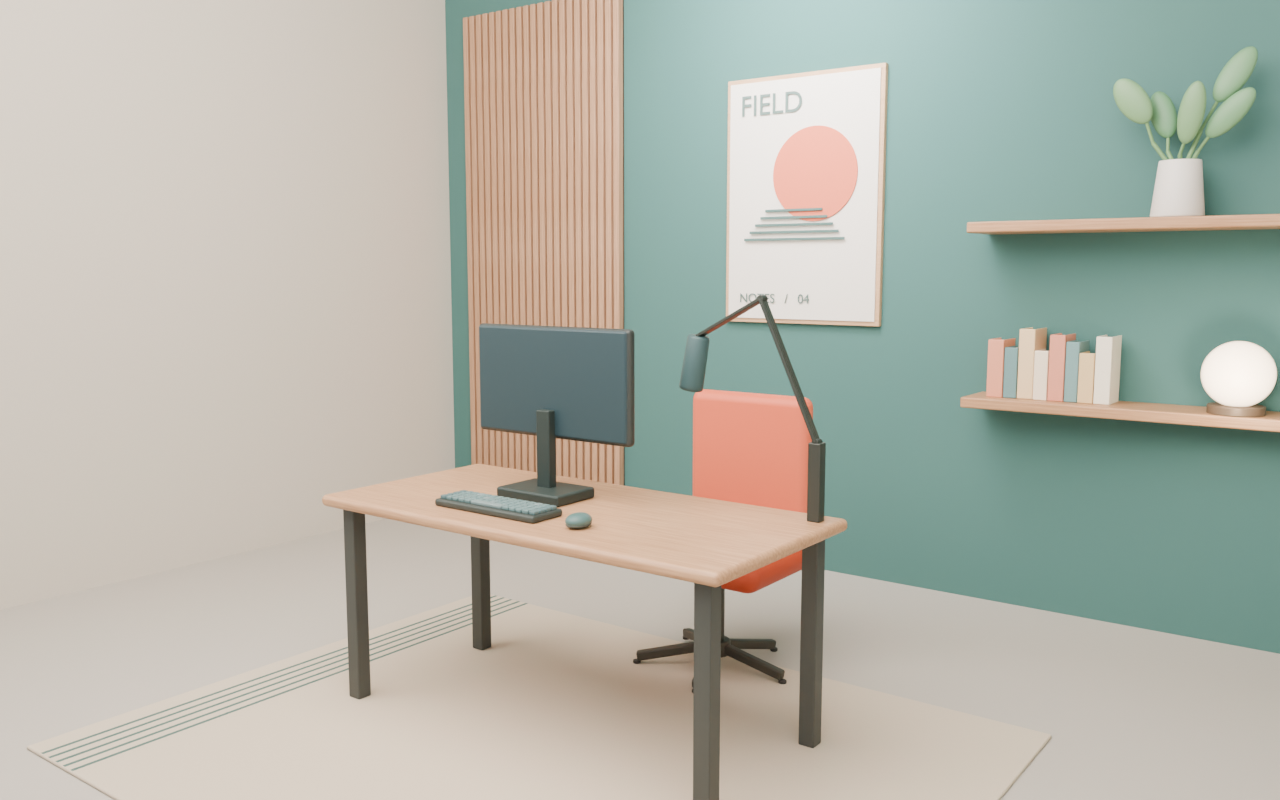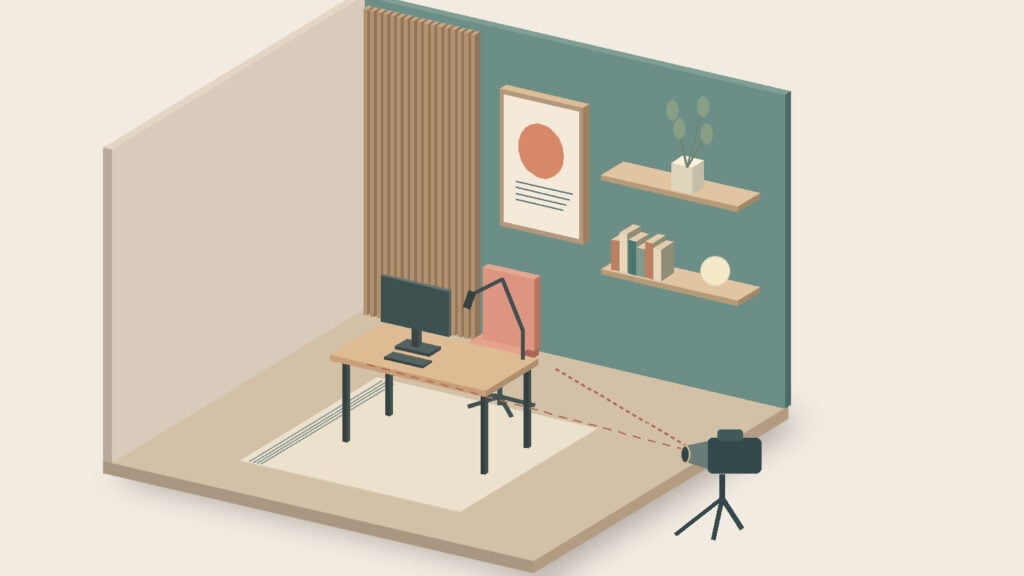
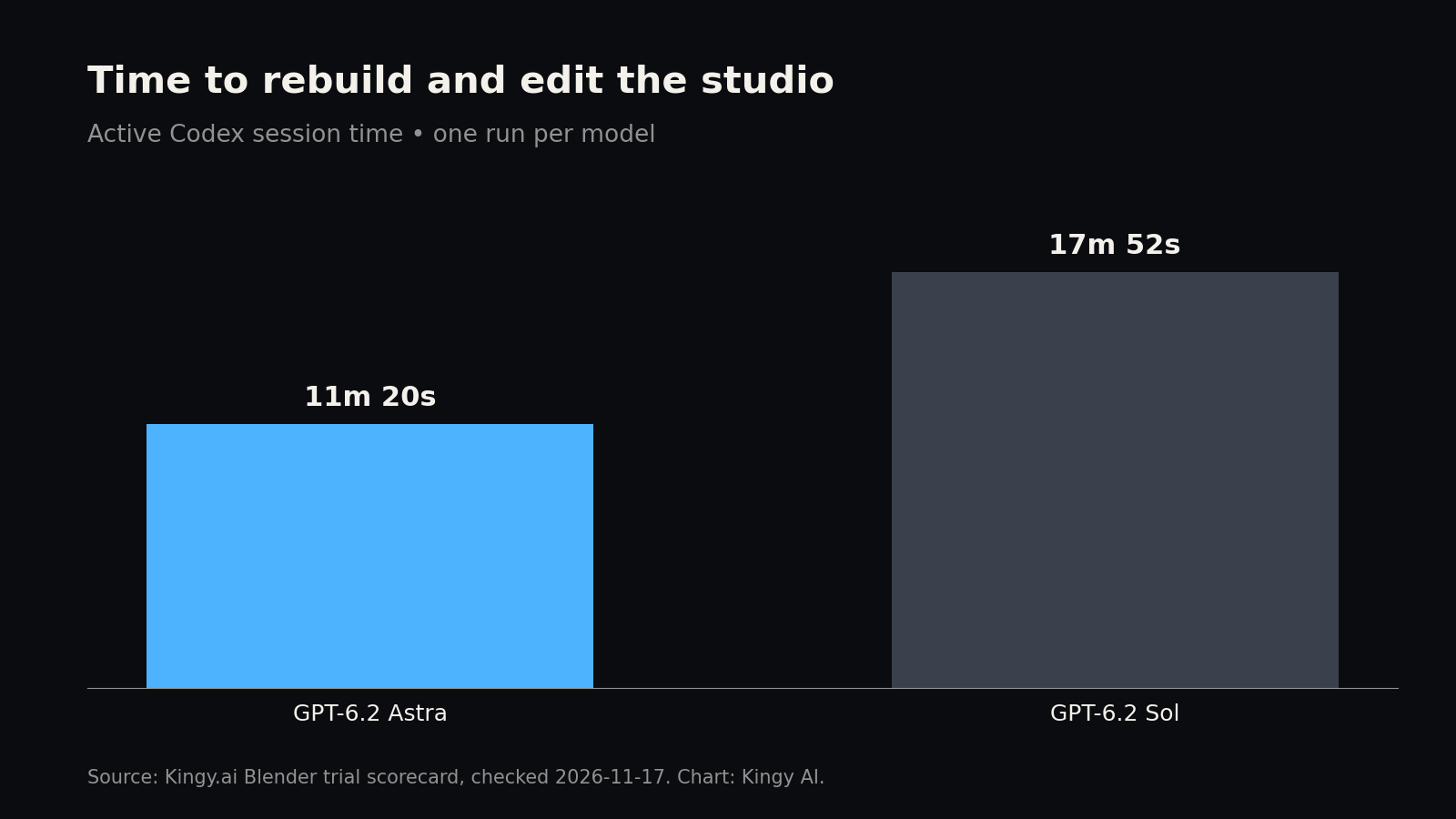
From the third camera position, the microphone arm crosses the bottom of the poster and the globe on the shelf nearly leaves the frame. We held this view back when we gave GPT-6.2 Astra and GPT-6.2 Sol two images of our synthetic Blender studio. Both models put the furniture in roughly the right place. Astra finished the reconstruction and edits in 11 minutes 20 seconds. Sol took 17 minutes 52 seconds.
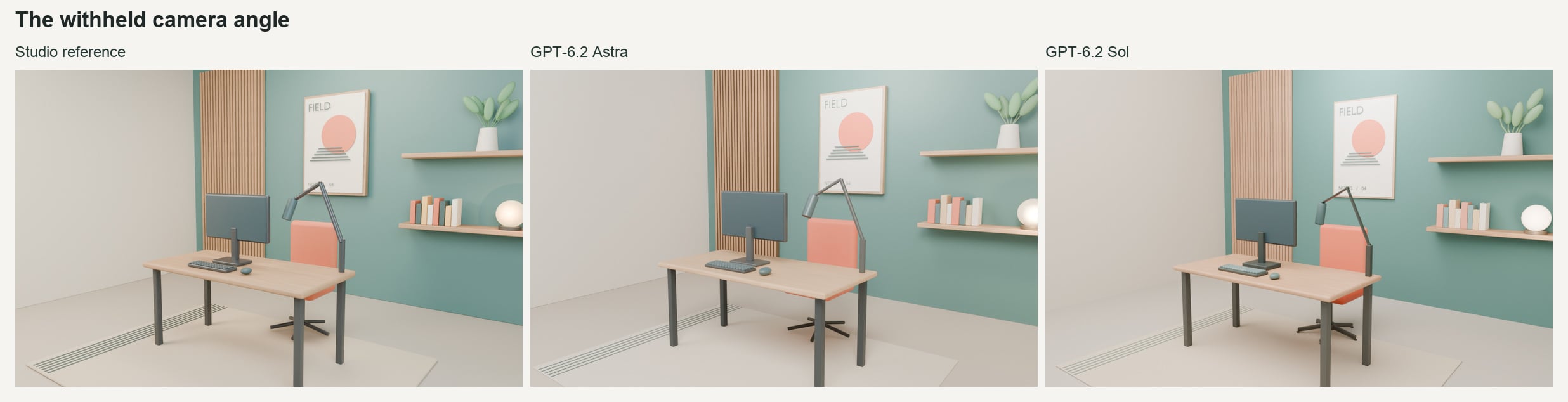
Look at the front-right corner of the desk and follow the microphone arm up to the poster. Astra’s desktop extends farther to the right in this view, and its globe is more cropped. Sol’s globe sits farther inside the frame, while its wall slats have less of the original’s dark contrast.
We marked five landmarks on the original before running the models, then measured their positions in each full-size, unaligned 1,280 × 800 render. The median displacement was 14 pixels for Astra and 12 for Sol. That two-pixel gap is within the few-pixel precision of marking edges and a partly cropped globe by eye, so we would not call a visual-accuracy winner from it. Both renders contained all five landmarks.
What we asked the models to do
For this original Kingy test, we made a synthetic studio in Blender and supplied a front view and a left-hand view in that order with the same build prompt. Fresh signed-in Codex sessions used GPT-6.2 Astra and GPT-6.2 Sol at High effort and default speed, on the same Mac, in separate temporary directories. Astra ran first. The reference scene, third image and scoring data stayed with the evaluator.
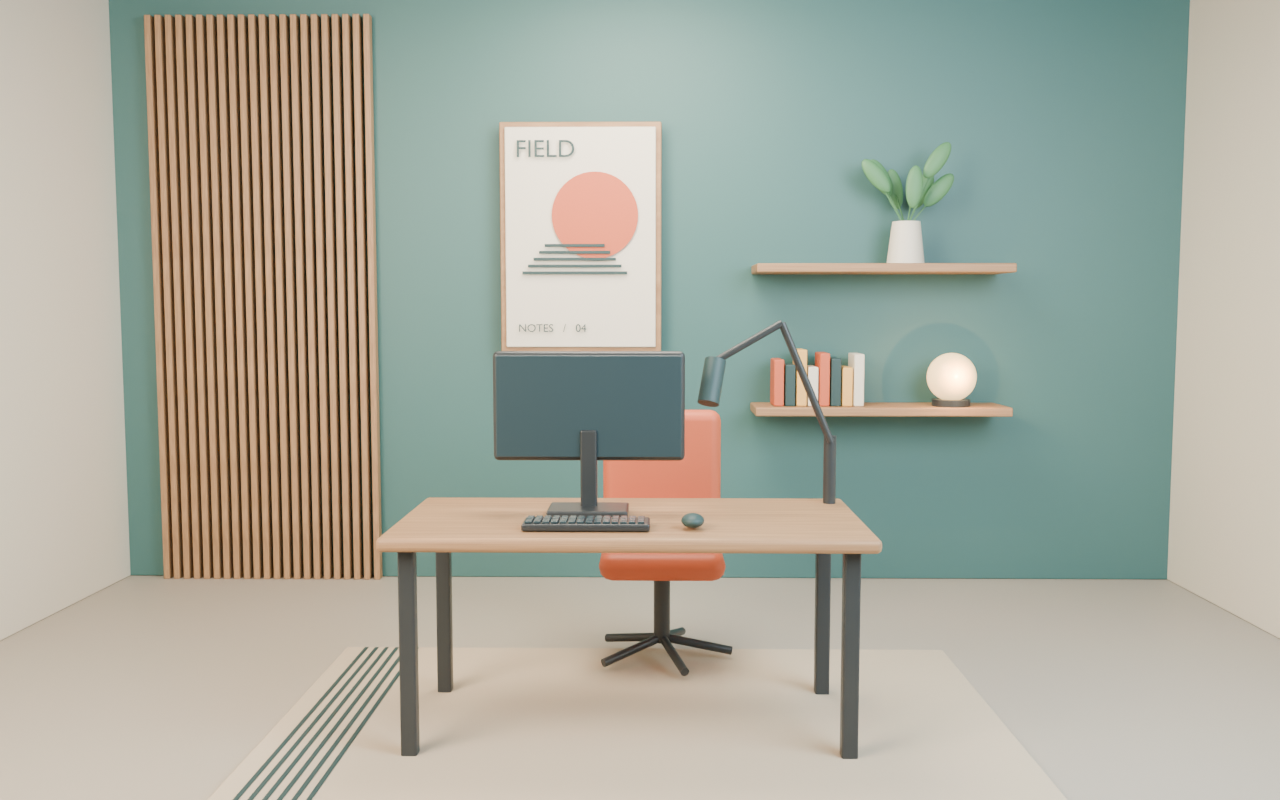
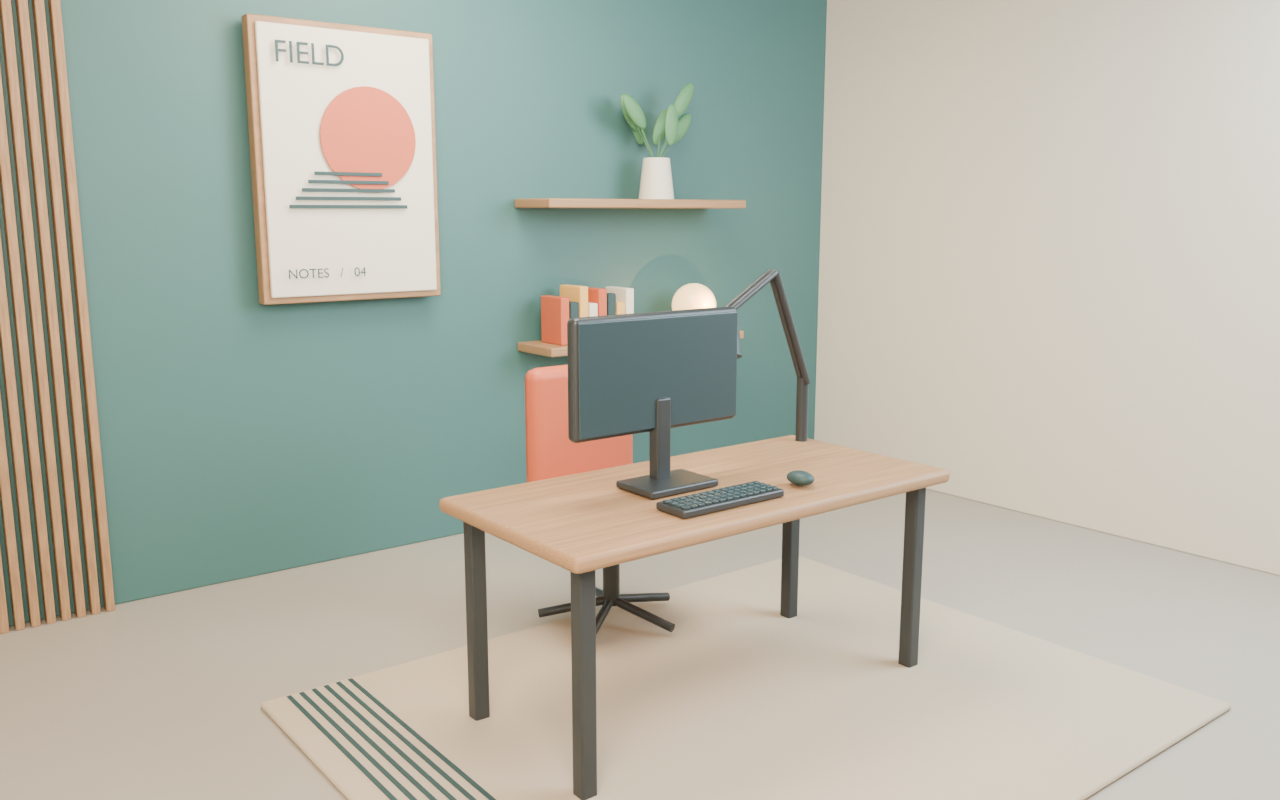
After archiving each submitted build, we gave the sessions the third camera’s coordinates and requested a render, a 30 cm chair move, and a separate warm-light edit. We used Blender 5.2.1 LTS with Cycles CPU, 24 samples and denoising for the scored frames. The idea came from OpenAI’s demonstration.
The scorecard
| Measure | Astra | Sol |
|---|---|---|
| Complete build submission | 9m 39s | 15m 37s |
| Camera, chair and lighting edit | 1m 41s | 2m 16s |
| Total active session time | 11m 20s | 17m 52s |
| Median error across five hidden-view landmarks | 14 px | 12 px |
| Desk width error | 5.0 cm | 2.18 cm |
| Desk depth error | 0.8 cm | 3.33 cm |
| Desk top-height error | 0.075 cm | 3.5 cm |
| Operator repairs / follow-up repair rounds | 0 / 0 | 0 / 0 |
The full scorecard includes the five landmark coordinates, dimension checks, render times and session usage.
Astra finished the build and edit 6 minutes 32 seconds sooner in this run. These elapsed times include model iteration, tool calls, rendering and startup retries, but exclude waiting for the other model and independent checks. Both models recovered from a sandboxed Blender startup crash during their timed builds. Astra also switched Python environments after an image-library import failed. No operator repaired either scene. We used an existing signed-in Codex plan. It gave us session usage figures but no attributable dollar charge for either run.
For scale, our reference desktop measured 165 cm wide, 80 cm deep and 78 cm high. Neither model received a known measurement. Sol came closer on width, while Astra came closer on depth and height. Astra assumed the desk was 170 cm wide. Sol estimated its height at 74.5 cm. Each assumption affected where the furniture landed in the third view.
Could we actually edit the scenes?
Yes. Each submitted .blend opened in a fresh Blender process from a directory containing only that file, and each reproduced its submitted camera-A render exactly. Both retained separate editable mesh objects, materials and lights. Neither original file depended on external image assets or missing textures.
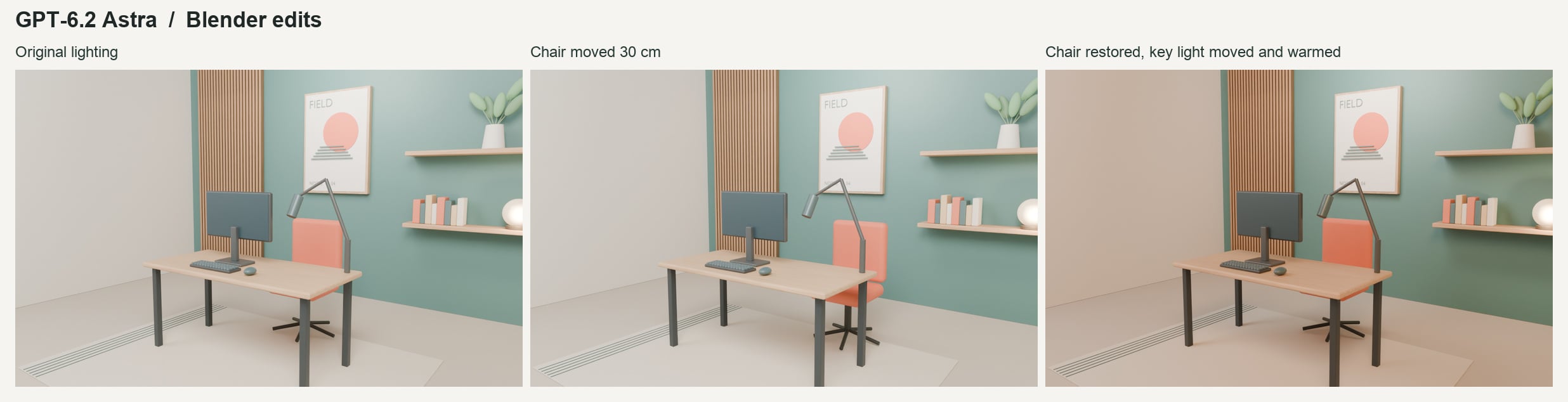
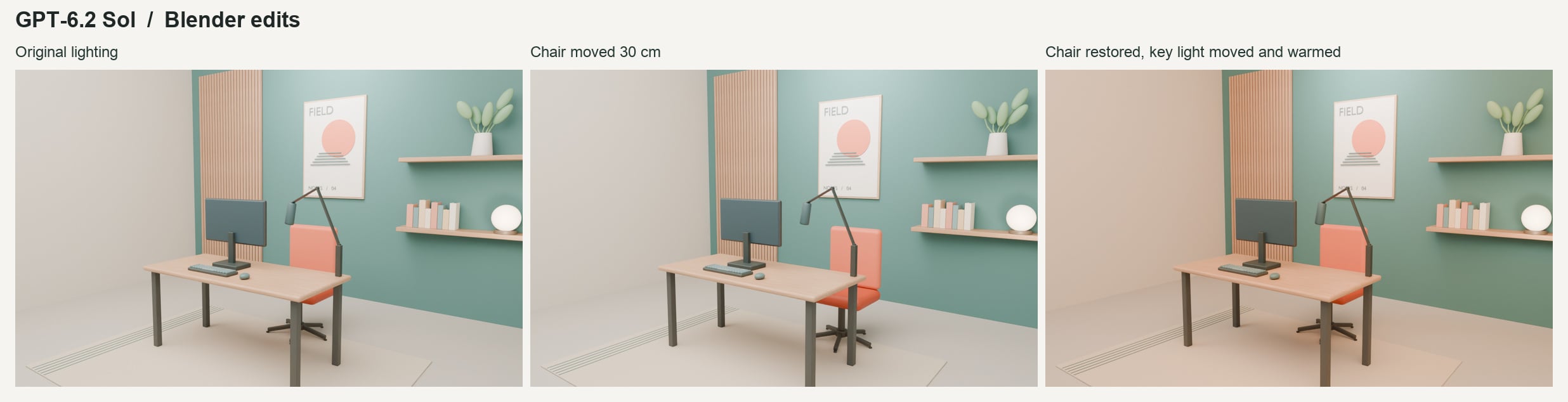
We independently recreated the third camera and chair move from each original file. Astra’s replay matched its submitted images exactly. Sol’s differed by less than 0.006 intensity levels per channel on average on a 0–255 scale. In both warm-light files, the chair and original geometry were back in place, the key light had moved one metre along the X axis, and its colour had changed. The other lights kept their settings.
- Tested
- One two-view synthetic Blender studio reconstruction and edit round per model.
- Machine
- Same Mac, Astra first, Sol second.
- Runner
- Signed-in Codex sessions and Blender 5.2.1 LTS.
- Cloud side
- GPT-6.2 Astra and GPT-6.2 Sol, High effort, default speed.
- Settings
- 1280 × 800, Cycles CPU, 24 samples, denoising.
- Grading
- Five preselected landmarks, measured on the withheld view. Clean-folder reopen and independent camera, chair and lighting checks.
- Cost
- Per-run dollar charges unavailable on the existing Codex plan.
- Dates
- run 2026-11-17 · checked 2026-11-17
Limits
We ran each model once on a clean, computer-rendered set. There were no moving people, lens distortion or exposure changes between the input views. A real studio shoot adds all three possibilities. For a creator planning a camera move, both files held up in this test. For a build that has to fit a physical space, the desk measurements show why we’d supply at least one real dimension.
Sources and full-resolution renders
Inspect the withheld reference, Astra render and Sol render at their native 1280 × 800 resolution. For launch pricing and benchmark context, see Kingy.ai’s GPT-6.2 Astra and Sol comparison.