

Claude is helping with cancer research, trial planning and regulatory paperwork. The evidence for those uses tells us little about Dario Amodei’s prediction that major diseases will be relics of the past in under a decade.
Anthropic began trading on Nasdaq under ANT on November 19 after pricing its $81.34 billion base offering at $83 a share. The total includes shares offered by existing shareholders. On listing day, Anthropic released a short film titled What we make of this moment, will make this moment. It puts questions about seemingly incurable diseases alongside projects in science, education and public life. Nasdaq listing event · First day of trading · Final SEC prospectus · Anthropic’s IPO-day film
The sharper claim came nine days earlier, in Anthropic’s investor roadshow. At about 40:38, CEO Dario Amodei names cancer, Alzheimer’s disease, heart disease and mental illness and says they will be “relics of the past in, I think, less than a decade.” He describes an “age of miracles” if the benefits of AI can be delivered while its risks are managed. The founders’ letter uses the same phrase and describes cures coming within reach, without putting a date on them. Anthropic’s investor roadshow · Roadshow captions review · Founders’ letter
The 10-year forecast is unsupported
Amodei said it, and “I think” matters. He offered a forecast and gave no clinical evidence in that passage for the timeline. “Relics of the past” leaves the outcome undefined. Fewer deaths, lower incidence, effective treatment for particular cases and widespread cures are different claims. Cancer alone encompasses more than 100 types. A successful treatment for one of them would be a genuine advance with a much narrower reach than the roadshow language suggests. Roadshow captions review · National Cancer Institute
The idea goes back to Amodei’s 2024 essay Machines of Loving Grace. He argued that AI could compress 50 to 100 years of progress in biology and medicine into five to ten years after the arrival of what he calls powerful AI. He discussed ways to speed up clinical studies and acknowledged that some rare, difficult cancers could persist. His roadshow remark dropped the essay’s explicit starting condition. Amodei’s 2024 essay · Roadshow captions review
Where Claude is helping drug developers
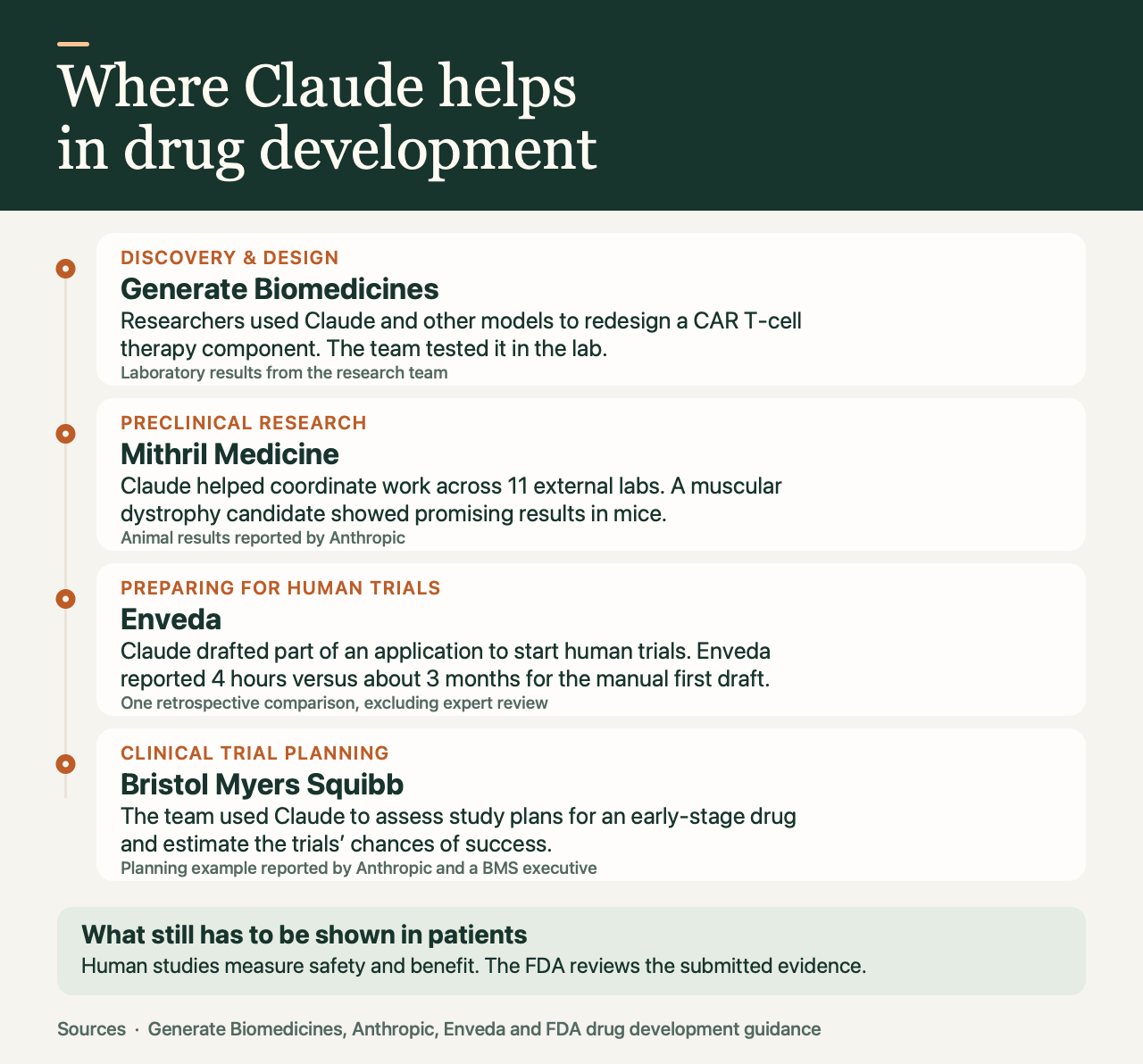
Four company-reported examples, placed by the type of work Claude supported. These are separate projects. The U.S. development process comes from the FDA. Generate Biomedicines · Anthropic · Enveda · FDA
Designing a cancer therapy component. Generate Biomedicines researchers used Claude and other models to help redesign part of a CAR T-cell therapy, a treatment that uses modified immune cells. The team reported a component about 70% shorter than the design it used for comparison and better tumor-cell killing in lab tests. The 70% measures the length of one component. The results for this design are preclinical. Generate’s research write-up · Generate’s November update
Coordinating early research. Anthropic says Mithril Medicine’s founder used Claude to help manage contracts, logistics and experiments across 11 outside labs. One muscular dystrophy program went from idea to promising mouse results in under 18 months, according to Anthropic, which acquired Mithril. Late 2028 is the earliest target for starting a human trial for that program, conditional on the candidate holding up. Anthropic’s Mithril report
Preparing paperwork for human trials. Enveda says Claude produced a first draft of part of an Investigational New Drug application in four hours. A comparable manual first draft took about three months. That was a retrospective comparison within Enveda, and both figures exclude expert review. In a separate task, Enveda corrected a unit-conversion error in an AI-drafted investigator’s brochure before submitting it to the FDA. Enveda’s account of both drafting tasks
Assessing trial plans. A Bristol Myers Squibb executive told Anthropic that the company used Claude to analyze internal data, develop a study plan and estimate the chance of trial success for an early-stage drug. The executive described a faster initial analysis. The report gives no evidence that the trial itself ran faster or was more likely to succeed. Anthropic’s BMS case study
What would make the forecast more credible?
Faster paperwork can free up researchers’ time. A better lab result can give a team a candidate worth pursuing. Some AI-assisted projects in the wider field have reached patients in studies. A 2025 Nature Medicine paper reported a randomized Phase 2a trial of rentosertib, an AI-designed candidate for a form of lung fibrosis. The researchers enrolled 71 participants and studied treatment over 12 weeks. That gives the field patient data for one drug candidate in one condition. Published Phase 2a trial
Drug developers still have to show how a treatment works in people, who benefits and what side effects emerge over time. The FDA describes Phase 3 trials as typically taking one to four years. Better trial design can make those years count. It takes measured results across multiple programs to show that AI is getting therapies to patients sooner. For Claude, the milestones worth following are named candidates entering human trials, published patient outcomes and comparisons that show how much time Claude saved across a whole program. FDA guidance on human trials
Sources and related coverage
Anthropic shared the IPO-day film on its official channels. The earlier investor materials include the full roadshow and founders’ letter. Anthropic’s film post · IPO roadshow and investor materials
Kingy.ai’s Anthropic IPO explainer · Kingy.ai’s Isomorphic Labs coverage