
Trending on Kingy
Keep reading with the stories getting the most attention now.
No. Cursor did not just kill GitHub.
Evidence and testing disclosure: This analysis uses public Cursor, GitHub, and Microsoft materials checked on August 17, 2026. Kingy did not independently load-test Origin or run an enterprise deployment; product claims and forward-looking inferences are separated throughout.
Origin, the code-hosting platform Cursor launched on August 17, 2026, is an early beta. It has not published the scale, reliability, governance, ecosystem depth, or adoption evidence required to support a GitHub obituary. Its easiest onboarding path is to sync a GitHub repository—and, for a mirrored repository, Cursor’s own documentation says GitHub remains the source of truth.
But the provocative question contains a useful signal. Origin is not merely another place to store Git objects. Cursor is trying to collapse the software-development loop—prompt, agent run, code change, review, CI, merge, and deployment—into one environment designed around AI agents. That is a credible strategic threat to GitHub even if it is not yet a credible replacement for GitHub.
What Cursor actually launched
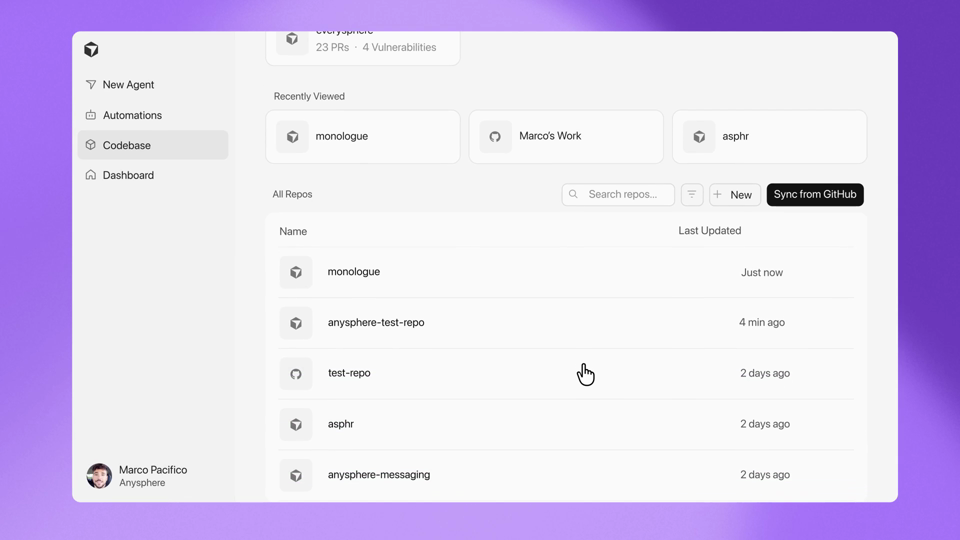
Cursor’s launch post calls Origin its “code hosting platform,” says it is live, and tells users to get started by syncing repositories from GitHub. A follow-up launch reply is more precise: the beta began rolling out that day. Cursor’s Origin documentation says it is available on Pro, Teams, and Enterprise plans—not Free—but that access opens in stages. “Live,” then, does not mean generally available to every eligible customer.
The current product is more substantial than a landing-page concept. Cursor documents native Origin repositories; standard Git clone, fetch, push, and pull operations; browser-based code browsing and search; pull requests with comments, reviews, checks, conflicts, and merges; repository settings and branch protections; and a public REST API. Origin can connect to Cursor cloud agents and Automations. For native Origin repositories, Cursor lists Vercel for deployments and Depot or Buildkite for CI.
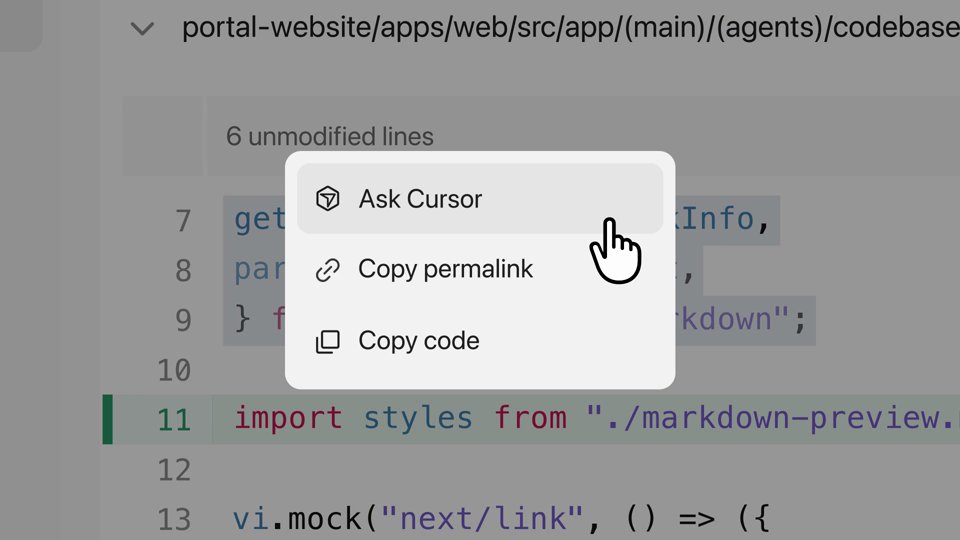
The 31-second launch video presents that workflow compactly: create a repository or sync one from GitHub, browse it in a Codebase view, review a pull request, select a diff and choose “Ask Cursor,” wait for checks, squash and merge, run CI through Depot, and deploy through Vercel. It ends with the positioning “Git hosting, at agent scale.”
That video is evidence of a coherent product flow, not evidence of production-scale performance. Cursor has not attached public latency, concurrency, uptime, or throughput benchmarks to the phrase “agent scale.” Its launch changelog also says agent-native features are still to come. The foundations have shipped; the larger promise is still a roadmap.
GitHub sync is the most revealing feature
Origin’s GitHub mirroring documentation makes two things clear at once: Cursor wants to reduce the friction of trying a new forge, and GitHub is still the incumbent.
When a team mirrors a repository, Origin copies Git history, branches, tags, code for browsing and search, and pull requests. Repository updates continue to sync into Origin. Pull-request activity, including comments and replies, can appear on both platforms. A developer can clone from Origin and push to the Origin remote, but those pushes pass through to GitHub. Cursor states explicitly that GitHub remains the source of truth for repositories that began there.
The bridge has boundaries. GitHub Issues are not migrated. GitHub Actions configuration and secrets are not copied into Origin, and mirrored projects continue to run CI on GitHub. Origin apps cannot access GitHub-mirrored repositories. A team can later detach the mirror and turn the Origin copy into a standalone repository, but that is a deliberate second step.
Mirroring makes Origin a low-risk working surface and a migration wedge: keep GitHub canonical, move more review and automation into Cursor, then detach only if the benefits prove material. Only the bridge is confirmed; the migration path is Cursor’s strategic bet.
The real threat: Cursor wants the whole workflow
Git hosting is not technically exotic. Git is distributed, and repositories can have multiple remotes. The valuable asset is the system wrapped around the repository: identity, permissions, issue history, reviews, checks, security controls, integrations, and the habits of everyone involved.
Cursor already owns an increasingly important creation surface. Its agents can take a task, inspect a codebase, make changes, run commands, and return a pull request. Origin extends that reach into the forge. The intended loop now looks like this:
instruction → agent runtime → code change → review → CI → merge → deployment
The advantage is not just fewer tabs. An integrated system could preserve context across the full lifecycle. An agent could understand why a change was requested, see the code it produced, react to a reviewer’s line comment, diagnose a failed check, revise the branch, and observe the deployment result without translating state between loosely connected tools. That context advantage is a plausible inference from Cursor’s architecture—not a capability benchmark proven by the launch.
Cursor has telegraphed this direction for months. When it announced an agreement to acquire Graphite in December 2025, Cursor argued that faster code creation was shifting the bottleneck toward review, safe merging, and collaboration. Cursor later reported that more than 30% of its own merged pull requests came from cloud agents, and separately said its internal security agents were reviewing more than 3,000 pull requests each week. Those are Cursor-reported internal figures, not independent evidence of market-wide demand or Origin capacity. They do show the workload Cursor is designing for: more parallel changes, more review pressure, and more machine-generated events around every merge.
If Cursor controls creation, review, checks, and merge outcomes, it can potentially improve agent orchestration faster than a tool that sees only one stage. No evidence permits the stronger—and very different—claim that Cursor trains on customers’ private repositories. Workflow integration and model-training policy should not be conflated.
Confirmed today, unanswered tomorrow
Origin’s launch materials support a grounded assessment, but they leave important buyer questions open.
| Area | Confirmed by Cursor | Still unanswered or unproved |
|---|---|---|
| Availability | Early beta; staged access for Pro, Teams, and Enterprise | GA date, long-term packaging, and production maturity |
| Git hosting | Native repositories and standard clone, fetch, push, and pull | Storage, transfer, Git LFS, file-size, and large-monorepo limits |
| GitHub bridge | Ongoing mirroring; PR activity sync; GitHub remains canonical until detachment | Full export fidelity for non-Git metadata and a tested rollback at scale |
| Review | PRs, comments, checks, reviewers, conflicts, protections, and merges | Complete parity for CODEOWNERS, merge queues, policy exceptions, and mature admin UX |
| CI and deploy | Depot and Buildkite for native repos; Vercel integration; GitHub CI for mirrors | Provider breadth, native CI economics, concurrency, protected environments, and approvals |
| Agents | Cloud agents and Automations can work with native Origin repositories | The promised future “agent-native features” and their operational limits |
| Scale and resilience | Cursor’s “agent scale” positioning | Benchmarks, SLA, status history, backup/restore design, RPO, and RTO |
| Security | Cursor-wide SOC 2 Type II and privacy documentation exists | Origin-specific data residency, encryption, audit, scanning, retention, and recovery detail |
The distinction matters. “Cursor demonstrated” is stronger than “Cursor intends,” but weaker than “customers have validated at scale.” Early adopters should treat the gaps as a test plan, not automatically as defects. Every beta has unknowns; critical infrastructure has to retire them before trust can follow.
Why GitHub remains exceptionally hard to displace
GitHub’s moat is not disk space. It is the accumulated network and operating environment around the code.
Microsoft reported in its July 2026 earnings call that GitHub had 225 million users, that more than 90% of the Fortune 500 used it, and that one in three pull requests involved an agent. Those are company-reported figures—“users” does not necessarily mean monthly active developers—but they make one point difficult to dispute: agentic development is already happening at enormous scale on GitHub.
GitHub’s public network contains developer identities, contribution histories, forks, stars, issues, discussions, releases, and discovery. Its private-enterprise footprint adds Actions workflows, Apps and Marketplace integrations, packages, webhooks, deployment controls, procurement relationships, and years of organizational policy. Moving a Git repository is easy. Moving that surrounding machinery is not.
Security and governance deepen the moat. GitHub offers code and secret scanning, push protection, dependency tooling, rulesets, artifact attestations, audit logs, managed identities, branch controls, deployment approvals, hosted and self-hosted runners, and enterprise policy. Its security validation for third-party coding agents checks work produced by agents including Claude and Codex for vulnerabilities, suspect dependencies, and secrets. Origin does not need to copy every feature, but an engineering team must either retain, replace, or knowingly abandon the controls it actually relies on.
Most importantly, GitHub is not waiting for an agent-native future to arrive. Its Agent HQ strategy positions GitHub as a control plane for multiple agents, not just Copilot. Claude and Codex can work from GitHub issues and produce pull requests. Agentic Workflows run through the existing Actions substrate with established runner and policy controls. GitHub’s Agent Control Plane adds centralized policies, visibility, identities, and audit events.
The strategic contrast is sharp:
- Cursor wants the agent workspace to become the forge.
- GitHub wants the forge to become the neutral home for every agent.
Neutrality is powerful for teams using Cursor, Codex, Claude, Copilot, and internal agents together. Cursor’s vertical integration may produce a smoother experience for Cursor-centric teams. GitHub’s breadth may remain safer for organizations that do not want their source, agents, automation, and governance concentrated in one vendor.
What Origin must prove
The case for Origin will be won or lost in operating details, not launch-day aesthetics.
First, portability: can teams preserve branches, tags, hashes, LFS objects, submodules, pull-request discussions, checks, permissions, and audit history? Can they export cleanly, and can they demonstrate a return path rather than merely assume one?
Second, agent-scale performance: how does Origin behave with a large monorepo, hundreds of simultaneous agent branches, rapid webhook traffic, and repeated rebases? Useful evidence would include p50, p95, and p99 latency for clone, fetch, push, checks, and merges—plus conflict and CI queue rates. A fast repository page is not the same as a resilient high-volume forge.
Third, reliability: buyers need an availability commitment, incident history, backup and restore mechanics, regional-failure planning, recovery-point and recovery-time objectives, and clear repository-deletion guarantees.
Fourth, security and governance: teams should verify SAML or OIDC, SCIM, granular roles, service accounts, audit coverage, signed changes, mandatory reviewers, protected environments, secret and dependency scanning, agent identities, least-privilege tokens, egress controls, and human approval gates. Cursor’s company-wide security and data-use pages are relevant context, but they do not substitute for an Origin-specific control matrix.
Finally, economics and ecosystem: what do storage, bandwidth, CI, and agent compute cost after beta? Which non-Cursor agents, CI providers, deployment platforms, and change-management systems can participate? The useful metric is not subscription price. It is cost per safely accepted change.
Origin does not need feature-for-feature parity. It does need to prove that its agent-native advantage outweighs the GitHub capabilities each buyer would give up or have to rebuild.
Practical verdict for individual developers
Try Origin—but do not make a launch-day beta the only home of important work.
Start with a disposable or non-critical private repository. Keep GitHub canonical through mirroring, or configure and verify a second remote. Clone the repository independently, compare commit hashes and tags, test detachment and export, and record what happens to pull-request comments and checks. Then measure whether the integrated workflow actually reduces task-to-review time or reviewer effort.
The “Ask Cursor” action inside a diff could be genuinely useful, especially when reviewing unfamiliar agent-generated code. The test is whether it improves comprehension and catches problems—not whether it feels novel.
For open-source maintainers, GitHub remains the practical default. Origin’s documented repository-creation flow currently exposes Internal and Private visibility, while GitHub already supplies contributors, issues, forks, reputation, discovery, and community expectations. Origin is more compelling today as an additional working surface than as the public home of a project.
Practical verdict for engineering teams
Pilot Origin; do not authorize a wholesale migration on the launch evidence alone.
The best early candidates are greenfield teams standardized on Cursor, working in private repositories with relatively simple integrations, and already producing enough agent pull requests that review has become the constraint. The weakest candidates are regulated organizations, large open-source projects, teams deeply dependent on GitHub Actions, Apps, Packages, or Advanced Security, and mixed-tool organizations that value a neutral agent control plane.
Run a two-to-four-week mirrored pilot on a representative repository. Preserve GitHub as the system of record and predefine an exit test. Measure time from task assignment to first review; human review minutes per pull request; median and p95 time to merge; CI queue and failure rates; merge conflicts and manual interventions; reverts, escaped defects, and security findings; cost per accepted change; audit completeness; and recovery time.
Also test the awkward cases: an unavailable CI provider, a compromised agent token, a failed mirror, an administrator departure, a large binary, a force push, and a need to investigate six months later. Infrastructure earns trust in exceptions.
Adopt more broadly only if Origin produces a material end-to-end gain without unacceptable losses in reliability, governance, ecosystem access, or portability. A smoother demo is not the threshold. A safer, faster, measurable delivery system is.
GitHub has a competitor, not an obituary
Cursor did not kill GitHub. Origin has not demonstrated the adoption, resilience, security depth, ecosystem, or public network required for that claim, and GitHub remains canonical for mirrored projects.
Origin does expose a vulnerability: attention can move before repositories do. GitHub wants to be the governed, neutral command center for every agent; Cursor wants the agent workspace to absorb the forge. The contest over the operating system for agentic software development is now explicit—and Origin is Cursor’s opening bid.
FAQ
Is Cursor Origin replacing GitHub?
No. Origin is a staged early beta. Its GitHub mirroring mode keeps GitHub as the source of truth until a team deliberately detaches the mirror, and Cursor has not published the scale, reliability, or governance evidence needed for a full replacement case.
Can I sync a GitHub repository to Origin without migrating it?
Yes. Cursor documents ongoing GitHub mirroring for Git history, branches, tags, code browsing, search, and pull-request activity. Issues, Actions configuration, and Actions secrets do not migrate, and mirrored-project CI continues to run on GitHub.
Should engineering teams migrate to Origin now?
Pilot it before migrating. Keep GitHub canonical, use a representative private repository, test recovery and export, and measure review time, merge latency, CI failures, security findings, cost per accepted change, and audit completeness.
Primary sources
- Cursor: Origin launch post, August 17, 2026.
- Cursor: Origin code-hosting changelog, August 17, 2026.
- Cursor: Origin overview and access.
- Cursor: Mirror a GitHub repository.
- Cursor: Origin pull requests.
- Cursor: Origin integrations.
- Cursor: Origin API.
- Cursor: Graphite acquisition announcement, December 19, 2025.
- Cursor: Security agents, March 16, 2026.
- Microsoft: FY2026 Q4 earnings call, July 29, 2026.
- GitHub: Welcome home, agents, October 28, 2025.
- GitHub: Security validation for third-party coding agents, June 9, 2026.
- GitHub: Agentic Workflows public preview, June 11, 2026.
- GitHub: Security features.