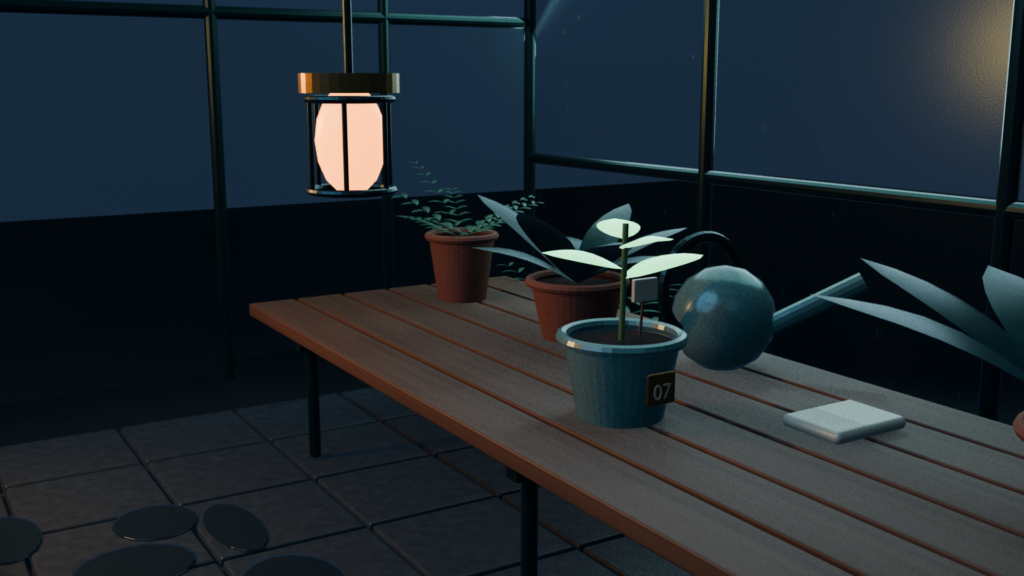
After Hours delivered a working Blender scene, six handle-bearing source clips, two 24-second masters and a 202 MB editable download. The production contract held up. The pictures still look like a prototype.
The answer in one sentence: After Hours is worth publishing as a candid workflow test because the agent completed the difficult production contract and preserved the editable work, provided readers see the stylized result and its limits before they download it.
Kingy is publishing this with one condition: the film comes before the automation story.
The agent built one continuous Blender environment, animated six cameras, rendered six source clips with edit handles, assembled clean and archival masters, preserved a 30-second recut path, and produced an editable 202 MB ZIP. The recorded wall time from first input inspection through build, export and QA was 74 minutes 51 seconds.
That is the impressive part. The film itself is coherent and watchable, but its flat foliage, simple glass, modest light spill and faceted props keep it closer to pre-visualization than finished studio animation. The useful story is what an agent can now finish, where the workflow broke, and how much editable material survived the run.
Quick verdict
This is a strong case study and a middling finished film. It is best for readers who care about agentic production, reproducible creative work, Blender automation, or the difference between completing a pipeline and reaching a professional visual bar. It is a poor showcase if the goal is to imply photoreal output or that one agent replaced a production team.
| Best for | Skip if |
|---|---|
| A transparent end-to-end agent test | You need a flagship cinematic reel |
| Readers who want the source scene and edit handles | You only want a polished final MP4 |
| Blender and creative-automation practitioners | Stylized procedural art will distract from the workflow |
| Studying recovery from a real render failure | You expect a price or per-task usage benchmark |
Pros
- The agent completed the requested scene, source media, masters, validation and documentation.
- The Blender project remains editable and has no external texture dependency.
- Every source shot has one-second handles, so the package supports a different cut.
- The run record separates measured facts from unknown runtime details.
- All 89 export and package checks passed.
Cons
- Foliage, soil, glass and wet surfaces are visibly simplified.
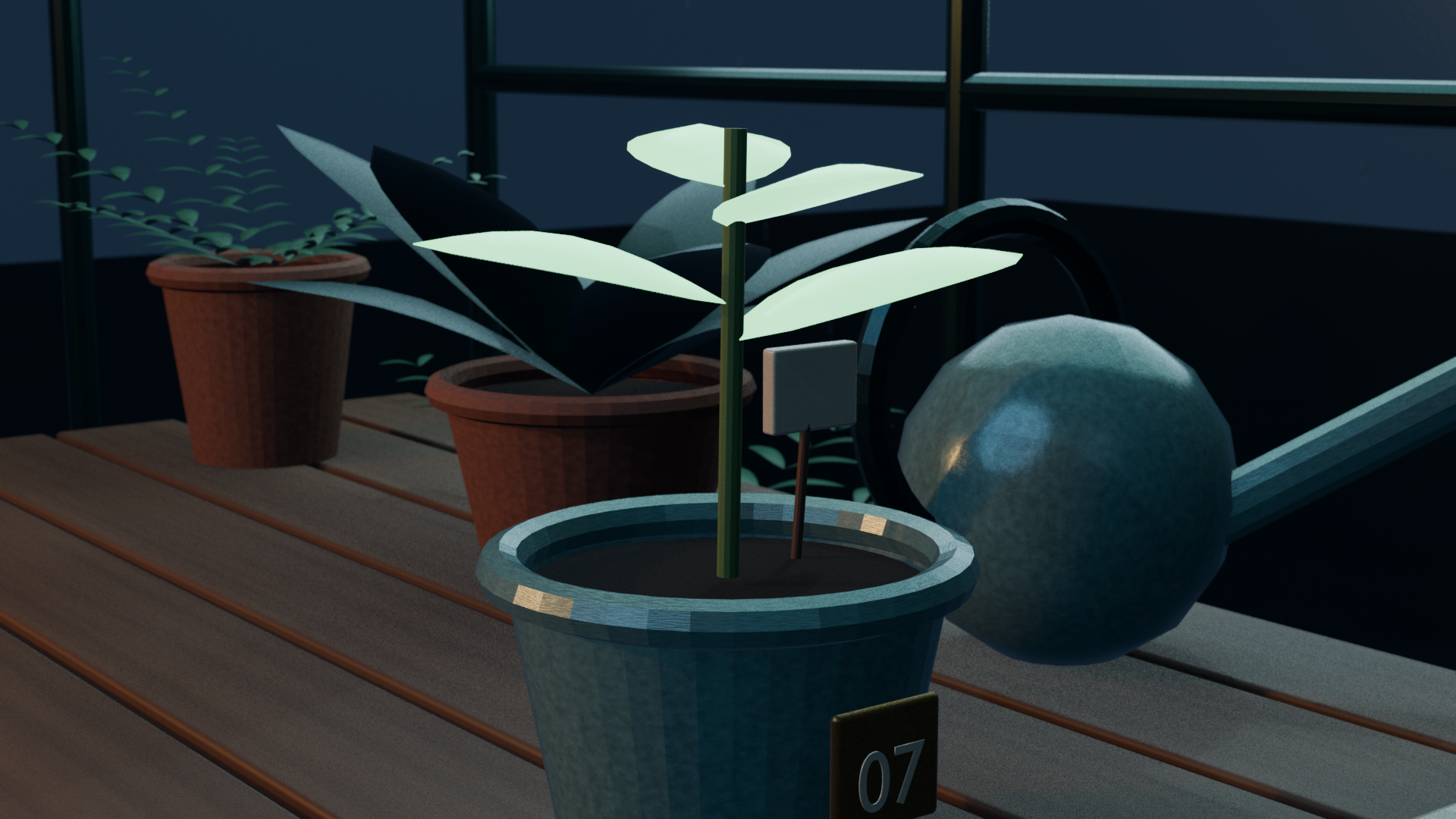
- The glowing seedling reads as pale emissive leaves with restrained surrounding spill.
- The archival grade is an aesthetic treatment, not a film-stock simulation.
- Both masters are silent.
- Visual QA used full-sequence contact sheets and exact stills, not a real-time color-critical playback session.
What the brief required
The brief called for a silent 24-second short inside a closed botanical conservatory at night. A warm maintenance light moves down a wet central aisle, slows beside seedling pot 07, and reveals a soft glow. Six shots had to share one physical scene. The pot, seedling and nearby props had to remain fixed while the cameras and light supplied the staging.
The delivery contract mattered as much as the image: a .blend file, six source clips with handles, clean and archival masters, an editable finishing timeline, a 30-second recut route, stills, manifests, instructions and verification evidence. Paid generation was outside scope.
This was a demanding but useful test. A single polished clip can conceal shortcuts. A source package exposes them.
What actually came back
| Deliverable | Actual result | Evidence or limit |
|---|---|---|
| Editable Blender scene | 675 objects, 648 meshes, 19 materials, 6 cameras | Geometry, materials, lights, targets and keyframes remain editable |
| Source footage | 6 clips × 6 seconds | 1920 × 1080, 24 fps, 144 frames each, silent |
| Edit handles | 1 second at each end of every clip | Selected range is frames [24,120) from each 144-frame source |
| Clean master | 24 seconds / 576 frames | Full decode passed |
| Archival master | 24 seconds / 576 frames | Full decode passed; aesthetic treatment only |
| Editable package | 212,195,892 bytes (202 MiB) | SHA-256 published with the download |
| Automated verification | 89 checks passed, 0 failed | Includes dimensions, rate, duration, silence, handles and full decode |
| Source-to-master comparison | 42.993 dB average PSNR | Confirms edit timing after re-encoding; says nothing about artistic quality |
The package is more complete than the film is beautiful. That distinction is the story.
How the run was measured
The recorded wall elapsed time was 74 minutes 51 seconds, from 03:10:57 to 04:25:48 UTC on September 7, 2026. This covers build, export and QA. It is not pure model-authoring time, and the overlapping stages below should not be added together.
| Stage | Measured time | What the number includes |
|---|---|---|
| Planning, scene authoring and initial preview window | 15:58 | Wall window through the saved final-settings scene; includes local preview and benchmark rendering |
| Final procedural scene-construction script | 6.57 s | Measured inside Blender |
| Corrected six-view small preview | 6.18 s | 672 × 378 at 16 samples |
| Full source batch | 39:55 | Six native 1080p source clips plus encoding; 864 rendered frames |
| Clean master assembly | 58.40 s | Successful HyperFrames render |
| Archival master assembly | 111.30 s | Successful one-worker streaming render |
| Failed archival attempt | 4.58 s | Refused before frame 0 because temporary storage was insufficient |
The run used a MacBook Pro with an Apple M4 Pro and 24 GB unified memory. Blender 5.2.1 LTS rendered the scene in EEVEE at 1920 × 1080, 24 fps and 16 samples. HyperFrames 0.8.30 assembled the edits.
The dispatch requested gpt-6-astra / Ultra, but the task tools did not expose a reliable actual model or effort value. The requested setting is not measured execution metadata.
There is also no defensible per-task cost figure. Account usage snapshots belonged to a shared account with concurrent work, so they cannot be attributed to this pilot.
What worked
The spatial contract held
All six shots use the same conservatory. Pot 07 stays at (1.65, 2.40, 1.04) metres with its watering can and folded cloth nearby. Camera markers select six editable cameras. A saved-scene audit found the hero transforms constant at the checked timeline positions and no unpacked external assets.
That continuity survives the cut. Reviewers inspected all 576 clean frames and all 576 archival frames in chronological contact sheets, along with exact full-resolution final frames, source midpoints and both stills. They found no material clipping, blank tail, camera collision or continuity break.
The source package is built for revision
Each four-second shot comes from the middle of a six-second source. There are 24 frames of head handle and 24 frames of tail handle per clip. The .blend contains the cameras and animation, while the finishing project contains clean and archival timelines and a runnable 30-second recut example.
A human editor can change pacing without asking the agent to rebuild the conservatory. A Blender artist can improve the materials, lighting or plant geometry without reverse-engineering a flattened video.
The documentation admits what is unknown
The run record does not invent a runtime model identifier, cost figure or causal explanation for shared-account usage. It also distinguishes camera-clearance sampling from a formal collision proof and edit-fidelity PSNR from artistic quality.
Where the visuals fall short
The film has a clear arc: exterior, threshold, aisle, lamp, discovery, wide reveal. It also has a stable night palette and a readable warm-to-cool contrast. That gets it through the story.
The surfaces stop it from feeling finished. Plants and props show the faceted character of procedural geometry. The glass and wet floor suggest moisture but lack the layered reflections and surface breakup of a convincing conservatory. Fine shadow and surface noise remain visible in places. The seedling glow stays controlled, yet it reads more like bright leaves than light affecting a damp surrounding space.
The archival version adds restrained grain, chromatic imperfections and handheld movement. It does not create new material detail, and it should not be described as a calibrated stock emulation. The clean master is the better evidence of what Blender rendered.
Audio is absent by design. That honours the brief, though it also makes the film feel more like a visual study. A sound-design pass would improve atmosphere without hiding the image limitations.
I would spend the reserved correction pass on more varied plant silhouettes, better glass and condensation, softer believable glow spill around the seedling, and a more tactile wet-floor response. More pipeline engineering would add less value than those art changes.
The failure that made the test useful
The first archival render estimated 4.78 GB of temporary disk space while only 1.72 GB was free. It stopped before frame 0. The clean master and passing checks remained intact.
The retry used one worker and streaming encoding, then finished the unchanged archival timeline in 111.30 seconds. After the system confirmed six complete source clips and both stills, it removed roughly 1.98 GB of reproducible Blender PNG intermediates. The scene, sources, scripts, films and stills stayed in the package.
The agent recognized an infrastructure limit, protected finished work, changed the rendering method, and completed the missing export without claiming an artistic correction.
Download the editable result
Download the complete 202 MB After Hours project
The ZIP contains the Blender scene, six source clips, two masters, editable assembly files, scripts, stills, manifests, the original brief and the full run record.
Verify the download with SHA-256:
955e89a0e99ea152f358dd32e87e41bff556a5e09290ff0a7643eeb7dd1d0ef4Open project/after-hours.blend in Blender to edit the environment. The scene uses procedural materials and carries no external texture dependency. Rebuild, render and verification commands are documented in the included README. Blender, HyperFrames, FFmpeg and local graphics access are required to reproduce the delivered workflow.
After Hours FAQ
Is the 75-minute figure a model-speed benchmark?
No. It is observed wall time for this build, export and QA run on shared hardware. Some stages overlapped, and the pure model-authoring portion cannot be isolated.
Was the requested model definitely used?
The dispatch requested gpt-6-astra / Ultra. The task tools did not expose a reliable actual runtime model or effort identifier, so that distinction remains explicit.
Is the Blender scene fully editable?
Yes. The geometry, materials, lights, six cameras, targets and keyframes are in the .blend file. The finishing timelines and source clips are also included.
Can the film be recut?
Yes. Every four-second shot has one second of source media before and after it. A runnable 30-second recut example is included, although the package does not contain a rendered 30-second master.
Is the result physically accurate or photoreal?
No. It is a stylized procedural EEVEE scene. The optics, plant biology, wet materials and archival treatment were not calibrated as physical simulations.
Did a human watch both films in real time?
The recorded visual QA used complete chronological contact sheets, exact full-resolution final frames, six source midpoints and the delivered stills. It did not claim a real-time, color-critical playback review.
Did the run use paid media or external textures?
No paid generation, music, voice service or image generator was used. The Blender file has no external texture or image dependency.
Final verdict
This is a build record with receipts. The agent completed the hard parts that usually disappear behind a demo: editable scene construction, handles, assembly, recovery, validation and handoff. Watch the film before treating the timing as meaningful, keep the actual-model caveat beside the requested setting, and inspect the full package.
After Hours is not a replacement for a finished studio short. Its value is clearer: it shows how far an agent can carry a small production in one session, and exactly where a human art pass still earns its place.
The Kingy Brief
Get The Kingy Brief.
AI changes, original tests and one practical thing to try. Fridays at 09:00 Vancouver time.
Free · Double opt-in · Unsubscribe anytime
Sign up for The Kingy Brief on Beehiiv.
Signup help and newsletter schedule
Signup form provided by Beehiiv. After submitting, check your inbox for "Confirm your subscription to The Kingy Brief" and open its confirmation link. Check Spam or Promotions if you cannot find it.
Fridays at 09:00 Vancouver time: source-checked AI changes, original tests and one practical thing to try. We skip a week when there is not enough verified material. Free. Unsubscribe anytime.