Qwen4-Max costs substantially less per API token than Claude Opus 5.5. Opus leads in the broad independent comparisons available so far. That makes Qwen a serious candidate for cost-sensitive workloads, while the evidence gives teams with difficult coding and agent tasks a reason to test Opus first. Neither conclusion guarantees the better result on your own prompts.
Alibaba now documents the stable qwen4-max API model. That matters because earlier comparisons often used qwen4-max-preview, a separate model ID with different limits and availability. Anthropic’s comparable flagship is claude-opus-5-5. Both advertise roughly one million tokens of context, accept images, and support tool use; Qwen also documents video input. Alibaba’s stable model documentation and Anthropic’s Opus overview describe the direct API offerings.
Testing disclosure: Kingy tested both models on 18 original tasks, producing 96 scored responses. Both passed this bounded pilot; Qwen cost less and Opus had lower median full-response latency. The broader benchmarks below come from the named independent evaluators, with vendor results separated.
Our verdict
Choose Qwen4-Max for an initial evaluation when token cost is a major constraint, video input matters, or you can check outputs before they reach customers. Its Singapore international API rate is 62.5% lower for uncached input and 77.5% lower for output than Opus’s standard direct API rate. Those savings are substantial enough to change the economics of high-volume drafting, extraction and other repeated tasks, provided the quality is sufficient.
Choose Claude Opus 5.5 as a starting point for demanding coding and agent workflows where mistakes or retries are expensive. Artificial Analysis reports a higher broad index score for its Opus Max configuration, and Arena’s early agent and web-development results also favor Opus. The configurations, tasks and populations differ, so these results do not produce a universal performance multiplier or establish which model will cost less per successful job.
The decision can change with a smaller quality gap, a different effort setting, or a batch workload. Run a representative sample with your own acceptance criteria before moving a production workload.
At a glance
| Specification | Qwen4-Max stable | Claude Opus 5.5 |
|---|---|---|
| Direct API model ID | qwen4-max |
claude-opus-5-5 |
| Documented input and output | Text, images and video in; text out | Text and images in; text out |
| Advertised context | 1,000,000 tokens | 1M tokens |
| Standard output limit | 262,144 tokens for thinking plus answer; 131,072 in non-thinking mode | 128K tokens; 300K through the Message Batches beta |
| Default reasoning | Thinking enabled; high effort | Adaptive thinking; medium effort |
| Direct standard API price per million input / output tokens | $1.50 / $4.50, Singapore international deployment | $4 / $20 |
| Model access | Hosted proprietary model; direct documentation lists self-deployment and fine-tuning as unsupported | Hosted proprietary model; no self-hostable weights verified |
Sources: Alibaba model documentation, Alibaba pricing, Anthropic model overview and Anthropic pricing. Rates are in U.S. dollars and can vary by region, service and configuration.
A context window is the amount of material a model can process within its documented limits, not a promise that it will recall every detail equally well. Large inputs also cost money and can take time. Alibaba documents maximum input sizes of 983,616 tokens in thinking mode and 991,808 in non-thinking mode for the stable model. Check the endpoint and gateway you plan to use for its own limits.
Stable Qwen4-Max is different from the preview
Alibaba’s stable model documentation lists pay-as-you-go pricing and the qwen4-max ID. The separate preview documentation describes a Token Plan offering and a scheduled retirement after November 25, 2026, in UTC+8. That retirement date belongs to the preview; the documentation does not establish the same deadline for the stable model.
The preview also lists a 393,216-token combined thinking and answer limit. Do not carry that number over to the stable endpoint: its published thinking-mode limit is 262,144. The model name, endpoint, region and settings belong in a test record. A result labeled “Qwen4-Max” without those details may be difficult to reproduce, especially around a release.
Inside Qwen4-Max
Alibaba describes Qwen4-Max as a mixture-of-experts model with a 2.4 trillion-parameter backbone, about 71 billion parameters active per token, and a separate 328 billion N-gram embedding parameters. The embedding table is additional to the backbone figure. Its launch announcement also describes Gated DeltaNet, Qwen Sparse Attention and gated residual branches. Active parameters give some context for how the model routes computation; they are not a direct measure of speed, accuracy or the hardware needed to run a hosted request.
In Alibaba’s own Work360 evaluation, Qwen4-Max scored 52.69 against 47.74 for Qwen3.8-Max, while reported task cost fell from $4.43 to $1.67. Those are comparisons with its predecessor, not Opus. Work360 is Alibaba’s evaluation; its reported task bill is specific to that test and does not predict the savings on another workload.
Alibaba’s benchmark chart
Alibaba’s launch chart compiles 16 panels from several evaluations. Some rows credit outside evaluators. The chart does not disclose complete effort settings, dates and harnesses for every result, so it should not be read as a single, uniformly controlled head-to-head. These selected values illustrate the range; the figures are vendor-compiled, not Kingy measurements.
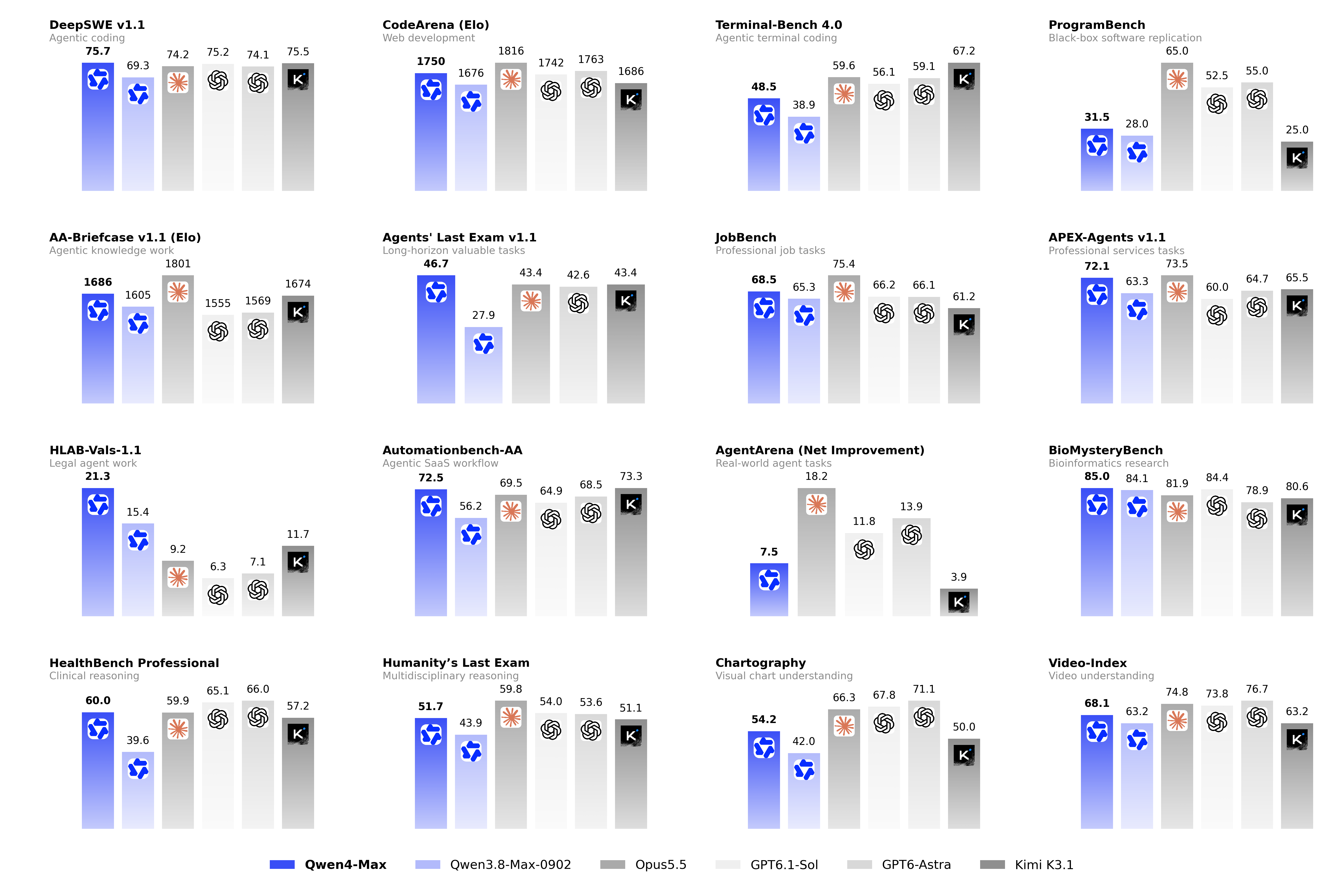
| Vendor-compiled panel | Qwen4-Max | Opus 5.5 |
|---|---|---|
| DeepSWE v1.1 | 75.7 | 74.2 |
| Terminal-Bench 4.0 | 48.5 | 59.6 |
| ProgramBench | 31.5 | 65.0 |
| Agents’ Last Exam v1.1 | 46.7 | 43.4 |
| HLAB-Vals-1.1 | 21.3 | 9.2 |
| AutomationBench-AA | 72.5 | 69.5 |
| AgentArena net improvement | 7.5 | 18.2 |
| BioMysteryBench | 85.0 | 81.9 |
Qwen has the higher number in six of the chart’s 16 panels and Opus in ten. That count is not an overall score: the domains overlap, error bars are absent, and the chart includes a 0.1-point difference on HealthBench Professional whose significance is not established. Read the individual tests and configurations rather than counting wins.
Numbers for a benchmark can also differ across publications. Alibaba’s chart lists Opus at 59.6 on Terminal-Bench 4.0; Vals lists 65.15 and Anthropic reports 66.4 in its launch material. Anthropic labels that result xhigh; its table generally uses production safeguards and fallbacks. These are separately attributed results with different or incompletely disclosed setups, not interchangeable estimates to average. Alibaba’s chart lists Opus at 65.0 on ProgramBench, while the current Vals model page lists 18.50. That discrepancy deserves investigation before using either number to predict your results.
What independent tests show
Artificial Analysis: a broad lead for Opus
Artificial Analysis reports 43 for Qwen4 Max on its Intelligence Index v5.0.1. Its Opus 5.5 page reports 59 for Max effort with “Default Fallback.” The 16-point gap favors that Opus configuration on the index; it is not a percentage by which one model is smarter.
The same pages report a weighted cost per index task of $3.27 for Qwen and $10.04 for Opus Max, about 67.4% less for Qwen by our calculation. Those are the evaluator’s observed costs for its index workload, not a quote for your API calls. The Qwen headline row does not state its reasoning effort. Opus’s “Default Fallback” label also means the result describes the evaluated production configuration, not necessarily an isolated model with fallback disabled.
| Artificial Analysis index observation | Qwen4 Max | Opus 5.5 Max, Default Fallback |
|---|---|---|
| Intelligence Index v5.0.1 | 43 | 59 |
| Weighted cost per index task | $3.27 | $10.04 |
| Total index output tokens | 127 million | 218 million |
Effort changes the picture. Artificial Analysis lists Opus at 35 on Low, 48 on Medium, 52 on High, 57 on Xhigh and 59 on Max. Its estimated time per task rises from 3.0 minutes on Low to 24.9 minutes on Max. Qwen’s 43 and Opus Medium’s 48 are useful context, but they are not a matched-effort or equal-budget experiment. The $10.04 figure above applies to the Max row, not Medium.
The index methodology combines knowledge work, coding, science and general categories, including tasks with and without tools. A composite is useful for orientation, but it can conceal a model’s strengths or weaknesses on the specific work you care about. Artificial Analysis did not publish Qwen latency in the headline results we reviewed, so this comparison does not establish a general speed winner.
Vals: a broader index and a legal-task counterexample
Vals Index v2.2 puts Qwen4-Max xhigh at 63.20% ±1.01 and Opus 5.5 max at 70.14% ±1.00. Its index covers eight components including finance, coding, legal and tax proxies. It is a different composite from the Artificial Analysis index, so their numbers cannot be directly compared.
| Vals evaluation | Qwen4-Max xhigh | Opus 5.5 max |
|---|---|---|
| Index v2.2 | 63.20% ±1.01 | 70.14% ±1.00 |
| Cost per index test | $9.33 | $24.77 |
| Latency per index test | 64 min 39 sec | 84 min 31 sec |
| Finance Agent v2.1 | 66.68% ±2.02 | 67.85% ±2.05 |
| Vibe Code Bench v1.1 | 86.66% ±2.27 | 90.29% ±1.53 |
| Terminal-Bench 4.0 | 48.48% ±0.88 | 65.15% ±0.00 |
| HLAB-Vals 1.1 | 21.25% ±3.33 | 9.17% ±2.37 |
| Legal Research Bench | 41.35% ±3.42 | 50.48% ±3.48 |
| Tax Agent | 40.35% ±3.54 | 44.54% ±3.58 |
Sources: Vals Qwen page, Vals Opus page, Terminal-Bench and HLAB. Vals’ index page displayed an update of November 15, while its terminal and HLAB pages displayed November 11; these dates do not establish when each model run occurred. Vals reports a 2.68% fallback rate for Opus on the current index, so its result includes fallback-assisted behavior.
HLAB is a meaningful counterexample to a blanket claim that Opus wins every professional task. Vals describes a legal-agent evaluation using filesystem and bash tools plus document, spreadsheet and presentation skills. Qwen’s lead on that benchmark does not establish general legal superiority: Opus leads the separate Legal Research Bench. Vals also warns that its HLAB differs from AA’s Harvey LAB-AA. A legal workflow still needs qualified review of its sources and conclusions.
Vals reports Qwen’s cost per index test about 62.3% lower by our arithmetic. On its terminal benchmark, Qwen costs $3.90 versus $12.04 for Opus, but takes a reported 1 hour 15 minutes versus 1 hour 4 minutes. That test uses mini-swe-agent with bash on 66 tasks, an average of three runs, an eight-hour per-task limit and no partial credit. Its individual task setup can differ from model-page defaults. Lower cost does not automatically mean faster completion.
Vals’ ± values are one standard error, not a 95% confidence interval or uncertainty across all possible workloads.
Arena: early web and agent results
Arena’s frontend leaderboard reports 1,782 for Qwen4-Max xHigh and 1,862 for Opus 5.5 Max. Its overall WebDev board reports 1,750 and 1,816 respectively. These ratings reflect Arena’s evaluation and preference system; they are not percentages of tasks solved.
On the frontend board, the Qwen row has 1,365 votes and is marked preliminary; Opus has 3,237 votes. Arena shows a November 13 data date on the pages we reviewed. The Qwen row’s label does not establish that the served checkpoint was the final stable API build. Treat it as early evidence about a Qwen4-Max-labeled configuration, not a verified stable-endpoint head-to-head.
| Arena result, displayed data date November 13 | Qwen4-Max xHigh | Opus 5.5 Max |
|---|---|---|
| WebDev overall rating | 1,750 ±15; 1,814 votes | 1,816 ±12; 4,399 votes |
| Frontend rating | 1,782 ±18; 1,365 votes | 1,862 ±14; 3,237 votes |
| Agent net improvement | 7.46% ±1.34% | 18.19% ±2.03% |
| Agent median cost / time per task | $1.47 / 15.7 minutes | $5.65 / 15.3 minutes |
The Agent Arena net-improvement figure is Arena’s composite session metric, not a raw success rate. The Qwen and Opus rows contain 14,727 and 14,649 sessions respectively, but the task mixes and session populations are not necessarily matched. Similar median times do not establish a speed tie on identical tasks, and lower median cost alone does not establish lower cost per accepted result.
Configuration again matters. Arena lists Opus High at 13.35% ±1.04% net improvement, with a $2.12 median cost and 4.5-minute median time. That row is a useful reminder to test an effort setting that fits the job instead of assuming every Opus request must use Max.
Preview experiments are narrower evidence
StealthModels’ comparison reports a 72.6 composite for Opus and 58.8 for Qwen4-Max-Preview across its game and SVG tasks. Qwen leads three SVG cases in that run; Opus leads both game tasks. The evaluation does not establish a matched-effort comparison or show that the preview checkpoint equals the stable release. Its results are useful examples of variation by task, not proof that the stable model will behave identically.
One Shipping Skool preview experiment reported that Qwen app runs sometimes failed to answer. Its setup used Qwen in app chat without terminal access and Opus in Claude Code at High effort. Those are different working environments, so the results should not be treated as a controlled comparison of the two APIs or their costs.
API pricing: compare the whole workload
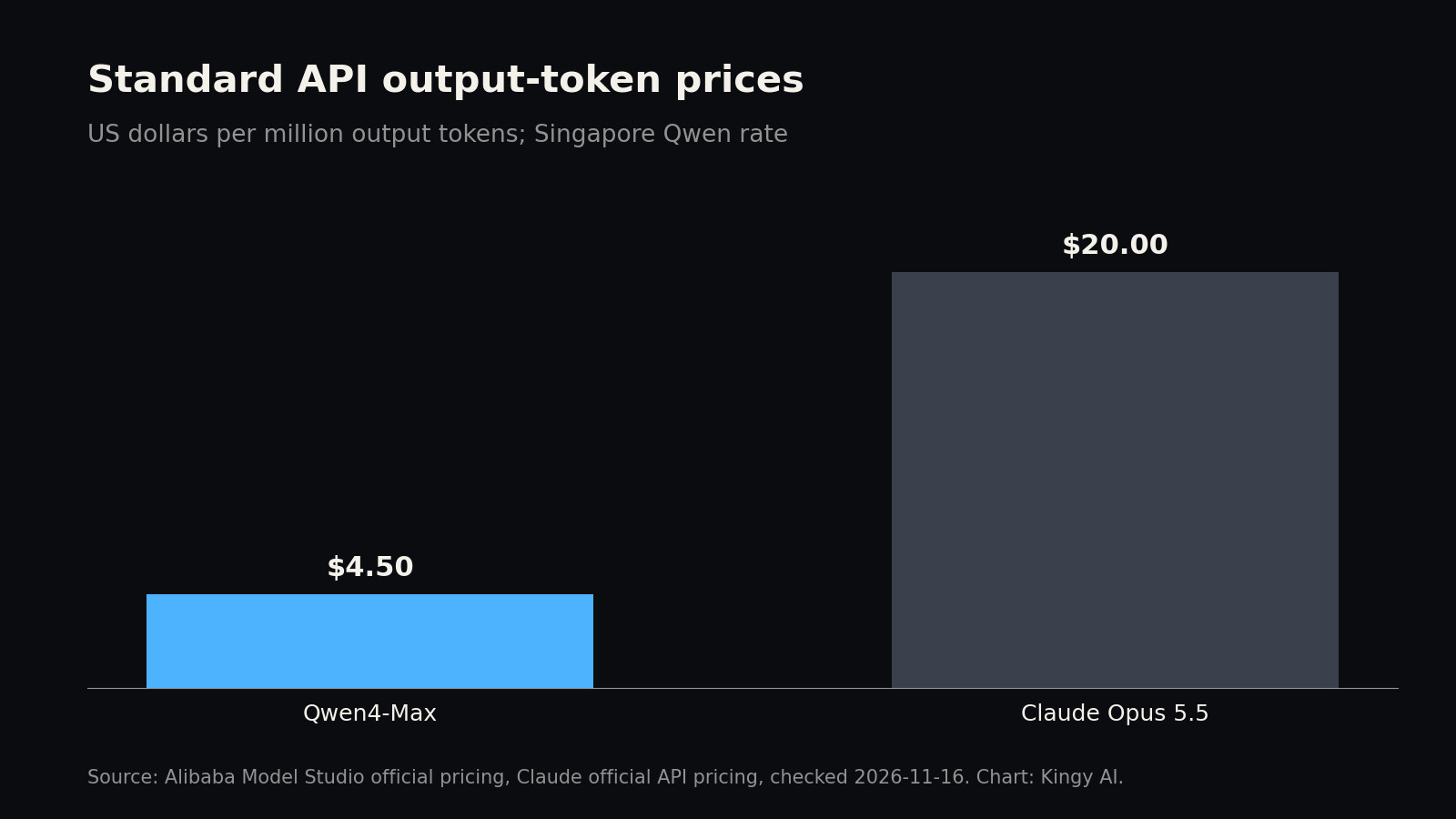
At standard direct API rates, Qwen’s Singapore international deployment is cheaper on each token category below. The Qwen figures come from Alibaba’s current price table; the Claude figures come from Anthropic’s pricing page. Prices are per million tokens in U.S. dollars. Other Qwen regions and deployment scopes can have different rates.
| Token charge | Qwen4-Max Singapore | Opus 5.5 standard | Qwen saving |
|---|---|---|---|
| Uncached input | $1.50 | $4.00 | 62.5% |
| Output, including chargeable reasoning | $4.50 | $20.00 | 77.5% |
| Cache hit | $0.075 | $0.20 | 62.5% |
| Five-minute cache creation | $1.875 | $5.00 | 62.5% |
| One-hour cache creation | $3.00 | $8.00 | 62.5% |
Cache reads and cache creation are separate charges. Reusing a long instruction set or document can reduce input costs after a qualifying cache entry is created, but a missed cache or a short-lived workload changes the bill. Check the provider’s cache rules and measure your actual hit rate.
Batch processing can narrow the gap. Anthropic lists a 50% discount on input and output through its Batch API. Alibaba’s stable model documentation lists batch as unsupported for international/global scope and supported in mainland China scope. Do not assume a Qwen batch discount applies to the Singapore rates above. Opus fast mode is separately priced at $8 per million input tokens and $40 per million output tokens; regional routing, optional tools, taxes and partner charges can also affect the final bill.
Four example token bills
These examples use the standard rates above and equal token counts. We calculated each bill by multiplying each token category by its rate. They are illustrations, not measurements of model behavior or estimates of equal-quality work.
| Illustrative workload | Qwen4-Max | Opus 5.5 | Qwen saving |
|---|---|---|---|
| 100K uncached input + 10K output | $0.195 | $0.600 | 67.5% |
| 100K uncached input + 100K output | $0.600 | $2.400 | 75.0% |
| 900K uncached input + 10K output | $1.395 | $3.800 | 63.3% |
| 800K cached input + 100K uncached input + 20K output | $0.3000 | $0.9600 | 68.75% |
The cache example assumes the 800K tokens qualify for a cache hit and excludes the original cache-creation charge. Models can tokenize the same material differently and use different amounts of chargeable reasoning. A cheaper output token can be offset by longer responses, retries, review time or failed tasks. Track total spend divided by accepted results, alongside the acceptance rate.
Our 96-response test: both models reached the ceiling
Kingy tested the stable gateway IDs alibaba/qwen4-max and anthropic/claude-opus-5.5 on 18 original tasks. Both passed all 48 scored responses after a correction to our answer key. Qwen cost less; Opus returned complete responses faster in this small run. These tasks did not separate the models’ accuracy. A perfect result here does not establish parity on difficult coding, professional judgment or long-running agents.
| Observed measure | Qwen4-Max | Claude Opus 5.5 |
|---|---|---|
| Passed responses / scored responses | 48 / 48 | 48 / 48 |
| 12 core tasks, three attempts each | 36 / 36 | 36 / 36 |
| Six follow-up tasks, two attempts each | 12 / 12 | 12 / 12 |
| Gateway-reported cost, scored calls only | $0.090553 | $0.410992 |
| Median time to full response | 4.20 seconds | 2.76 seconds |
| Billed input tokens | 83,598 | 80,588 |
| Completion tokens, including reported reasoning | 6,849 | 4,432 |
The first set covered ambiguous dates, identity extraction, inventory reconciliation, discounted prices, scheduling, logic, abstention when evidence is missing, a malicious instruction inside a document, English/Chinese extraction, deduplication, a small code-expression task and retrieval from a synthetic 59,622-character document. The code task checked seven cases through a restricted expression interpreter; it did not run a repository or test a full coding agent.
Because both models were reaching the ceiling, we added six follow-up tasks before seeing their answers: a portfolio optimization problem with dependencies, a refund ledger, a policy correction with effective dates, a shortest path with a closed edge, a constrained schedule and an 11,589-character archive with misleading instructions and required citations. These were also solved correctly. The follow-up was adaptive rather than preregistered, and remained too easy to rank these models.
Both received identical task text, a request for JSON only, high reasoning effort and a maximum of 25,000 completion tokens. Model order alternated by repeat. We did not set temperature, supply tools, enable browsing, request a response-schema constraint or feed either model its previous answer. The same effort label does not prove equal computation across providers. This was a gateway test from one client, not a direct-endpoint speed trial.
Costs above are the gateway’s reported per-call charges, including reported reasoning and any automatic input caching, summed across the 96 scored calls. They total $0.501545. Equal accuracy on this sample makes Qwen’s scored-call bill 78.0% lower, but it does not predict that saving on another workload. The latency measure runs from sending a request until the complete non-streaming response is read; it includes network and serving time, and says nothing about time to first token. We overlapped the tail of the core run with the follow-up run, so this was not an isolated load benchmark.
What went wrong in our test setup
Our first Qwen probe used a 4,096-token maximum. The API rejected it because its high-effort thinking budget was 24,576 tokens and required a larger completion allowance. We changed the maximum to 25,000 for both models, confirmed both endpoints with one simple probe each, then began the scored study. The rejected request and two successful probes are retained separately; they are excluded from the accuracy, timing and cost table.
We also entered the wrong inventory answer key. The correct calculation is 240 + 18 + 25 + 12 − 76 = 219, with a physical-count discrepancy of 251 − 219 = 32. Both models answered correctly on every attempt. We fixed the key, preserved the original responses, and rescored them without rerunning the prompts or giving feedback. An independent arithmetic review checked all remaining answers; the complete code-expression outputs and JSON numeric types were also inspected.
Repeated answers to the same task are not independent task samples. There were 18 unique tasks, not 96. We did not test vision, video, real-world software changes, tool-selection loops, million-token retrieval, safety robustness, maximum output length or production reliability. The simple injection example is not a security certification.
Download the test kit and raw responses or view the machine-readable summary. The kit includes prompts, expected answers, original and corrected grading records, the runner, timestamps, usage and provider generation identifiers. It contains synthetic data and no API credentials.
Which model fits your work?
For high-volume extraction or drafting: Start by evaluating Qwen where errors can be detected and corrected. Prepare a sample that includes messy documents and edge cases, then score the fields or outputs that matter. If Qwen meets the quality threshold, its lower token rates leave room for meaningful savings.
For coding agents: Opus has the stronger result in the independent broad and agent comparisons above. Test it on your own repository with the same tools, instructions, time limit and acceptance tests you give Qwen. Include the cost of reruns and human review. A model that writes a plausible patch but breaks a neighboring feature has not completed the job.
For long documents: A representative retrieval test matters more than filling the advertised window. Put questions about details in different parts of a real document, include conflicting passages, and check citations against the source. Compare the cost of full-context requests with a smaller retrieval workflow.
For privacy or self-hosting: Treat both as hosted services for this decision. Alibaba’s stable documentation lists self-deployment as unsupported, and we found no verified self-hostable Opus weights. Review each provider’s current data handling, retention, region and contract terms for your account; a model’s name or advertised context does not answer those questions. A public model family can contain both open-weight and proprietary offerings, so check the exact model rather than assuming its weights are available.
- Tested
- 18 original tasks:12 repeated3times and6 repeated2times;96 scored responses;both models48/48 after answer-key correction.
- Runner
- Python 3.14.0;std-library HTTPS runner and deterministic local grader.
- Cloud side
- Vercel AI Gateway:alibaba/qwen4-max and anthropic/claude-opus-5.5.
- Settings
- High effort requested;25000 max completion tokens;no tools,web or temperature override;model order alternated.
- Grading
- Exact JSON and7 restricted-expression cases. Inventory key corrected;raw answers rescored. Independent answer review.
- Cost
- 96 scored calls:US$0.5015455;with probes:US$0.5034245 of existing gateway credit. No credit purchase.
- Dates
- run 2026-11-15 · checked 2026-11-15
Sources and limits
This article compares provider documentation with results from Artificial Analysis, Vals and Arena, plus two smaller preview evaluations. We observed the sources on November 15, 2026 Pacific time. Prices, model aliases, endpoints and leaderboards can change. The Arena pages displayed a November 13 data date, marked Qwen preliminary, and did not identify the served Qwen checkpoint as the stable API build. Artificial Analysis’s Qwen headline row did not disclose effort, while its Opus Max row included Default Fallback.
Kingy ran the bounded API pilot above. We did not inspect model weights or audit either provider’s data handling. Our latency observations are specific to this client, gateway, task set and run. Alibaba’s chart does not fully disclose each panel’s settings. The price examples exclude optional charges and initial cache creation where stated. Before choosing a model, record the exact model ID, provider, region, effort, tools and date, then score repeated runs against your own acceptance criteria.