AI Launch Profile
LeRobot v0.6.0
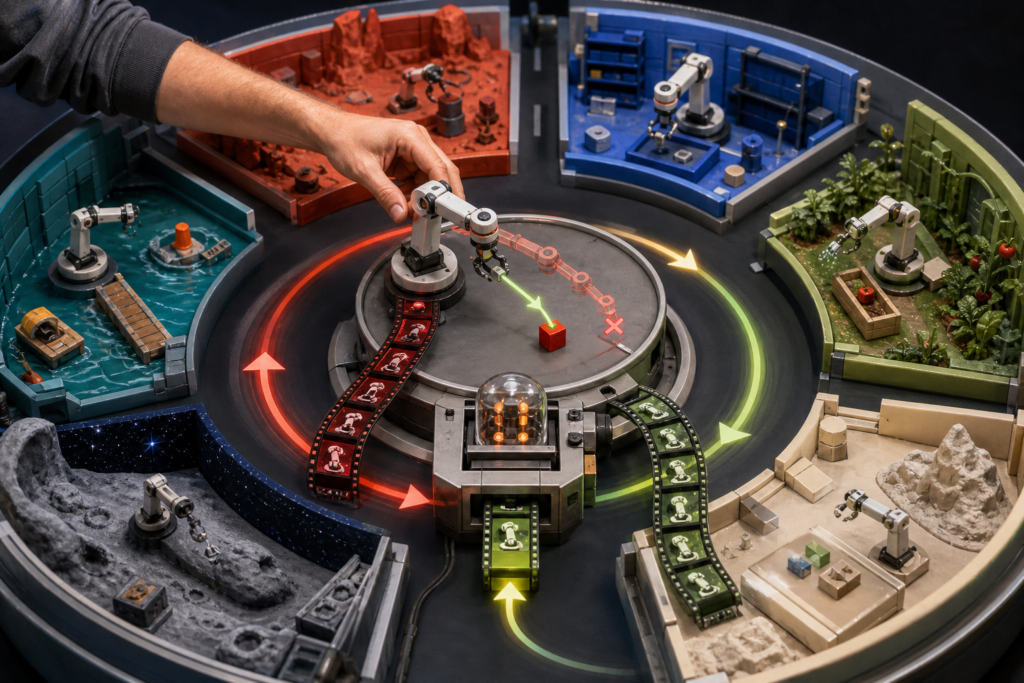
Hugging Face released LeRobot v0.6.0 with world-model policies, a reward-model API, six new simulation benchmark integrations, a deployment rollout CLI, DAgger-style human correction, richer dataset tooling, FSDP and optional cloud training.
At a glance
Launch Snapshot
- Company
- Hugging Face
- Launch date
- July 7, 2026
- Launch type
- Not classified
- Audience
- AI Engineers, Developers, Engineering Teams, Researchers
- Pricing
- LeRobot is open-source software. Hardware, storage, inference and training remain user costs; optional Hugging Face Jobs compute is billed according to the live platform pricing surface.
- Free plan
- Yes
- API
- Yes
- Open weights/source
- Yes
Launch Context
Use these links to move from this record into the broader Launch Intelligence database.
Verification & Sources
- Evidence state
- Recheck due
- Source links
- 6
- Freshness
- Needs recheck: checked July 28, 2026
- Last updated
- July 28, 2026
What this evidence state means
- Definition
- The claim was previously checked, but its review window expired or a material change may have invalidated it.
- Required provenance
- The prior evidence and check date are retained, together with the expiry or change signal that triggered recheck.
- Owner
- Kingy freshness queue owner and assigned editorial reviewer
- Freshness rule
- This is already outside its freshness rule. It must not be presented as current until reviewed against current evidence.
- Disputes and corrections
- Use “Suggest a correction” on the record. Kingy editorial reviews the cited evidence, records material corrections, and changes or removes the state when it is not supported.
Key source checks
Suggest a correction
Kingy AI Take
LeRobot v0.6.0 connects evaluation, deployment, intervention data and retraining more coherently than earlier releases, and its source material is unusually detailed. Breadth is also the risk: models, benchmarks, simulators and hardware paths have different maturity and licenses. Kingy did not run a robot or reproduce a benchmark, so adoption should begin with a frozen task, safety envelope and untouched test set.
Who it is for
Robotics researchers, AI engineers, developers, educators and hardware teams that can validate each model, dataset, simulator, robot configuration and safety boundary for a specific task.
What feels promising
A unified evaluation CLI and rollout-to-human-correction path can make robotics failures easier to capture, compare and turn into documented training data.
What feels unproven
Kingy did not reproduce speed or benchmark claims, validate reward-model accuracy, test physical safety, measure intervention quality, audit every license, run cloud training or compare real-world transfer.
Source list
Sources
Related Kingy Links
Editorial submissions and sponsor-fit reviews are separate. Payment does not influence Kingy scores, verdicts, rankings, evidence labels, or publication decisions.