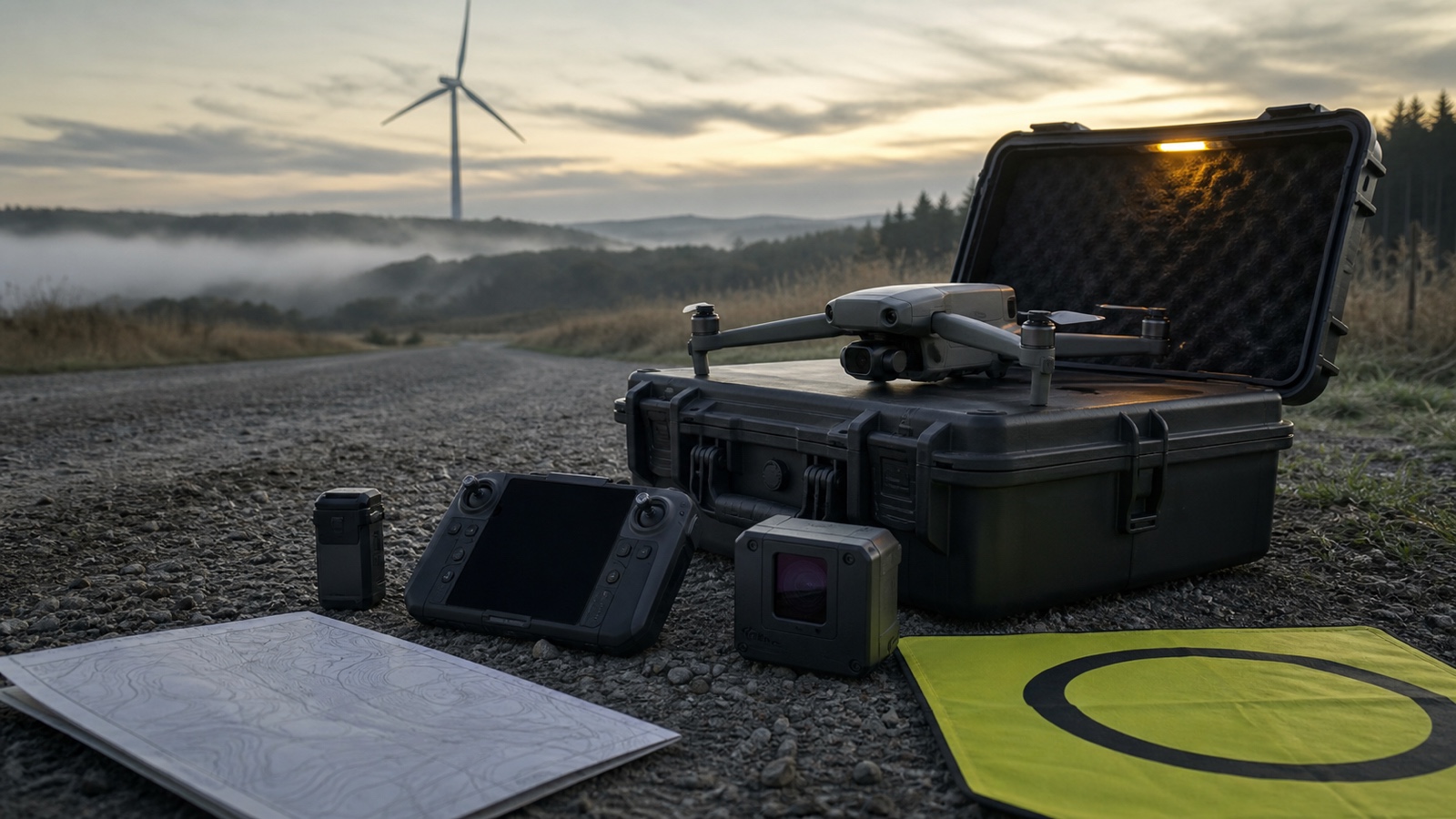
Mission and system buying guide
An AI drone is an aircraft, payload, controller, application, data pipeline, operator, and authorization. Select the whole mission system and prove every boundary.
Separate the mission classes
Creator capture
Define subject, shot, camera, codec, frame rate, lens behavior, controller, crew, location, airspace, transfer, and editing path. Automated framing or tracking does not remove pilot responsibility.
Inspection and public safety
Define target, stand-off distance, visible or thermal payload, radiometric requirement, repeatability, evidence handling, live sharing, environmental limits, and the authority for the operation.
Mapping and surveying
Define area, ground sampling need, overlap, positioning method, checkpoints, coordinate system, capture application, processing software, output, accuracy test, and data custody.
Autonomy and onboard inference
Define sensors, compute module, model, runtime, input rate, actuator authority, geofence, fallback, remote stop, logs, update path, and the boundary between perception and flight control.
Freeze an exact aircraft-to-output packet
| System element | Record exactly | Reject when |
|---|---|---|
| Aircraft and payload | Manufacturer, model, hardware revision, serial class, weight with every accessory, camera or sensor, lens, gimbal, RTK module, battery, propeller, and Remote ID configuration. | A feature is shown on a related aircraft, payload, region, or firmware but not documented for the orderable configuration. |
| Controller and application | Controller model, mobile device if any, operating system, flight app and version, account, offline maps, firmware set, required network, and supported aircraft matrix. | The workflow depends on an unsupported app/aircraft pair, unavailable account service, or unverified offline behavior. |
| SDK and onboard compute | Mobile, payload, cloud, or onboard SDK version; supported aircraft; processor; runtime; model format; sensor access; timing; actuator interface; license; and deployment rights. | “SDK available” is asserted without the exact product matrix, or a perception demo is treated as certified autonomous flight. |
| Data path | On-aircraft storage, controller cache, radio link, live stream, cloud sync, export format, encryption, retention, deletion, access roles, and chain of custody. | The buyer cannot state where original media, telemetry, model outputs, and logs travel or persist. |
| Operation and jurisdiction | Country, airspace, site, pilot credential, registration, Remote ID, visual-line-of-sight plan, people/vehicle exposure, night operation, waivers or authorizations, insurance, and client rules. | A vendor feature or aircraft declaration is mistaken for permission to conduct the intended operation. |
Two documented system patterns
These examples show why the system boundary matters; they are not recommendations.
DJI Mavic 3 Enterprise mapping/inspection pattern
DJI publishes separate exact specifications for Mavic 3E and the thermal variants, including different payloads, weights, storage, batteries, and regional class notes. Procurement must pair the exact aircraft with its supported controller, DJI Pilot 2 workflow, optional RTK module, processing software, firmware, and regional compliance evidence. A specification-table maximum is not a field-performance result.
ModalAI VOXL 2 developer pattern
ModalAI documents a development stack spanning VOXL 2 compute, PX4 or ArduPilot paths, camera interfaces, deep-learning tools, mapping, Remote ID, logging, and supported development drones. That openness increases the verification burden: freeze the board and drone SKU, system image, SDK, model, sensors, estimator, flight stack, radio, power, and failsafe behavior.
Regulation is mission-specific
For the United States, the FAA’s Part 107 material covers many commercial small-UAS operations and requires the remote pilot certificate or direct supervision described by the rule. The FAA also states that drones required to be registered must comply with Remote ID, using a Standard Remote ID aircraft, an attached broadcast module, or operation inside an FAA-Recognized Identification Area under the applicable conditions.
Do not turn those summaries into blanket clearance. Airspace authorization, operations over people or vehicles, night operations, visual line of sight, temporary restrictions, critical infrastructure, local launch/landing rules, and agency or client requirements can change the permitted mission. Check the official authority on the flight date.
Prove what the “AI” actually controls
Separate detection, classification, tracking, route planning, obstacle sensing, camera pointing, and flight control. Record which processor runs the model, the sensor stream it receives, update rate, confidence output, fallback, and whether the pilot can override it. An object box on a video feed does not prove safe separation, regulatory approval, or autonomous mission authority.
For a custom onboard model, test representative weather, lighting, backgrounds, motion, altitude, target scale, occlusion, radio loss, GNSS degradation, sensor fault, compute overload, thermal state, and restart behavior. Keep raw logs and versioned model artifacts. Use the Local AI Hardware Buying Guide for the compute/runtime acceptance method, then add aviation-specific hazards and controls.
Acceptance gates
Identity and documentation
Aircraft, payload, controller, compute, firmware, application, SDK, radio, battery, accessories, declarations, manuals, warranty, and service path match the approved packet.
Regulatory and site
The named operator has current authority for the exact jurisdiction, airspace, site, date, aircraft, and mission; Remote ID and any required authorization are verified independently.
Functional and data
Capture, model, control boundary, live link, local storage, cloud transfer, export, retention, deletion, logging, and recovery pass on representative missions.
Performance and failure
Endurance, accuracy, tracking, avoidance, thermal, weather, communications, navigation, and failsafe claims are accepted only from exact primary evidence or reproducible tests on the delivered system.
Official and primary documentation
- FAA: Small UAS Rule Part 107 overview (United States)
- FAA: Remote Identification requirements and compliance paths (United States)
- FAA: accepted Remote ID Declarations of Compliance lookup
- DJI Enterprise: exact Mavic 3 Enterprise-series specifications and regional notes
- DJI Developer: Mobile SDK documentation
- ModalAI: VOXL 2 hardware, SDK, flight-stack, camera, inference, logging, and Remote ID documentation