As of November 22, 2026, Kingy.ai found no publicly verified classical polynomial-time algorithm for integer factoring. The rumor says researchers might be close. It offers no evidence that AI discovered such a method.
A practical, general-purpose breakthrough could threaten RSA, a public-key system used in digital signatures and key establishment. The public evidence so far shows what AI can contribute to factoring research and how much work remains. NIST’s definition of RSA
What the rumor says
On November 21, the X account @Xenoimpulse said an unnamed friend had seen people hinting that a polynomial-time factoring algorithm might be close. The account named no research team and supplied no algorithm, proof, or demonstration. Kingy.ai could not open the original directly and checked its wording against a public repost and a separately indexed copy. Original X link, Reddit repost, indexed copy
What does polynomial-time factoring mean?
Factoring means breaking a whole number into prime numbers that multiply together to produce it. For example, 77 = 7 × 11. Finding the factors of a carefully chosen number hundreds of digits long is a much harder computational task.
Computer scientists measure an algorithm’s running time against the length of its input, usually the number of bits needed to write the integer. A polynomial-time algorithm has an upper bound proportional to a fixed power of that length, such as n² or n⁵. A high exponent or a large constant can make even a polynomial-time method too costly to use on real-world keys. Scott Aaronson’s complexity survey
The fastest known general-purpose classical method, the general number field sieve, has a heuristic running-time estimate that is subexponential in the input length and still grows faster than any fixed power of it. A faster implementation can bring down the cost of a particular computation while leaving that growth rate in place. Google DeepMind’s analysis of the number field sieve
What AI-assisted factoring has demonstrated
In September, Eric Lu factored the 862-bit RSA-260 public challenge number using a GPU implementation of the general number field sieve. Lu credits Cognition’s Devin with helping build the software and estimates the computation used about 4,900 GPU-days. Eric Lu’s account for Cognition
Later that month, Stephen A. Weis factored the 896-bit RSA-896 challenge. Weis says Claude helped adapt the same family of factoring software to GPUs and coordinate the run, which used roughly 30 GPU-years over ten days. Stephen A. Weis’s account
A Google DeepMind preprint studies a model trained to propose factors. The researchers report one successful factorization among 15,523 held-out 68-bit semiprimes, each a product of two primes. The successful case used conventional mathematical post-processing. The authors report exponential growth in compute with bit length at fixed accuracy for their approach. DeepMind’s preprint, section 4.5
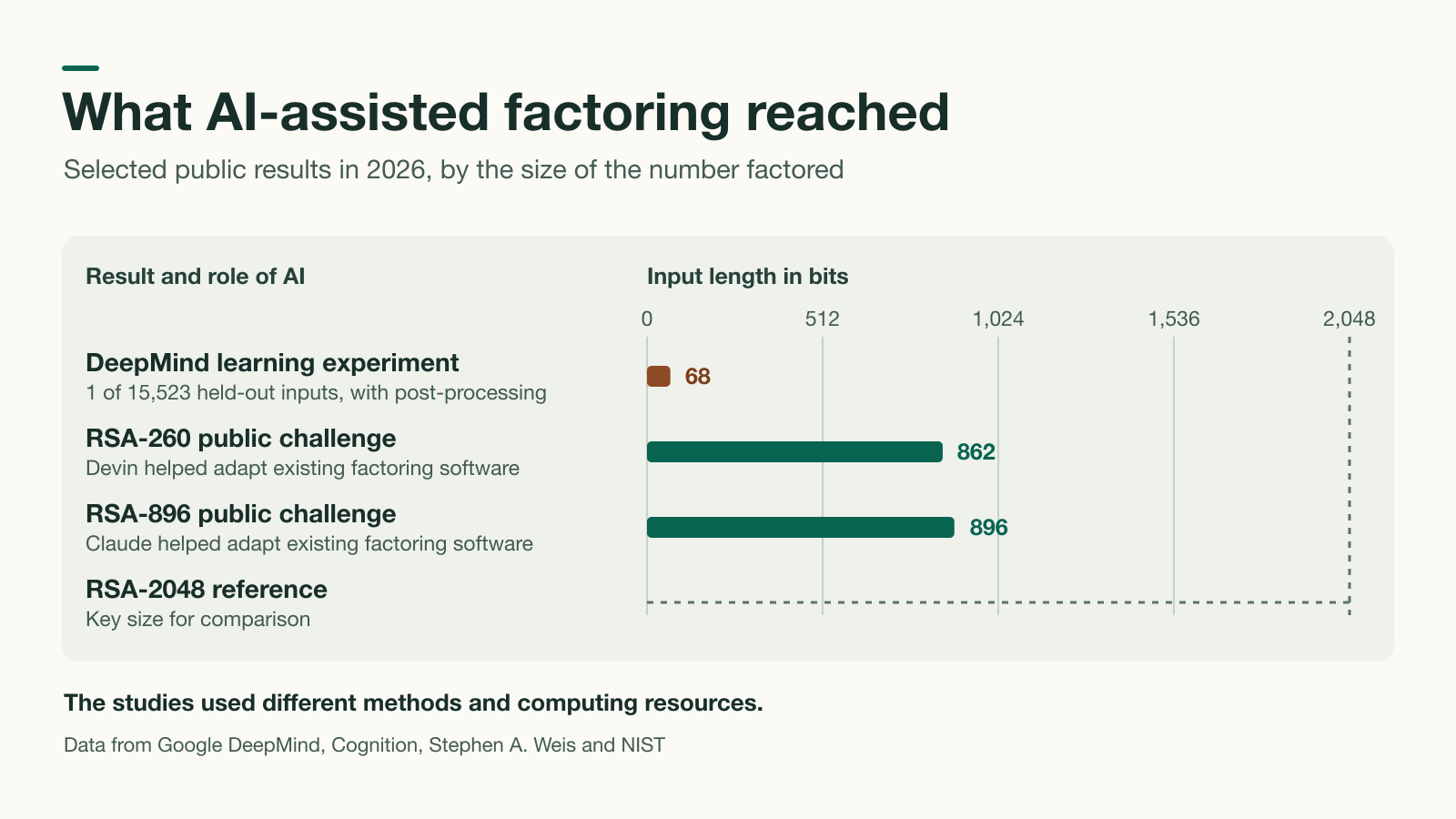
Input lengths describe the numbers factored. Each result used a different setup. Sources include DeepMind, Cognition, Stephen A. Weis, and NIST’s key-management guidance.
What this tells us about AI
Devin and Claude helped researchers get an established algorithm running at scale on GPUs. AI also contributed to work on new bounds. In October, Isaac Rudich and Louis-Martin Rousseau posted a preprint claiming a subexponential bound for deterministic factoring and credited Claude with the ideas and formal proof. Joseph Shunia’s follow-up claims a more explicit subexponential bound. Even if these claims hold, the stated bounds fall short of establishing polynomial time in the number of input bits. Rudich and Rousseau’s preprint, Shunia’s preprint
Google DeepMind’s separate November 5 working paper describes an AI-assisted, theoretical improvement for factoring batches of same-size numbers by sharing some of the work. Its cost estimates depend on standard number field sieve heuristics. The authors say they have yet to implement the method. DeepMind’s Fan Factories working paper
What would a breakthrough mean for RSA?
Finding the prime factors of a conventional RSA public modulus would allow recovery of the corresponding private key. If a classical method made that affordable at deployed key sizes, it would threaten RSA signatures and systems that use RSA to encrypt or establish keys. The practical impact would depend on the time and resources required at those key sizes. NIST’s RSA key-establishment recommendations, NIST’s Digital Signature Standard
A 2,048-bit key is a useful RSA reference point. As the chart shows, both public challenges used much smaller numbers. NIST’s key-management guidance
NIST has already standardized post-quantum alternatives for key establishment and signatures. These standards use different mathematical foundations, including lattices and hash functions. NIST’s post-quantum cryptography standards
What about quantum computers, P vs. NP, and the Riemann hypothesis?
Peter Shor’s algorithm already gives polynomial-time factoring on a sufficiently capable quantum computer. The rumor is of cryptographic interest if it concerns a classical algorithm, which could run on conventional hardware. Peter Shor’s paper
P versus NP asks whether every problem in NP, the class of yes-or-no problems with efficiently checkable evidence for yes answers, can also be solved efficiently. The decision version of factoring is in NP, but it is not known to be NP-complete. An efficient factoring algorithm alone would leave P versus NP open. Scott Aaronson’s complexity survey
The Riemann hypothesis concerns the distribution of primes. Knowing how many primes lie in a range supplies no known general method for finding which ones multiply to a given integer in polynomial time. Kingy.ai’s Riemann hypothesis explainer
What evidence would change the assessment?
A public claim would need an explicit algorithm, its assumptions, and a proof of correctness and running time that independent specialists can check. Reproducible runs on public inputs, with hardware, time, and cost reported, would answer the separate question of practical performance.
If researchers credit AI, their account should show which ideas, proofs, or code came from the model and what people verified. That record would tell us how the discovery was made and give other researchers a way to test whether the process works on new problems.
Sources and further reading
The original reports by Eric Lu and Stephen A. Weis describe the challenge computations. Section 4.5 of DeepMind’s preprint gives the exact breakdown of the 68-bit experiment. Shor’s paper gives the quantum result.