
There are exactly 78,498 prime numbers up to one million. Mathematicians can count them one by one, or use a formula that misses by about 130. Move the finish line far enough out and an exact count becomes impractical. How large a mistake can the formula make there? The Riemann hypothesis would give a guarantee that holds however far you go.
Bernhard Riemann proposed an answer in 1859, expressed as a claim about the zeros of a function. A proof would put a universal limit on the fluctuations in prime counts. A disproof would establish that those fluctuations escape the proposed bound somewhere. The consequences for physics, technology and AI depend on a second question that the yes-or-no answer leaves open. How did anyone get the answer?
Where the proof claims stand on November 20, 2026. Levent Alpöge says he and Claude found a proof of the classical hypothesis and a generalization. MIT mathematician Andrew Sutherland has reported substantial independent checks of their released formal argument. His report dated 22:05 UTC lists further checks in progress. The Clay Mathematics Institute still lists the problem as unsolved. Kingy.ai has separate accounts of what Alpöge released and the two proposals announced that day. Alpöge’s announcement · Sutherland’s verification report · Clay’s problem page.
Counting primes without listing them
Prime numbers are whole numbers greater than one that have no positive divisors except one and themselves. The first few are 2, 3, 5, 7, 11 and 13. Every whole number greater than one has a unique prime factorization, apart from the order of its factors. For example, 60 = 2 × 2 × 3 × 5. Primes are the building blocks of multiplication.
Mark each prime on a number line and count as you move right. The count rises at 11, stays still at 12 and rises again at 13. Farther out, the steps generally come less often, though individual gaps still vary. Prime counting asks how closely a smooth curve can follow that staircase.
Mathematicians write the count as π(x), pronounced “pi of x.” The prime number theorem, proved in 1896, says the ratio of π(x) to x/log x tends to one as x grows. Here log means the natural logarithm. A better estimate for our example is the logarithmic integral, li(x). It accumulates the changing local density of primes, roughly 1/log t at position t, along the way up to x. The prime number theorem describes the average trend. The Riemann hypothesis (RH) controls the error around the smoother estimate. NIST’s prime-counting formulas.
At one million, x/log x gives about 72,382. The logarithmic integral gives 78,627.55, only 129.55 above the exact count. An explicit consequence of RH bounds the absolute error here by about 549.70. The rule is |π(x) − li(x)| < √x log x/(8π) for every x ≥ 2,657. The vertical bars mean absolute difference. The π in 8π is the circle constant. Notice which estimate gets the guarantee. The rough estimate missed by more than 6,000. NIST, equation 27.12.7.
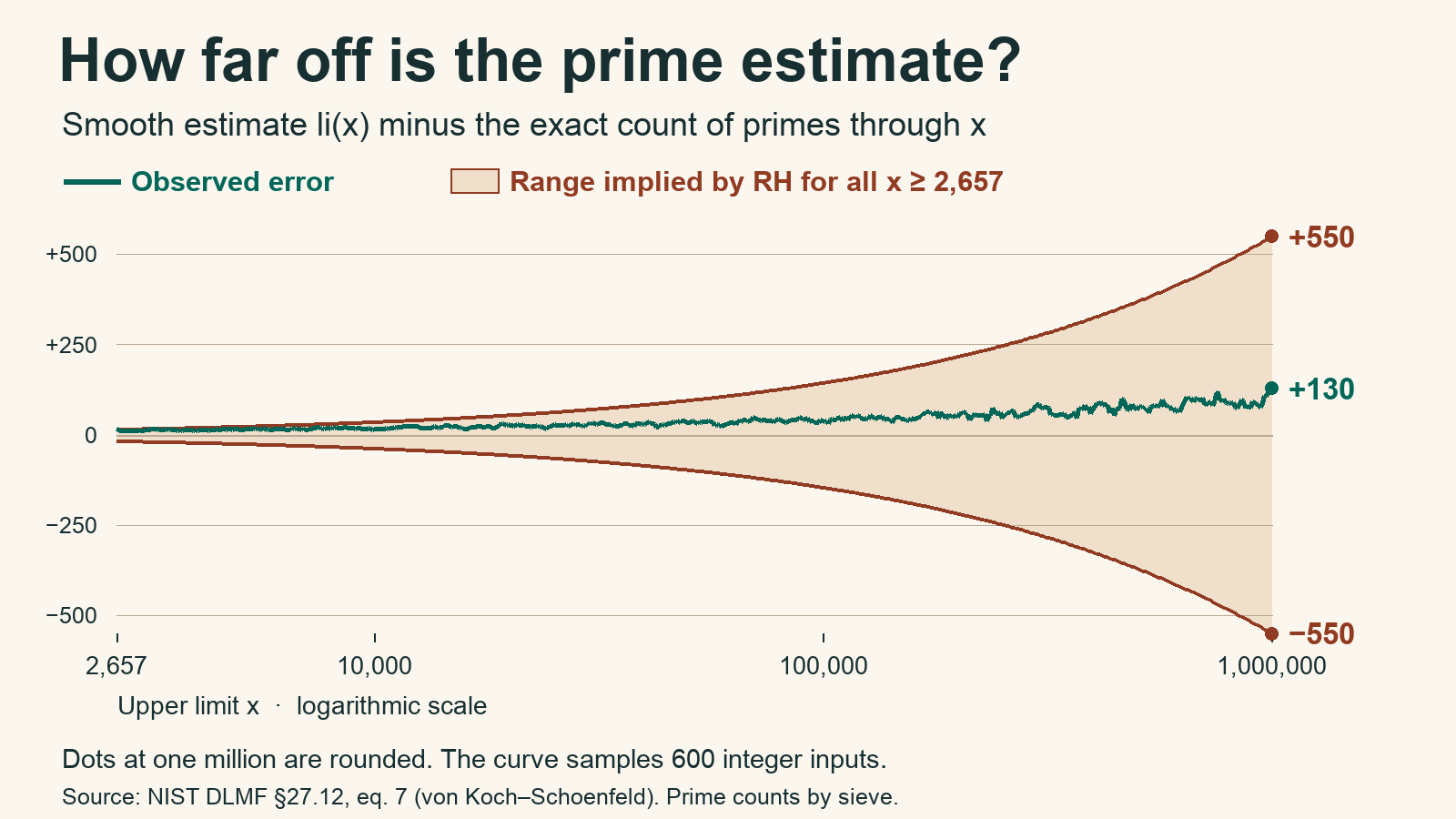
The green curve shows li(x) minus the actual prime count at 600 values of x. We counted primes with a sieve and rounded the chart labels at one million. The shaded band gives the allowed error in either direction. Daniel Johnston already proved that this same bound holds from 2,657 through 1.101 × 1026. RH would remove the upper cutoff entirely. That is the difference between checking a region vastly larger than this graph and having a theorem about every scale. Johnston’s finite-range theorem.
How zeros enter the picture
Bernhard Riemann approached prime counting through a function now called the Riemann zeta function, written ζ(s). When the real part of s is greater than one, it can be written as an infinite sum.
ζ(s) = 1 + 1/2s + 1/3s + 1/4s + …
Leonhard Euler found another expression for the same function in that region. It multiplies one factor for each prime.
ζ(s) = 1/(1 − 2−s) × 1/(1 − 3−s) × 1/(1 − 5−s) × …
To see why primes appear, take the first two factors. Each expands as a geometric series. For example, 1/(1 − 2−s) = 1 + 2−s + 4−s + …, and similarly for powers of 3. Multiplying them gives terms for numbers made from powers of 2 and 3, including 1/6s from 2 × 3. Including every prime produces a term for every positive integer, because each has a unique prime factorization. The product is a bridge between all whole numbers and the primes that compose them. Enrico Bombieri’s Clay problem description.
The input s can be a complex number, with a real part and an imaginary part. To plot it, move horizontally for the real part and vertically for the imaginary part. Mathematicians extend the zeta function beyond the region where the infinite sum above converges, using a process called analytic continuation. This extension lets them study the function in the region that matters for RH. You cannot find its values there by naively adding the original series. NIST, Riemann zeta function.
A zero is an input where the extended function equals zero. Some zeros occur at the negative even integers −2, −4, −6 and so on. Mathematicians call them the trivial zeros. The nontrivial zeros lie in the strip between real parts 0 and 1. They occur symmetrically under reflection across the real axis and across the vertical line where the real part is 1/2. RH says every nontrivial zero lies on that vertical line, called the critical line. NIST, zeros of the zeta function.
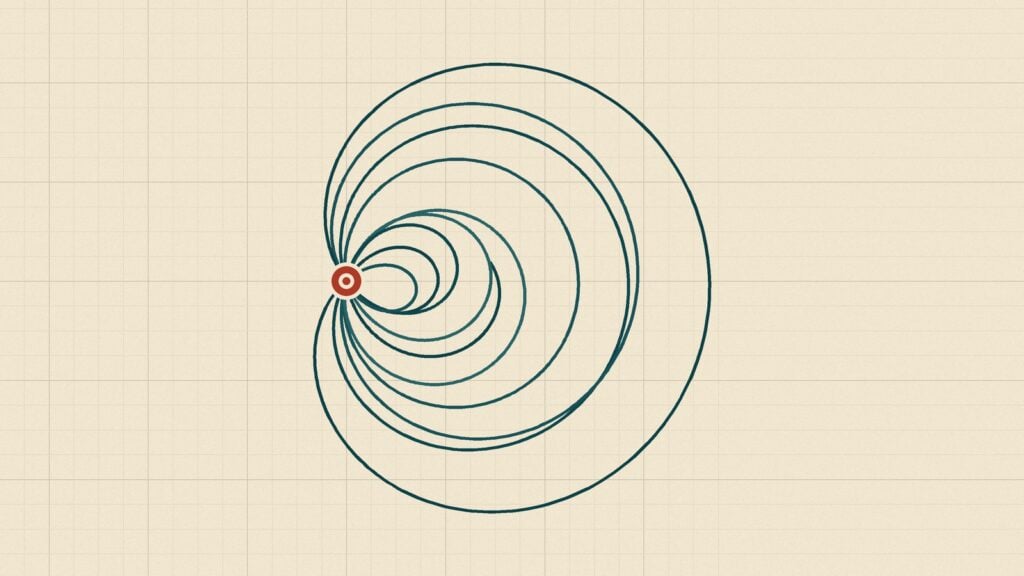
The lowest zero with positive height sits at about ½ + 14.134725i. Its horizontal coordinate is exactly one half. The decimal is an approximation to its height. The cover of this guide draws a different picture of the same calculation. It traces the output of ζ(½ + it) as t runs from 9 through the tenth positive zero height. The ink passes through the marked origin each time the output equals zero. A picture made by following that one input line can show its zeros beautifully while leaving the rest of the strip unexplored. Andrew Odlyzko’s tables of zeros.
The bridge back to the primes is Riemann’s explicit formula. One version counts prime powers with weights. A prime p contributes log p at p, again at p², again at p³ and so on. The formula expresses this weighted count as a main term x, a sum of corrections from the nontrivial zeros, and smaller explicit terms. A zero ρ contributes a correction of the form −xρ/ρ. Write ρ = β + iγ. The size of xρ is xβ, while its angle turns through γ log x. Pairing a zero with its complex conjugate turns those rotations into a real oscillation. Bombieri on the explicit formula.
Now the fraction one half has a job. If β = ½, the size factor is √x. A hypothetical zero with β = 0.6 would contribute a factor x0.6, which outgrows √x by an arbitrarily large multiple as x grows. Many terms can cancel, so one term cannot give the error at a particular x. The full theorem controls their combined effect and gives the square-root scale, with a logarithmic factor, in the prime-counting bound.
What a proof would change in mathematics
In a paper that proves “assuming RH, T follows,” the implication is already a theorem. A proof of RH would let a reader use T directly wherever RH is the only outstanding assumption. That could save the reader from proving a weaker substitute each time T is needed. A result that also assumes a separate conjecture would still depend on that conjecture.
The prime-counting bound gives an example in both directions. A proof of RH would justify the error band for every x ≥ 2,657. Conversely, a proof that the prime count lies inside that band for every such x would prove RH. Someone could in principle solve a problem about the locations of complex zeros by proving a sufficiently sharp statement about a staircase of whole numbers. NIST’s statement of the equivalence.
Another equivalent statement reaches into ordinary arithmetic. Let σ(n) be the sum of all positive divisors of n. Guy Robin proved that RH holds exactly when σ(n) < eγn log log n for every integer n greater than 5,040, where γ is the Euler–Mascheroni constant. One rigorously verified integer above that threshold violating the inequality would therefore disprove RH. This gives the zeta-zero question an equivalent formulation using divisors, though checking any finite collection of integers still cannot prove the universal statement. Robin inequality discussion.
For a sense of what even a complete solution leaves to explore, imagine knowing that every zero lies on the critical line. Where along it? How far apart are neighboring zeros? Can two coincide, giving a zero of multiplicity greater than one? The assertion Re(ρ) = ½ records a horizontal position. Those further questions ask for different information. NIST on zero locations.
The generalized Riemann hypothesis (GRH) extends the zero-location question to related functions. Consider odd primes sorted into two columns by their remainder after division by four. The first column contains 5, 13 and 17, all leaving remainder 1. The second contains 3, 7, 11 and 19, all leaving remainder 3. An accurate estimate of the total in both columns can conceal an excess in one and a deficit in the other. Dirichlet L-functions carry information about individual residue classes. Their zero locations give finer control over counts in arithmetic progressions. A proof about ζ alone would leave that extra work to do. Sutherland explicitly limits the GRH in his verification report to Dirichlet L-functions. The scope of the five formal statements · Clay’s account of the generalization.
What if the hypothesis is false?
A rigorously established nontrivial zero away from the critical line would disprove RH. A proof of its negation could also settle the question without displaying a zero as a list of decimal coordinates. Either route would show that the proposed restriction on every nontrivial zero fails.
Mathematicians would then examine which RH-dependent conclusions remain true and whether they can be proved by other means. The logical statement “if RH is true, then T” can still be a valid theorem even if RH turns out to be false. It would no longer establish T on its own. Each conclusion would need its own justification.
The prime number theorem would remain proved, as would other results established without RH. A counterexample could reveal where our expectations about very large numbers need correction without erasing the mathematics that led us there.
Dave Platt and Tim Trudgian used interval arithmetic to certify that every nontrivial zero with positive height up to three trillion lies on the line. Three trillion here measures height. Their calculation rules out an exception anywhere within that range, including between sampled points. An off-line zero above it would still disprove RH. A decimal that appears to land just off the line would need an error bound small enough to certify that it really does. Platt and Trudgian’s verification.
Would encryption be at risk?
RSA gives this question practical stakes. Factoring the public modulus of a conventional two-prime RSA key would compromise that key. What would the Riemann hypothesis give that person to work with?
Take 77. Being told there are 21 primes through 77 gives you the size of a list. To factor 77 you must find the particular pair, 7 and 11, whose product is 77. At cryptographic sizes this distinction matters. A bound on the count of primes supplies no procedure for finding the factors of a particular RSA modulus efficiently. A future algorithm inspired by a proof would have to be evaluated in its own right. NIST on integer-factorization cryptography.
Even finding out whether a number is prime differs from factoring it. Agrawal, Kayal and Saxena gave an unconditional deterministic polynomial-time primality test. Their paper describes an earlier test, due to Gary Miller, whose guarantee relied on an extended Riemann hypothesis. This history shows why the exact hypothesis and computational task matter. Settling one mathematical statement does not automatically make every related algorithm fast in practice. Agrawal, Kayal and Saxena, PRIMES is in P.
Why physicists care
A physicist can list the allowed energies of a quantum system in increasing order and measure the gaps. A number theorist can list the heights of zeta zeros and do the same. To compare different regions, divide the gaps by the typical local spacing. This removes the fact that the zeros become denser higher up. Researchers can then compare how often the two lists contain unusually small gaps.
Hugh Montgomery studied correlations between pairs of zero heights. The pattern he conjectured matches a prediction from random Hermitian matrices, a class of mathematical models used for quantum spectra. In particular, very close neighbors are suppressed relative to uncorrelated levels. Andrew Odlyzko compared high zeta zeros with the predictions numerically and found close statistical agreement. This concerns the pattern in a list of numbers. It identifies neither a particular atom nor an energy level in nature corresponding to each zero. Odlyzko’s numerical study · Berry and Keating on zeta zeros and quantum chaos.
A more ambitious connection goes by the name Hilbert–Pólya. Write a candidate zero as ρ = ½ + iE and allow E to be complex. If researchers constructed a self-adjoint operator and proved that all those E values are its eigenvalues, RH would follow. Self-adjoint operators have real eigenvalues, and a real E puts ρ exactly on the required vertical line. Constructing the operator and proving that it accounts for every nontrivial zero is the difficult part. Berry and Keating’s account of the spectral approach.
The implication runs in one direction. A successful spectral construction would prove RH and explain why the line appears. A successful proof by another route could settle RH while leaving physicists with the same puzzle about the observed spacings. Predicting a measurable effect in a physical system would require identifying that system and deriving a prediction for it.
What would an AI-assisted proof show?
Mathematical work has several stages. A researcher may look for a pattern, propose a conjecture, find a proof strategy, fill in lemmas, check each step and explain the result to others. AI systems can contribute differently at each stage. A system that suggests a promising identity has performed a different task from one that constructs a complete proof or checks a precisely encoded argument.
Formal proof assistants add another distinction. A proof is expressed in a language with explicit definitions and assumptions, and a small checking program tests whether the conclusion follows under its rules. That can make a very long argument independently reproducible at a level difficult to achieve through ordinary reading alone. A successful check is evidence about the formal argument presented to the checker. Reviewers also check that the formal statement says what the mathematician intended. Lean’s proof-validation documentation.
Alpöge describes choosing a promising direction from a simpler problem and credits Claude with crucial steps late in the work. That is his account of how the discovery happened. Sutherland’s report answers a different question that other people can investigate from the released files. In his November 20 report, all 175,187 Lean modules compiled, two independently written kernels accepted the full exported proof, and a separate comparison matched five target statements. The classical target uses the mathematics library’s own definition of RH. The five statements depended on three standard Lean axioms. Sutherland also named unfinished checks, including an end-to-end Comparator run. Alpöge’s account · Sutherland’s report and logs.
AI also appears on the other side of the review process. Ravi Vakil shared a separate proposed GRH proof by Alessandro Maria Masullo, which he described as human work. Later the same day, Vakil reported that readers using different AI models had identified problems requiring resolution. That update establishes that objections were raised. Deciding what they do to the argument requires examining the mathematics. Vakil’s announcement and update.
A confirmed AI-assisted proof would be evidence that this human–model collaboration could produce a checkable solution to a major open problem. Assessing the model’s contribution would require a record of which ideas each participant supplied, which failed attempts were discarded, and how much expert guidance was necessary. Assessing whether the process transfers to other fields would require doing it again on genuinely new problems. Researchers who have the formal proof can isolate a lemma, verify its assumptions and try to use it in another proof. Lean on validating proofs.
What humanity would gain
One precedent comes from an earlier Riemann hypothesis where researchers already know the answer. In arithmetic over a finite field, the coordinates in an equation take values from a finite set. That makes it possible to count how many points lie on a curve. André Weil proved a Riemann-hypothesis analogue that limits the error in such counts. The zeta functions here belong to curves, and the objects being counted are points. The resemblance to the prime-counting problem is precise enough to guide research while the two proofs remain separate tasks. James Milne on the finite-field history.
Weil’s work led him to formulate conjectures that drove decades of progress in geometry. That gives a better picture of the potential gain for humanity than assigning a date to a new technology. A way of reasoning invented to count one collection of objects became useful for understanding other collections. A classical RH proof could yield a reusable method of similar breadth. Its reach will become visible as other researchers extract its ideas, teach them and try them on other problems. Milne’s historical survey.
The million-dollar Millennium Prize runs on its own timetable. Before considering a proposed solution, Clay requires publication in a qualifying outlet and general acceptance by the mathematical community. At least two years must have passed since that publication. Mathematicians can learn from a proof much sooner. A telling early sign would be a second group using one of its ideas to prove a theorem about a different problem. That would show what the solution has given us beyond the answer to Riemann’s question. Clay’s prize rules.
Sources and further reading
- Enrico Bombieri’s official Clay problem description, for the mathematical statement and its background.
- NIST on asymptotic prime counts, including the explicit RH-equivalent error bound.
- Berry and Keating on zeta zeros and spectra, for the physics connection.
- Andrew Sutherland’s verification report, for the current status and limits of the formal checks.