
Inkling 2 Mini on a 24 GB M4 Pro Mac
November 20, 2026. Kingy measured Inkling 2 Mini on a MacBook Pro with an M4 Pro chip, 20 GPU cores, 24 GiB of unified memory and macOS 26.3, plugged into power. In three short generation trials it ran at a median of 11.6 output tokens per second, with a range of 11.2 to 20.3. The first streamed text arrived in 0.78 to 3.47 seconds after the request on a loaded server. Each trial used a 30-token raw text prompt and forced 128 output tokens by ignoring the end-of-sequence token.
We used the 9.14 GB Unsloth UD-Q2_K_XL GGUF on an external SanDisk SSD and verified its SHA-256. The Unsloth llama.cpp build was b12588 (binary commit 883286076). The runtime used one slot, FP16 key/value caches and no context shifting. We put the expert weights in the first eight layers on the CPU and kept the rest on Metal. Flash Attention was on, with a batch of 512 and a microbatch of 128. Other apps were open, and the Mac already had 13.6 to 15.1 GiB of system swap in use at the start of the two successful context tiers. All inference ran locally. Unsloth model files · Runtime release
How much context fit on this Mac?
At each window size, we sent a synthetic text prompt near the configured limit and checked that the runner processed the entire prompt without truncation or cache reuse. We planted three eight-character codes near the beginning, middle and end and required the model to return them exactly in order.
| Configured window | Input tokens sent | Time to first output | Sampled peak resident memory | Result |
|---|---|---|---|---|
| 4,096 | 3,828 | 29.1 s | 7.6 GiB | 3 of 3 codes |
| 8,192 | 7,928 | 118.4 s | 8.7 GiB | 3 of 3 codes |
| 12,288 | — | — | — | Stopped for critical system memory pressure before the server was ready |
| 16,384 | 16,103 | — | — | Stopped for critical system memory pressure during prompt processing |
The largest completed trial processed 7,928 input tokens in an 8,192-token window and returned all three codes. It took 118.4 seconds to reach the first output and 125.1 seconds to complete the request. The runtime reported about 9.25 GiB of model, context and compute buffers across Metal and host memory for that tier. At one-second sampling intervals, the Mac reported a peak of 8.7 GiB resident in the server process. These are different measurements on the same unified memory. Sampled resident memory includes resident mapped weight pages and varies as macOS moves pages in and out. The 8K trial’s peak system swap was 1.15 GiB above its starting level.
- Tested
- Three 30-token raw continuation trials with 128 generated tokens each. Near-capacity text prompts at 4K and 8K passed three-code retrieval. The 12K and 16K attempts stopped on system memory pressure.
- Machine
- MacBook Pro with M4 Pro, 20 GPU cores, 24 GiB unified memory, macOS 26.3, on AC power with other apps open.
- Runner
- Unsloth llama.cpp b12588, binary commit 883286076.
- Files
- Unsloth Inkling 2 Mini UD-Q2_K_XL GGUF, 9.14 GB, SHA-256 verified, loaded from an external SanDisk SSD.
- Settings
- One slot, FP16 key/value caches, Flash Attention, batch 512 and microbatch 128, context shifting off. Expert weights in the first eight layers on CPU, remainder on Metal.
- Grading
- All three randomly generated codes had to match exactly in order, with the full prompt evaluated and no cache reuse or truncation.
- Peak memory
- 8.7 GiB sampled resident server memory and 9.25 GiB in runtime-reported buffers at 8K.
- Dates
- run 2026-11-20 · checked 2026-11-20
Limits of the Mac test
The runner stopped both attempts to load the 13.63 GB Q3 file before generation, once for rising system swap and once for critical memory pressure. The more compact Q2 file also hit the swap guard with full Metal offload. With all expert layers on the CPU, it generated 1.9 to 2.6 tokens per second across three short runs. The faster figures above come from the partial CPU/Metal configuration.
This is one text-only run series on a 24 GiB machine with other apps open. Each context tier used one synthetic retrieval prompt. The results describe this quantized build and this Mac’s workload during the test. Image input, coding accuracy and the original checkpoint would require separate measurements.
Update, November 20, 2026
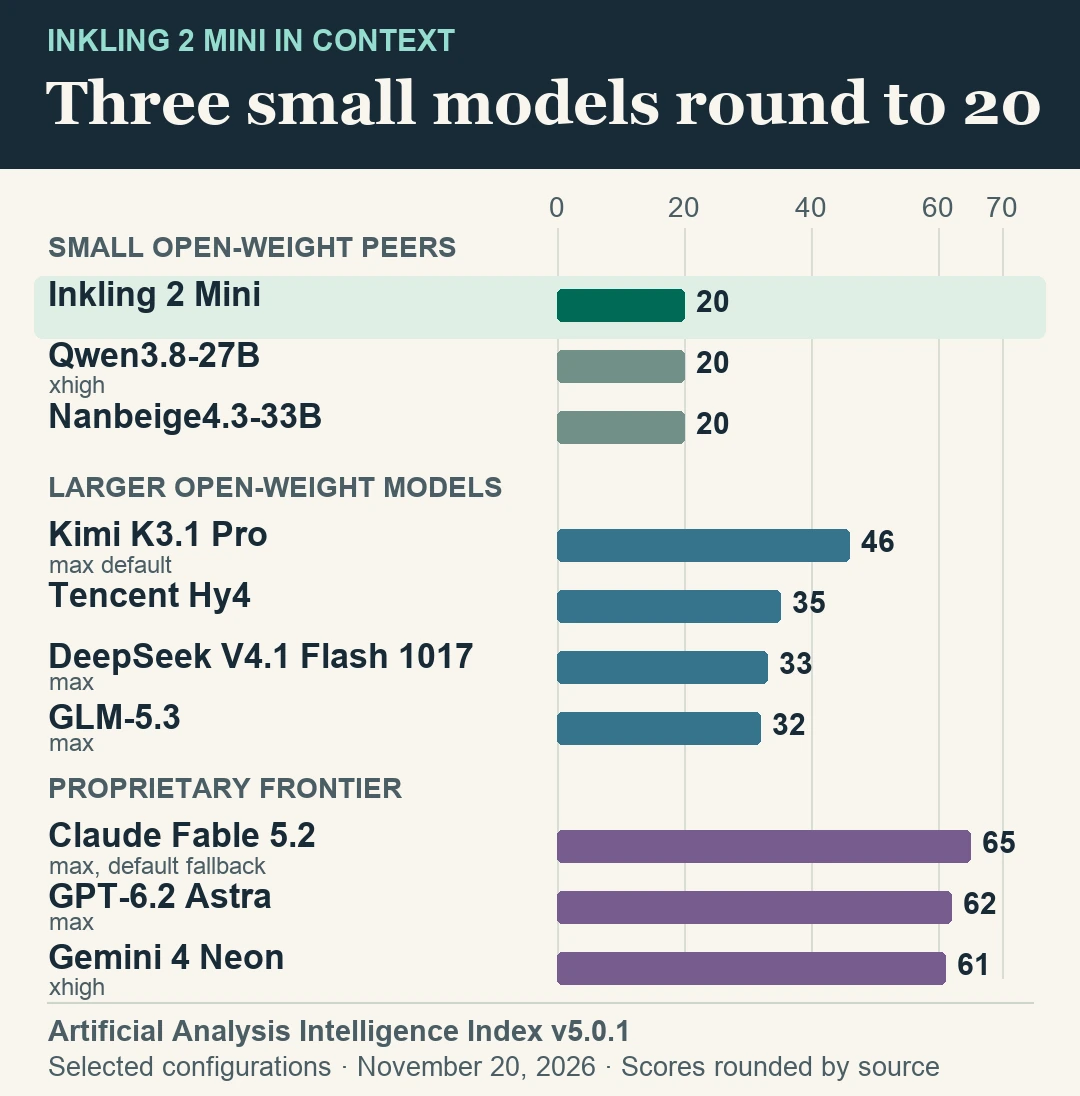
Inkling 2 Mini scored 20 on Artificial Analysis’s Intelligence Index, the same rounded score as Qwen3.8-27B and Nanbeige4.3-33B. Those are the closest comparisons for someone considering a model this size. Kimi K3.1 Pro scored 46, and Claude Fable 5.2 scored 65. Mini’s case rests on what it can do with a roughly 20GB checkpoint on supported local hardware. Kingy’s local measurements above cover the Q2 Inkling build. The comparison below uses published evaluation scores. Official model repository · Artificial Analysis assessment
How the independent comparisons work
Artificial Analysis and Vals measure different mixes of work. Artificial Analysis v5.0.1 gives equal weight to knowledge work, coding, science and general tasks. Vals v2.2 gives the most weight to finance and coding, followed by legal and tax. The scores are a November 20, 2026 snapshot. Each column uses its evaluator’s own models, settings and scoring. A dash marks a missing comparable result for the exact model. Artificial Analysis methodology · Vals Index methodology
| Model | Artificial Analysis v5.0.1 | Vals Index v2.2 |
|---|---|---|
| Compact open-weight models | ||
| Inkling 2 Mini | 20 | 46.46%, 0.99 |
| Qwen3.8-27B | 20, xhigh | — |
| Nanbeige4.3-33B | 20 | — |
| Muse Glimmer | 6, high | — |
| Google Gemma 4 31B | 4, reasoning | — |
| Larger open-weight models | ||
| Kimi K3.1 Pro | 46, max default | 62.52%, max |
| Tencent Hy4 | 35 | 59.35%, effort not listed |
| DeepSeek V4.1 Flash 1017 | 33, max | 61.26%, max |
| GLM 5.3 | 32, max | 59.85%, max |
| Inkling 2 Small | 31 | 56.08%, 0.99 |
| MiMo V2.6 Pro | 30 | 57.81%, effort not listed |
| Ling 3.1 Flash 1019 | 30 | — |
| MiniMax-M3.1-Flash | 29, max default | 53.78%, max |
| Qwen3.8-Flash-Next | 29 | — |
| Mistral Large 4 | 26, high | 56.53%, high |
| Meta Muse Spark Open | 25, xhigh | 48.57%, xhigh |
| DeepSeek V4 Pro 0813 | 23, max | 52.97%, max |
| Reflection Beam 1.0 | 18 | 43.42% |
| NVIDIA Nemotron 3.5 Super VL | 14, high default | 29.78%, high |
| gpt-oss-120b | 4, high | — |
| Proprietary frontier | ||
| Claude Fable 5.2 | 65, max, default fallback | 71.31%, high |
| GPT-6.2 Astra | 62, max | 67.66%, max |
| Gemini 4 Neon | 61, xhigh | 70.87%, xhigh |
| Claude Opus 5.5 | 59, max, default fallback | 70.14%, max |
| GPT-6.2 Sol | 57, max | 66.06%, max |
Artificial Analysis scores are rounded index points. Vals scores are percentages on its own weighted index. Effort labels in each cell refer to that evaluator, and an unlabeled score means the effort could not be confirmed from the leaderboard. Vals model-page settings are defaults and individual benchmark settings can differ. Vals lists Fable 5.2’s default effort as high. The Vals scores retain its published default fallback handling. Artificial Analysis uses max with default fallback for its Fable result. Vals reports Mini at 46.46% ±1.11, ranked 38th of its 43 listed models. The uncertainty is one standard error. Its leaderboard is dated November 19 but included the November 20 Mini result when observed. Artificial Analysis leaderboard · Vals leaderboard · Vals Mini model page · Vals methodology
The table covers major open-weight families and compact models with a current Artificial Analysis result. Qwen3.8 2.4T A95B, Llama 4 Maverick and gpt-oss-20b lack a comparable current Artificial Analysis score in this snapshot. Qwen3.8 2.4T · Llama 4 Maverick · gpt-oss-20b
“Open-weight” describes access to the model weights. Inkling 2 Mini’s weights use Apache 2.0. Other releases have different terms. Kimi K3.1 Pro uses a custom license, and Meta gates access to Muse Spark Open under its own license. The Open Source Initiative’s broader definition also calls for training code and detailed information about the training data. The larger downloads often call for a server or hosted provider. Kimi’s published files total roughly 1.56 TB. Inkling weights · Kimi files and license · Muse weights and license · Open Source AI Definition
The closest local comparison
Artificial Analysis reports that Inkling 2 Mini, Qwen3.8-27B at xhigh and Nanbeige4.3-33B each score a rounded 20 on its Intelligence Index. Its small-model ranking lists Nanbeige first and Mini second despite their equal displayed scores. In the evaluator’s hosted comparison, Mini generated about 152,000 output tokens per task against Qwen’s 110,000, roughly 38% more. Mini cost $0.59 and took 9.0 minutes per task against $3.53 and 38.2 minutes for Qwen in that assessment. Those timings reflect hosted runs on the evaluator’s providers. Artificial Analysis launch assessment
What the frontier gap costs
Mini scored 21 to 25 percentage points below Astra, Neon and Fable on the Vals Index. On the Artificial Analysis run, DeepSeek V4.1 Flash 1017 at max scored 33 at $0.60 per task, close to Mini’s $0.59 at 20. Astra at max scored 62 at $4.00 per task. Neon at xhigh scored 61 at $6.44, and Fable at max with default fallback scored 65 at $26.54. These are the evaluator’s estimated costs on its mix of tasks. Vals leaderboard · Artificial Analysis leaderboard
Hosted prices depend on the provider and how much work a model generates. Artificial Analysis reports GPT-6 Luna at max effort scoring 28 for $0.15 per task in the same assessment where Mini scored 20 at $0.59. Compare how many tasks each model completes and what those attempts cost. Local operation adds hardware, electricity and setup time, while a hosted service adds provider charges and data-handling considerations. Artificial Analysis launch assessment
Which model should you try?
For a local coding or agent experiment on supported hardware, start with Inkling 2 Mini and compare it with Qwen3.8-27B and Nanbeige4.3-33B on your own tasks. Measure completion time, memory use and the quality of finished work. Try the same checkout, instructions and tool budget with each model. Artificial Analysis assessment
For a hosted open-weight option, DeepSeek V4.1 Flash 1017 is a useful price comparison. Kimi K3.1 Pro is the stronger option on the two broad indexes in the table. If you plan to self-host, budget for the full checkpoint. Thinking Machines recommends at least 500GB of aggregate GPU VRAM for the native NVFP4 version of Inkling 2 Small. Artificial Analysis leaderboard · Vals leaderboard · Inkling 2 Small hardware guidance
For work where accuracy matters more than keeping the model local, compare a leading hosted model against Mini on representative examples and include the total cost of the job. Weight that cost against the consequences of getting the task wrong. Vals leaderboard
Inkling 2 Mini release and local setup
Thinking Machines released Inkling 2 Mini with downloadable weights on November 20, 2026. The company lists Apple silicon Macs with at least 32GB of memory among the supported hardware. Thinking Machines announcement · Model repository
The model runs its middle layers three times for each generated token. Reusing those weights keeps the download small enough for supported laptops while adding computation to every token. The practical questions are how long it takes to finish your task and how much context fits with your runtime and tools running.
Inkling 2 Mini specs
| Specification | Inkling 2 Mini |
|---|---|
| Architecture | Looped mixture-of-experts transformer |
| Parameters | 26.4B total, 3.4B active, 5.4B weight activations per token including the loops |
| Inputs and output | Text and images in, text out |
| Context | Up to 1 million tokens for inference |
| Official checkpoint | About 20GB, mostly NVFP4 with the final four layers in MXFP8 |
| License | Apache 2.0 |
| Release | November 20, 2026 |
Model card · Launch announcement
How the three passes work
Inkling 2 Mini has 26.4 billion total parameters and 3.4 billion active parameters, according to its model card. With repeated passes included, the company reports 5.4 billion effective weight activations per token. The extra activations come from using the same weights again. Model card
The repository describes 24 stored layers. The middle 12 run three times, producing 48 layer applications per token. The model selects eight of 128 experts per layer and combines local and global attention with a vision encoder. Its weights are distributed under the Apache 2.0 license. Official model repository
Thinking Machines says it pruned two-thirds of the experts and used recovery training followed by reinforcement learning. The company trained and released most of the weights in NVFP4, a four-bit floating-point format. It kept the last four layers in MXFP8. Both choices help explain how 26.4 billion parameters fit into a roughly 20GB download. Launch announcement
Developer benchmarks show mixed results against Qwen
In Thinking Machines’ launch table, Inkling 2 Mini scored 48.2% on DeepSWE v1.1 against Qwen3.8-27B’s 42.2%, and 77.9% against 73.8% on the 51-task SWE-bench Pro v2 Hard subset. Qwen led Terminal-Bench v2.1, 73.0% to 71.6%. The developer warns that evaluation setups vary by model, so the figures should be read with their harness details. Thinking Machines benchmark table
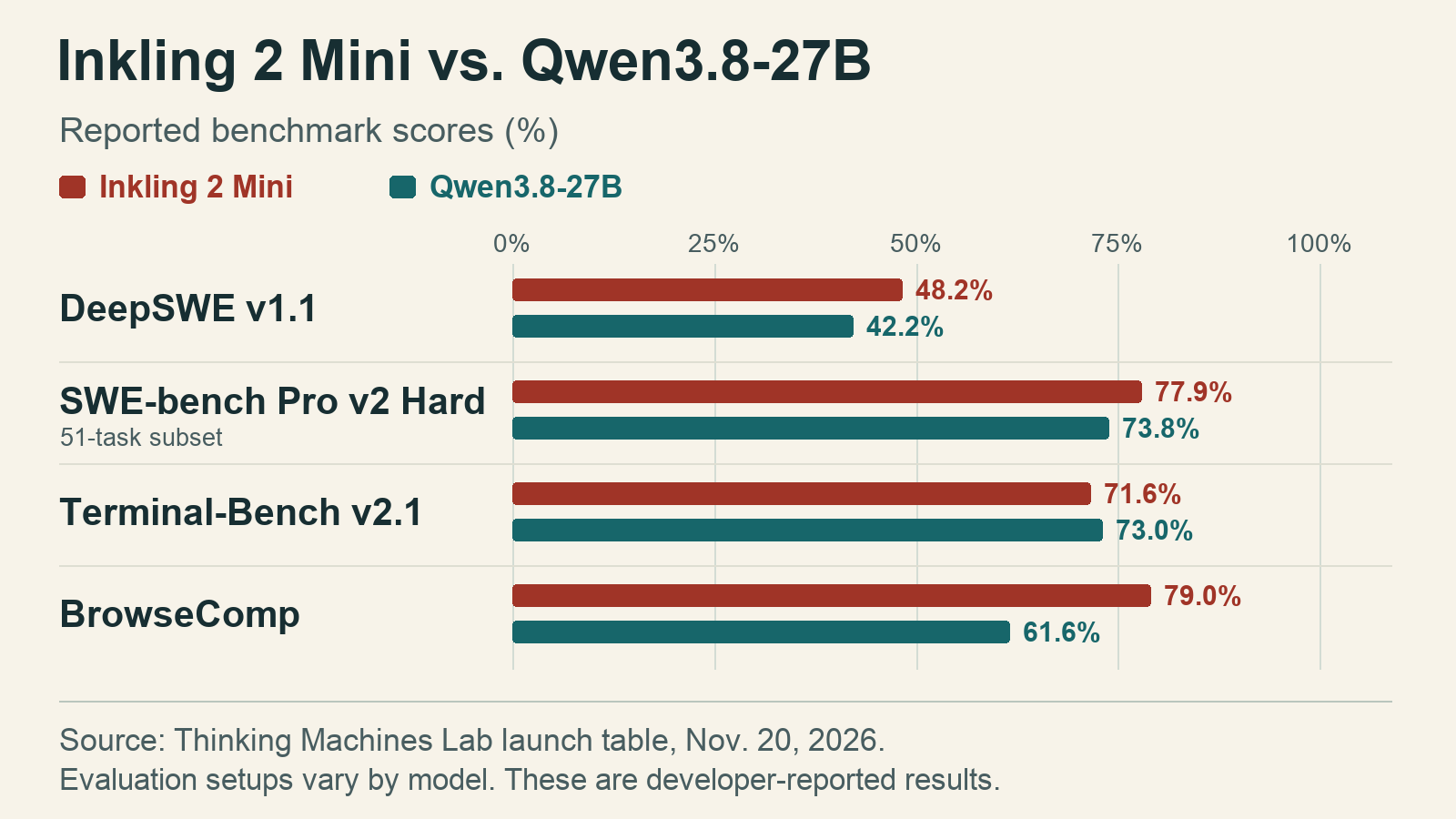
The same table reports 79.0% for Mini and 61.6% for Qwen on BrowseComp, with compaction listed for Mini. DeepSWE and SWE-bench Pro use mini-swe-agent v2.4.6 in the displayed comparison, while Mini’s Terminal-Bench run used pi v0.83.0. BrowseComp measures web research. Compaction summarizes earlier context so the agent can keep searching as the working context fills. That makes the result a measure of the model and its search setup together. Launch announcement
Mini also scores 85.3% on DeepSearchQA with compaction and 82.7% on the public MCP Atlas tool-use evaluation. For multi-turn instruction following, Thinking Machines reports 50.0% on MultiChallenge and 33.4% on ComplexConstraints v1.1. Launch benchmark table and limitations
The company also charts a theoretical decoding-speed ceiling using a 614GB/s bandwidth assumption, BF16 and batch size one. That calculation includes repeated loop reads. Use it to understand the developer’s speed comparison. Actual Mac throughput depends on the hardware, context length and runtime. Launch announcement
Independent tests show strengths and limits
Artificial Analysis’s model page lists 280 output tokens per second and 9.72 seconds to the first answer token on Thinking Machines’ hosted service. The output rate describes generation speed. Time to a usable result also includes the wait for the answer and, on agent tasks, the work done between model calls. Artificial Analysis hosted measurements
Beyond its index, Vals reports 77.92% on Vibe Code Bench v1.1, 37.92% on SWE-bench Multimodal and 0.00% on SRE Bench. The difference between these results gives teams a reason to measure their own workload. Vals model results · Vals methodology · Index methodology
On ARC Prize’s semi-private ARC-AGI-2 visual reasoning set, Mini scored 49.3%, Qwen3.8-27B scored 42.4%, and Inkling 2 Small scored 81.7%, all at xhigh. Claude Fable 5.2 scored 93.8% at xhigh, and GPT-6.2 Astra scored 95.8% with either xhigh or max effort. Mini also scored 84.5% on ARC-AGI-1 at xhigh. ARC Prize results · Fable configurations · Astra configurations
Thinking Machines also reports 77.5% on the multimodal MuirBench and 17.0% on the main ZeroBench set, rising to 34.0% when Python is available. That change illustrates why image results depend on the tools in the test setup. ARC Prize results · Thinking Machines vision results
Running Inkling 2 Mini locally
Thinking Machines supports Apple silicon with at least 32GB of unified memory and NVIDIA’s DGX Spark. For other GPU platforms it recommends at least 32GB of VRAM. It lists compatible routes including Transformers, vLLM and SGLang. Ollama lists the command ollama run inkling-2-mini and directs Mac users to its preview release. The model listing includes text and image input. Model repository · Ollama listing
Unsloth also provides smaller GGUF conversions. Its UD-Q3_K_XL file is listed at 13.63GB and its UD-Q4_K_M at 16.61GB. Those are download sizes. Each conversion can change quality and runtime behavior, and the scores above do not measure either of these GGUFs. Unsloth GGUF files and measurements
The approximately 20GB checkpoint is only part of the memory requirement. The runtime, context cache and other work also need room, so checkpoint size alone cannot tell you how much context a particular machine can use. The model card lists up to one million tokens of inference context. The Mac measurements above apply to the smaller Q2 file at the tested window sizes. Model repository
Tinker pricing and context limits
Thinking Machines lists Mini in the Tinker Playground for chat and on Tinker for sampling and fine-tuning. The standard model ID is thinkingmachines/Inkling-2-Mini for 64K training context. The 256K option adds :peft:262144. Both support up to one million tokens for sampling. The sampling limit is a maximum sequence length that includes the prompt. Model card and Playground link · Tinker models and pricing documentation
| Operation | Price in US dollars |
|---|---|
| Prefill | $0.15 per million input tokens |
| Cached prefill | $0.015 per million input tokens on cache hits |
| Sampling | $0.50 per million output tokens |
| Training, 64K context | $0.75 per million training tokens |
| Training, 256K context | $1.50 per million training tokens |
| Checkpoint storage | $0.10 per GB per month |
At those listed rates, 10,000 uncached input tokens and 2,000 output tokens cost $0.0025. At 100,000 input tokens and 20,000 output tokens, the token cost is $0.025 with an uncached prompt or $0.0115 if all input tokens qualify for the cached rate. These calculations exclude storage, tools, retries and any other billed operations. Long reasoning outputs can add to the bill. Prices were observed November 20, 2026, Pacific time, and may change. Tinker pricing
For hosted integration, the documented launch route is the Tinker sampling client. The separate serverless inference beta table lists Inkling 2 Small, Inkling and Inkling-Small. Tinker pricing
The research model and practical reliability
The separate research release, TML-d24-varloop-research, lets researchers vary the pass count. On Think Fast, Thinking Machines estimates that its 50%-success horizon for tasks answered without written reasoning went from 16 seconds at one pass to 37 seconds at three. Those seconds refer to how long a person would take to complete a task. The Mini checkpoint uses three fixed passes, and the study’s findings on monitoring reasoning are preliminary. Launch announcement
The model card warns that Mini can hallucinate, repeat reasoning, miss project conventions, report outcomes inaccurately or delete and overwrite files without confirmation. It recommends limits on output and turns, along with sandboxing for agent workloads. Minimum reasoning effort does not fully turn reasoning off. For a coding evaluation, use a disposable checkout and score whether patches pass tests and respect project conventions. Record time to a usable patch alongside tokens per second. Inkling 2 Mini model card
Sources
- Thinking Machines, Inkling 2 Mini launch announcement
- Thinking Machines, model card
- Thinking Machines, official model repository
- Tinker models and pricing documentation and Tinker pricing
- Ollama, Inkling 2 Mini listing
- Artificial Analysis, launch assessment
- Artificial Analysis, model benchmarks and hosted performance
- ARC Prize, verified results
- Unsloth, quantized GGUF releases
- Vals, model results and methodology